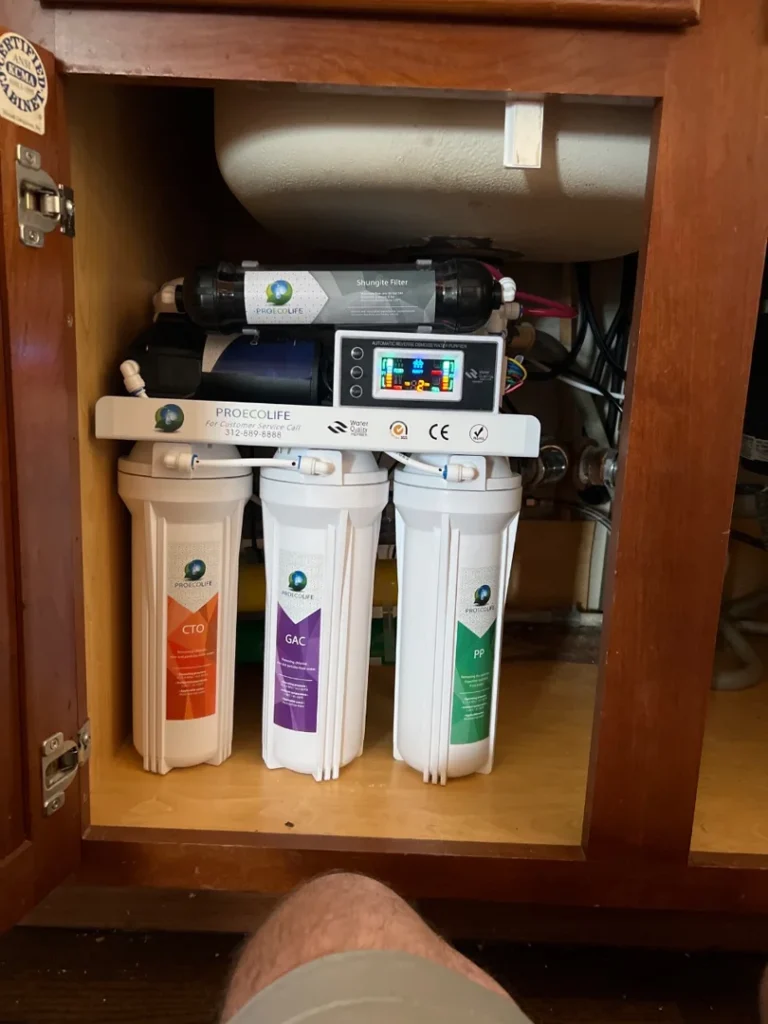
Start With Chicago RO Water Testing at Your Kitchen Tap
For reliable Chicago RO water testing, test both your unfiltered cold kitchen tap water and your RO-filtered water. Use a certified laboratory test for lead and other chemicals, then use a TDS meter as a quick check of how well the RO membrane is reducing dissolved solids.
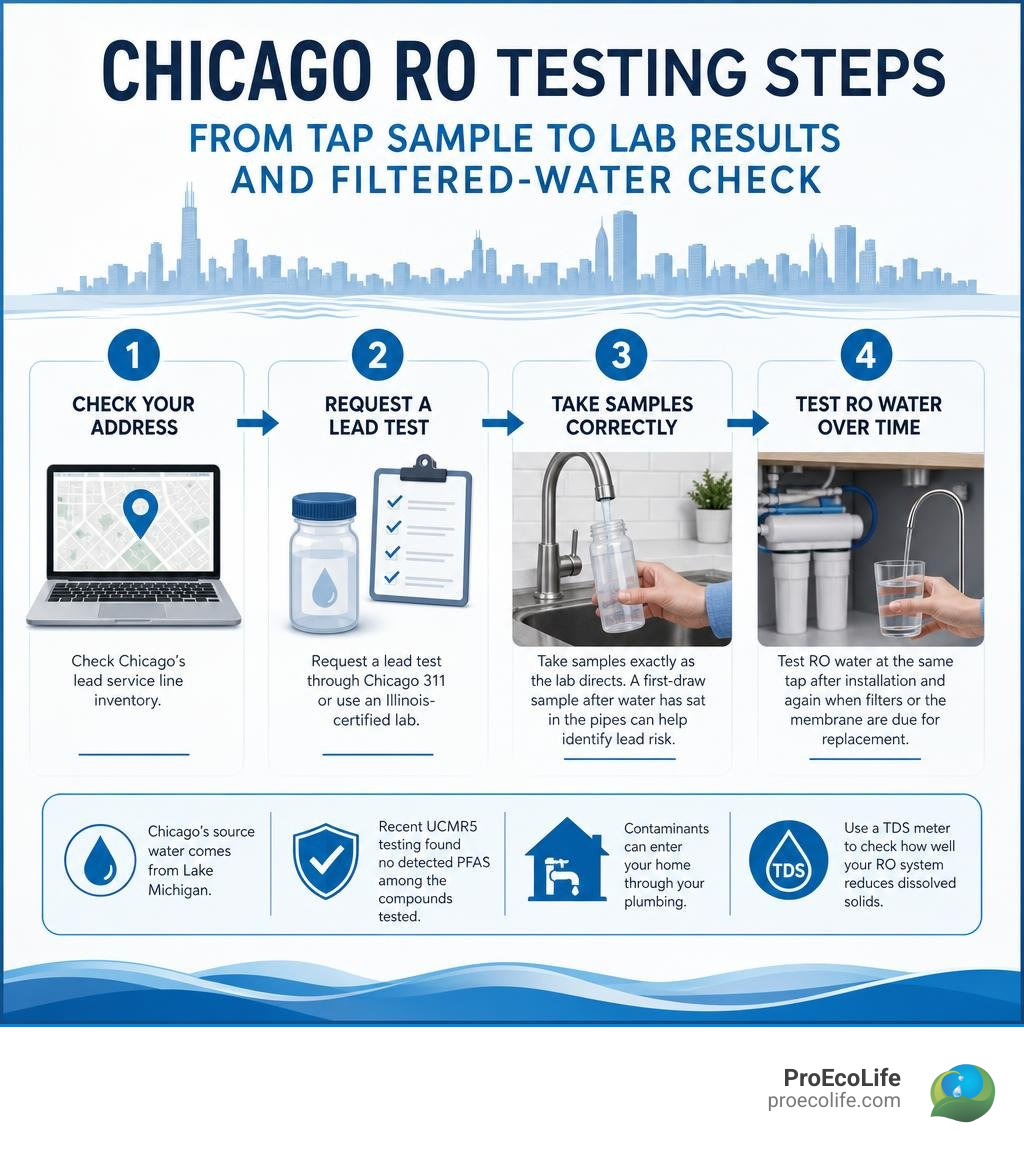
Start with these steps:
- Check your address in Chicago’s lead service line inventory, especially if your home was built before 1986.
- Request a lead test through Chicago 311 or use an Illinois-certified lab.
- Take samples exactly as the lab directs. A first-draw sample after water has sat in the pipes can help identify lead risk.
- Test RO water at the same tap after installation and again when filters or the membrane are due for replacement.
Chicago’s Lake Michigan source water is generally low in sodium and recent UCMR5 testing found no detected PFAS among the compounds tested. But water can pick up contaminants on its way into a home. Chicago has more lead service lines than any other U.S. city, and the city’s 2025 lead 90th-percentile results ranged from 8.2 to 9.4 ppb. That is below the current EPA action level of 15 ppb, but lead has no known safe exposure level.
RO testing helps you make a decision based on your plumbing, not a citywide average. It can also show whether Chicago’s moderately hard water, about 140 ppm or 8.2 grains per gallon, is creating scale that may shorten RO prefilter and membrane life.
Relevant articles related to Chicago RO water testing:
Chicago Water Quality Challenges: Why Reverse Osmosis Is Essential
When evaluating tap water quality in Chicago, looking solely at broad municipal treatment reports never tells the complete story. The municipal infrastructure treats surface water from Lake Michigan to serve roughly 2.7 million residents. While this source water leaves treatment plants meeting base federal guidelines, the journey through thousands of miles of subterranean distribution mains and private pipes introduces notable hazards. To explore our local supply dynamics in depth, we often reference The Deep Dish on Chicago Tap Water Quality. Independent health-advocacy assessments, including the Chicago Water Authority Water Quality Report — Grade D, highlight that regulatory compliance under the Safe Drinking Water Act does not necessarily mean water is entirely free from health-concerning compounds.

Beyond heavy metals, our region encounters persistent disinfection byproducts. To disinfect raw Lake Michigan water, water facilities utilize chloramine treatment. When chemical disinfectants react with trace organic matter, they form Total Trihalomethanes (TTHMs) and Haloacetic Acids (HAA5). Recent sampling across the city identified TTHM concentrations at 25.7 ppb (which is 172 times higher than the Environmental Working Group’s health benchmark) and HAA5 levels reaching up to 40.5 ppb.
Furthermore, industrial heavy metals such as Chromium-6 (hexavalent chromium) have been detected across Chicago taps at levels reaching 0.39 ppb, substantially above strict health-protective goals. These chemical risks were accompanied in 2025 by three citywide regulatory monitoring violations, which involved failures in Surface Water Treatment Rule turbidity monitoring and delays in certifying annual lead service line notifications. These real-world factors emphasize why advanced purification like reverse osmosis is essential for local kitchens.
Legacy Lead Service Lines and Health Risks
Chicago possesses more lead service lines than any other municipality in the nation. This reality stems from a historical city building code that mandated the installation of full lead plumbing lines connecting street mains to private residences until the federal ban in 1986. For homeowners navigating these legacy pipes, understanding A Practical Guide to Chicago Lead Water Levels is crucial, and public resources such as Water – Lead-Safe Chicago provide additional background on municipal inventory tracking.
Infants and developing children face severe risks from lead exposure, with scientific consensus showing that tap water may contribute 40% to 60% of an infant’s overall heavy metal intake when formula is prepared with unfiltered tap water. While citywide 90th percentile lead metrics sit between 8.2 and 9.4 ppb (with specific test sites testing above the 15 ppb federal action level), the EPA and the CDC maintain that no safe threshold for human lead consumption exists. Because lead dissolves invisibly from aging service lines, brass fixtures, and lead-soldered copper joints, a certified multi-barrier reverse osmosis system provides the dependable reduction homeowners require.
Hard Water and Mineral Impact on Reverse Osmosis Systems
Chicago municipal tap water carries an average water hardness of 140 PPM (approximately 8.2 grains per gallon, or GPG). Sourced from mineral-rich Lake Michigan, this hardness level places our regional water squarely in the “moderately hard” category. When hard water flows directly into home filtration equipment without proper pre-filtration, calcium and magnesium minerals precipitate onto fine semi-permeable membranes. Over time, this scaling restricts water flow, elevates system operating pressure, and shortens the operational lifespan of the membrane.
For comprehensive whole-property plumbing protection, pairing point-of-use reverse osmosis with Expert Water Softener Installation in Chicago: Protect Your Plumbing may help prevent mineral build-up across water heaters, dishwashers, and drinking water systems alike.
Need Clean, Safe Water at Home?
Get a free water test at your home or business. We install and service whole-house filtration and PEL75 reverse osmosis systems across Chicagoland. We also take select projects in Wisconsin and Indiana.
Book a Free Water TestCall (312) 889-8888How to Perform Chicago RO Water Testing Step-by-Step
Validating whether your under-sink purification system is performing effectively requires a structured testing approach. Evaluating water at the point of use ensures that incoming dissolved solids, heavy metals, and chemical compounds are being rejected at proper operational rates. To understand the underlying scientific principles, check out How Does Reverse Osmosis Work? for an overview of membrane separation technology.

Collecting Tap Samples and Baseline Quality Assessment
To achieve an accurate diagnostic assessment of what is entering your home plumbing, testing must begin with standardized water collection protocols:
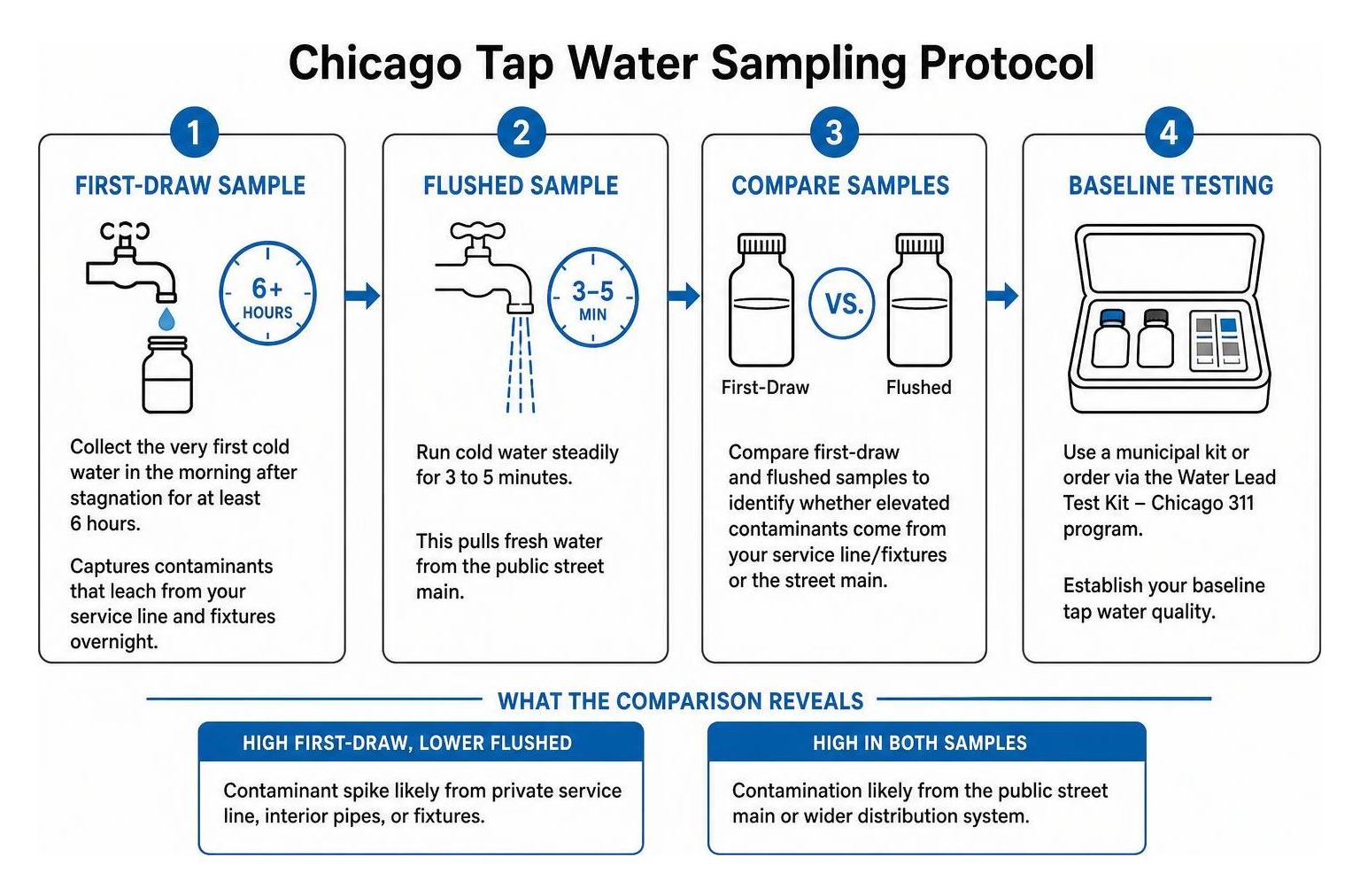
- First-Draw Sample: Collect the very first water from the cold tap first thing in the morning after the plumbing has stagnated for a minimum of 6 hours. This sample captures dissolved heavy metals that leach from the service line and interior fixtures overnight.
- Flushed Sample: Allow the cold water tap to run steadily for 3 to 5 minutes to pull fresh water directly from the public street main. Comparing the first-draw sample with the flushed sample isolates whether contaminant spikes originate in the private service line or the street infrastructure.
- Utilizing resources such as a municipal kit detailed in DWM Water Test Kit: How to Test Your Chicago Tap Water or ordering via the Water Lead Test Kit – Chicago 311 program gives an initial baseline of unfiltered tap quality.
In-Home Chicago RO Water Testing and TDS Verification
For daily and monthly performance monitoring, an electronic Total Dissolved Solids (TDS) meter serves as an effective operational tool. TDS measures the combined total of mobile charged ions—including minerals, salts, and trace metals—dissolved in a given volume of water, expressed in parts per million (PPM).
Chicago’s raw tap water consistently registers between 180 and 220 PPM TDS. When testing water treated by Top Reverse Osmosis System Options in Chicago for Pure Water, an efficient reverse osmosis membrane should exhibit a rejection rate of 90% to 98%, lowering pure product water to 10–25 PPM TDS before remineralization stages.
If your TDS meter indicates that purified water rejection has dropped below 80% to 85%, this is an immediate operational signal that pre-filters are exhausted or the primary RO membrane has experienced mineral scaling or chemical breakthrough.
Laboratory Analysis for Lead and Chemical Contaminants
While a handheld TDS meter offers instant operational validation, it cannot identify specific hazardous chemical species like hexavalent chromium, dissolved lead ions, or chloramine byproducts. For precise analytical validation, homeowners should schedule professional diagnostics through a Reliable Water Testing Service in Chicago for Your Home or Business. State-certified environmental testing laboratories use inductively coupled plasma mass spectrometry (ICP-MS) and chromatography to measure contaminants down to parts per billion (ppb) or parts per trillion (ppt).
Need Clean, Safe Water at Home?
Get a free water test at your home or business. We install and service whole-house filtration and PEL75 reverse osmosis systems across Chicagoland. We also take select projects in Wisconsin and Indiana.
Book a Free Water TestCall (312) 889-8888Reverse Osmosis vs. Standard Filtration for Chicago Homes
Many residents wonder whether standard activated carbon filters or gravity pitchers provide adequate protection against Chicago’s specific water contaminants. While carbon block filters excel at reducing aesthetic chlorine taste and odor, they cannot match the broad-spectrum purification capabilities of multi-stage reverse osmosis. To see how membrane filtration addresses municipal plumbing risks, review Get the Lead Out: How Reverse Osmosis Filters Save Your Tap.
| Contaminant / Water Metric | Standard Pitcher Filter | Single-Stage Under-Sink Carbon | Multi-Stage Reverse Osmosis (RO) |
|---|---|---|---|
| Dissolved Lead (at Tap) | Variable / Inconsistent | Moderate (if NSF 53 certified) | 98% – 99%+ Removal |
| Hexavalent Chromium-6 | Ineffective | Ineffective | High Efficiency (95%+) |
| TTHMs & Haloacetic Acids | Low Reduction | Good (Activated Carbon) | Excellent (Carbon + Membrane) |
| Total Dissolved Solids (TDS) | No Reduction | No Reduction | 90% – 98% Reduction |
| Water Hardness Minerals | No Reduction | No Reduction | High Rejection (Pre-softening advised) |
| Remineralization Stage | Rare | Rare | Available (Balances Alkalinity/Taste) |
System Maintenance and Membrane Replacement Protocol
Maintaining peak membrane performance requires adhering to regular cartridge replacement cycles. In our regional climate, sediment and rust from aging distribution mains can load mechanical pre-filters quickly. Understanding Why Chicagoans Are Obsessed with 9-Stage Water Filtration illustrates how layered filtration safeguards the core membrane.
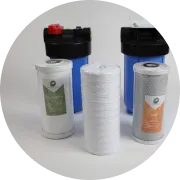
- Stage 1 & 2 Sediment Pre-Filters: Replace every 6 to 12 months to trap suspended sand, pipe rust, and silt before water enters downstream stages.
- Stage 3 & 4 Carbon Block Pre-Filters: Replace every 6 to 12 months to eliminate chloramines and chlorine that would otherwise degrade the delicate polyamide thin-film composite (TFC) membrane material.
- Primary RO Membrane: Replace every 24 to 36 months, depending on daily volume and incoming water hardness.
- Post-Carbon & Mineral Polish: Replace every 12 months to ensure balanced alkalinity and fresh taste.
- System Sanitization: Clean internal storage tanks and filter housings annually using sanitization protocols to prevent biological biofilm buildup.
Since our establishment in 2014 under the leadership of founder Karol Dolega, ProEcoLife has delivered local expertise tailored to Chicago’s infrastructure challenges. Headquartered at 7109 W Higgins Ave, we provide residential and commercial solutions throughout Chicago’s Northwest Side neighborhoods—including Norwood Park, Edison Park, Jefferson Park, Oriole Park, Forest Glen, Dunning, and Portage Park—as well as adjacent communities like Park Ridge, Niles, Des Plaines, Skokie, Lincolnwood, Evanston, Glenview, Morton Grove, and Arlington Heights.
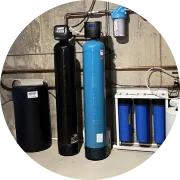
Our team specializes in advanced engineering, including the proprietary PEL75 9-Stage RO System, whole-property Whole House Filtration, Shower Filter System units, targeted Well Water Conditioning, and high-capacity Commercial Water Filtration Systems.
Frequently Asked Questions About Chicago RO Water Testing
How Frequently Should You Schedule Chicago RO Water Testing?
We recommend performing in-home digital TDS checks every month and scheduling formal diagnostic testing annually or whenever filter cartridges are serviced. Regular testing helps ensure that aging service pipes or shifts in municipal chlorination levels are not overwhelming your system. For practical long-term maintenance insights, review How to Keep Your Drinking Water Safe.
Can Reverse Osmosis Remove All Lead and Chromium-6 from Chicago Tap Water?
Reverse osmosis systems certified to NSF/ANSI Standard 58 are designed to achieve exceptional reduction rates, frequently removing up to 98% to 99%+ of heavy metals, including particulate lead, dissolved lead ions, and Chromium-6. While no mechanical process guarantees absolute mathematical zero in every environmental scenario, RO represents the most reliable household purification method. Discover more in our Best Way to Remove Lead from Water Guide.
Is RO Filtered Water More Cost-Effective Than Bottled Water in Chicago?
Yes. Purifying municipal tap water at your kitchen sink eliminates the ongoing expense of purchasing bottled water while removing dependence on single-use plastics. Families consuming multiple gallons daily may achieve substantial savings, while avoiding microplastics associated with bottled alternatives. Read our full comparison in Taste Test: Tap Water Versus Bottled Water.
Conclusion
Protecting your household’s drinking water begins with understanding what comes out of your tap. While Lake Michigan provides a reliable surface water source, the reality of aging urban pipe networks, elevated disinfection byproducts, and legacy lead service lines across the Chicago area makes point-of-use purification an essential investment. Implementing multi-stage reverse osmosis paired with routine testing gives homeowners clarity and control over their drinking water.
Whether you live on Chicago’s Northwest Side or in the surrounding suburban communities, custom residential filtration solutions like our chicago water filter system may help provide the reliable quality your home deserves; results vary based on plumbing age and household usage.
To take the first step in verifying your home’s water quality, contact ProEcoLife today to schedule a water test by visiting proecolife.com.