
Lead in Chicago’s Water: What Every Homeowner Needs to Know
The best way to remove lead from water in a Chicago home is to install a certified point-of-use filtration system — specifically a reverse osmosis (RO) system or a multi-stage carbon block filter certified to NSF/ANSI Standard 53 or 58.
Quick answer — most effective methods, ranked:
- Reverse osmosis (RO) — removes up to 99% of lead; gold standard for drinking water
- Multi-stage carbon block with ion exchange — NSF 53 certified; two independent removal pathways
- Certified carbon block filter — NSF 53 certified; solid single-stage option
- Certified pitcher filter (NSF 53 only) — lowest cost, lowest performance; not recommended as a primary solution
Never rely on boiling water. Boiling removes water through evaporation but leaves lead behind — actually concentrating it.
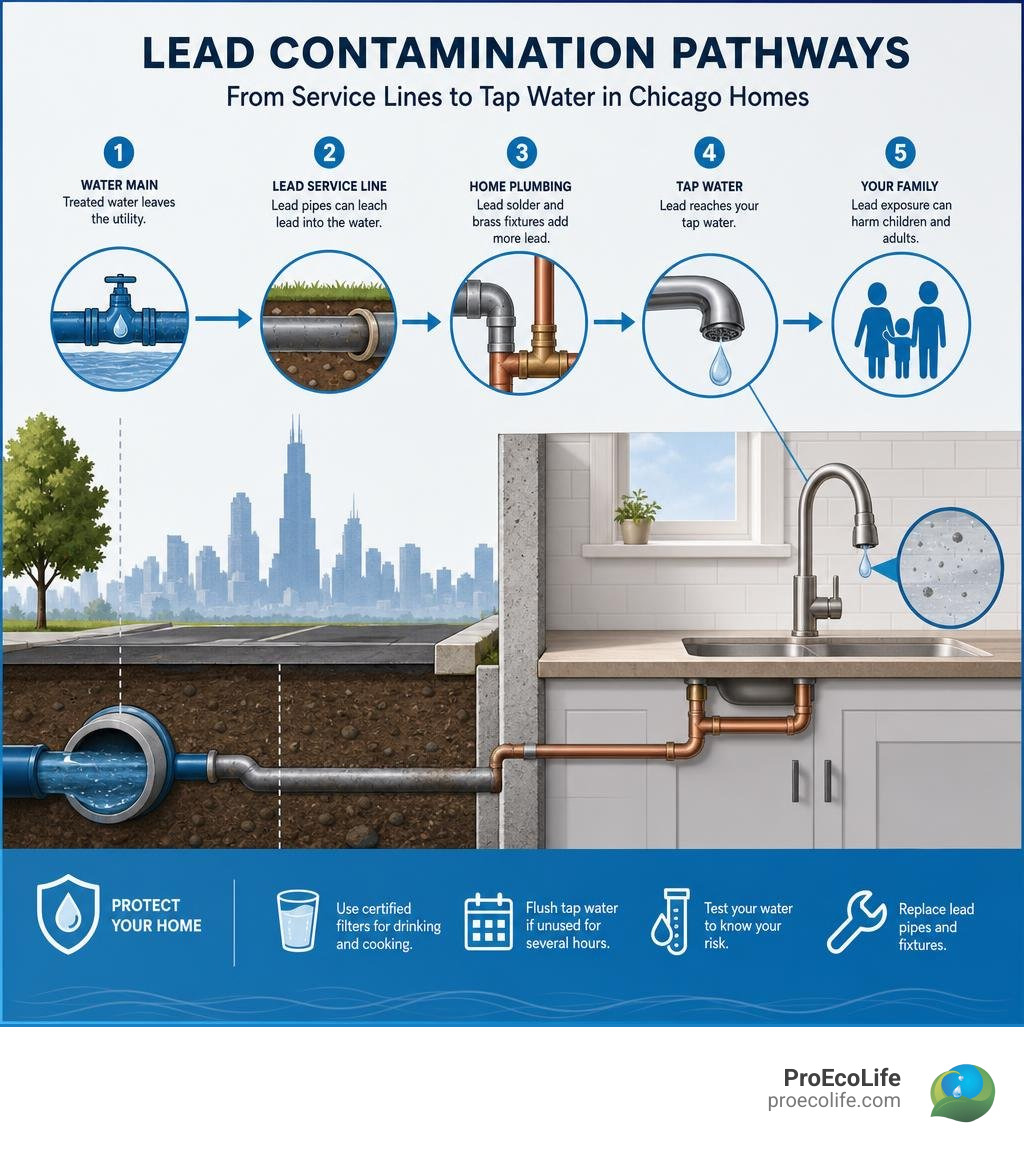
Chicago sits on Lake Michigan, one of the cleanest large-scale water sources in the country. The Metropolitan Water Reclamation District does its job well. But here’s the problem: lead almost never comes from the source water itself. It leaches into water after treatment, from aging service lines, lead solder at pipe joints, and old brass fixtures — right inside your home or on the street in front of it.
The EPA estimates 9.2 million lead service lines are still in use nationwide. Chicago has more of them than almost any other city. Older neighborhoods on the Northwest Side — Jefferson Park, Norwood Park, Edison Park — and suburbs like Park Ridge, Niles, and Des Plaines have significant concentrations of pre-1986 plumbing where lead exposure risk is highest.
Lead is colorless, odorless, and tasteless. You cannot detect it without testing. And according to the CDC, there is no safe level of lead exposure for children — none.
Similar topics to best way to remove lead from water:
Health Risks and Identifying Lead in Chicago Homes
Understanding the health risks associated with heavy metal exposure is the first step toward protecting your household. Lead is a cumulative neurotoxin that builds up in the body over time. According to the World Health Organization (WHO), lead exposure is responsible for an estimated 21.7 million years lost to disability and death globally.
The risks are exceptionally high for vulnerable populations:
- Infants and Children: Young children absorb up to five times more lead than adults. Exposure can cause irreversible damage to the nervous system, leading to learning disabilities, developmental delays, behavioral problems, and lower IQ. Infants who rely on baby formula prepared with tap water are at extreme risk due to the high volume of water they consume relative to their body weight.
- Pregnant Women: Lead stored in bones can be released into the blood during pregnancy, exposing the fetus. This increases the risk of premature birth, low birth weight, and developmental issues.
- Adults: In adults, long-term exposure is linked to cardiovascular issues, high blood pressure, decreased kidney function, and cognitive decline.
Because lead is invisible and tasteless, you cannot rely on your senses to detect it. Homes built before 1986 are particularly at risk because older plumbing systems commonly utilized lead solder to connect copper pipes. Furthermore, homes built before 1930 often feature complete lead service lines extending from the water main to the house.
To identify if your plumbing contains lead, you can perform a simple scratch test on the pipe entering your home (usually near the water meter):
- Locate the pipe and gently scrape the surface with a coin.
- If the pipe is soft, dull gray, and scratches easily to reveal a shiny, silver-like metal underneath, it is likely lead.
- A magnet will not stick to a lead pipe.
While the EPA’s Maximum Contaminant Level Goal (MCLG) for lead is set at zero due to the severity of its health impacts, the regulatory “action level” was historically set at 15 parts per billion (ppb). However, the EPA’s 2024 Lead and Copper Rule Improvements (LCRI) officially lowered this action level to 10 ppb, establishing a strict 10-year timeline for water utilities to replace all lead service lines. More details on these federal mandates can be found in the federal register 86418.
Local municipalities across the Chicago area are actively working to inventory and replace these lines. If you live in the northern or northwestern suburbs, you can check your town’s specific inventory and replacement protocols through local resources like the Lead Service Line Replacement – Park Ridge portal, the Lead Line Replacement Information | Niles, IL guidelines, the Lead Water Service Lines | Skokie, IL database, the FAQs | Lincolnwood Village, IL page, or the Home | City of Evanston Lead Service Line Replacement program.
For a deeper dive into how lead enters your domestic plumbing and what steps you must take to secure your household, refer to No Lead, No Worries: Your Guide to Lead-Free Drinking Water and the CDC’s comprehensive overview on About Lead in Drinking Water | Childhood Lead Poisoning Prevention | CDC. For a broader look at local water filtration solutions, read Heavy Metal Meltdown: The Best Way to Remove Lead from Drinking Water.
Need Clean, Safe Water at Home?
Get a free water test at your home or business. We install and service whole-house filtration and PEL75 reverse osmosis systems across Chicagoland. We also take select projects in Wisconsin and Indiana.
Book a Free Water TestCall (312) 889-8888Reverse Osmosis: The Best Way to Remove Lead from Water
When it comes to selecting the best way to remove lead from water, reverse osmosis (RO) technology stands out as the industry gold standard. Unlike basic physical barrier filters, reverse osmosis operates at a molecular level.

An RO system forces water under pressure through a semipermeable membrane with microscopic pores measuring approximately 0.0001 microns. Because lead ions are significantly larger than water molecules, they are blocked by the membrane and flushed away, removing up to 99% of dissolved lead.
To ensure a filter actually does what it claims, look for independent third-party certifications:
- NSF/ANSI Standard 53: This certification verifies that a point-of-use filter is tested to reduce specific health-related contaminants, including lead, from an incoming concentration of 150 ppb down to below 10 ppb.
- NSF/ANSI Standard 58: This is the specific certification standard for reverse osmosis systems, ensuring high-efficiency lead reduction and material safety.
Comparing Lead Filtration Technologies
| Feature | Reverse Osmosis (NSF 58) | Carbon Block (NSF 53) | Standard Pitcher / GAC |
|---|---|---|---|
| Lead Removal Rate | Up to 99% | 97% – 99% | Highly inconsistent (often 0%) |
| Mechanism | Semipermeable membrane | Physical adsorption | Granular absorption |
| Pore Size | 0.0001 microns | 0.5 – 1.0 microns | Variable (allows channeling) |
| Lifespan | 24 – 36 months (membrane) | 6 – 12 months | 1 – 2 months |
| Other Contaminants | PFAS, Arsenic, Fluoride, TDS | Chlorine, VOCs, large sediment | Chlorine taste and odor only |
For a complete breakdown of how this filtration process safeguards your household, check out Get the Lead Out: How Reverse Osmosis Filters Save Your Tap.
Why Multi-Stage Filtration is the Best Way to Remove Lead from Water
While a single-stage carbon block filter can reduce lead levels, a multi-stage approach provides redundant layers of protection. In the water filtration industry, we know that water chemistry changes throughout the year. Factors like temperature fluctuations and changing pH levels in Lake Michigan water can alter how lead behaves in your plumbing.
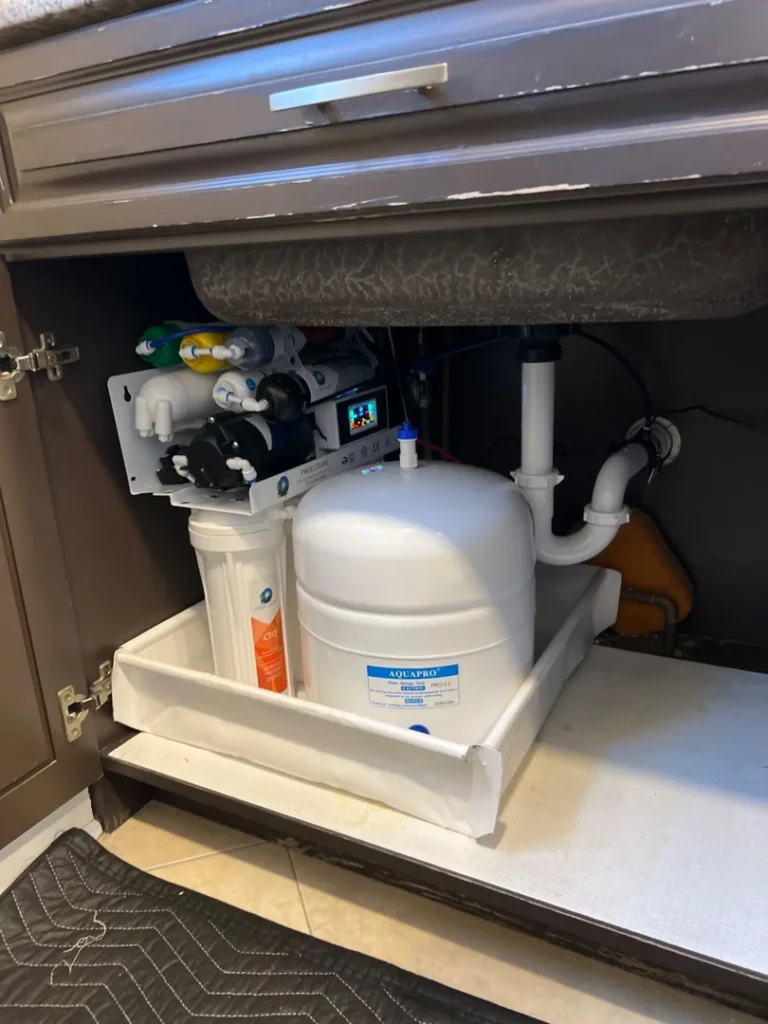
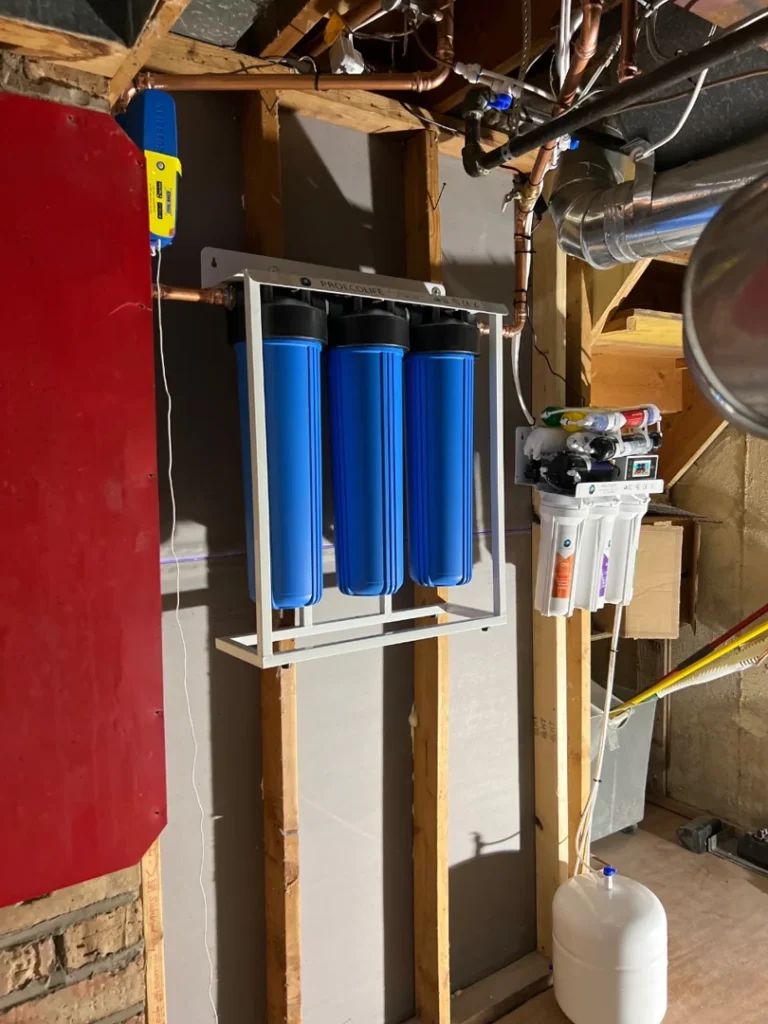
Our proprietary PEL75 9-Stage RO System is engineered specifically to handle these complex water profiles. Instead of relying on a single barrier, the PEL75 utilizes a sophisticated sequence of filtration media:
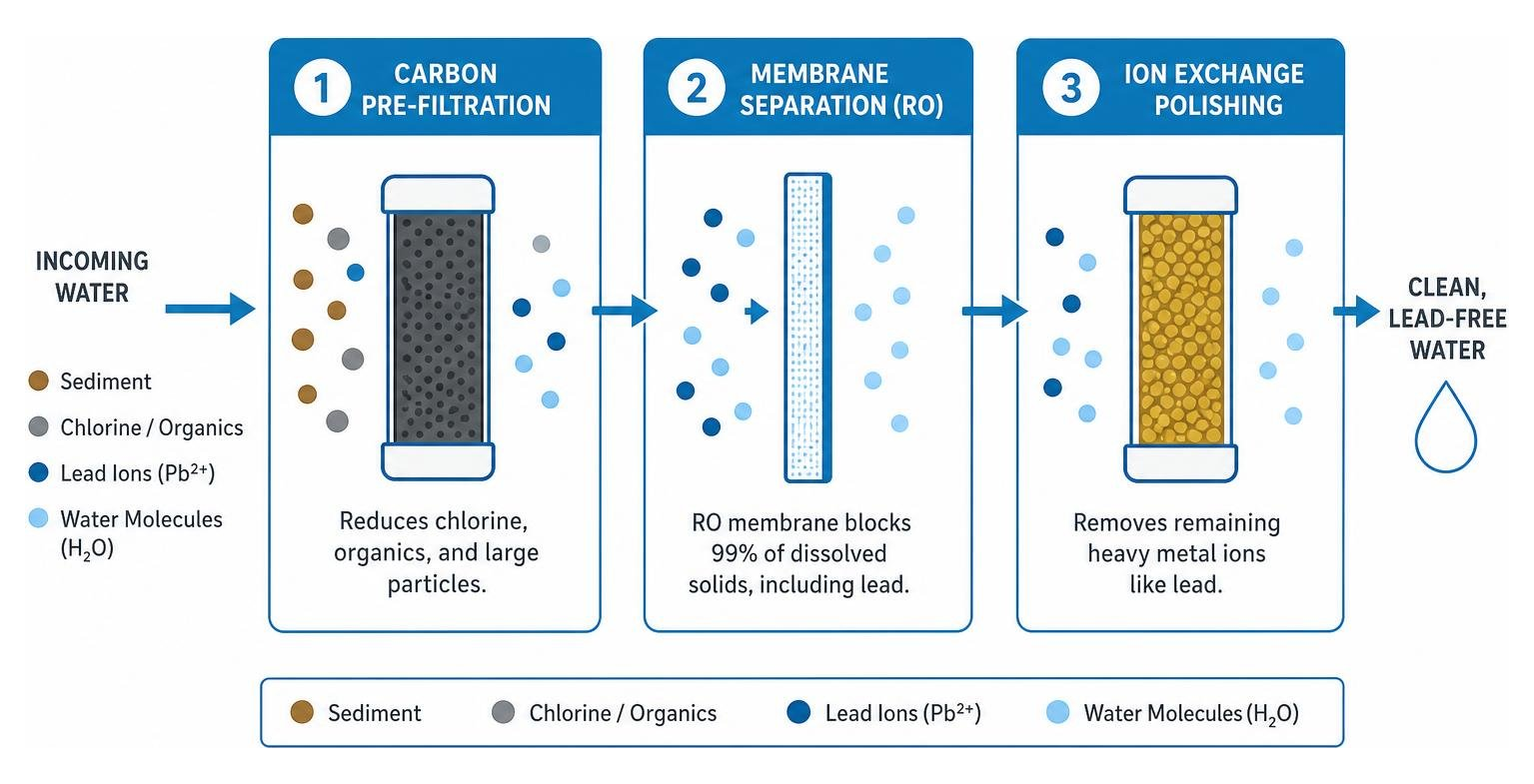
- Sediment Pre-filtration: Removes rust, dirt, and physical debris that can clog finer filters.
- Activated Carbon Blocks: Adsorbs organic chemicals, chlorine, and large heavy metal particles.
- Ion Exchange Media: Specifically targets dissolved heavy metal ions like lead, exchanging them for harmless ions.
- The RO Membrane: The ultimate barrier, stripping away up to 99% of remaining dissolved solids.
- Post-Carbon Polishing: Refines the taste of the water.
- Remineralization: Replenishes essential minerals like calcium and magnesium, ensuring the water is balanced, tastes crisp, and is not overly acidic.
By combining ion exchange with advanced carbon block technology and reverse osmosis, you create a fail-safe system. If one stage experiences heavy loading from a sudden spike in lead particles, the subsequent stages act as a safety net. You can learn more about how advanced faucet and under-sink filtration systems leverage these technologies in our Lead Filter for Faucet Guide: Heavy Metal is Only Good for Your Playlist.
Choosing the Best Way to Remove Lead from Water for Your Household
When choosing a filtration setup, you will encounter several formats. While point-of-entry or Whole House Filtration systems are excellent for removing chlorine, iron, and hardness minerals, they are generally not recommended as the primary defense against lead. This is because lead often leaches from the brass fixtures and copper pipe solder located inside your home’s walls, downstream of a whole-house filter.
Point-of-use (POU) systems, installed directly where you draw drinking and cooking water, are the most reliable and cost-effective approach.
- Under-Sink RO Systems: These offer the highest filtration capacity, lowest cost per gallon over time, and the most consistent contaminant reduction. They are ideal for busy kitchens in areas with older infrastructure like Jefferson Park or Edison Park.
- Faucet-Mounted Filters: These offer a smaller footprint but have significantly shorter cartridge lifespans and are highly susceptible to damage from hot water.
- Pitcher Filters: While convenient, most standard pitchers use loose granular activated carbon (GAC). Water easily creates “channels” through loose carbon, bypassing the filtration media entirely. Unless specifically certified to NSF 53 for lead, standard pitchers will not protect you.
For private well owners in suburbs like Des Plaines or Glenview, lead can occasionally be accompanied by other heavy metals or hard water minerals. In these scenarios, combining a specialized Well Water Conditioning system with an under-sink RO system ensures comprehensive protection.
To compare various consumer options and read independent reviews of top-performing systems, you can consult the Best Water Filters for Lead (2026) | ZipCheckup buyer’s guide.
Need Clean, Safe Water at Home?
Get a free water test at your home or business. We install and service whole-house filtration and PEL75 reverse osmosis systems across Chicagoland. We also take select projects in Wisconsin and Indiana.
Book a Free Water TestCall (312) 889-8888Immediate Steps and Filter Maintenance to Reduce Exposure
If you suspect or know that your home has elevated lead levels, there are several immediate behavioral changes you should adopt while waiting for a professional filtration system installation:
- Use Cold Water Only: Never use hot or warm tap water for drinking, cooking, or preparing baby formula. Hot water is highly corrosive and dissolves lead from pipes and fixtures much faster than cold water.
- Run Your Tap Before Use: If water has sat unused in your pipes for more than six hours, flush the cold water tap for 1 to 2 minutes (or up to 5 minutes if you have a confirmed lead service line) before using it. This flushes out the stagnant water that has had the most contact with lead-bearing plumbing.
- Clean Faucet Aerators Regularly: Faucet aerators (the small screens screwed onto the tip of your faucet) can trap tiny lead flakes and sediment. Unscrew the aerator every few months and rinse out any trapped particles.

- Avoid the Boiling Water Myth: We cannot stress this enough: boiling water does not remove lead. It actually increases the concentration of lead in the water because some of the water evaporates as steam while the heavy metal remains behind.
The Importance of Professional Filter Maintenance
Even the most advanced water filter will fail if it is not maintained. Over time, filtration media becomes saturated with contaminants. When a carbon block or ion exchange filter reaches its capacity, it can experience “breakthrough,” where trapped lead begins to leach back into your drinking water.
To keep your system operating at peak performance:
- Pre-filters and Post-filters: Typically require replacement every 12 months.
- Reverse Osmosis Membranes: Typically require professional testing and replacement every 24 to 36 months depending on local water hardness.
- Sanitization: The system’s storage tank and lines should be sanitized periodically to prevent biological growth.
For authoritative safety tips and a detailed look at how to protect your family from plumbing-related contaminants, read the NRDC’s guide on How to Protect Yourself from Lead-Contaminated Water. You can also find specialized advice for municipal water supplies in the Advice to Chicago Residents About Lead in Drinking Water bulletin, or learn about selecting certified systems in the EPA’s WaterSense Guide to Selecting Water Treatment Systems. For temporary filtration options, see our guide on Heavy Metal Detox: The Best Faucet Water Filter for Lead Removal in 2026.
Frequently Asked Questions About Lead Removal
Does boiling water remove lead?
No, boiling water does not remove lead. Lead is a heavy metal with an extremely high boiling point. When you boil water, a portion of the clean water evaporates as steam, leaving the lead behind in a smaller volume of liquid. This actually increases the concentration of lead in your water. If your water contains lead, the only safe option is to use a certified filtration system or bottled water.
Do standard pitcher filters remove lead?
The vast majority of standard pitcher filters do not remove lead. Most basic pitchers utilize Granular Activated Carbon (GAC) designed solely to improve taste and odor by reducing chlorine. Because the carbon granules are loose, water can easily find paths of least resistance (called “channeling”), bypassing the filtration media. To remove lead, a pitcher must be specifically certified to NSF/ANSI Standard 53 for lead reduction. For reliable, long-term protection, high-density carbon blocks or reverse osmosis systems are far superior.
Is lead absorbed through the skin during bathing or showering?
No, human skin does not absorb lead from water. According to the CDC, bathing and showering in water containing lead is considered safe because the metal cannot penetrate the skin. However, many homeowners in the Chicago area choose to install a Shower Filter System or water softener anyway. This is primarily because hard water minerals from Lake Michigan can combine with trace metals to cause dry skin, brittle hair, and scale buildup on shower fixtures, rather than due to a risk of lead poisoning.
What are some methods for removing lead from drinking water besides using a whole house system or a filtered pitcher?
Point-of-use under-sink reverse osmosis systems, faucet-mount carbon block filters, and counter-top distillation units are highly effective alternatives. Distillation heats water to create steam and re-condenses it into a clean container, leaving lead behind, though it is slow and energy-intensive. For an interactive discussion on alternative filtration methods, you can read the community insights on What are some methods for removing lead from drinking water besides ….
Secure Your Chicago Home with ProEcoLife
At ProEcoLife, we have been proud of our deep Chicago roots since our founding in 2014 by Karol Dolega. We understand the unique challenges facing homeowners on the Northwest Side — from the historic bungalows of Norwood Park, Edison Park, and Jefferson Park, to the sprawling residences in nearby suburbs like Park Ridge, Niles, Des Plaines, Skokie, Glenview, Arlington Heights, and Morton Grove.
Our mission is to provide families with water filtration systems tailored to local water chemistry. Whether you need a high-capacity PEL75 9-Stage RO System under your kitchen sink, a whole-house filtration system to combat suburban water hardness, or specialized Commercial Water Filtration Systems for your local business, we are here to help.
Don’t guess when it comes to your family’s health. For a comprehensive guide on choosing the right system for your specific neighborhood, read our resource on How to Choose the Best Lead Water Filter in Chicago: A 2026 Guide.
Ready to take control of your home’s water quality? Contact ProEcoLife today to schedule a professional water test at (312) 889-8888 or visit us online at proecolife.com.