How to Protect Your Tap Water From Lead Pipes in Chicago
If your home may have lead pipes, use a water filter certified specifically for lead reduction under NSF/ANSI 53 or NSF/ANSI 58. Filter cold water for drinking and cooking, replace cartridges on schedule, and test your tap water. A filter can reduce exposure while you arrange to replace a lead service line; it does not fix the pipe.
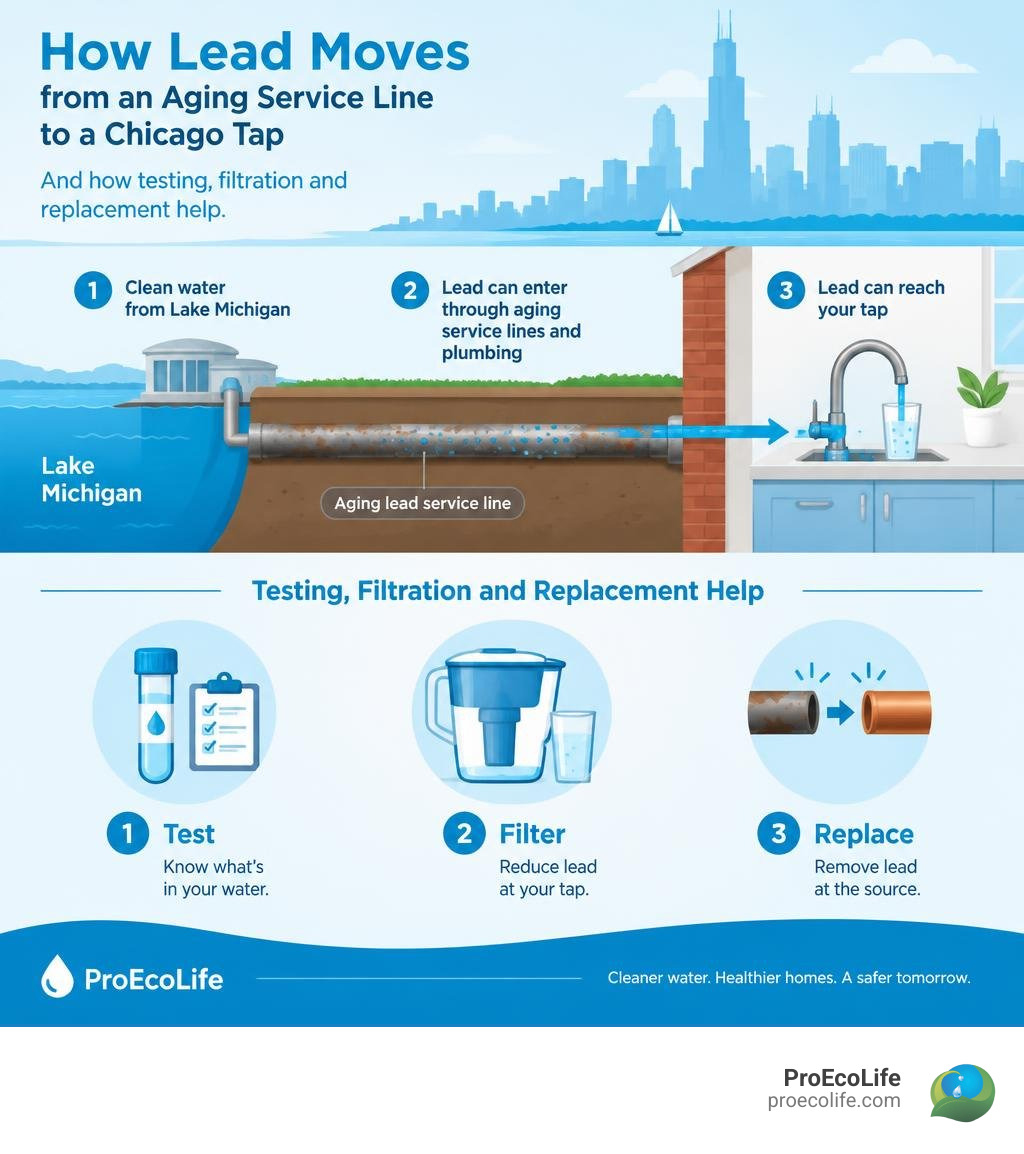
Chicago draws its water from Lake Michigan, but lead can enter it later through aging service lines and plumbing in older homes. You cannot see or taste it. And the hard water common in the northwest suburbs is a separate issue; it does not tell you whether lead is present.
Easy water filter lead pipes glossary:
- best way to remove lead from drinking water
- lead free drinking water
- whole house water filtration system to remove lead
Understanding Chicago’s Lead Infrastructure and Health Risks
Here in the Chicagoland area, our municipal water begins at Lake Michigan, where treatment plants deliver water that meets stringent quality guidelines. However, the heavy metal reality of Chicago lead levels and tap water tells a different story once that water travels through aging distribution networks. With an estimated 400,000 lead service lines running beneath our city streets, Chicago has more lead utility pipes than any other city in the United States.
Lead primarily leaches into household water through these buried service lines—the underground pipes connecting the municipal water main under the street directly to your home. Beyond the main service line, internal plumbing can also contribute to contamination. Before national code changes in 1986, lead-based solder was standard practice for joining copper pipes, and interior brass fixtures frequently contained elevated amounts of lead.
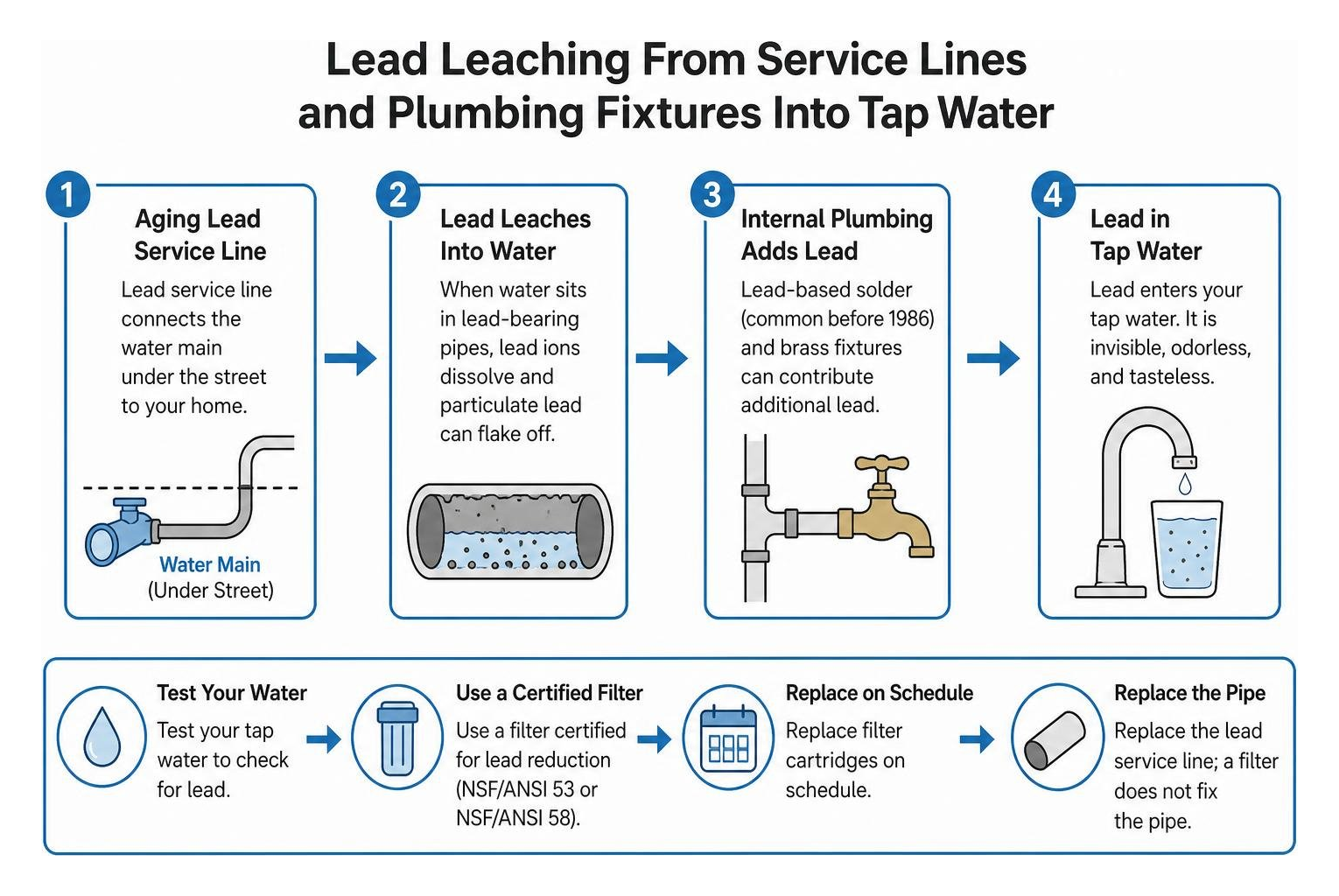
When water sits motionless in lead-bearing pipes for several hours, lead ions gradually dissolve into the standing water. Additionally, physical vibrations from street construction or temperature swings can cause particulate lead to flake off pipe walls. Health authorities, including Health Canada, emphasize that there is no safe threshold for lead exposure.
Lead is a potent neurotoxin. In infants and young children, exposure can lead to irreversible cognitive deficits, behavioral challenges, and developmental delays. In adults, chronic exposure may contribute to elevated blood pressure, cardiovascular complications, and reduced kidney function. Because lead is completely invisible, odorless, and tasteless, identifying plumbing risks and using an appropriate guide to Chicago water testing is essential.
Identifying Lead Plumbing in Older Properties
Determining whether your home receives water through a lead pipe requires a straightforward physical inspection. If you live in an older property in Northwest Side neighborhoods like Norwood Park, Edison Park, or Jefferson Park, or nearby suburbs such as Park Ridge, Niles, or Des Plaines, locating the main water shutoff valve is your first step.
- Locate the Incoming Line: Find where the main water line enters your home from the street, typically located in the basement, crawlspace, or near the water meter.
- The Scratch Test: Lead is a relatively soft, dull gray metal. Carefully scratch the outer surface of the pipe with a coin or key. If the scratched area turns a bright, shiny silver, the pipe is likely lead.
- The Magnet Test: Hold a household magnet against the pipe. A magnet will not stick to a lead or copper pipe, whereas it will cling firmly to galvanized steel or iron.
- Inspect the Joints: Lead pipes frequently feature a distinct, bulbous “wiped” solder joint where they connect to modern brass shutoff valves.
Homeowners can also verify their pipe material by checking municipal databases. Local investigative reports highlighting that lead pipes are everywhere in Chicago show that many suburban public works departments—including those in Skokie, Glenview, and Arlington Heights—maintain searchable service line inventories to help residents track utility records.
Public vs. Private Pipe Replacement Responsibilities
A common point of confusion among property owners is who owns which section of the water service line. Water infrastructure is divided at the property line:
- Public Portion: The municipality owns the section running from the water main under the street to the property shutoff valve (often called the curb stop or b-box).
- Private Portion: The property owner is responsible for the line running from the curb stop into the building’s interior plumbing.
Full service line replacement is the only permanent solution to eliminate lead leaching from underground pipes. Municipalities across Cook County have established replacement programs to coordinate upgrades. For example, exploring how to handle your lead service line replacement can help homeowners navigate local permitting, equity programs, and municipal infrastructure grants designed to reduce out-of-pocket costs.
Need Clean, Safe Water at Home?
Get a free water test at your home or business. We install and service whole-house filtration and PEL75 reverse osmosis systems across Chicagoland. We also take select projects in Wisconsin and Indiana.
Book a Free Water TestCall (312) 889-8888Choosing the Right Water Filter for Lead Pipes
While replacing underground pipes takes time, installing a targeted point-of-use filtration system offers immediate protection at the kitchen sink. Advanced water filtration relies on specialized physical barriers and chemical adsorption media to extract heavy metals before water reaches your glass.

At ProEcoLife, we have been engineering water filtration systems tailored to the unique water profiles of the Chicagoland area since 2014. Founded by Karol Dolega, our approach focuses on heavy metal extraction while accounting for the sediment and mineral levels delivered through regional municipal lines. Understanding how lead is removed from drinking water allows you to select equipment that addresses both dissolved ions and particulate flakes.
NSF Standards and Certified Water Filter Lead Pipes Performance
Not every filter on the market removes lead. When evaluating a water filter for lead pipes, independent certification is the primary factor to look for:
- NSF/ANSI Standard 53: Evaluates drinking water treatment units for health-related contaminant reduction. A system certified under Standard 53 is verified by an accredited body (such as NSF, WQA, or IAPMO) to reduce lead concentrations down to 5 parts per billion (ppb) or less.
- NSF/ANSI Standard 58: Applies specifically to reverse osmosis systems, confirming heavy metal extraction and total dissolved solids reduction under strict performance protocols.
- NSF/ANSI/CAN 372: Verifies that the internal plumbing components and filter housings themselves meet low-lead content requirements (less than 0.25% lead), though it does not certify filtration performance on its own.
There is a significant difference between a product that is officially certified and one merely marketed as “tested to meet NSF standards.” Official certification means an accredited third party conducted rigorous laboratory testing, verified contaminant extraction rates, and performs ongoing factory audits. Uncertified products may have undergone internal spot testing without third-party validation.
Comparing Filtration Technologies: From Jugs to Reverse Osmosis
Different filter types offer varying levels of reduction efficiency, capacity, and maintenance requirements:
| Filter Type | Primary Technology | Lead Reduction Capability | Filter Lifespan | Best Application |
|---|---|---|---|---|
| Standard Jug Filter | Loose Granular Activated Carbon | Moderate reduction (58% – 74% in lab tests) | 1 to 2 months | Temporary rental use, travel |
| Faucet-Mount Unit | Carbon Block / Ion Exchange | Certified reduction (when NSF 53 rated) | 2 to 3 months | Small apartments, single taps |
| Under-Sink Carbon | Solid Carbon Block Matrix | High reduction of dissolved and particulate lead | 6 to 12 months | Dedicated kitchen drinking taps |
| Multi-Stage Reverse Osmosis | Semi-Permeable RO Membrane + Carbon | Maximum broad-spectrum heavy metal extraction | 12 to 24 months (membrane) | Comprehensive home drinking water |
Basic gravity jug filters generally use loose carbon and ion-exchange beads. In independent testing on water containing trace lead levels, standard jugs removed between 58% and 74% of the contaminant. While helpful in short-term scenarios, gravity pitchers can experience channeling, where water bypasses active media.
For comprehensive protection, point-of-use reverse osmosis provides the highest level of lead reduction. Exploring how reverse osmosis systems manage heavy metals shows how semi-permeable membranes separate dissolved heavy metal ions at the molecular level. Our PEL75 9-Stage RO System combines multi-stage sediment pre-filtration, advanced carbon blocks, a high-efficiency membrane, and remineralization to deliver pure, balanced drinking water directly to your tap.
Need Clean, Safe Water at Home?
Get a free water test at your home or business. We install and service whole-house filtration and PEL75 reverse osmosis systems across Chicagoland. We also take select projects in Wisconsin and Indiana.
Book a Free Water TestCall (312) 889-8888Immediate Household Practices to Reduce Lead Exposure
If you suspect lead plumbing in your home, implementing targeted daily habits can help lower your exposure while you evaluate long-term filtration or pipe replacement options.
- Flush Stagnant Water: If your tap has sat unused for six hours or more, run the cold water faucet for several minutes before collecting water for drinking or cooking. Everyday activities like running a shower, doing laundry, or flushing toilets help pull fresh water from the main into your home plumbing.
- Always Use Cold Tap Water: Never drink, cook with, or prepare infant formula using water from the hot water tap. Hot water accelerates the corrosion of internal plumbing and dissolves lead much faster than cold water. If you need hot water, draw cold water and heat it on the stove or in a kettle.
- Clean Faucet Aerators Monthly: Unscrew the aerator screen on the tip of your kitchen and bathroom faucets. Particulate lead and sediment can accumulate on these mesh screens, continuously exposing running water to lead fragments. Rinse the screen thoroughly and replace damaged components, as detailed in standard household water quality guidelines.
- Maintain Filter Cartridges: Any filtration system requires regular filter changes. Saturated filters lose their binding capacity, which may result in breakthrough where trapped contaminants enter your drinking water. Maintaining a consistent schedule ensures lead-free drinking water throughout your home.
Selecting an Under-Sink or Whole-House Water Filter for Lead Pipes
Choosing between an under-sink system and a point-of-entry system depends on your home’s layout and plumbing configuration.
A point-of-use under-sink system, such as the PEL75 9-Stage RO System, treats water right at the dedicated kitchen faucet where your family drinks and cooks. This is widely considered the most effective defense against lead because it catches heavy metals leaching from both underground service lines and interior brass fixtures before the water enters your glass.
For comprehensive water treatment, a Whole House Filtration system treats water where the main line enters the building. This setup helps manage municipal chlorine, chloramines, and sediment throughout the entire property. In the Northwest suburbs—including communities like Morton Grove, Skokie, and Glenview—homeowners frequently pair whole-house conditioning with under-sink reverse osmosis. This combination addresses both water hardness and heavy metal risks across all household taps. Reviewing the top home filtration designs for lead can help clarify how point-of-use and point-of-entry systems complement one another.
For bathroom fixtures, installing a dedicated Shower Filter System helps reduce chlorine exposure during bathing, while homes on private supplies benefit from specialized Well Water Conditioning systems. We also design and support Commercial Water Filtration Systems for local businesses, schools, and offices across the Chicago area.
Frequently Asked Questions About Lead in Drinking Water
Does boiling tap water remove lead from plumbing pipes?
No, boiling tap water does not remove lead. Lead is a heavy metal element, not a biological pathogen like bacteria or viruses. When you boil contaminated water, some of the water evaporates as steam while the lead remains behind. This process actually increases the concentration of lead in the remaining water.
What is the difference between a filter tested to NSF standards and one certified for lead reduction?
A filter that is “tested to” NSF standards has been evaluated under specific test protocols, but may have only undergone internal testing by the manufacturer without independent oversight. In contrast, a filter that is “certified” has been evaluated by an accredited third-party organization (such as NSF International, WQA, or IAPMO). Certification confirms that the unit passed standardized testing to reduce lead down to 5 ppb or lower, the production facility meets quality standards, and the product undergoes regular audits.
How do I get my home’s drinking water tested for lead?
Because lead is invisible and flavorless, laboratory testing is the only definitive way to confirm its presence. You can request testing kits through municipal programs or consult certified local laboratories. For reliable results, collect a first-draw sample immediately after water has sat undisturbed in your pipes for at least six hours, followed by a flushed sample taken after running the tap.
Conclusion
Aging lead service lines remain a reality across Chicago and surrounding suburbs like Lincolnwood, Evanston, and Harwood Heights. While public infrastructure updates continue, protecting your household’s drinking water requires proactive, verified point-of-use filtration. Using certified multi-stage systems ensures your family has clean, great-tasting water every time you turn on the tap. For more guidance on choosing equipment, explore our 2026 Chicago lead water filter guide.
To ensure your home’s water is safe, schedule a comprehensive water analysis with our local specialists. Contact ProEcoLife today at (312) 889-8888 or visit proecolife.com to book your appointment.