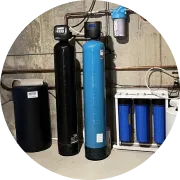


Is Your Chicago Home’s Water Safe from Lead? Here’s What You Need to Know
A whole house water filtration system to remove lead is one of the most important investments a Chicago homeowner can make — especially if you live in a home built before 1986 or rely on aging city infrastructure to deliver water to your taps.
Quick answer: A whole house lead filtration system installs at your main water line and filters all water entering your home before it reaches any tap, shower, or appliance. Here’s what to know at a glance:
- Who needs it most: Homeowners in older Chicago neighborhoods (Norwood Park, Edison Park, Jefferson Park) and suburbs like Park Ridge, Skokie, and Des Plaines with pre-1986 plumbing
- How it works: Multi-stage filtration removes both soluble (dissolved) and particulate lead using technologies like activated carbon, KDF media, and ionic bonding
- What to look for: Certification to NSF/ANSI 53 for lead reduction (and NSF/ANSI P473 if PFAS is also a concern)
- Typical filter life: Most systems last 100,000 gallons or roughly 12 months before the main filter needs replacement
- Key benefit: Every tap in your home delivers filtered water — not just the kitchen sink
Chicago’s water story is complicated. The city draws from Lake Michigan, which is a relatively clean source. But that water travels through miles of aging distribution pipes — and in many cases, through lead service lines running directly into your home. According to the EPA, the maximum contaminant level goal for lead is zero, because there is no safe level of lead exposure. Yet 18 million Americans still live in communities where water systems are in violation of lead regulations.
For Chicago families, that’s not an abstract statistic. It’s a real daily risk.
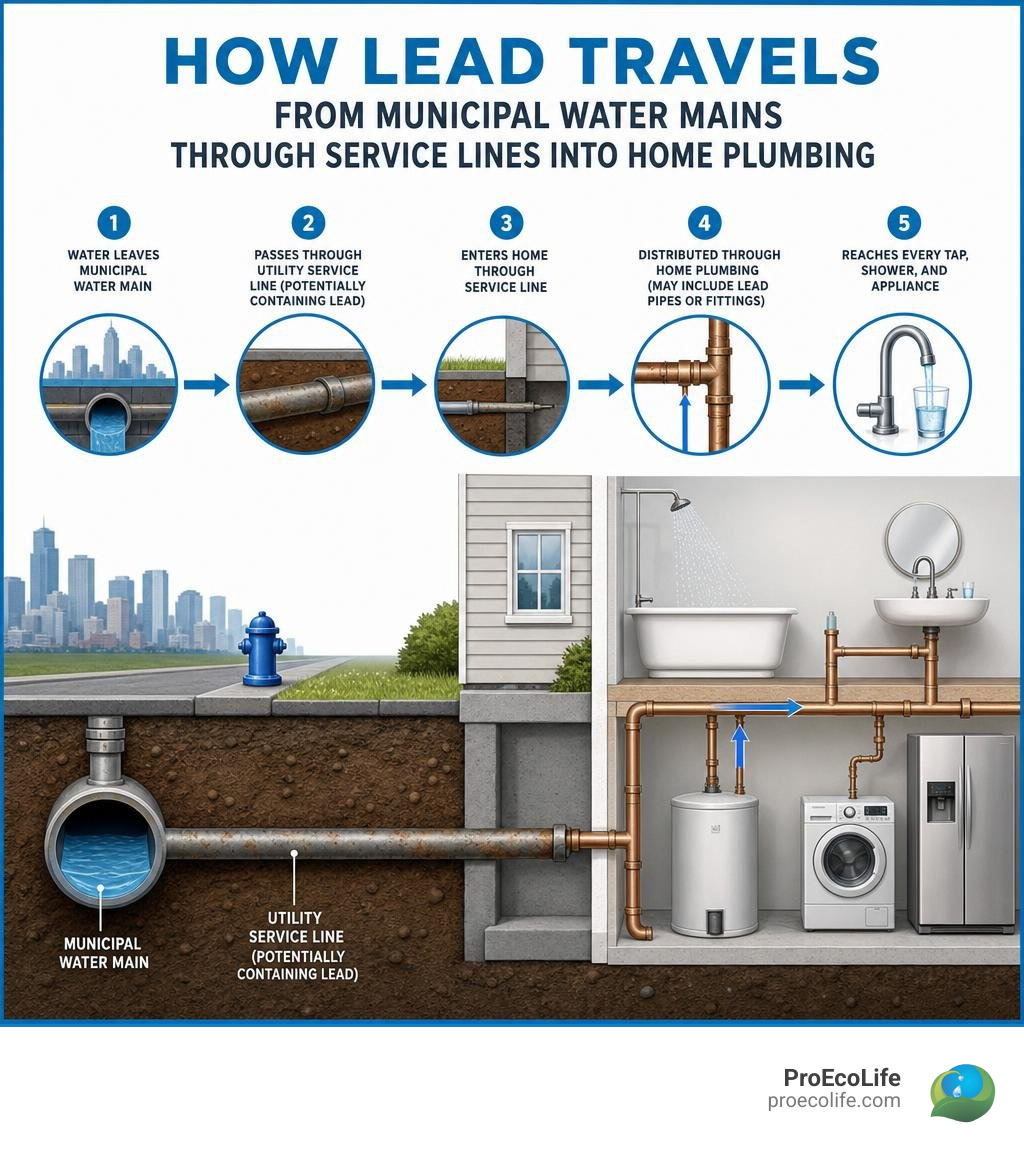
Key terms for whole house water filtration system to remove lead:
Why Lead Contamination is a Critical Concern for Chicago Homes
When we talk about water quality in the Chicago area, we are dealing with a historic plumbing legacy. Until the federal ban in 1986, homes and commercial buildings were regularly built using lead pipes, lead service lines, and copper pipes joined with lead solder. In fact, Chicago actually mandated the use of lead service lines for decades up until that ban. This means that if your home in Norwood Park, Edison Park, or Jefferson Park was built before 1986, there is a very high probability that lead is leaching into your daily water supply.
Lead is a highly toxic heavy metal and a potent neurotoxin. Unlike many other contaminants, lead is invisible, completely odorless, and tasteless. You cannot boil it out of your water—in fact, boiling water actually concentrates the lead as the water evaporates.
According to public health advocates at Water – Lead-Safe Chicago, lead exposure can cause irreversible damage. When lead enters the human body, it behaves like calcium, storing itself in our bones and soft tissues. Over time, it accumulates, posing severe risks:
- For Children: Even trace levels of lead can cause learning disabilities, stunted growth, hearing loss, and permanent damage to the brain and nervous system.
- For Adults: Prolonged exposure may help contribute to high blood pressure, kidney dysfunction, cardiovascular issues, and reproductive complications.
Because our municipal water treatment facilities do their best to control corrosion at the street level, water leaving the plant is generally lead-free. However, as that water travels through the city’s aging water mains and enters your private service line, the chemistry of the water can cause lead to dissolve or flake off directly into your household stream. Ensuring you have lead free drinking water is not just about filtering what you drink; it is about securing every single point of contact in your household.
Need Clean, Safe Water at Home?
Get a free water test at your home or business. We install and service whole-house filtration and PEL75 reverse osmosis systems across Chicagoland. We also take select projects in Wisconsin and Indiana.
Book a Free Water TestCall (312) 889-8888How a Whole House Water Filtration System to Remove Lead Works
Unlike point-of-use systems—such as pitcher filters or under-sink units—a whole house filtration system is installed directly at your home’s main water line. In the water treatment industry, this is known as a Point-of-Entry (POE) system.
By intercepting the water immediately as it enters your home (usually in your basement or utility closet), a POE system ensures that every drop flowing to your kitchen faucet, bathroom sinks, showers, washing machine, and dishwasher is thoroughly treated.
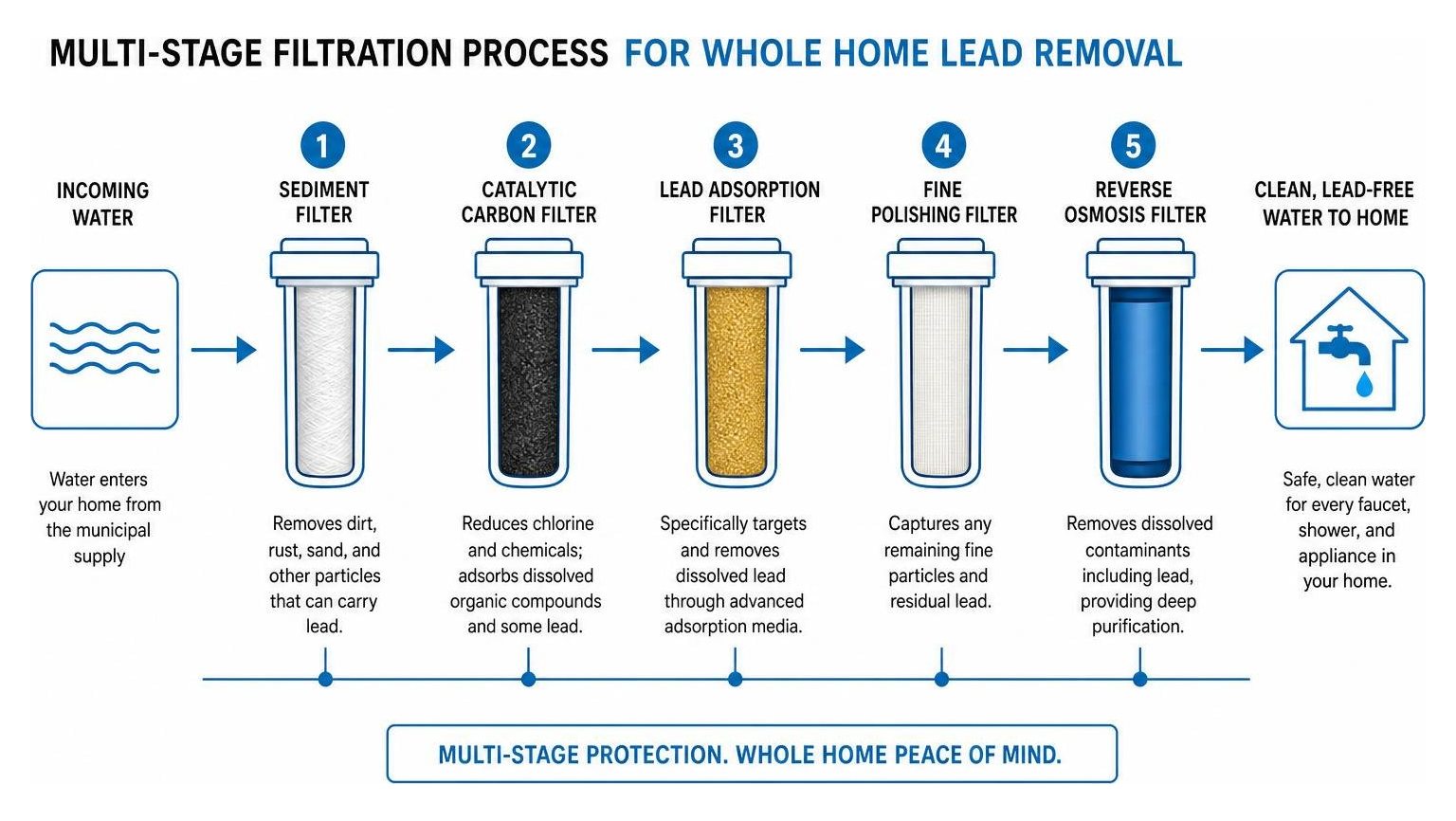
When we install a Whole House Filtration System, we are setting up a multi-stage defensive barrier. The water passes through a series of specialized media chambers, each designed to target different physical and chemical impurities. This comprehensive process ensures that you do not just get clean-looking water, but truly purified water free from the invisible heavy metals that threaten your family’s health.
Soluble vs. Particulate Lead: The Dual Challenge for a Whole House Water Filtration System to Remove Lead
To effectively remove lead on a whole-house scale, a system must be engineered to handle two completely different forms of lead:
- Soluble Lead (Dissolved Lead): This is lead that has completely dissolved into the water due to chemical corrosion. It is entirely invisible and cannot be trapped by a standard sediment filter. To capture soluble lead, filtration systems rely on advanced chemical binders or ion-exchange resins. These binders create an ionic bond with the dissolved lead, pulling it out of the water stream and locking it away.
- Particulate Lead (Physical Flakes): These are microscopic physical particles of lead that have physically broken off from corroding pipes. To stop these, a system requires ultra-fine physical filtration.
A high-performance whole house water filtration system to remove lead typically utilizes a 0.5-micron nominal filtration barrier. This physical block is dense enough to mechanically trap particulate lead, cysts, and other microscopic sediment while maintaining an adequate flow rate for the entire household. Understanding this dual challenge is key to executing a true Heavy Metal Meltdown: The Best Way to Remove Lead from Drinking Water.
Multi-Stage Filtration and Ion Exchange Technologies
A robust whole house system does not rely on a single filter cartridge. Instead, it combines several highly effective water treatment technologies:
- Sediment Pre-Filter: The first line of defense. It captures larger physical particles like dirt, rust, and silt, protecting the more sensitive lead-removal media downstream from clogging prematurely.
- Activated and Catalytic Carbon: These media are exceptional at removing chlorine, chloramines, volatile organic compounds (VOCs), and unpleasant tastes and odors.
- KDF (Kinetic Degradation Fluxion) Media: Utilizing high-purity copper-zinc granules, KDF media uses basic electrochemical reactions to reduce heavy metals (including lead, mercury, and nickel) while inhibiting the growth of bacteria and algae within the filter.
- Ion Exchange Resin: This technology swaps harmful heavy metal ions for harmless sodium or potassium ions, acting as a highly targeted chemical magnet for dissolved lead.
By combining these stages, a premium system—such as those described in The Complete Guide to 3 Stage Water Filter Housings and Systems—provides complete, multi-tiered protection for your entire home.
Need Clean, Safe Water at Home?
Get a free water test at your home or business. We install and service whole-house filtration and PEL75 reverse osmosis systems across Chicagoland. We also take select projects in Wisconsin and Indiana.
Book a Free Water TestCall (312) 889-8888Choosing the Right Whole House Lead Filter for Your Chicago Home
Selecting the ideal filtration setup depends heavily on your specific location, plumbing infrastructure, and household size. A system that works perfectly for a small condo in Lincolnwood might not meet the demands of a large historic home in Park Ridge or a property utilizing a private well in the outer Northwest suburbs.
When homeowners look for Water Filtration System Installation Services in Skokie, IL or nearby Niles and Des Plaines, they quickly realize that water chemistry varies. For instance, municipal water sourced from Lake Michigan is treated with chlorine or chloramines, which requires robust carbon filtration. Meanwhile, well water in the surrounding areas may require specialized iron, manganese, or sulfur pre-treatment to prevent the lead-filtering media from fouling.
To find the perfect fit, we always recommend consulting The Best Whole House Water Filtration Systems in Chicago for Crystal Clear Water to compare configurations that suit our regional water profile.
Key Factors: Flow Rate, Home Size, and Water Source
Before committing to a system, you must evaluate three critical operational parameters:
- Flow Rate (Measured in Gallons Per Minute – GPM): Your system must be able to deliver enough water to keep up with peak household usage. If you have multiple bathrooms, a low-flow system can cause a noticeable drop in shower pressure when someone runs the washing machine. A typical home needs a flow rate of at least 8 to 12 GPM, while larger homes with 4+ bathrooms may require 15 GPM or more.
- Home Size and Plumbing Diameter: The physical size of your incoming water line (usually 1-inch or 3/4-inch NPT) must match the system’s ports to prevent restricting your home’s natural water pressure.
- Water Source: City water is pre-treated and regulated, but often contains chemical disinfectants. Well water is entirely untreated and can vary wildly in pH, mineral hardness, and microbiological safety.
For a deeper dive into sizing and plumbing compatibility, check out our comprehensive resource, All About Whole House Filters.
Certifications to Look For in a Whole House Water Filtration System to Remove Lead
You should never take a manufacturer’s word at face value when it comes to removing a dangerous neurotoxin like lead. Always look for independent, third-party certifications:
- NSF/ANSI Standard 53: This is the gold standard certification for contaminant reduction. It verifies that the system has been rigorously tested to reduce specific health-related contaminants, including soluble and particulate lead, as well as cysts.
- NSF/ANSI Standard P473 or NSF 53 for PFAS: This certification ensures the system effectively reduces emerging chemical contaminants like PFOA and PFOS.
- IAPMO R&T Platinum Seal: This seal indicates that the system has been certified to meet strict industry standards for material safety, structural integrity, and performance.
Investing in certified technology is the only way to guarantee peace of mind, ensuring that your system performs flawlessly from From Shower to Sink: Finding the Best All House Water Filtration System.
Comparing Lead Removal Systems: Cost, Capacity, and Maintenance
To help you visualize your options, let us look at how different whole-house lead removal technologies stack up against one another:
| System Type | Lead Removal Method | Lifespan / Capacity | Key Maintenance Tasks | Best Suited For |
|---|---|---|---|---|
| Heavy-Duty Cartridge Systems | 0.5-micron carbon block with ionic binders | 100,000 gallons (approx. 12 months) | Replacing cartridge filters annually; monitoring flow rates | Average city homes, tight spaces, lower initial cost |
| Media Tank Systems | Bulk ion-exchange resin or specialized heavy-metal media | 600,000 to 1,000,000 gallons (5–10 years) | Periodic backwashing; replacing media beds every few years | Large homes, high water usage, long-term convenience |
| Point-of-Entry Reverse Osmosis | Semi-permeable membrane physical separation | 2–3 years for membranes; annual pre-filter changes | Monitoring membrane pressure; routine sanitization | Homes with extremely high TDS, heavy metals, and chemical contamination |
If you are looking for a heavy-duty cartridge system, you might want to read our analysis on sizing, such as Go Big or Go Home: Demystifying the 20 x 45 Whole House Water Filter, which explains why larger filter housings are critical for maintaining water pressure while capturing heavy metals.
Frequently Asked Questions about Whole House Lead Filtration

How often do whole house lead filters need to be replaced?
The replacement frequency depends heavily on your household’s water consumption and the level of sediment in your incoming water. For a standard cartridge-based system, the main lead-reduction filter is typically rated for 100,000 gallons or up to 12 months, whichever comes first.
Pre-filters (which protect the main lead filter from clogging with dirt and rust) usually need to be swapped out every 6 months. Neglecting these changes can restrict water pressure and reduce the system’s lead-binding efficiency. For a closer look at multi-cartridge maintenance, read The Ultimate Guide to 2 Stage Domestic Water Filtration.
Does a whole house filter remove hard water minerals?
Standard carbon-block or ion-exchange lead filters do not remove calcium and magnesium (the minerals responsible for hard water). In the Northwest suburbs of Chicago—such as Arlington Heights, Glenview, and Mount Prospect—hard water is incredibly common and causes stubborn scale buildup on fixtures and appliances.
To address this, many homeowners choose to pair their lead filter with a salt-free water conditioner. These conditioners use Template Assisted Crystallization (TAC) to alter the structure of hard minerals so they cannot stick to pipes, without adding sodium to your drinking water. Learn more about coordinating these systems in our guide on Whole House Filtration.
Can a whole house system address other contaminants like PFOA/PFOS and chlorine?
Yes! High-quality whole house systems that use catalytic activated carbon are highly effective at reducing chlorine, chloramines, cysts, VOCs, and industrial chemicals like PFOA and PFOS.
However, if you want the absolute highest level of purification for your drinking and cooking water, we often recommend combining a whole-house system with a dedicated under-sink reverse osmosis system. This dual-defense approach is detailed in our overview of the Top Rated Reverse Osmosis Systems to Remove Lead from Your Home.
Protecting Your Home with ProEcoLife
At ProEcoLife, we believe that clean water is the foundation of a healthy home. Founded by Karol Dolega, we have been proudly serving the Chicago area since 2014. We understand the unique challenges of our local water infrastructure—from the historic lead service lines on Chicago’s Northwest Side to the hard water minerals found throughout the surrounding suburbs.
We design and install advanced water treatment solutions tailored to your home’s specific needs. Whether you require a robust Whole House Filtration system to protect every faucet in your home, a targeted Shower Filter System to protect your skin and hair, or specialized Well Water Conditioning, we have the expertise to help. For the ultimate in pure drinking water, our proprietary PEL75 9-Stage RO System delivers unmatched filtration performance, while our Commercial Water Filtration Systems provide reliable solutions for local businesses.
We proudly serve homeowners and businesses across Chicago and its surrounding suburbs, including:
- Chicago Neighborhoods: Norwood Park, Edison Park, Jefferson Park, Oriole Park, Forest Glen, Dunning, Portage Park, O’Hare, and more.
- Suburbs: Park Ridge, Niles, Des Plaines, Skokie, Lincolnwood, Evanston, Glenview, Morton Grove, Arlington Heights, Mount Prospect, Rolling Meadows, Palatine, Wheeling, Buffalo Grove, Northbrook, Wilmette, and Northfield.
If you are ready to take control of your home’s water quality and protect your family from lead and other contaminants, we invite you to read our detailed guide on How to Choose the Best Lead Water Filter in Chicago: A 2026 Guide.
Take the first step toward safer water today. Contact the local experts at ProEcoLife to schedule a comprehensive water test for your home by visiting proecolife.com.