




Why Chicago Homeowners Are Rethinking Their Water Quality
All house water filtration systems — also called whole house or point-of-entry systems — are installed where your main water line enters your home, filtering every drop of water before it reaches any tap, shower, or appliance.
Quick answer: What does an all house water filtration system do?
- Filters water at the main supply line, so every faucet gets treated water
- Removes contaminants like chlorine, chloramines, sediment, rust, and heavy metals
- Protects plumbing, appliances, and water heaters from buildup and corrosion
- Improves water taste, odor, and feel throughout the entire home
- Reduces reliance on bottled water — the average household spends $600–$1,200 per year on it
If you live in Chicago or the surrounding suburbs, water quality is not a distant concern. It’s a daily reality.
Chicago’s water comes from Lake Michigan — one of the largest freshwater sources in the world. But by the time that water reaches your kitchen faucet in a home in Norwood Park, Park Ridge, or Des Plaines, it has traveled through aging infrastructure that may include lead service lines and older pipes. The city has tens of thousands of lead service lines still in use, and even treated municipal water picks up chloramines, sediment, and other contaminants along the way.
Hard water is another widespread issue in the Chicago area, particularly in the Northwest suburbs. Roughly 85% of U.S. homes deal with hard water, and the Chicago metro is no exception. High mineral content accelerates wear on water heaters, dishwashers, and plumbing — often without homeowners even noticing until the damage is done.
Many customers only start thinking about filtration after noticing a chlorine smell in the shower, a strange taste in their drinking water, or rust-colored staining in their sinks. By that point, the problem has usually been present for a long time.
The good news: a properly matched all house water filtration system can address these issues at the source — before the water ever reaches you or your family.
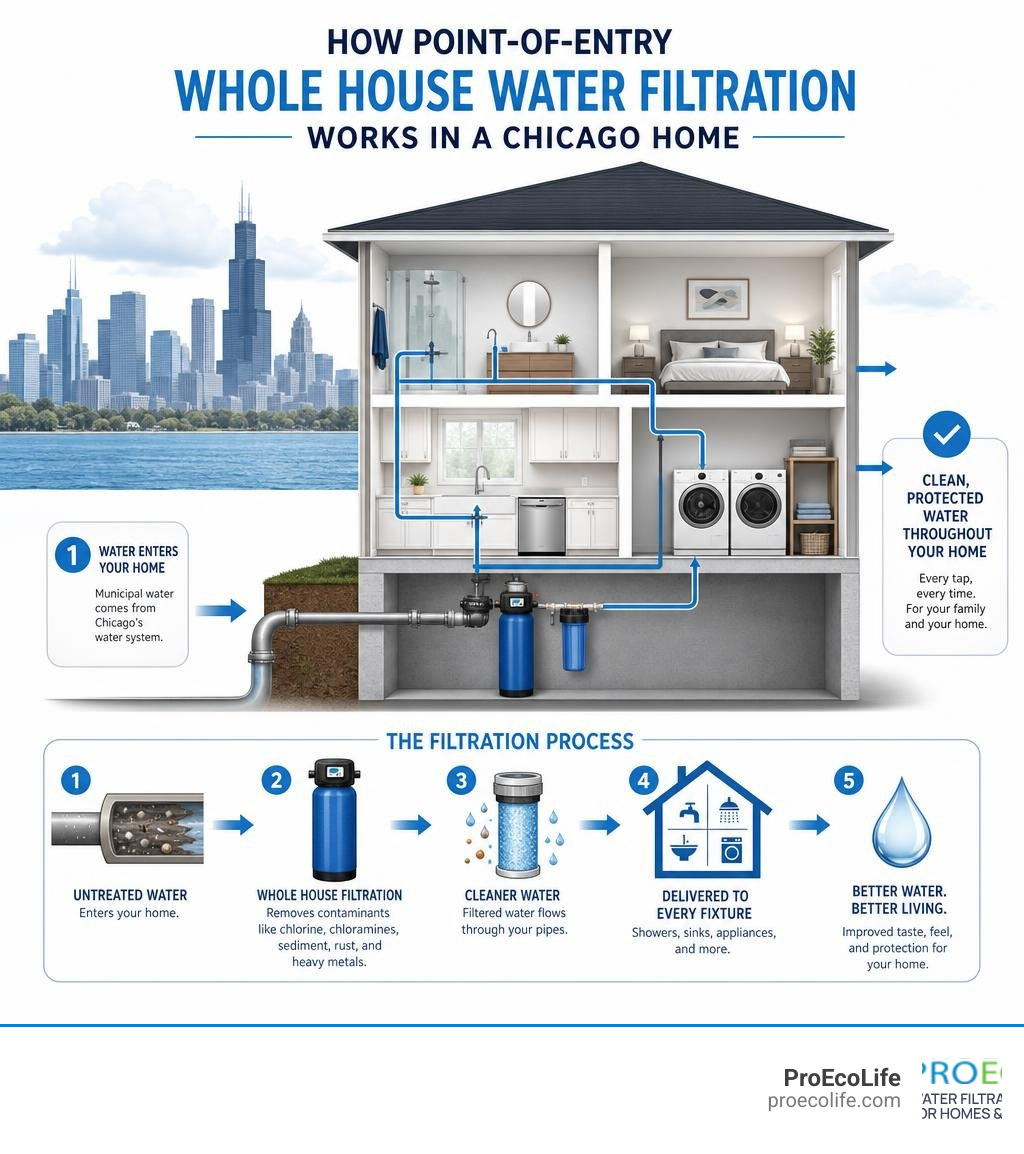
What is a Whole House Water Filter and How Does It Work?
To understand how all house water filtration systems work, it helps to think of them as a protective shield for your home. Unlike pitcher filters or under-sink units, which only treat water at a single faucet (point-of-use), a whole house system is a point-of-entry (POE) solution. It intercepts municipal or well water the moment it crosses your property line, ensuring that every shower, washing machine, dishwasher, and faucet receives clean, conditioned water.
But how does this process actually take place? A premium system does not rely on a single filter. Instead, it utilizes a multi-stage approach, where each stage is engineered to target specific types of impurities.
Stage 1: The Sediment Pre-Filter
The first line of defense is the sediment pre-filter. As water travels from Lake Michigan through miles of city mains, it picks up physical debris. This includes fine sand, silt, clay, and rust particles flaking off aging iron pipes. The sediment filter acts like a fine net, catching these physical particles (often down to 5 microns, which is smaller than a red blood cell).
By capturing this debris early, the pre-filter prevents clogging and extends the lifespan of the more delicate filtration media downstream. It also protects your household appliances, such as your water heater and washing machine, from abrasive sediment wear.
Stage 2: Activated Carbon Filtration
Once the physical sediment is removed, the water moves into the main filtration tank, which typically contains high-grade activated carbon. Carbon is incredibly porous; a single gram of activated carbon has a surface area of over 3,000 square meters.
As water passes through this media, chemical contaminants stick to the carbon pores in a process called adsorption. This stage is highly effective at reducing:
- Chlorine and chloramines (the chemical disinfectants used by municipal water treatment plants)
- Volatile Organic Compounds (VOCs)
- Industrial solvents, pesticides, and herbicides
- Unpleasant tastes and musty odors
For municipal water, this is where the magic happens. It is the reason why many customers report that their water no longer smells like a backyard swimming pool when they turn on the shower.
Stage 3: Kinetic Degradation Fluxion (KDF) Media
To elevate performance, advanced systems incorporate KDF media—a high-purity copper-zinc formulation. KDF utilizes a basic chemical process known as redox (oxidation-reduction) to transfer electrons between contaminants.
This reaction converts free chlorine into harmless, water-soluble chloride ions. Additionally, KDF is highly effective at reducing water-soluble heavy metals (such as lead, mercury, and nickel) and creates an environment that is bacteriostatic, meaning it naturally inhibits the growth of bacteria, algae, and fungi within the filter bed itself.
Stage 4: Post-Filtration and Specialized Care
Depending on your home’s needs, the water may pass through a final post-filter to catch any remaining microscopic particles, or move through specialized treatment tanks. For instance, our Whole House Filtration systems are designed to deliver consistent, clean water throughout your home, while our specialized Shower Filter System provides an extra layer of protection for your skin and hair by removing harsh chemicals right at the showerhead.
To learn more about the engineering behind these systems, you can read more info about whole house filtration to see how different stages work in harmony to protect your household plumbing.
Need Clean, Safe Water at Home?
Get a free water test at your home or business. We install and service whole-house filtration and PEL75 reverse osmosis systems across Chicagoland. We also take select projects in Wisconsin and Indiana.
Book a Free Water TestCall (312) 889-8888Key Differences: City Water vs. Well Water Systems in the Chicago Area
When selecting an all house water filtration system, your water source dictates the type of technology you need. City water and well water present entirely different chemical profiles, which means a system designed for a home in the city may not perform well on a property relying on a private well.
Municipal (City) Water: Dealing with Disinfectants and Infrastructure
If your water comes from a municipal system—whether you are directly in Chicago or in nearby suburbs like Skokie, Evanston, or Niles—your water has already been treated at a municipal plant. The primary challenges here are not bacteria or living pathogens, but rather the chemical disinfectants added during treatment and the contaminants picked up during transit.
Municipalities use chlorine or chloramines (a combination of chlorine and ammonia) to keep water safe from bacteria as it travels through the pipe network. While necessary for public health, these chemicals emit a strong chemical odor, dry out skin and hair, and can degrade rubber seals in plumbing fixtures. Furthermore, as municipal water travels through miles of older iron and lead service lines, it can pick up heavy metals and rust.
City water systems focus heavily on:
- High-capacity catalytic carbon to break down stubborn chloramines
- KDF media to target heavy metals like lead
- Sediment filtration to capture rust flakes from aging city mains
Private Well Water: Overcoming Nature’s Chemistry
Approximately 15% of the U.S. population relies on private wells. In the outer Northwest suburbs of the Chicago area, many homes draw water from private wells tapping into deep underground aquifers. Because well water bypasses municipal treatment, it is highly susceptible to natural geological contaminants and local agricultural runoff.
Well water challenges typically include:
- Excessive Hardness: Well water in Northern Illinois is notoriously hard, rich in calcium and magnesium that create thick white scale on fixtures.
- Iron and Manganese: These minerals cause orange, brown, or black staining in toilets, sinks, and laundry, and can give water a metallic taste.
- Hydrogen Sulfide: This gas produces a highly objectionable “rotten egg” odor.
- Microbiological Risks: Private wells are vulnerable to bacterial contamination from heavy rainfall or agricultural runoff.
For these homes, a standard carbon filter is not enough. Well water requires specialized Well Water Conditioning to oxidize and filter out iron, manganese, and sulfur. Additionally, incorporating a UV purification system is highly recommended as a physical barrier to sterilize up to 99.8% of bacteria, viruses, and cysts without adding chemicals.
Understanding these differences is key to choosing the right setup. For a deeper look at how various household filters target these distinct water profiles, explore more info about different types of water filters.
Need Clean, Safe Water at Home?
Get a free water test at your home or business. We install and service whole-house filtration and PEL75 reverse osmosis systems across Chicagoland. We also take select projects in Wisconsin and Indiana.
Book a Free Water TestCall (312) 889-8888Choosing the Best All House Water Filtration Systems for Chicago Homes
Selecting the right system for a Chicago-area home requires a localized approach. Our region’s unique combination of historic architecture, local industrial history, and Lake Michigan water chemistry means that off-the-shelf retail systems often fall short.
1. The Lead Challenge in Chicago’s Historic Neighborhoods
Chicago has a well-documented history with lead service lines. In fact, the city mandated the use of lead pipes for water service lines connecting homes to the city mains all the way up until 1986. If your home in Norwood Park, Edison Park, or Jefferson Park was built before this time, there is a very high probability that water passes through lead before reaching your tap.
While municipal treatment plants add corrosion inhibitors to prevent lead from leaching into the water, construction, water main repairs, and temperature fluctuations can disrupt this protective coating. When choosing all house water filtration systems, ensuring the system includes media capable of reducing heavy metals is a critical safety consideration. For a comprehensive strategy on managing this issue, read our guide on how to choose the best lead water filter in Chicago.
2. Flow Rate and Water Pressure
One of the most common mistakes homeowners make is choosing a system that cannot keep up with their household’s water demand. Water flow is measured in Gallons Per Minute (GPM). If a system’s flow rate is too low, you will experience a noticeable drop in water pressure when multiple fixtures are used simultaneously—such as running the washing machine while someone is taking a shower.
- 1 to 3 Bathrooms: Requires a system with a flow rate of at least 9 GPM.
- 4 to 6 Bathrooms: Requires a system delivering 12 to 15 GPM.
- Large Estates / Commercial: May require specialized, high-capacity Commercial Water Filtration Systems designed for continuous, high-volume flow.
Our systems are engineered with high-flow control valves and advanced media beds to ensure that your household maintains optimal water pressure, even during peak usage hours.
3. The Importance of Professional Installation and Testing
Water chemistry is complex. Before purchasing any equipment, it is essential to know exactly what is in your water. A professional water test will identify the precise levels of hardness, chlorine, heavy metals, and total dissolved solids in your supply.
Because whole house systems must be spliced directly into your home’s main water line—usually near the water meter or pressure tank—professional installation is highly recommended. Working with a licensed professional ensures that the system is positioned correctly, utilizes proper bypass valves for easy maintenance, and complies with local plumbing codes in suburbs like Park Ridge, Niles, and Des Plaines.
Whole House Filtration vs. Reverse Osmosis: Which Do You Need?
A common point of confusion for homeowners is the difference between whole house filtration and Reverse Osmosis (RO) systems. While both improve water quality, they utilize different technologies and serve entirely different purposes.
Point-of-Entry (Whole House) vs. Point-of-Use (Reverse Osmosis)
Whole house filtration is a Point-of-Entry (POE) system. Its primary job is to act as a broad gatekeeper, removing chlorine, sediment, rust, and chemical odors from all the water entering your home. This protects your skin in the shower, prevents chlorine vapors from affecting your indoor air quality, and keeps sediment from damaging your pipes and appliances. However, whole house carbon systems do not remove dissolved inorganic minerals or microscopic dissolved solids.
Reverse Osmosis is typically a Point-of-Use (POU) system, installed under the kitchen sink or connected to your refrigerator’s ice maker. RO systems use a semi-permeable membrane to force water molecules through microscopic pores, leaving behind up to 99% of all dissolved solids, including fluoride, nitrates, arsenic, sodium, and heavy metals.
To achieve the ultimate water quality, many homeowners pair these two technologies. They install a whole house system to protect the entire home’s plumbing and showers, and our proprietary PEL75 9-Stage RO System at the kitchen sink to provide ultra-pure, crystal-clear water for drinking and cooking.
To help you decide which setup fits your household, explore our detailed guide on how to choose a water filter.
Comparison: Whole House Filtration vs. Reverse Osmosis
| Feature | Whole House Filtration (POE) | Reverse Osmosis (PEL75 9-Stage) |
|---|---|---|
| Primary Installation | Main water line (basement/utility closet) | Under the kitchen sink / Point-of-use |
| Water Treated | 100% of water entering the home | Drinking and cooking water only |
| Protects Plumbing & Appliances? | Yes, prevents sediment and chemical wear | No, only treats the designated faucet |
| Removes Dissolved Minerals? | No, retains natural minerals | Yes, removes dissolved solids and minerals |
| Reduces Lead & Heavy Metals? | Yes, via KDF/specialty media | Yes, highly efficient membrane reduction |
| Flow Rate | High (9 to 20+ GPM) | Low (designed for glass-by-glass use) |
Frequently Asked Questions About Whole Home Water Treatment
How Do All House Water Filtration Systems Affect Home Water Pressure?
A common concern is whether installing a whole-house system will cause your showers to lose their pressure. The short answer is: if the system is sized correctly, many customers notice no drop in water pressure whatsoever.
Pressure drops typically occur when a system’s GPM rating is too low for the home, or if the filters have become clogged with sediment due to neglected maintenance. By choosing a system designed for your home’s size and ensuring professional installation, your water flow will remain strong and consistent. For more details on system sizing and pressure management, read about our high-flow Whole House Filtration systems.
What Contaminants Do All House Water Filtration Systems Typically Remove?
Our Whole House Filtration systems are designed to tackle a wide array of impurities commonly found in both Lake Michigan municipal water and local suburban wells. These include:
- Chlorine and chloramines (reducing that distinct chemical taste and smell)
- Rust, sediment, silt, and clay particles
- Volatile Organic Compounds (VOCs) and industrial chemical residues
- Heavy metals like lead and mercury (via specialized KDF media)
- Hydrogen sulfide (the source of rotten egg odors in well water)
To see real-world examples of how these systems clean up regional water supplies, check out our resource on The Best Whole House Water Filtration Systems in Chicago.
How Often Do Whole House Filters Require Maintenance and Replacement?
While whole house systems are highly automated, they do require periodic maintenance to perform at their best:
- Sediment Pre-Filters: Typically need to be replaced every 6 to 9 months, depending on the amount of physical debris in your incoming water.
- Main Carbon Media: High-capacity carbon tanks are incredibly long-lasting, often performing effectively for up to 1,000,000 gallons or up to 10 years before requiring media replacement.
- UV Lamps (if installed): Require annual replacement to maintain their sterilizing power, as the UV output naturally diminishes over time.
To keep your system running at peak performance without any guesswork, we recommend utilizing our expert water filter installation services to set up a regular maintenance schedule tailored to your local water quality.
Conclusion
Your home’s water quality is too important to leave to chance. Whether you are dealing with the aging lead service lines of older Chicago neighborhoods or the high mineral hardness of the Northwest suburbs, installing a whole house system is a proactive step toward protecting your family’s health, your skin, and your home’s plumbing infrastructure.
At ProEcoLife, we have been proud of our deep Chicago roots since 2014. Founded by Karol Dolega, our mission has always been to provide local homeowners with the highest standard of water filtration technology. We understand the unique challenges of Lake Michigan water and suburban well systems, serving communities across Chicago’s Northwest Side—including Norwood Park, Edison Park, and Jefferson Park—as well as surrounding suburbs like Park Ridge, Niles, Des Plaines, Skokie, Glenview, Arlington Heights, and Morton Grove.
If you are ready to transition your home to cleaner, healthier water, explore our premium Whole House Filtration System options.
Contact ProEcoLife today to schedule a comprehensive water test at (312) 889-8888 or visit us at proecolife.com.