

Why Chicago Aquarium Owners Are Switching to Reverse Osmosis Water
Reverse osmosis water for aquariums is one of the most effective ways to give your fish, coral, and plants the clean, stable environment they need to thrive — especially here in Chicago, where Lake Michigan source water arrives at your tap carrying chloramines, phosphates, and dissolved minerals that your aquatic life cannot tolerate.
Quick answer: Here is what you need to know right away:
- RO water is tap water forced through a semi-permeable membrane, removing 95–99% of dissolved solids, heavy metals, chlorine, chloramines, and phosphates
- Saltwater and reef tanks require RO/DI (with a deionization stage) to reach 0 TDS — non-negotiable for sensitive coral
- Freshwater tanks benefit from RO water too, but the purified water must be remineralized before fish are added
- Chicago tap water contains chloramines (not just chlorine), silicates, and — in older homes in neighborhoods like Norwood Park or Edison Park — lead from aging pipes, all of which standard conditioners cannot fully remove
- Never add pure, untreated RO water directly to a tank — it lacks minerals and can cause fatal osmotic shock in fish
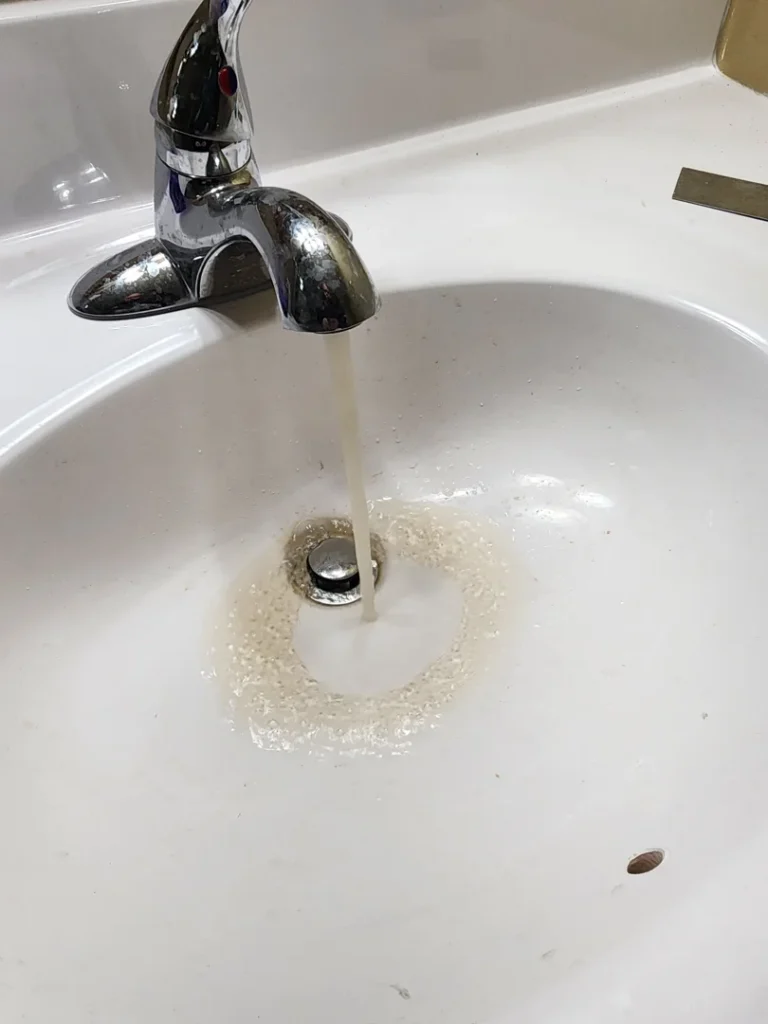
If you have ever battled persistent brown algae, seen fish behave strangely after a water change, or struggled to keep sensitive species alive, your tap water is almost certainly the culprit. Chicago’s water is treated heavily with chloramines, which are far more stubborn than standard chlorine and require specialized filtration to break down. Add the hard water common across Northwest suburbs like Park Ridge, Niles, and Des Plaines — loaded with calcium and magnesium — and your aquarium chemistry becomes difficult to control without a proper RO system.
This guide walks you through everything: how RO filtration works, which tank types need it most, how to remineralize and prepare your water safely, and how to size and maintain your system for the long term.
Common reverse osmosis water for aquarium vocab:
What is Reverse Osmosis Water for Aquarium Use?
At its core, reverse osmosis (RO) is a highly sophisticated physical filtration process. Instead of relying on chemical additives to neutralize toxins, an RO system uses water pressure to force tap water through a semi-permeable membrane. This membrane features microscopic pores measuring approximately 0.0001 microns. To put that in perspective, a single strand of human hair is about 75 microns wide.

Because these pores are so microscopic, only pure water molecules (H₂O) can pass through. Dissolved salts, heavy metals, organic pollutants, and chemical disinfectants are physically left behind and washed away. You can learn more about this physical separation process in our guide on how does reverse osmosis work?.
For aquarium hobbyists, this level of filtration is a game-changer. Standard tap water is a chemical cocktail. While municipal water treatment facilities make water safe for human consumption, they leave behind trace elements that can be highly toxic to delicate aquatic life.
Furthermore, Chicago’s aging infrastructure presents unique challenges. Many older homes on the Northwest Side, including areas like Jefferson Park, still have lead service lines. While these heavy metals may be kept within legal limits for human drinking water, even minor traces of lead or copper can be dangerous to sensitive invertebrates like dwarf shrimp or marine corals.
Why Tap Water Fails and Why You Need Reverse Osmosis Water for Aquarium Setups
Relying solely on conditioned tap water is like playing Russian roulette with your aquarium’s ecosystem. Standard tap water conditioners are designed to neutralize chlorine and chloramine. However, they do not physically remove these substances; they merely bind them into less harmful chemical states. More importantly, standard conditioners do absolutely nothing to remove other dissolved solids.
Lake Michigan water is naturally rich in silicates and phosphates. When you use untreated tap water for your aquarium, these nutrients build up over time with every water change and top-off. This accumulation can lead to stubborn brown diatom and green hair algae blooms that ruin the aesthetic of your tank and choke out live plants.
By upgrading to a dedicated reverse osmosis system, you strip many of these algae-promoting nutrients out of the equation. You start with a true “blank slate”—pure, predictable water that you can customize to the exact biological requirements of your specific aquatic species.
The Power of Multi-Stage RO Filtration
A single RO membrane cannot do the job alone. If you ran raw Chicago tap water directly into a delicate thin-film composite (TFC) membrane, physical particulates like rust and sand from municipal pipes would clog it quickly, while chlorine can chemically damage it.
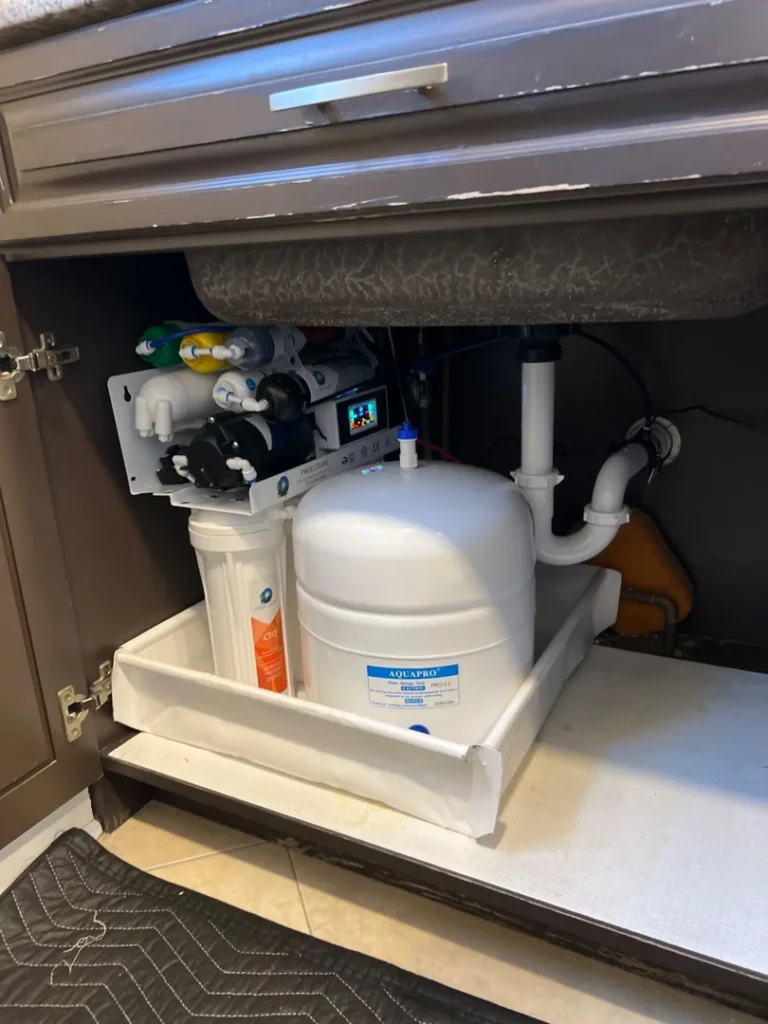
This is why modern water purification relies on multi-stage filtration. A standard system utilizes three to four stages:
- Sediment Filter: Captures physical debris, silt, and sand.
- Carbon Block Filter: Absorbs chlorine, organic contaminants, and odor-causing chemicals to protect the membrane.
- RO Membrane: The heart of the system, rejecting up to 98% of all Total Dissolved Solids (TDS), heavy metals, and lead.
- Deionization (DI) Stage (Optional but common for reef tanks): Uses specialized ion-exchange resins to catch the final 1–2% of trace minerals, bringing the water to a perfect 0 TDS.
For those looking for a higher level of purification for Chicago-area tap water, our proprietary PEL75 9-Stage RO System takes this process to the next level, utilizing advanced filtration phases designed to reduce the contaminants that commonly show up in Lake Michigan source water and older local plumbing. For a deeper look at how these stages protect your home and your hobby, explore our in-depth guide to reverse osmosis systems.
Need Clean, Safe Water at Home?
Get a free water test at your home or business. We install and service whole-house filtration and PEL75 reverse osmosis systems across Chicagoland. We also take select projects in Wisconsin and Indiana.
Book a Free Water TestCall (312) 889-8888The Benefits of Multi-Stage RO Systems for Different Tank Types
Different aquatic environments have vastly different chemical requirements. Whether you are keeping a high-end saltwater reef or a delicate freshwater aquascape, starting with RO water provides unparalleled benefits.
Saltwater and Reef Aquariums
In the marine hobby, using reverse osmosis water for aquariums is not just a recommendation; it is an absolute necessity. Corals and marine invertebrates are incredibly sensitive to copper toxicity, which can leach from household plumbing.
Furthermore, marine salt mixes are scientifically formulated to contain the precise ratio of calcium, magnesium, and trace elements found in natural seawater. If you mix these synthetic salts with tap water, you are adding those synthetic minerals on top of whatever random minerals are already present in your tap, leading to dangerously high hardness levels and chemical precipitation.
Freshwater Planted and Aquascaped Tanks
For freshwater enthusiasts, RO water allows you to breed highly sensitive species like Crystal Red Shrimp or wild-caught Discus, which require soft, acidic water. Because pure RO water has zero hardness, you can use natural botanicals like Indian almond leaves or peat moss to safely lower the pH without fighting the natural buffering capacity of hard municipal water.
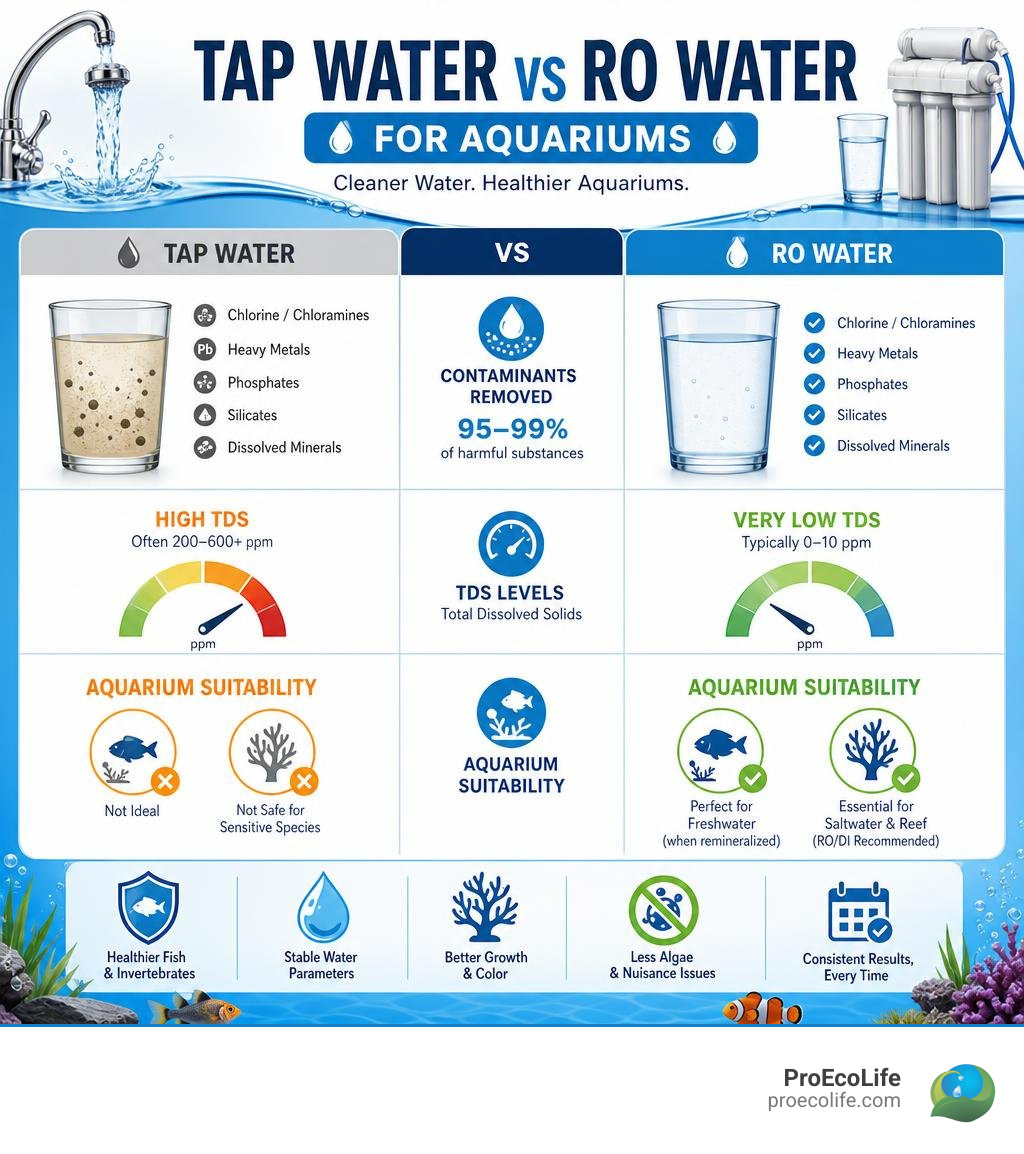
To see the stark difference between what comes out of your tap and what a multi-stage RO system produces, consider this comparison based on typical Chicago-area water profiles:
| Parameter | Typical Chicago Tap Water | Multi-Stage RO Water | Why It Matters for Aquariums |
|---|---|---|---|
| TDS (Total Dissolved Solids) | 150 – 180 ppm | < 10 ppm (0 with DI) | High TDS causes mineral buildup and limits osmotic control. |
| Lead / Heavy Metals | Trace amounts (higher in older homes) | 0 ppm | Even trace heavy metals are highly toxic to shrimp and corals. |
| Chloramines | Present (used as municipal disinfectant) | 0 ppm | Destroys beneficial biological filtration and burns fish gills. |
| Phosphates & Silicates | Moderate to High | 0 ppm | Primary fuel source for unsightly brown and green algae. |
| General Hardness (GH) | 7 – 9 dGH (Hard) | 0 dGH | Soft-water species require low GH to prevent osmotic stress. |
| Carbonate Hardness (KH) | 5 – 6 dKH | 0 dKH | Zero KH allows for precise pH customization. |
Need Clean, Safe Water at Home?
Get a free water test at your home or business. We install and service whole-house filtration and PEL75 reverse osmosis systems across Chicagoland. We also take select projects in Wisconsin and Indiana.
Book a Free Water TestCall (312) 889-8888Managing Water Chemistry: Remineralization and TDS
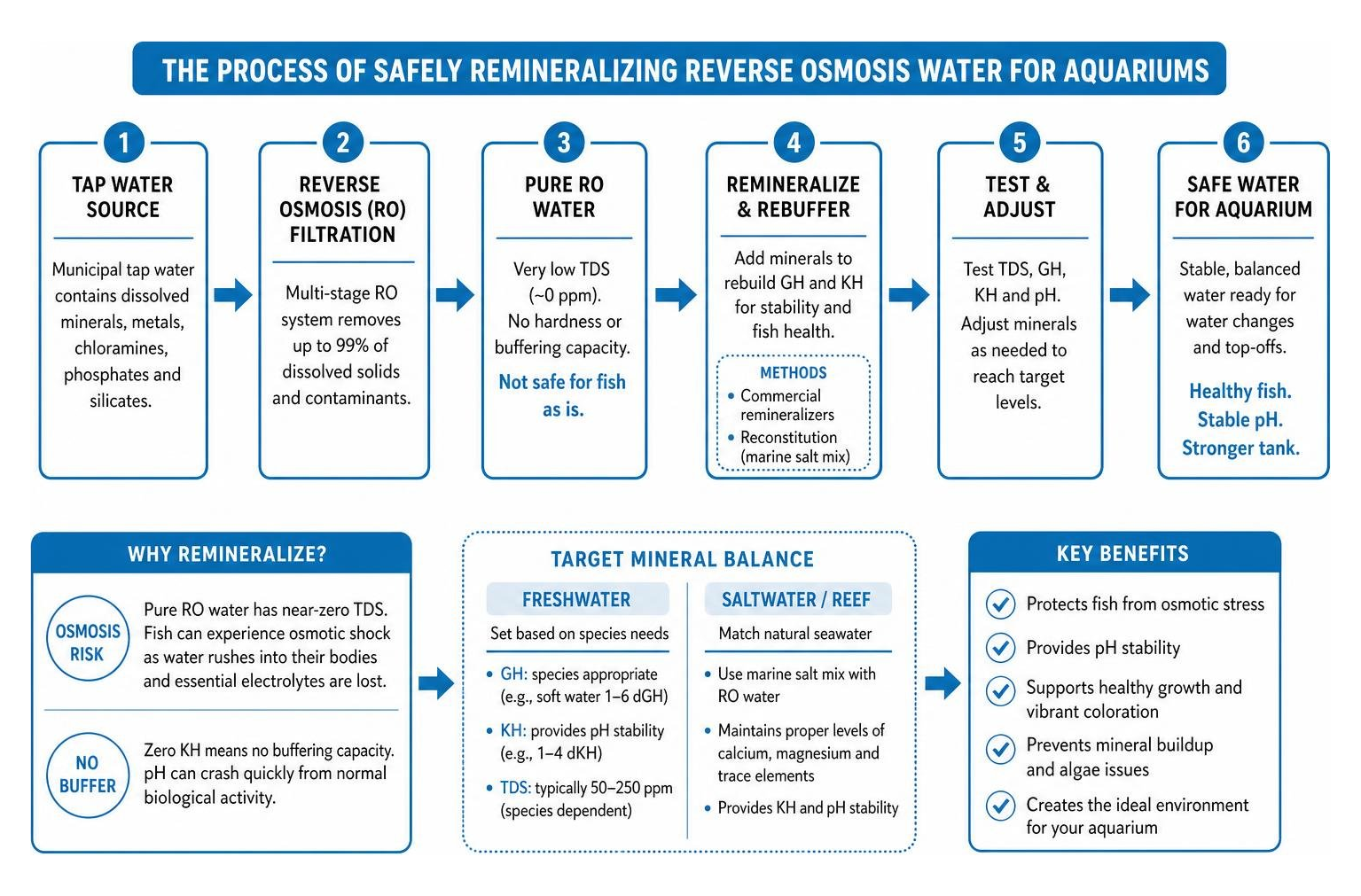
While pure RO water is the ultimate starting point, you must never add it directly to an active aquarium without proper preparation. Because it is completely stripped of minerals, pure RO water has a Total Dissolved Solids (TDS) reading of near zero. This creates an extreme osmotic gradient.
If you place fish in pure RO water, the laws of osmosis will force water rapidly into the fish’s body to balance the salt concentration, while leaching essential electrolytes out of their cells. This process, known as osmotic shock, is highly stressful and often fatal to fish.
Additionally, pure RO water has zero Carbonate Hardness (KH), meaning it has absolutely no buffering capacity. Without a buffer, even minor biological processes in your tank (like fish waste breaking down) will cause the pH to crash rapidly—sometimes dropping from a neutral 7.0 to a highly acidic 5.0 in a matter of hours.
How to Safely Prepare Reverse Osmosis Water for Aquarium Environments
To make RO water safe for your aquatic pets, you must rebuild its mineral profile. Depending on your setup, you can do this using a couple of reliable methods:
- Commercial Remineralizing Agents: For freshwater tanks, products like Seachem Equilibrium or SaltyShrimp GH/KH+ allow you to add precise amounts of calcium, magnesium, and potassium back into the water. This lets you target the exact GH and KH levels required by your fish.
- Blending with Tap Water: If you live in an area with clean tap water free of heavy metals, you can blend a calculated percentage of dechlorinated tap water back into your RO water to achieve your target TDS. However, in older Chicago neighborhoods with potential lead concerns, we highly recommend sticking to commercial remineralizers to keep your water completely toxin-free.
Always prepare your water in a separate clean, food-grade container (like a dedicated 5-gallon bucket or utility trash can) before adding it to your tank. Ensure you perform these three essential steps:
- Aeration: Run an air stone or a small pump in the mixing container for at least 15 to 30 minutes. This oxygenates the water and stabilizes the dissolved carbon dioxide levels, locking in a stable pH.
- Temperature Matching: Use an aquarium heater to match the temperature of your prepared water to within 1°C of your display tank. Adding cold water can shock your fish’s immune system, making them susceptible to diseases like Ich.
- Double-Check Parameters: Use a handheld TDS meter and liquid test kits to verify that your GH, KH, and pH match your tank parameters before executing the water change.
Sizing and Maintaining Your Aquarium RO System
Choosing the right RO system capacity is all about matching your weekly water change habits. RO systems are rated in Gallons Per Day (GPD), which indicates how much purified water the system can produce in a 24-hour period under optimal conditions. Common sizes include 50 GPD, 75 GPD, and 100 GPD.
However, keep in mind that these ratings are calculated under perfect laboratory conditions: a water temperature of 77°F and an incoming water pressure of 65 PSI.
In the real world—especially during cold Chicago winters when Lake Michigan water temperatures plummet—the water becomes denser, which can cut your system’s production rate by up to 50%. If your home’s water pressure is below 40–50 PSI, the system will run incredibly slowly and produce excessive wastewater. A properly selected RO booster pump may help improve production speed and efficiency when installed as part of a professionally configured system.
To keep your system running at peak performance and help protect your aquarium inhabitants, regular maintenance is essential. We recommend the following schedule:
- Sediment Filters: Replace every 6 months to protect the carbon blocks from clogging with physical debris.
- Carbon Block Filters: Replace every 6 to 12 months. This is critical because exhausted carbon blocks will allow chlorine to pass through, which will quickly ruin your expensive RO membrane.
- RO Membrane: Typically lasts 2 to 3 years if the pre-filters are replaced on schedule. You can monitor the membrane’s health using a TDS meter; when the rejection rate drops below 90–95%, it is time for a replacement.
- Regular Flushing: Utilizing a membrane flush valve regularly helps wash away accumulated mineral deposits, extending the lifespan of your membrane.
For homeowners in Skokie, Glenview, Arlington Heights, and Morton Grove, our professional technicians can handle the routine maintenance, sanitization, and filter replacements for you, helping your system continue to produce consistent, aquarium-ready source water year-round.
Frequently Asked Questions about Aquarium Water
Can an RO system remove chloramines from Chicago tap water?
Yes, but it requires the right type of carbon filtration. Standard municipal water treatment often uses chloramine (a bond of chlorine and ammonia) because it is more stable than chlorine. Standard carbon blocks can struggle to fully break this bond.
To safely remove chloramines, an RO system should utilize specialized catalytic carbon blocks. The catalytic carbon breaks the bond, allowing the carbon to absorb the chlorine while the RO membrane filters out the remaining ammonia. Our PEL75 9-Stage RO System is specifically engineered to handle these tough municipal disinfectants.
What is the waste water ratio and can it be reused?
The reverse osmosis process naturally produces “waste water” (or concentrate), which is used to constantly flush rejected minerals away from the membrane. Traditional residential systems can have a waste-to-pure water ratio of 4:1. However, high-efficiency membranes and systems can bring this ratio down significantly.
Because this water has simply been run through sediment and carbon filters, it is entirely chlorine-free, though it does contain a higher concentration of minerals. While you should never use this wastewater in your aquarium, many eco-conscious hobbyists reuse it for watering non-sensitive garden plants, washing cars, or household cleaning. For more details, read about how reverse osmosis turns wastewater back into pure H2O.
Do I need to remineralize RO water for all freshwater fish?
Yes, with very few exceptions (such as top-offs for evaporated water, where you only want to replace pure water because the minerals remained behind in the tank). All fish rely on dissolved minerals for proper osmoregulation—the process of maintaining fluid balance within their bodies.
While some highly adaptable species may tolerate wider ranges, failing to remineralize your RO water will eventually lead to severe osmotic stress, weakened immune systems, and pH instability. For detailed discussions on species-specific water requirements, you can check out resources like LiveAquaria, Bangalore Aqua, BRS Fresh, Care A Lot Pets, and Uncle Bill’s.
Take Control of Your Aquarium’s Water Quality Today
Creating a thriving aquatic ecosystem starts with the foundation of all life: pure, predictable water. Since 2014, our founder Karol Dolega and the entire team at ProEcoLife have been helping Chicago homeowners overcome local water challenges tied to Lake Michigan source water, hard water in the Northwest suburbs, and aging infrastructure in older city homes.
Whether you are dealing with lead concerns in Norwood Park, Edison Park, or Jefferson Park, or the hard municipal water common in Park Ridge, Niles, Des Plaines, Skokie, Glenview, Arlington Heights, and Morton Grove, we have the local experience to recommend a system that fits your water conditions and aquarium goals.
From our proprietary PEL75 9-Stage RO System to Whole House Filtration, Shower Filter System, Well Water Conditioning, and Commercial Water Filtration Systems, ProEcoLife provides professional water testing and seamless installation for Chicago-area homes and businesses. Results vary by water source and plumbing conditions, but the right filtration setup may help you create a cleaner, more predictable starting point for your fish, plants, and corals.
Ready to give your aquarium a better clean slate? Contact ProEcoLife today to schedule a water test at (312) 889-8888 or proecolife.com.