




Why Chicago Homeowners Are Choosing a 2-Stage Whole House Filter
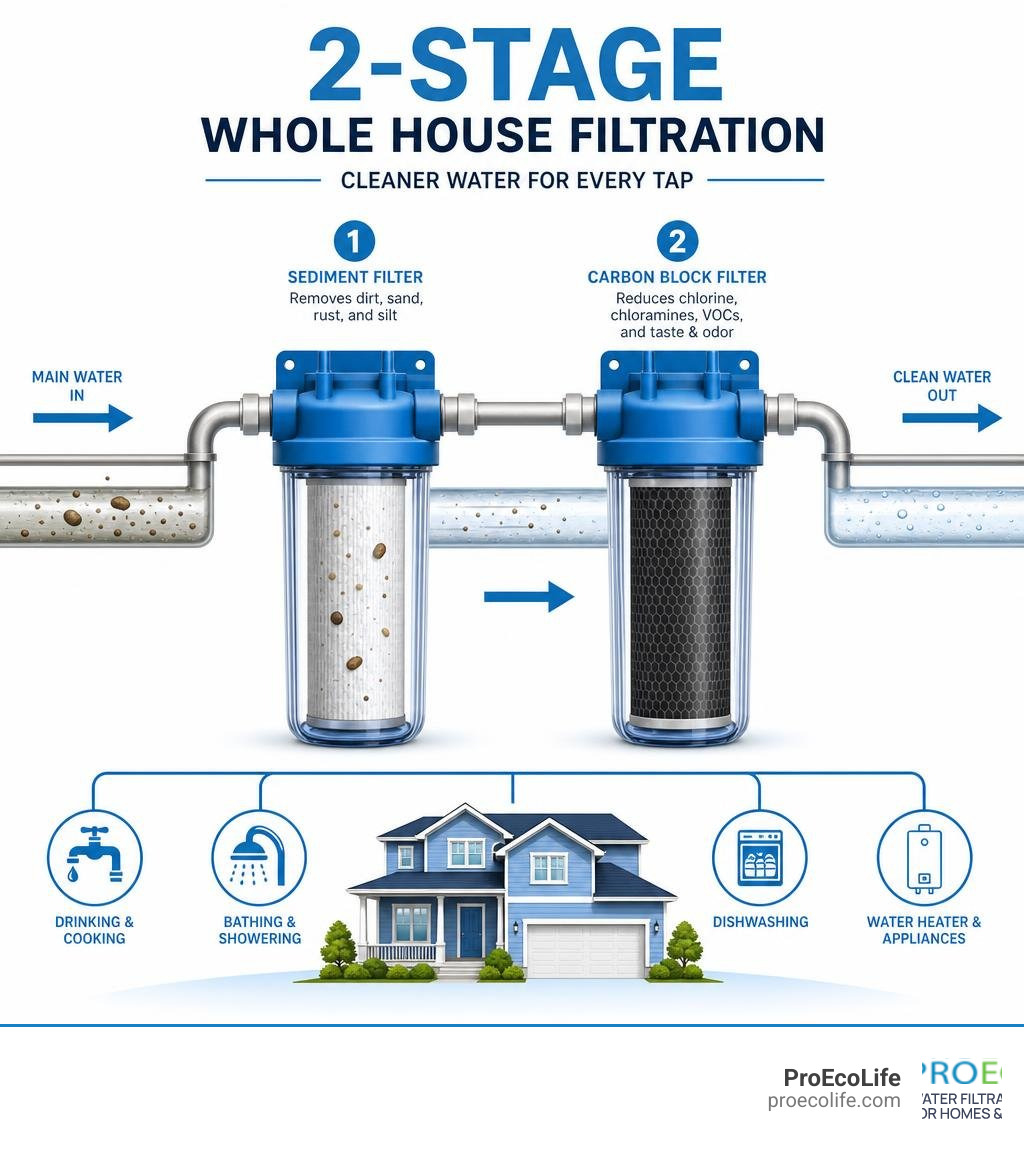
A 2-stage whole house filter is a point-of-entry water filtration system that treats all the water entering your home through two sequential filter stages — typically a sediment filter followed by a carbon block filter.
Quick answer: What does a 2-stage whole house filter do?
- Stage 1 – Sediment filter: Removes dirt, sand, rust, and silt down to 5 microns
- Stage 2 – Carbon block filter: Reduces chlorine, chloramines, VOCs, and taste and odor problems
- Result: Cleaner water from every tap, shower, and appliance in your home
If you live in Chicago or the Northwest suburbs, water quality is a real concern — not a hypothetical one. Chicago’s water comes from Lake Michigan, but by the time it travels through aging infrastructure and older home plumbing, it can pick up sediment, chlorine byproducts, and even lead from corroding pipes.
Neighborhoods like Norwood Park, Edison Park, and Jefferson Park have some of the oldest housing stock in the city. Many homes still have original plumbing that can leach contaminants into otherwise treated water.
That’s where whole-house filtration matters most. A 2-stage system is often the first step homeowners take to protect their family at every faucet — not just in the kitchen.
ProEcoLife has been helping Chicago families address these exact concerns since 2014, led by founder Karol Dolega and a team of local water experts who understand what’s actually in Chicago-area water.
This guide explains how 2-stage systems work, how they compare to other options, and what to look for when choosing one for a Chicago home.
Understanding the 2 Stage Whole House Filter
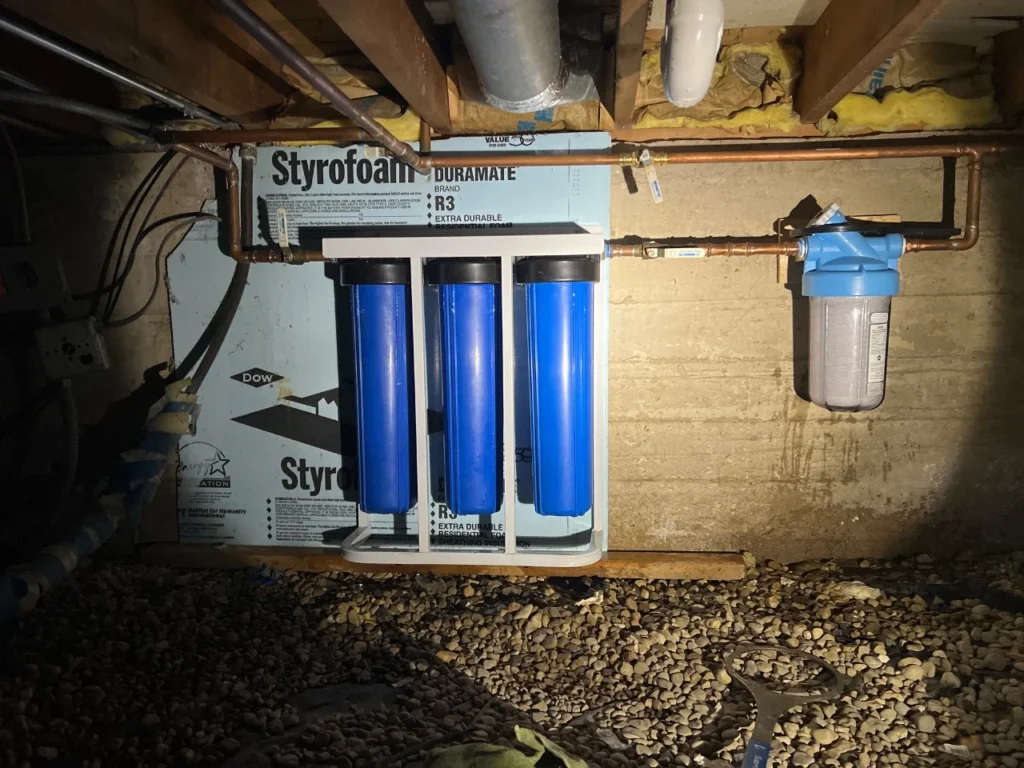
When we talk about a 2 stage whole house filter, we are referring to a point-of-entry (POE) system. Unlike point-of-use filters that screw onto a single kitchen faucet or sit in a pitcher on your counter, a POE system is professionally installed right where your main water line enters your home. This means every single drop of water—whether it is going to your master shower, your washing machine, or your kitchen sink—passes through both filtration stages first.
To explore how these POE systems serve as the foundation of home water security, you can read more about our approach to a complete Whole House Filtration System.
The primary goal of a dual-stage setup is to provide a balanced, high-flow defense against the most common aesthetic and chemical impurities found in municipal tap water. By pairing two distinct types of filter media, the system delivers clean, clear, and odor-free water without dramatically lowering your household water pressure. Many homeowners rely on these systems as a reliable baseline to protect their plumbing and appliances.
How Sediment and Carbon Block Filters Work Together
A 2-stage system is only as good as the relationship between its two cartridges. Think of them as a tag team where each partner has a highly specialized job.
In the first stage, water flows through a high-efficiency sediment pre-filter (often made of spun polypropylene or pleated polyester). This filter acts as a physical barrier, capturing suspended solids such as rust flakes from aging Chicago water mains, fine sand, and silt down to 5 microns.
If you did not have this first stage, those larger particles would quickly coat the second-stage filter, clogging its tiny pores and rendering it useless within weeks. By capturing the heavy debris first, the sediment filter protects and extends the life of the second-stage cartridge.
In the second stage, the water encounters an activated carbon block filter. Carbon block filters are made of extremely fine carbon powder bound together into a solid cartridge. This stage works through adsorption—a process where dissolved chemicals, volatile organic compounds (VOCs), chlorine, and chloramines chemically bond to the vast surface area of the carbon.
This is where the magic happens for your water’s taste and smell. It eliminates that distinct pool-like chlorine odor that many Chicagoans notice during seasonal water treatment shifts. To understand how this dual-action setup compares to other filtration methods, take a look at our comprehensive breakdown of Whole House Filtration. For those who want to separate fact from fiction regarding home water treatment, we have busted some of the most common myths in our guide on Filtry do wody – obalamy sześć mitów na ten temat.
Comparing 2-Stage Systems to Multi-Stage Filtration
While a 2 stage whole house filter is an exceptional and economical way to clean up your home’s utility water, it is important to understand what it can and cannot do compared to more advanced multi-stage systems.
A standard 2-stage system is designed to improve the taste, smell, and clarity of your water while protecting your plumbing and appliances from sediment buildup. However, because it must maintain a very high flow rate to supply your entire home simultaneously, it cannot filter down to the sub-micron levels required to remove dissolved metals like lead, or microscopic pathogens like bacteria and viruses.
For true purification of your drinking and cooking water, we recommend pairing a whole-house system with a point-of-use system like our proprietary PEL75 9-Stage RO System. Reverse osmosis systems use a semi-permeable membrane to strip away up to 99% of all dissolved solids, heavy metals, and contaminants, giving you bottled-water quality right from a dedicated kitchen tap.
For commercial applications or larger residential properties with unique structural demands, we also design custom Commercial Water Filtration Systems that scale far beyond standard residential capacities. If you are looking to treat specific areas of your daily routine, adding a targeted Shower Filter System can protect your skin and hair from residual chlorine that escapes standard municipal treatment. To see how these different options fit together to create a healthier household environment, read our guide on the complete System filtracji wody w domu.
Need Clean, Safe Water at Home?
Get a free water test at your home or business. We install and service whole-house filtration and PEL75 reverse osmosis systems across Chicagoland. We also take select projects in Wisconsin and Indiana.
Book a Free Water TestCall (312) 889-8888Sizing, Capacity, and Flow Rate Differences
Choosing the right size for your whole-house system is crucial. If the system is too small, you will experience a frustrating drop in water pressure whenever someone runs a bath while the dishwasher is on. Whole-house filters are generally classified by their cartridge dimensions: the compact 10-inch standard and the heavy-duty 20-inch “Big Blue” standard (both usually measuring 4.5 inches in diameter).
| Specification | 10-Inch 2-Stage System | 20-Inch 2-Stage System |
|---|---|---|
| Typical Flow Rate | 5 – 10 Gallons Per Minute (GPM) | 12 – 15+ Gallons Per Minute (GPM) |
| Average Filter Lifespan | 50,000 Gallons (approx. 6 months) | 100,000 Gallons (approx. 12 months) |
| Best Suited For | 1–2 Bathroom Homes / Condos | 3+ Bathroom Homes / Large Families |
| Pressure Drop | Minimal to Moderate | Extremely Low |
| Contaminant Holding Capacity | Moderate | Very High |
As the data shows, a larger 20-inch system does not just filter more water; it handles a higher volume of water simultaneously with virtually zero pressure drop. This is because the larger surface area of a 20-inch carbon block allows water to pass through more freely while still maintaining the necessary contact time with the carbon media to effectively adsorb chemicals.
Sizing a 2 stage whole house filter for Chicago Homes
When sizing a system for homes in Chicago’s historic Northwest Side neighborhoods—such as Norwood Park, Edison Park, and Jefferson Park—we must account for unique local factors. Many of these beautiful classic bungalows and multi-family homes still rely on older, narrower water service lines.
If your home has 3/4-inch or 1-inch plumbing lines, installing a system with matching 1-inch NPT inlet and outlet ports prevents the filter from becoming a bottleneck. Sizing the system correctly ensures that even during peak morning hours, when showers are running and appliances are active, your household water pressure remains strong and steady.
Capacity and Lifespan of a 2 stage whole house filter
The actual lifespan of your filter cartridges depends heavily on your household’s daily water consumption and the baseline quality of your local water supply. For instance, while a standard 10-inch system might be rated for 50,000 gallons, heavy sediment loads from local water main repairs can shorten that window.
As a general rule, sediment pre-filters should be inspected regularly and typically replaced every 6 months. Carbon block filters in a 20-inch system can easily last up to 12 months or 100,000 gallons before the carbon pores become fully saturated.
For our Polish-speaking neighbors across Niles, Des Plaines, and the surrounding areas, we have written a detailed analysis of what solutions truly work over the long term in our article, Filtry do wody w domu – jakie rozwiązanie naprawdę działa.
Need Clean, Safe Water at Home?
Get a free water test at your home or business. We install and service whole-house filtration and PEL75 reverse osmosis systems across Chicagoland. We also take select projects in Wisconsin and Indiana.
Book a Free Water TestCall (312) 889-8888Well Water vs. City Water in Chicago Suburbs
The water treatment needs of a home in the Chicago area vary dramatically depending on whether you are connected to the municipal grid or drawing from a private well.

Municipal water drawn from Lake Michigan and treated by the city is highly regulated, but it relies heavily on chlorine or chloramines to keep the water safe during transit. This leaves a chemical taste and odor by the time it reaches your tap.
In contrast, many homes in the outer Northwest suburbs—including parts of Park Ridge, Niles, and Des Plaines—rely on private or community wells. Well water does not contain municipal chlorine, but it frequently carries high concentrations of naturally occurring minerals, iron, sulfur, and fine sediment from underground aquifers.
Addressing Hardness and Iron in Suburban Wells
If you live in suburbs like Arlington Heights, Glenview, or Morton Grove and draw from a well, you are likely familiar with the white, crusty limescale buildup on your fixtures and the orange-brown staining in your sinks and toilets. This is caused by hard water minerals (calcium and magnesium) and dissolved iron.
A standard 2 stage whole house filter with a basic sediment and carbon block setup is not designed to soften hard water or remove high levels of dissolved “clear-water” iron. If your well water has high iron content, you may need a specialized iron-reduction cartridge in your second stage to help manage these specific mineral levels.
For comprehensive protection against extreme hardness and heavy iron, we highly recommend installing a dedicated Well Water Conditioning system upstream of your filtration unit. This system neutralizes hard minerals and oxidized metals before they can damage your home’s plumbing and appliances.
Protecting Municipal Water from Chlorine and Lead
For municipal water users on Lake Michigan city water, the primary goals are removing chemical disinfectants and protecting against heavy metals. While the city treats water to meet federal safety standards, the chloramines used for disinfection can corrode older lead service lines, which are still common in many Chicago area homes.
To safeguard your household from these dissolved chemical compounds and protect your family’s health, a robust whole-house carbon system is an excellent first line of defense. To learn more about how to achieve crystal-clear, safe municipal water throughout the Chicago area, read our dedicated guide on The Best Whole House Water Filtration Systems in Chicago for Crystal Clear Water.
Frequently Asked Questions about Whole House Filtration
We receive many questions from homeowners looking to improve their water quality. Below, we address some of the most common inquiries regarding system capabilities, installation, and maintenance.
Does a 2-stage system remove lead and bacteria?
A standard 2-stage sediment and carbon block system is highly effective at removing physical particles and dissolved chemicals like chlorine, but it does not reliably remove dissolved lead or biological pathogens like bacteria, viruses, and cysts.
Because lead is dissolved in the water, it requires specialized lead-selective carbon filters or a reverse osmosis membrane to be more fully addressed at the tap. This is especially important in older Chicago homes and Northwest Side neighborhoods where lead service lines and aging plumbing may still be part of the water pathway. The U.S. Environmental Protection Agency’s guidance on lead in drinking water explains why lead requires targeted treatment and careful testing.
For biological contaminants – which are a common concern for private well owners in some Northwest suburbs – you must pair your physical filtration system with a UV disinfection system to help neutralize bacteria. Results vary based on water chemistry, plumbing conditions, and the specific system selected.
How often should the cartridges be replaced?
For optimal performance, we recommend replacing your sediment pre-filter every 6 months and your carbon block filter every 12 months. However, if you notice a sudden drop in water pressure or a return of chlorine odors before that mark, it is a clear sign that your filters have reached their capacity and need to be changed.
Will this system reduce my home’s water pressure?
If sized correctly for your home’s plumbing and bathroom count, a high-quality whole-house system will not cause a noticeable drop in water pressure. Choosing a system with 1-inch ports and 20-inch high-flow cartridges ensures that water flows freely through the media, even when multiple taps are running at the same time.
Conclusion
Investing in a 2 stage whole house filter is one of the most practical and effective ways to protect your home’s plumbing, improve your daily showers, and help cleaner water flow from every tap. Whether you are dealing with municipal chlorine on Chicago’s Northwest Side or managing well water challenges in the surrounding suburbs, understanding your water is the first step toward a healthier home.
Since 2014, ProEcoLife has been Chicago’s trusted local water partner. Founded by Karol Dolega, we are dedicated to helping our community navigate local water challenges with reliable, high-performance filtration solutions.
Ready to find out exactly what is in your water and discover the right system for your home? Contact the local water experts at ProEcoLife today to schedule a water test at (312) 889-8888 or visit proecolife.com.