
Chicago Has 412,000 Lead Pipes — Here’s How to Request a Lead Test Kit Today
If you’re looking into lead testing in Chicago, here’s the short answer:
- Request a city lead test kit online at chicagowaterquality.org or by calling 311
- Collect your water samples following the included instructions; water must be unused for at least 6 hours before sampling
- Return the samples for lab analysis through the city process
- Check your service line at the city’s Service Line Inventory map at chicago.gov/water
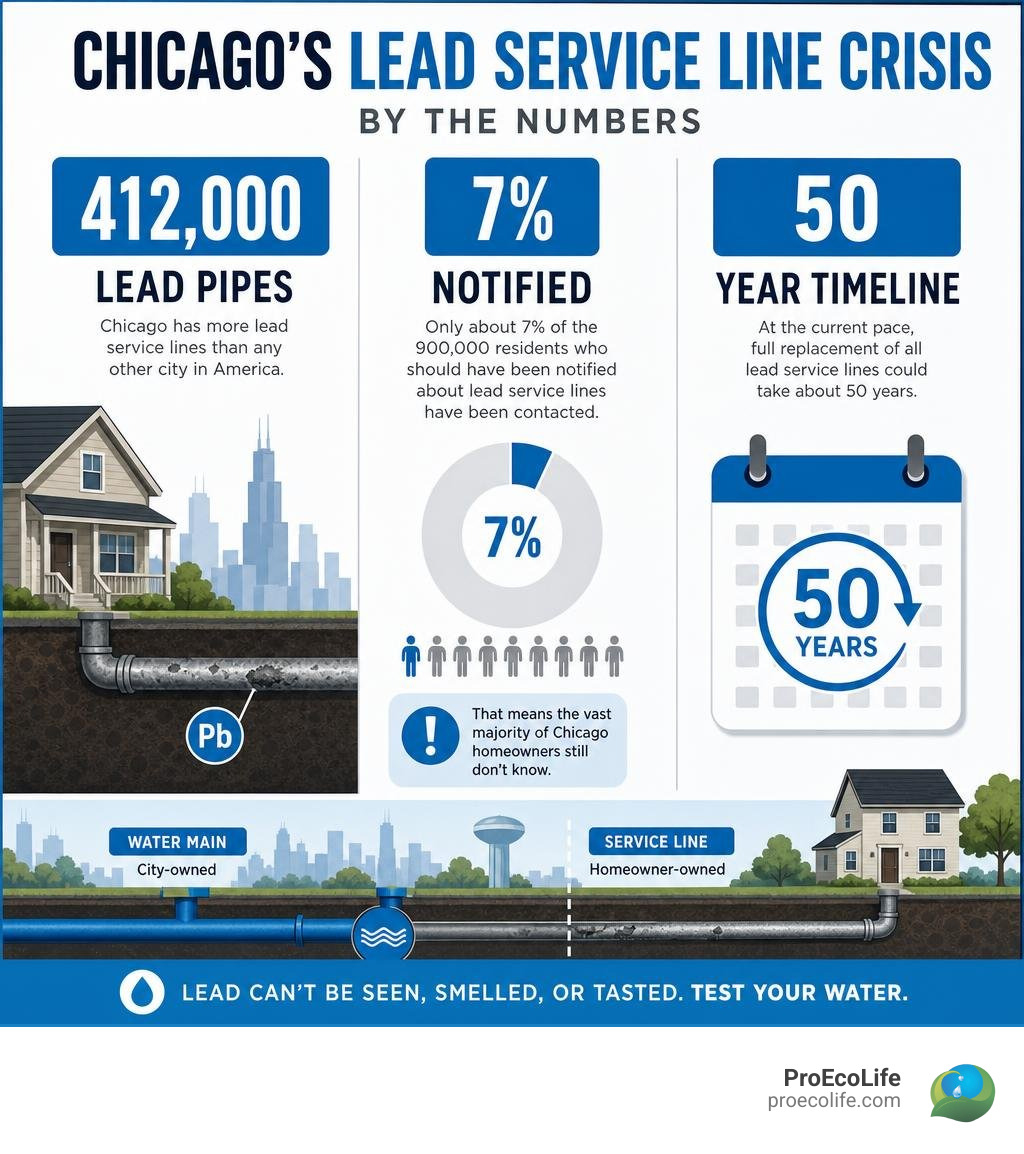
Chicago has more lead service lines than any other city in America — roughly 412,000 of them. Most of those pipes run directly into homes built before 1986, including thousands of houses and two-flats across the Northwest Side in neighborhoods like Norwood Park, Jefferson Park, and Edison Park.
Here’s the part that should concern you: the city was required by federal law to notify roughly 900,000 residents about their lead service lines by November 2024. As of July 2025, only about 7% of those residents had been notified. That means the vast majority of Chicago homeowners still have no idea whether their pipes are putting lead into their drinking water every day.
Lead can’t be seen, smelled, or tasted. The only way to know if it’s in your water is to test it.
For Chicago homeowners drawing Lake Michigan source water through aging service lines and older in-home plumbing, requesting a city lead water test kit is a practical first step.
Chicago’s Lead Pipe Crisis and the Notification Delay
To understand why a Chicago lead testing kit is so critical for your household, it helps to look at the sheer scale of the city’s infrastructure problem.
Chicago’s drinking water is sourced from Lake Michigan and is treated extensively at the city’s purification plants. When the water leaves the plant, it contains no detectable lead. However, the journey from the water main under your street into your kitchen faucet is where the danger lies.
Until the federal government banned them in 1986, Chicago building codes actually mandated the use of lead pipes for service lines—the underground pipes connecting individual homes to the city’s water mains. Because of this historical policy, Chicago now has approximately 412,000 lead service lines, the highest concentration of any municipality in the country.
Under the federal Lead and Copper Rule Revisions, Chicago was legally required to notify roughly 900,000 residents about the presence of these toxic pipes by November 2024. However, progress has been incredibly slow. By July 2025, the city had managed to notify only about 7% of those affected.
At the current pace of municipal replacement programs, completing the full replacement of all 412,000 lead service lines will take approximately 50 years. This means many local families could be waiting until the late 2070s for a permanent infrastructure fix.
This slow progress is detailed in our investigative look at Chicago’s risky water problem, which highlights the gap between public notifications and the reality of what is flowing from your tap. For a deeper look at how these pipes are distributed across our neighborhoods, you can read the reporting in Lead pipes are everywhere in Chicago. Here’s how to protect yourself. | Grist.
Need Clean, Safe Water at Home?
Get a free water test at your home or business. We install and service whole-house filtration and PEL75 reverse osmosis systems across Chicagoland. We also take select projects in Wisconsin and Indiana.
Book a Free Water TestCall (312) 889-8888How to Request a Chicago Lead Testing Kit from the City
Testing your water is the only definitive way to know if lead is leaching from your service line or home plumbing. The Chicago Department of Water Management (DWM) administers a Water Quality Study that allows residential addresses in the city to request a testing kit.
Here is the step-by-step process to request and use your kit:
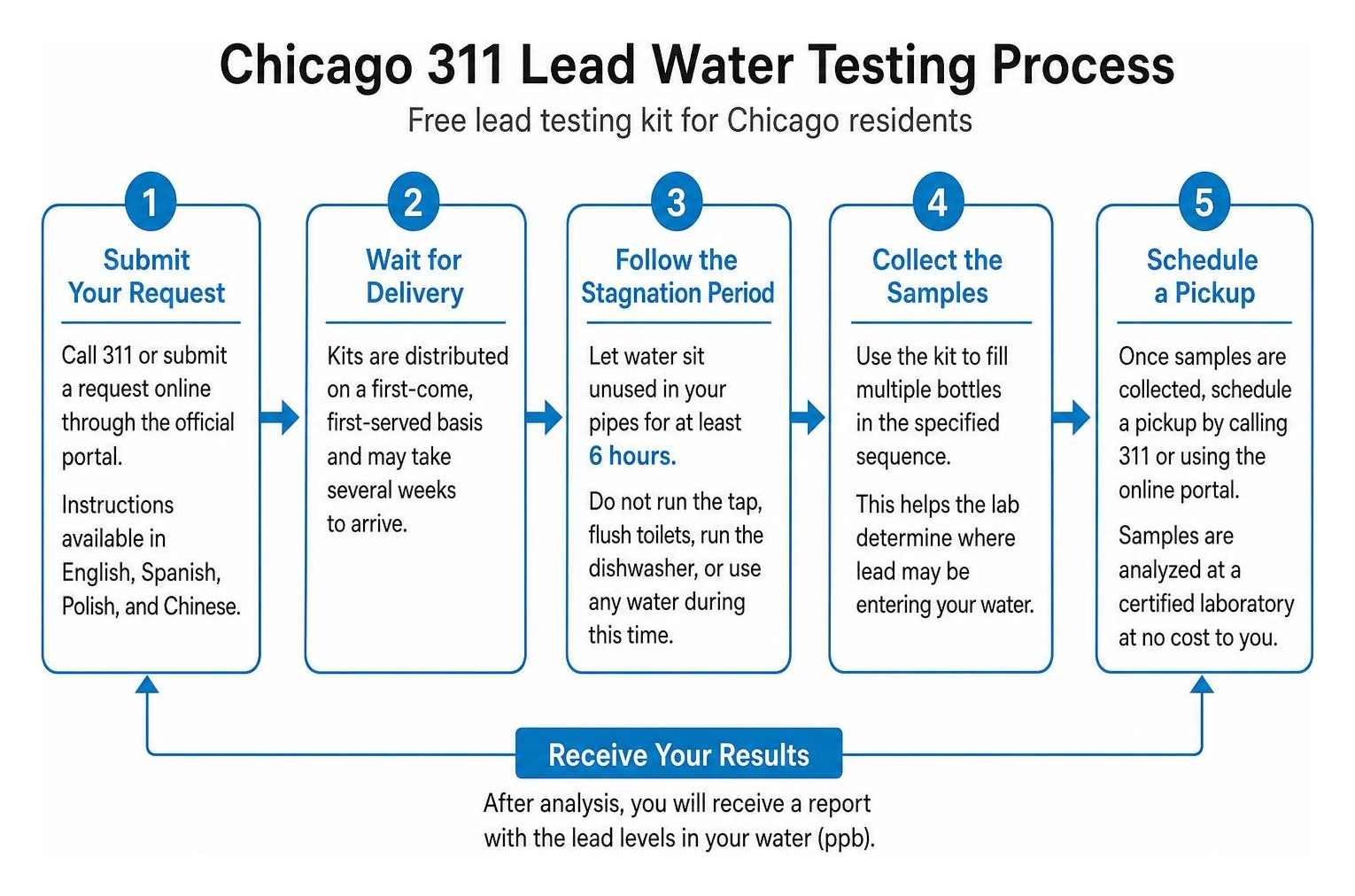
- Submit Your Request: You can order a kit by calling 311 or by submitting a request online through the official Chicago 311 portal. You can also read the city’s official guidelines on the Water Lead Test Kit – Chicago 311 page. The city provides instructions in English, Spanish, Polish, and Chinese.
- Wait for Delivery: Because of high demand across the city, kits are distributed on a first-come, first-served basis and may take several weeks to arrive at your home.
- Follow the Stagnation Period: To get an accurate reading, your water must sit completely unused in your pipes for at least 6 hours before you take the samples. Most residents find it easiest to perform the test first thing in the morning or immediately after returning home from work. Do not run the tap, flush toilets, run the dishwasher, or use any water during this 6-hour window.
- Collect the Samples: The kit contains sample bottles and clear instructions. You will typically fill multiple bottles in a specific sequence to help the lab determine whether lead is leaching from your faucet fixtures, your interior plumbing, or the main service line outside.
- Schedule a Pickup: Once your samples are collected, you can schedule a city representative to pick up the kit by calling 311 or using the online portal. The samples are then analyzed through the city’s process.
For a more complete look at your household water beyond lead — including the hard water issues common in Park Ridge, Niles, Des Plaines, Skokie, Glenview, Arlington Heights, and Morton Grove — ProEcoLife can help you Test your water and review treatment options built for local Chicago-area conditions.
Understanding Your Chicago Lead Testing Results
Once the laboratory processes your samples, you will receive a report detailing the lead levels in your water, measured in parts per billion (ppb).
The U.S. Environmental Protection Agency (EPA) has established an “action level” of 15 ppb for lead in public drinking water. However, public health organizations, including the World Health Organization and the Centers for Disease Control and Prevention (CDC), emphasize that there is no safe level of lead exposure. Even extremely low levels of lead in drinking water can accumulate in the body over time.
A recent study of Chicago homes receiving water meters showed that approximately 7.1% of tested properties had lead levels exceeding the EPA’s 15 ppb action level.
The health risks of lead exposure are particularly severe for developing bodies:
- Infants and Children: Lead exposure can cause irreversible damage to the brain and nervous system, leading to lower IQ, learning disabilities, developmental delays, and behavioral problems. Historically, the number of children with lead poisoning in Chicago has declined from 25% of those tested in the late 1990s to about 2% today—largely due to aggressive lead paint abatement—but water remains a critical exposure route that must not be ignored.
- Pregnant Individuals: Lead can cross the placental barrier, posing severe risks to the developing fetus, including premature birth and reduced fetal growth.
- Adults: Chronic exposure in adults is linked to cardiovascular issues, high blood pressure, and kidney damage.
Next Steps After Your Chicago Lead Testing Kit Confirms Lead
If your city water test results return with elevated lead levels, take action quickly to reduce your household’s exposure. While you plan for a long-term filtration or plumbing solution with a qualified professional, public health agencies commonly recommend these exposure-reduction habits:
- The Flushing Protocol: Flush your cold water tap before using it for drinking, cooking, or preparing baby formula, especially if the water has sat stagnant in your pipes for 6 hours or more. This may help draw fresher water from the city main rather than water that has been sitting in a lead service line.
- Use Only Cold Water for Consumption: Hot water can dissolve lead more readily than cold water. Do not use hot tap water for drinking, cooking, or making formula. If you need hot water, draw cold water and heat it separately.
- Maintain Faucet Aerators: Sediment and small particles can collect in faucet aerators. If you are unsure how to handle aerator maintenance, ask a qualified plumber or water professional.
- Never Boil Water to Remove Lead: Boiling water does not remove heavy metals. As water evaporates during boiling, lead can become more concentrated in the remaining water.
Need Clean, Safe Water at Home?
Get a free water test at your home or business. We install and service whole-house filtration and PEL75 reverse osmosis systems across Chicagoland. We also take select projects in Wisconsin and Indiana.
Book a Free Water TestCall (312) 889-8888Lead Service Line Replacement Programs in Chicago
The only permanent solution to lead in your drinking water is the physical removal and replacement of the lead service line. The city of Chicago offers assistance programs that may help qualifying homeowners with this work. Costs and program terms can vary, so homeowners should confirm current details directly through the city before making decisions.
The Equity Lead Service Line Replacement Program
This program provides lead service line replacement from the water main into the home for qualifying residents. To qualify for the Equity Lead Service Line Replacement Program, applicants must:
- Own and occupy the residential property, limited to single-family homes or two-flat buildings.
- Have a household income below 80% of the Area Median Income (AMI).
- Meet additional criteria, such as having children under the age of 18 living in the home or having documented elevated lead levels above 15 ppb from a city water test.
The Homeowner-Initiated Program
For homeowners who do not meet the income requirements of the Equity program but still want to replace their lead lines, the city offers the Homeowner-Initiated Program. Under this track, the homeowner works with a licensed plumbing contractor to perform the replacement, while the city coordinates applicable municipal steps and the connection to the water main.
You can find more localized information on how to navigate these municipal steps through resources like the Lead Service Line Testing & Replacement | Chicago’s 49th Ward guide.
Choosing the Right Water Filter for Lead Removal
Because lead service line replacement is a massive, decades-long undertaking, installing a high-quality water filtration system is the most practical and immediate way to protect your family. However, not all water filters are designed to remove heavy metals.
When shopping for a filter, it is vital to understand the difference between standard carbon filters and specialized heavy metal reduction systems:
- NSF/ANSI Standard 42: This certification only covers aesthetic impurities. It means the filter is certified to improve the taste and odor of your water by reducing chlorine, but it does not remove lead.
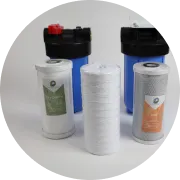
- NSF/ANSI Standard 53: This is the critical certification you must look for. A filter certified under Standard 53 has been independently tested and proven to reduce lead and other health-related contaminants to safe levels.
| Filter Type | NSF Certification | Lead Removal Effectiveness | Best Use Case |
|---|---|---|---|
| Standard Pitcher Filters | Standard 42 | Very Low (Aesthetic Only) | Basic taste and odor improvement |
| Certified Faucet Mounts | Standard 53 | Moderate (Requires frequent cartridge changes) | Small households with low water usage |
| 9-Stage Reverse Osmosis | Standard 53 & 58 | High (Removes up to 99% of heavy metals) | Comprehensive home drinking water safety |
| Whole-House Filtration | Standard 53 (Select Systems) | High (Protects all taps and appliances) | Complete household protection |
For a detailed breakdown of the best options on the market, read our comprehensive guides on How to choose the best lead water filter in Chicago: a 2026 guide and our rankings of the Heavy metal detox: best water filters for lead in 2026.
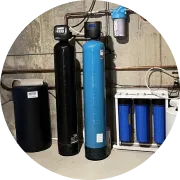
At ProEcoLife, we specialize in advanced water treatment systems designed specifically for Chicago’s unique water profile. Our proprietary PEL75 9-Stage RO System uses advanced multi-stage reverse osmosis technology to reduce lead, chromium-6, and other heavy metals, helping ensure that your drinking water is clean and safe. For families looking to protect every tap in their home, our Whole House Filtration systems provide robust, point-of-entry protection.
Frequently Asked Questions About Chicago Water Quality
How do I check if my service line is lead?
If you live in a house or a two-flat built before 1986, especially in older Northwest Side neighborhoods such as Norwood Park, Edison Park, and Jefferson Park, there is a higher chance that your service line may be made of lead. The safest starting point is to consult the city’s official Service Line Inventory Map or work with a qualified plumbing or water professional to identify the material where the service line enters your home.
You can also consult the city’s official Service Line Inventory Map. To learn how to navigate these records, see our guide on How to use the WBEZ lead pipe map to check your Chicago home.
Are there other contaminants in Chicago tap water?
While lead is the most prominent concern due to aging service lines, Chicago tap water can contain other impurities. Lake Michigan water is treated with chlorine to kill bacteria, which can react with organic matter to create disinfection byproducts. Additionally, trace amounts of Chromium-6 and Radium are occasionally detected in municipal supplies.
Furthermore, residents in Chicago’s Northwest suburbs—such as Park Ridge, Niles, Des Plaines, Skokie, Glenview, Arlington Heights, and Morton Grove—often contend with high levels of water hardness. Hard water contains elevated levels of calcium and magnesium, which can cause scale buildup in pipes, stress water heaters, and dry out skin.
To address these diverse water issues, we offer specialized solutions like our Shower Filter System, Well Water Conditioning for properties on private wells, and Commercial Water Filtration Systems for local businesses.
Can I use a refrigerator filter to remove lead?
Most standard refrigerator water filters are only certified under NSF/ANSI Standard 42. They are designed to make your ice and water taste better by removing chlorine, but they are generally not capable of filtering out heavy metals like lead. Always check the manufacturer’s documentation to verify if the filter carries the NSF/ANSI Standard 53 certification specifically for lead reduction. If it does not, do not rely on it to keep your family safe from lead exposure.
Conclusion
Protecting your home from lead contamination requires a proactive approach. While municipal programs are slowly working to replace Chicago’s 412,000 lead service lines, the 50-year timeline means that safeguarding your family’s health is ultimately in your hands today.
Since 2014, ProEcoLife—founded by Karol Dolega—has been deeply rooted in the Chicago community. We understand the local water conditions, from the historic lead pipes of Northwest Side neighborhoods like Norwood Park, Edison Park, and Jefferson Park, to the hard water challenges faced by families in Park Ridge, Niles, Des Plaines, Skokie, Glenview, Arlington Heights, and Morton Grove.
We are committed to helping our neighbors secure cleaner, safer water. Our proprietary technology, including the PEL75 9-Stage RO System and our comprehensive Whole House Filtration systems, is designed to address these specific local challenges. Many customers notice an improvement in water taste and peace of mind after upgrading their home filtration, though results vary based on local plumbing, water chemistry, and system selection.
To take the first step toward better understanding your home’s water supply, explore our Chicago Water Filter System options or visit proecolife.com to schedule a water test.