Choose a Lead Water Filtration System That Is Verified to Reduce Lead
For a Chicago home with aging plumbing, start with a whole-house system designed for your water conditions and add a certified drinking-water filter at the kitchen sink if needed. Most importantly, choose equipment independently certified for lead reduction, test your water through a laboratory, and keep up with cartridge changes.
Look for:
- NSF/ANSI 53 certification for filters that reduce lead and other health-related contaminants.
- NSF/ANSI 58 certification for reverse osmosis systems that are certified for lead reduction.
- A system sized for your home’s flow rate, water use, and maintenance budget.
- A plan to address the source, including possible lead service lines, solder, or older fixtures.
Lead cannot be seen, smelled, or tasted. The U.S. EPA states that there is no safe amount of lead in drinking water, and Chicago-area homes with older service lines or plumbing deserve extra attention. A filter can reduce exposure, but replacing lead-bearing plumbing remains the more permanent fix where it is practical.
This guide explains how whole-house and point-of-use options compare, what certifications actually mean, and how to choose a solution that may help protect the water your family drinks and cooks with.
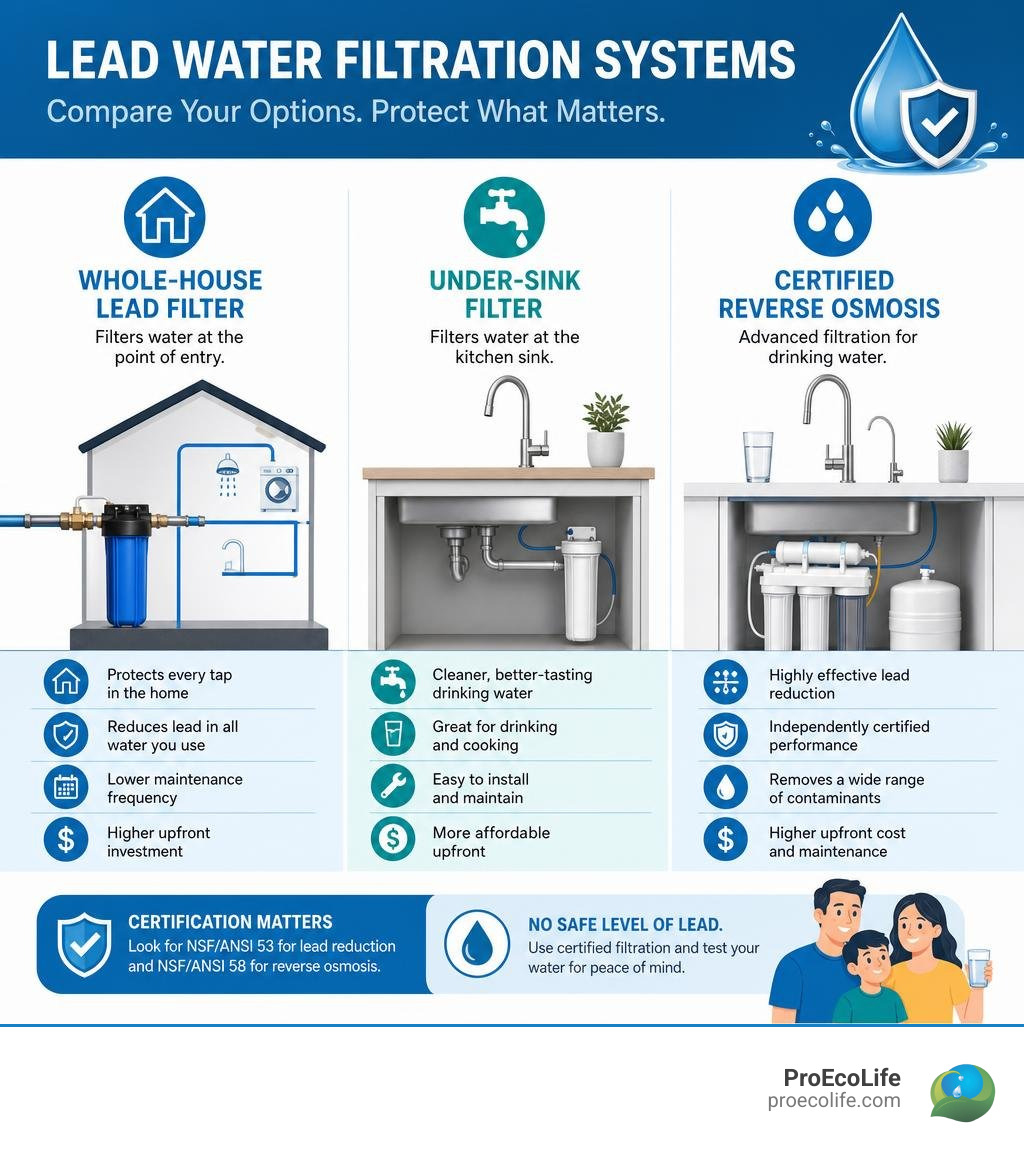
Simple guide to lead water filtration system terms:
Health Risks and Signs of Lead in Drinking Water
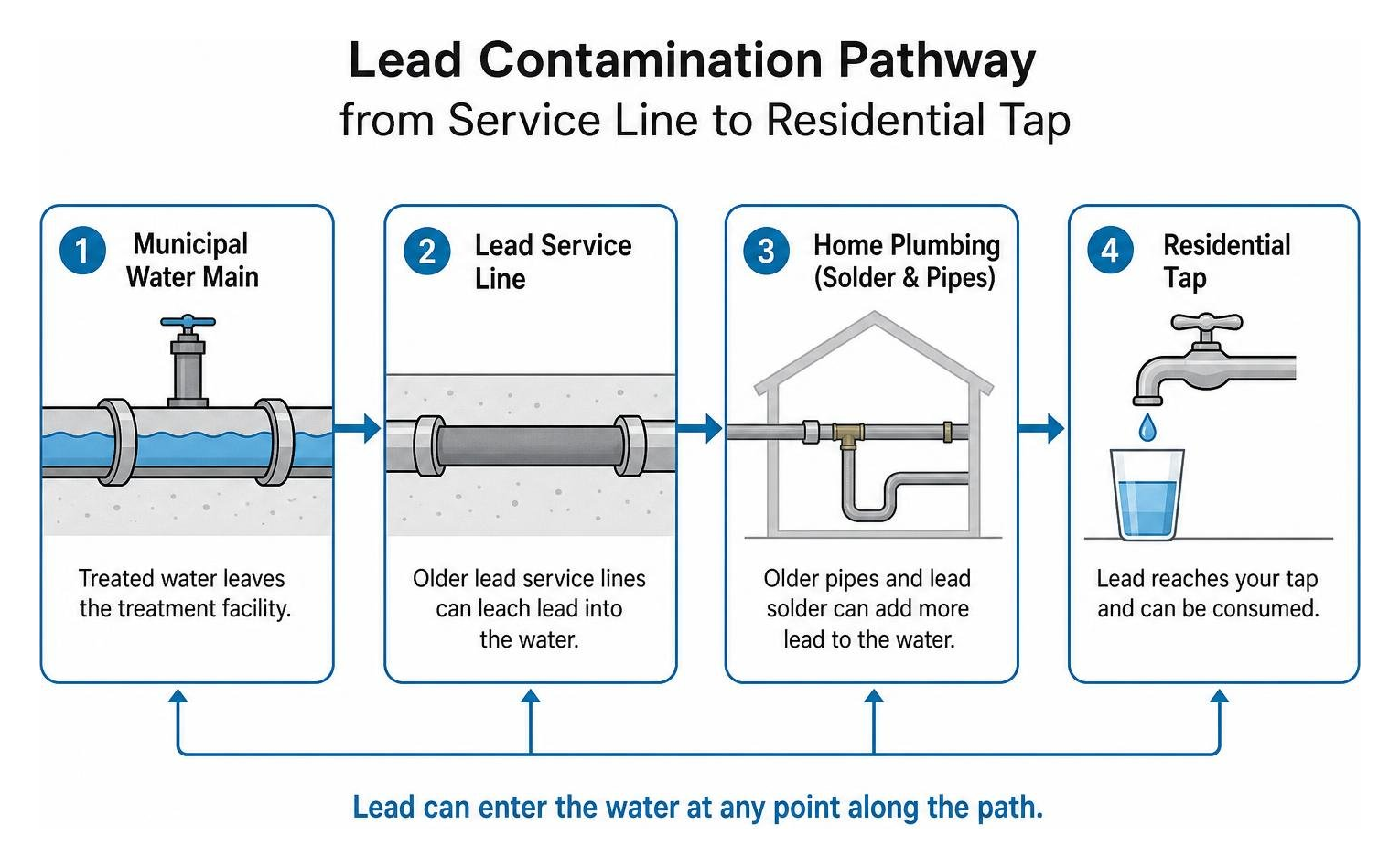
Lead is a potent heavy metal and toxic neurotoxin. When municipal water leaves modern treatment facilities, it is treated to maintain safe water guidelines. However, as that water travels through municipal utility mains, underground connector pipes, and older private plumbing, chemical reactions can cause corrosive leaching.
Unlike sediment, iron, or chlorine, dissolved lead creates zero cloudiness, produces no odd odors, and imparts no metallic flavor at typical toxic concentrations. Understanding your exposure pathways requires looking straight into the history beneath our streets and behind our walls.
Vulnerable Populations and Health Effects
According to the US EPA, there is no safe amount of lead in drinking water. Because lead bioaccumulates within bone tissue and organs over time, even trace amounts measured in parts per billion (ppb) present measurable risks.
- Infants and Young Children: Developing brains and bodies absorb lead far more rapidly than adults. Exposure during early growth phases can contribute to central nervous system damage, lowered IQ, attention disorders, and delayed developmental milestones.
- Expectant Mothers: Lead stored within maternal bones can mobilize into the bloodstream, increasing risks of premature birth, reduced fetal growth, and gestational health complications.
- Adults: Chronic low-level ingestion over decades is linked with persistent hypertension, diminished kidney filtration capability, and accelerated cardiovascular strain.
How to Detect Lead: Lab Testing vs Test Strips
Over-the-counter visual dip test strips sold in home improvement aisles are notoriously unreliable for low-level detection. They often fail to register lead concentrations below 15 ppb, completely missing subtle yet biologically hazardous amounts.
To gain an accurate evaluation of your home’s water profile, verified sampling submitted to an accredited facility is essential. Our team relies on rigorous laboratory water testing methods that evaluate both initial first-draw samples (measuring fixture-leached lead) and fully flushed lines (identifying service-pipe leaching).
Need Clean, Safe Water at Home?
Get a free water test at your home or business. We install and service whole-house filtration and PEL75 reverse osmosis systems across Chicagoland. We also take select projects in Wisconsin and Indiana.
Book a Free Water TestCall (312) 889-8888Choosing the Right Lead Water Filtration System for Your Home
Selecting an effective treatment platform depends on your home’s baseline plumbing condition, family water usage, and physical layout. Here is how standard residential filtration options compare when evaluated for lead abatement:
| Technology Type | Lead Reduction Efficiency | Typical Location | Maintenance Frequency | Target Contaminant Form |
|---|---|---|---|---|
| Multi-Stage Reverse Osmosis | Up to 99%+ | Under-Sink / Point-of-Use | Semi-Annual / Annual | Dissolved Ions & Particulate |
| Solid Carbon Block (NSF 53) | High (95–99%) | Under-Sink / Faucet | 6 to 12 Months | Dissolved & Particulate |
| Ion-Exchange Water Softener | Moderate (Low concentrations) | Point-of-Entry (Whole-Home) | Salt replenishment monthly | Cationic Dissolved Lead (Pb²⁺) |
| Thermal Distillation | 100% | Countertop Batch | Periodic scale cleaning | Total Dissolved Solids & Heavy Metals |
| Standard Sediment Cartridge | Ineffective for dissolved lead | Whole-House Pre-filter | 3 to 6 Months | Coarse particulates only |
Whole-House vs Point-of-Use Lead Water Filtration System Solutions
A complete strategy frequently leverages both entry-point and point-of-use equipment:
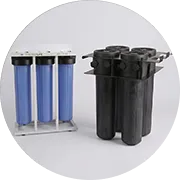
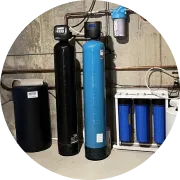
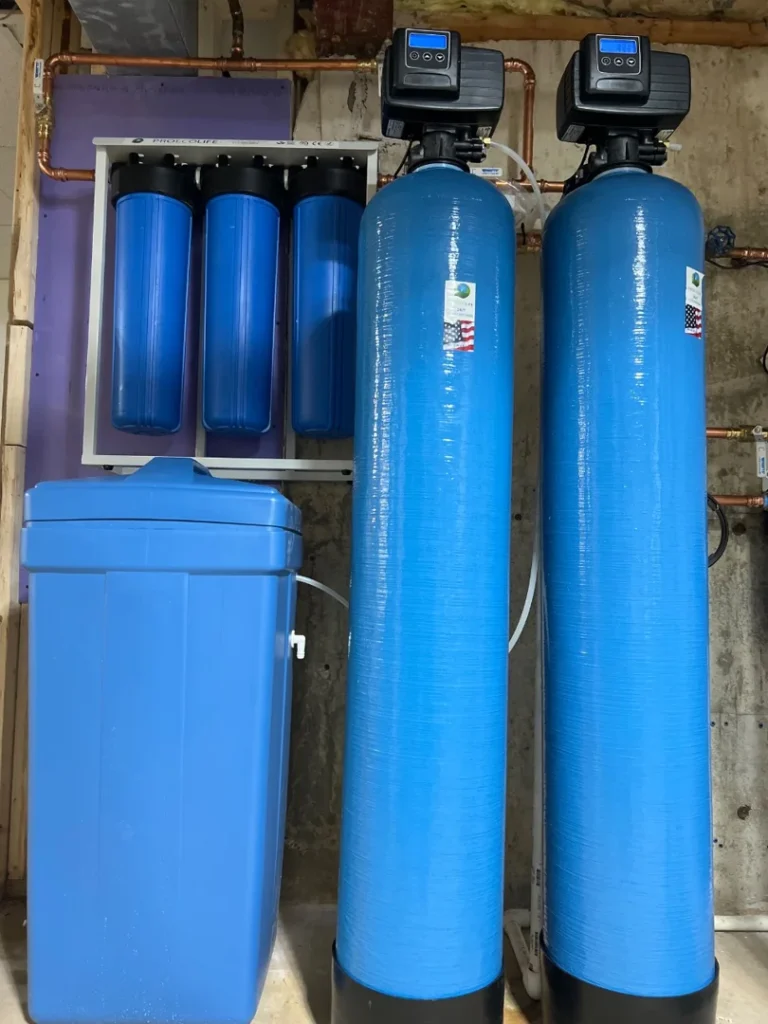
- Point-of-Entry (POE): Installing our Whole House Filtration platform at the main water supply helps stop particulate matter, heavy sediments, and chlorine before water disperses across your pipes.
- Point-of-Use (POU): Placing dedicated under-sink lead filters right where you fill cooking pots and drinking glasses provides dedicated, multi-barrier purification for maximum peace of mind.
Critical NSF Certifications for a Lead Water Filtration System
When reviewing any treatment equipment, always check for rigorous third-party certifications:
- NSF/ANSI 53: Validates that point-of-use mechanical and adsorption filters reduce health-related contaminants, specifically targeting lead below 5 ppb under laboratory conditions.
- NSF/ANSI 58: Applies specifically to reverse osmosis systems, verifying high-pressure membrane reduction of total dissolved solids and dissolved heavy metals.
- NSF/ANSI/CAN 372: Confirms that the physical materials and fittings within the filtration housing itself are certified lead-free.
Need Clean, Safe Water at Home?
Get a free water test at your home or business. We install and service whole-house filtration and PEL75 reverse osmosis systems across Chicagoland. We also take select projects in Wisconsin and Indiana.
Book a Free Water TestCall (312) 889-8888Core Treatment Technologies Compared for Lead Removal
Lead enters domestic water in two distinct forms: particulate (microscopic metal flakes from deteriorating pipe walls) and dissolved (soluble lead ions created by chemical reactions). Thorough protection requires systems capable of intercepting both forms.

Reverse Osmosis and Distillation
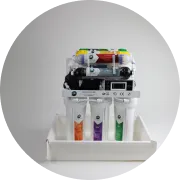
Reverse osmosis uses pressure to force water through an ultra-dense, semipermeable membrane with microscopic pores measuring roughly 0.0001 microns. Our proprietary PEL75 9-Stage RO System combines advanced membrane separation with customized pre-filtration stages to isolate dissolved ions. Homeowners seeking specialized POU purification often explore advanced reverse osmosis systems to remove lead.
Thermal distillation boils water into vapor, leaving behind heavy metals and mineral scale in the boiling chamber before condensing the steam back into purified water. While distillation removes virtually all dissolved lead, it operates slowly in small batches and requires regular mineral descaling.
Activated Carbon Blocks and Ion Exchange Softeners
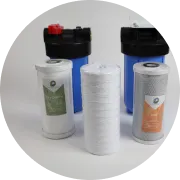
Solid extruded carbon blocks treated with specialized heavy-metal binding resins capture lead through physical filtration and chemical adsorption.
Whole-home ion-exchange softeners exchange hard minerals and dissolved divalent lead ions (Pb²⁺) for sodium ions. In suburban homes with elevated mineral hardness, a dedicated water softener can assist with whole-house pipe protection, though high-flow point-of-use filtration remains best for drinking water.
Local Infrastructure and Plumbing Considerations
Water sourced from Lake Michigan is treated thoroughly at central utility plants, but regional distribution presents unique local challenges:
Founded by Karol Dolega, ProEcoLife has operated with deep Chicago roots since 2014. We understand the specific plumbing architecture of local properties, from historic bungalows on Chicago’s Northwest Side in Norwood Park, Edison Park, and Jefferson Park to classic homes across Park Ridge, Niles, Des Plaines, Skokie, Glenview, Arlington Heights, and Morton Grove.
Many older residences in these areas were built during eras when lead service lines and 50/50 tin-lead solder were standard. Suburbs further out often encounter harder water that demands balanced treatment to keep appliances running smoothly.
Practical Steps Beyond Filtration
While a multi-stage filter provides everyday security, homeowners should adopt these sensible habits:
- Cold Water Flushing: Always draw water from the cold tap for drinking and cooking. Hot water dissolves plumbing metals substantially faster.
- Morning Run: If a tap has sat idle for over six hours, run the cold water for one to two minutes before filling a kettle.
- Track Infrastructure Updates: Review municipal replacement programs like the Lead Service Line Replacement | Lincolnwood Village, IL , Lead Water Service Lines | Skokie, IL , Lead Service Line Replacement – Park Ridge , Water Service Distribution Information | Niles, IL , or regional reports documenting how Evanston’s lead pipes are everywhere, and could become … an issue during street utility work. Homeowners can also research options for lead pipe replacement to upgrade private infrastructure over time.
Frequently Asked Questions About Lead Water Filters
Can a standard water softener remove lead from tap water?
A traditional ion-exchange water softener exchanges dissolved lead cations (Pb²⁺) for sodium ions. While this mechanism may help reduce low levels of soluble lead throughout the home, water softeners are not engineered or certified as standalone lead purifiers. They do not capture insoluble particulate lead flakes, making dedicated NSF-certified filtration necessary for drinking water.
What is the difference between NSF 53 and NSF 58 certifications?
NSF/ANSI Standard 53 evaluates point-of-use filtration systems (such as carbon block and composite media cartridges) for the reduction of specific health-related contaminants, including dissolved and particulate lead. NSF/ANSI Standard 58 applies exclusively to reverse osmosis systems, validating total dissolved solids (TDS) reduction and membrane efficiency under pressure.
Does boiling water remove lead contamination?
No. Boiling water does not remove lead. Because lead is a heavy metal element that does not evaporate, boiling water causes a portion of the clean water to turn to steam, which actually concentrates the remaining lead into a smaller volume of liquid.
Conclusion
Protecting your household from invisible lead contamination requires reliable laboratory testing, certified equipment, and regular maintenance. Whether you install a multi-stage under-sink reverse osmosis system, an entry-point whole-house system, or a combination of both, choosing verified technologies tailored to your local plumbing may help keep your family’s drinking water clean.
For more detailed product comparisons, explore our guide on choosing the best lead water filter.
Schedule your comprehensive in-home water evaluation with our local team today by visiting proecolife.com.