

Chicago Has 400,000 Lead Pipes — Here’s How to Get Yours Replaced for Free
Chicago lead pipe replacement is available at no cost to many homeowners through city-assisted programs — if you meet the eligibility requirements.
Here’s a quick overview of your options:
| Program | Who Qualifies | Cost to You |
|---|---|---|
| Equity Program | Homeowners below 80% AMI with kids under 18 or elevated lead levels | Free |
| Homeowner-Initiated Program | Any homeowner with a lead service line | Permit fees waived (up to $5,000) |
| Breaks & Leaks Program | Homes with a service line break or leak | Free (city-triggered) |
| Block-Long Program | Homes on a block with active water/sewer main work | Free (city-triggered) |
| Daycare Program | Licensed daycare operators | Free |
Chicago has a water problem that’s been hiding underground for decades.
If your home was built before 1986, there’s a strong chance the pipe carrying water from the street into your house is made of lead. Not copper. Not plastic. Lead — a neurotoxin with no safe level of exposure, especially for children under six.
Chicago has roughly 400,000 lead service lines, more than any other city in the United States. To put that in perspective, New York City has around 100,000. The scale of Chicago’s problem is unlike anything else in the country.
Growing up in Chicago, many residents instinctively avoided drinking tap water. As NRDC senior policy advocate Chakena D. Perry described it, distrust of the tap was an “unspoken truth” in low-income Black households on the South Side — a community-level awareness that something wasn’t right, long before official warnings were issued.
That instinct wasn’t wrong.
The city has programs to help homeowners replace lead service lines, some entirely free. But navigating the eligibility rules, application steps, and program differences can be confusing. This guide breaks it all down clearly, so you know exactly where you stand and what to do next.
Chicago lead pipe replacement terms made easy:
- reverse osmosis wastewater treatment
- reverse osmosis water for sale
Understanding Chicago’s Lead Service Line Crisis and Health Risks
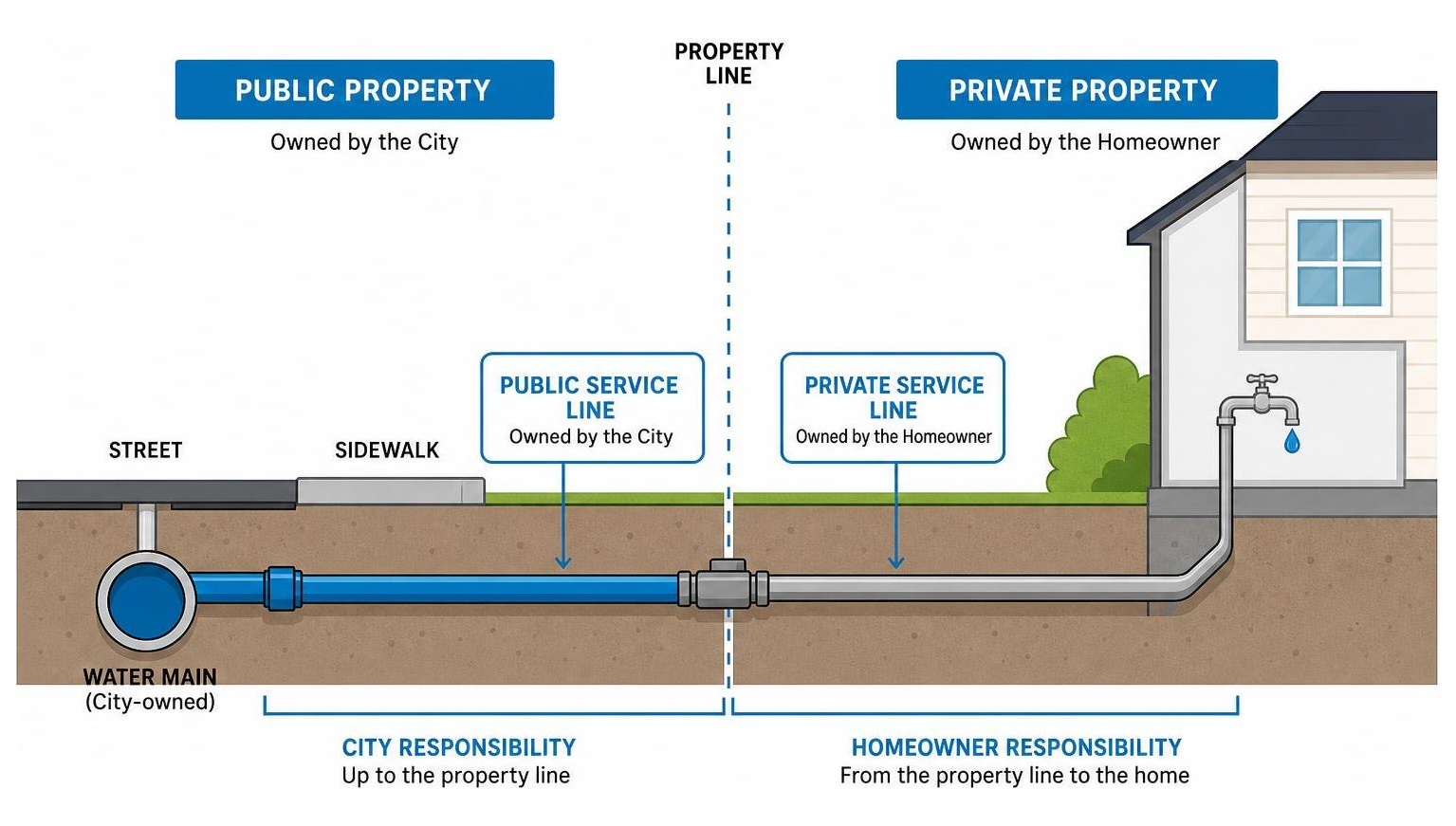
To understand the urgency of chicago lead pipe replacement, we first need to look at what a water service line actually is. The service line is the underground pipe that connects your home’s internal plumbing to the public water main running down the middle of your street.
Because Chicago municipal code actually mandated the use of lead pipes for these connections until the federal ban in 1986, our city has the highest concentration of toxic lead lines in the nation. This has created a massive, systemic health hazard.
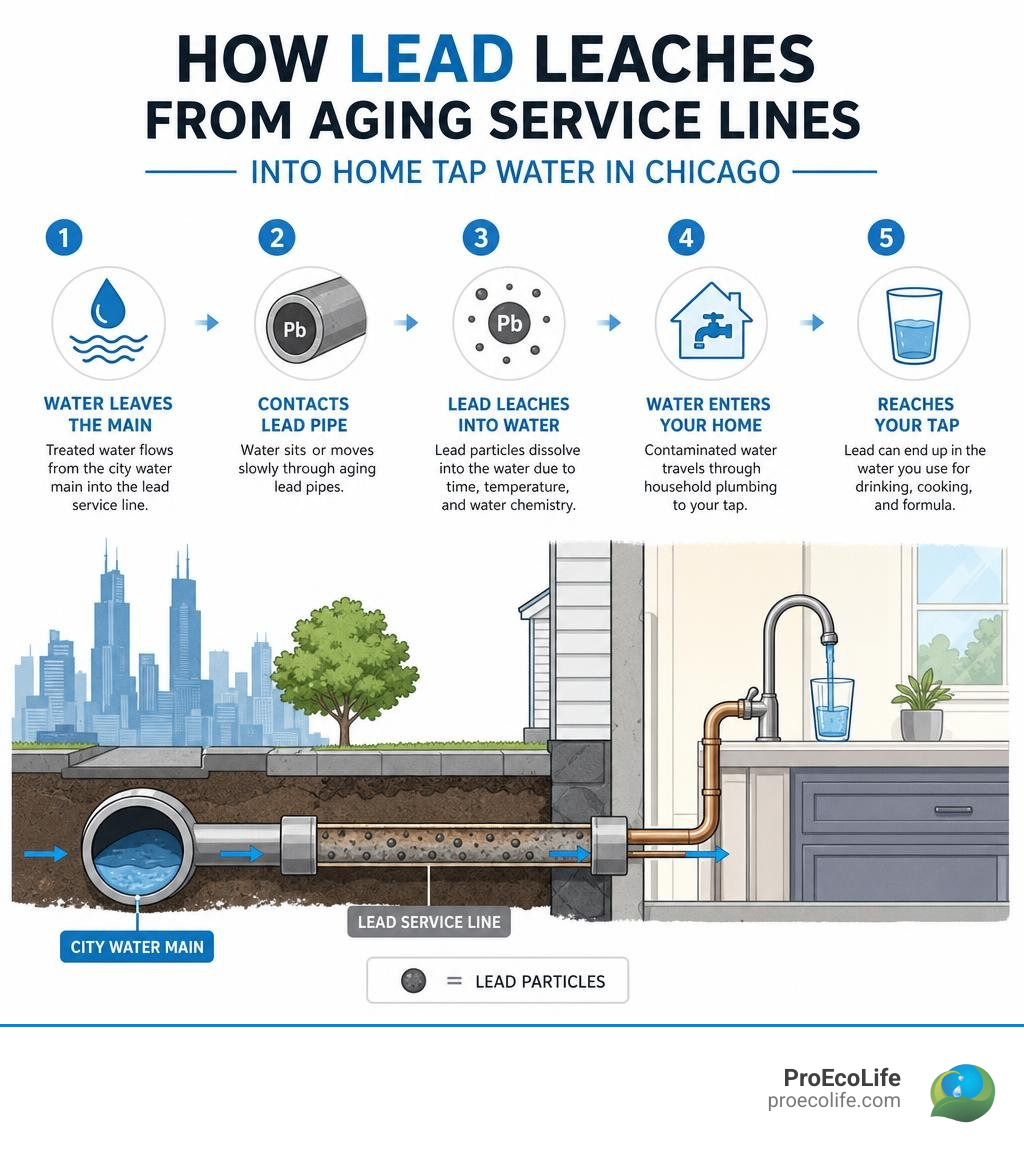
Lead is a powerful neurotoxin. When water sits in these service lines, lead can leach directly into the water you use for drinking, cooking, and mixing baby formula. There is absolutely no safe level of lead exposure. For children under six, even low levels of lead exposure can cause:
- Lowered IQ and learning disabilities
- Hyperactivity and behavioral challenges
- Slowed growth and hearing problems
- Brain and nervous system damage
Adults aren’t immune either; lead exposure can lead to high blood pressure, kidney damage, and reproductive issues. Because Lake Michigan water is treated with corrosion control chemicals to help coat the pipes, the lead doesn’t always spike to extreme levels immediately. However, physical disturbances—like nearby water main construction, street vibrations, or changes in water temperature—can cause lead particles to flake off into your tap water.
This ongoing threat is why we frequently discuss Chicago’s Risky Water Problem and the broader Problem with Dangerous Water in Chicago.
The regulatory landscape is shifting quickly. Under the EPA’s Lead and Copper Rule Improvements (LCRI), the federal government is requiring most water systems to replace all lead service lines within 10 years. However, because of Chicago’s sheer scale, the EPA has granted the city an extended timeline of approximately 20 years, starting in 2027, to complete the job.
While this timeline is a massive improvement over the city’s initial 50-year plan, it still means that thousands of families in our service areas—from Northwest Side neighborhoods like Norwood Park, Edison Park, and Jefferson Park to suburbs like Skokie, Niles, and Park Ridge—will continue to face lead risks for decades.
You can read more about this extended timeline and its environmental justice implications in this report: EPA Gives Chicago Decades to Replace Lead Pipes, Leaving Communities at Risk – Inside Climate News.
Need Clean, Safe Water at Home?
Get a free water test at your home or business. We install and service whole-house filtration and PEL75 reverse osmosis systems across Chicagoland. We also take select projects in Wisconsin and Indiana.
Book a Free Water TestCall (312) 889-8888How to Qualify for Chicago Lead Pipe Replacement
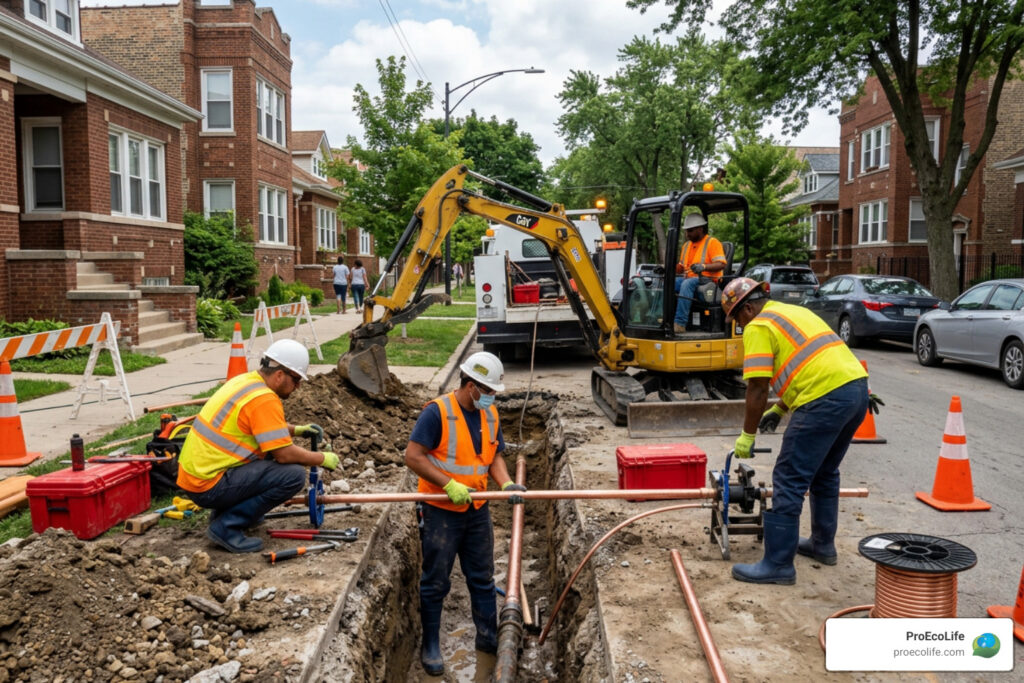
To address this crisis, the Chicago Department of Water Management (DWM) has established several city-assisted programs to replace lead service lines. Under Illinois state law, partial replacements are banned because cutting into a lead line and leaving the other half intact actually flushes massive amounts of lead into the home. Therefore, any city-assisted replacement must be a “full replacement,” swapping out both the public portion (from the main to the property line) and the private portion (from the property line into the home).
Here is a breakdown of the programs governed by ARTICLE IX. LEAD SERVICE LINE REPLACEMENT PROGRAMS (11-12-900 et seq.):
1. The Equity Lead Service Line Replacement Program
This program provides completely free replacement for qualifying low-income homeowners.
- Who Qualifies: You must own and reside in a single-family home, two-flat, or three-flat built before 1986. Your household income must be below 80% of the Area Median Income (AMI).
- Priority Criteria: Priority is given to households with children under the age of 18, or those with confirmed elevated lead levels in their water (at or above 15 parts per billion).
- How to Apply: You will need to provide proof of income, residency, and homeownership. You can learn more and apply directly via the Lead Service Line Replacement – Lead-Safe Chicago portal.
2. The Homeowner-Initiated Program
If you do not meet the income requirements for the Equity Program but still want to replace your lead line, you can hire a private, licensed plumber to do the work.
- Who Qualifies: Any residential property owner with a confirmed lead service line.
- The Benefit: While you must pay the contractor for the physical replacement, the city will waive permit fees (saving you up to $5,000) and provide a free water meter and connection to the water main.
- More Info: Check the specific application guidelines on the Homeowner-Initiated Program page.
3. The Breaks and Leaks Program
This program is triggered automatically by the city. If a leak or break occurs on your lead service line, the city will replace the entire line at no cost to you, rather than performing a temporary patch.
4. The Block-Long Program
When the city is actively replacing water mains or sewer lines on your specific block, they will replace all lead service lines on that block at no cost to the residents. This is highly efficient but depends entirely on the city’s capital improvement schedule.
5. The Daycare Program
To protect our most vulnerable residents, licensed daycare facilities operating in buildings with lead service lines can qualify for free, expedited replacements.
To see if your home has a confirmed or suspected lead line, you can consult local mapping resources. We have put together a detailed guide on How to Use the WBEZ Lead Pipe Map to Check Your Chicago Home to help you navigate your property’s status.
| Program Name | Target Audience | Primary Benefit | Income Cap |
|---|---|---|---|
| Equity LSLR | Low-income owner-occupants | 100% free replacement | Below 80% AMI |
| Homeowner-Initiated | Any homeowner | Waived permit fees (up to $5,000) | None |
| Breaks & Leaks | Emergency repair situations | Free full replacement | None |
| Block-Long | Active water main construction zones | Free full replacement | None |
| Daycare LSLR | Licensed child care facilities | Free prioritized replacement | None |
Need Clean, Safe Water at Home?
Get a free water test at your home or business. We install and service whole-house filtration and PEL75 reverse osmosis systems across Chicagoland. We also take select projects in Wisconsin and Indiana.
Book a Free Water TestCall (312) 889-8888Why is Replacing Chicago’s Lead Pipes So Expensive and Slow?
If we have federal loans and clear health risks, why is progress so slow? The reality of the chicago lead pipe replacement effort is bogged down by eye-watering costs and bureaucratic hurdles.
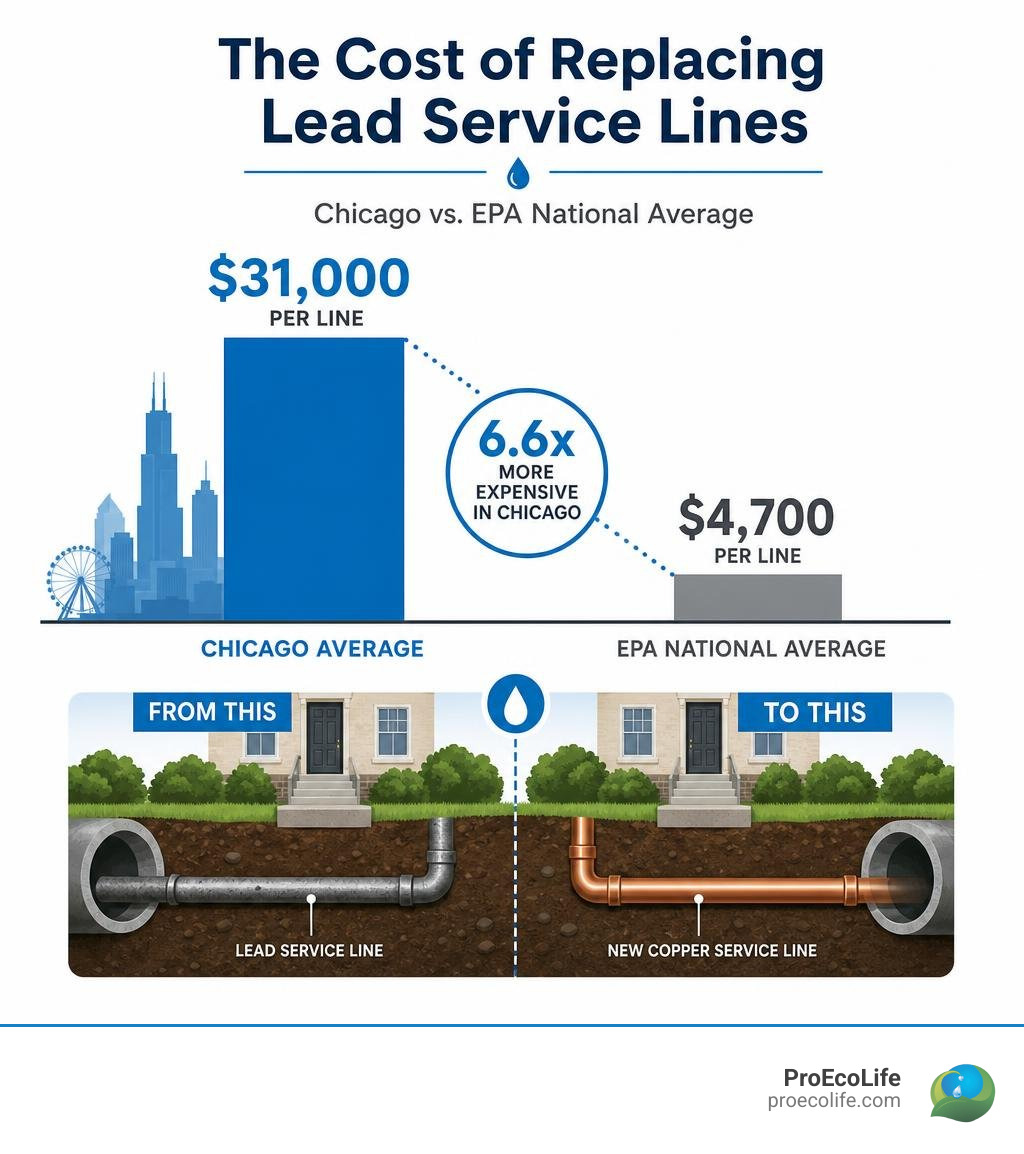
The numbers are staggering. Replacing Chicago’s lead service lines is expected to cost a total of $14 billion. While the EPA’s national average estimate to replace a single lead service line is around $4,700, the average cost in Chicago is approximately $31,000 per line—and can range up to $40,000 in some historic brick bungalows.
Several factors drive these massive costs:
- Cumbersome Permitting and Restorations: Chicago requires extensive street cuts, sidewalk restorations, and coordinate permits across multiple city departments.
- One-Off vs. Block-Wide Work: The city has historically relied on “one-off” replacements under the equity and homeowner-initiated programs, which are incredibly inefficient. Block-level replacements accounted for only 3% of the roughly 15,000 lines replaced between 2021 and the end of 2025.
- Labor and Contracting Inefficiencies: High union labor rates, complex city contracts, and a lack of streamlined, multi-block scheduling keep prices high.
- Homeowner Consent Barriers: Under Illinois law, the city must obtain explicit permission from property owners to work on the private side of the property line. Language barriers, tenant-landlord disputes, and general distrust of government often prevent owners from signing the required consent forms.
This slow pace is further complicated by funding bottlenecks. The state of Illinois is recognized as Illinois One of Worst Contaminated Water States, yet of the $325 million federal loan available to Chicago for lead line replacement, only $70 million to $90 million has actually been spent. The city has faced intense criticism for sitting on these funds while residents remain exposed.
To dive deeper into the systemic reasons behind these high costs, you can read the investigative piece: Why is it so unusually expensive to replace lead pipes in Chicago? | Grist.
Protecting Your Home and Frequently Asked Questions
While the city works through its 20-year timeline, you cannot afford to wait. If you live in Norwood Park, Edison Park, Jefferson Park, or nearby suburbs like Park Ridge, Niles, Des Plaines, Skokie, or Glenview, taking immediate, proactive steps is essential to protect your household.
Immediate Steps for Chicago Lead Pipe Replacement Safety
If you suspect or know you have a lead service line, here are the immediate safety measures you should practice daily:
- Flush Your Pipes: If water has sat unused in your pipes for more than six hours, run your cold water tap for at least five minutes before using it for drinking or cooking. This flushes out the stagnant water that has been in direct contact with the lead pipe.
- Clean Aerators Regularly: Unscrew the aerator screens on your faucets and rinse out any trapped sediment or lead particles that may have collected there.
- Get Your Water Tested: Do not guess. You can request a free lead testing kit by calling 311 or signing up on the city’s water quality website. Alternatively, you can use a Reliable Water Testing Service in Chicago for Your Home or Business to get a highly accurate, independent analysis of your tap water.
Long-Term Protection Against Chicago Lead Pipe Replacement Delays
While flushing helps, the only way to guarantee lead-free water at your tap is through professional filtration. Standard pitcher filters or basic refrigerator filters are often insufficient for heavy lead loads.
We recommend utilizing certified point-of-use or whole-house filtration systems. At ProEcoLife, we have been helping Chicago families secure their drinking water since 2014. Our founder, Karol Dolega, designed our systems specifically to handle local water conditions, including Lake Michigan source water and the heavy mineral hardness common in Northwest suburbs like Morton Grove, Arlington Heights, and Glenview.
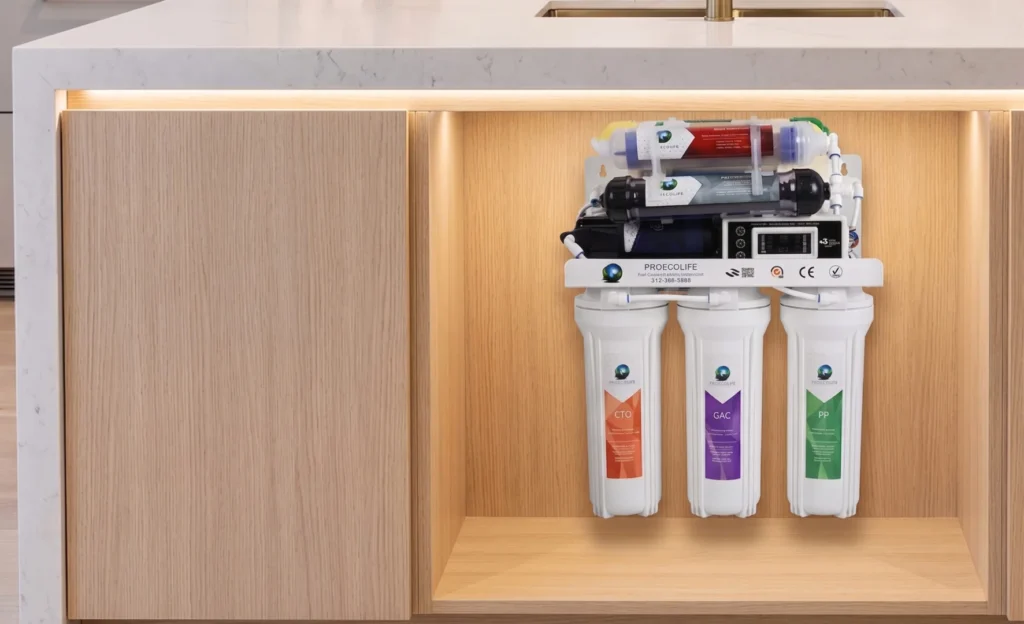
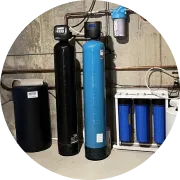
Our PEL75 9-Stage RO System is engineered to remove lead, chlorine, heavy metals, and microplastics, providing pristine drinking water directly to your kitchen tap. For comprehensive protection, we also offer Whole House Filtration systems, Shower Filter Systems, Well Water Conditioning, and Commercial Water Filtration Systems.
To explore your options, you can read our comprehensive guide on How to Choose the Best Lead Water Filter in Chicago: A 2026 Guide or view our selection of the Top Rated Reverse Osmosis Systems to Remove Lead from Your Home.
How do I know if my home has a lead service line?
If your home was built before 1986, there is a very high likelihood it has a lead service line. You can perform a simple “scratch test” on the pipe where it enters your basement or utility closet (usually near the water meter). Lead is a soft, dull gray metal. If you scratch it gently with a key or coin and it turns shiny silver, and a magnet does not stick to it, you have a lead pipe. You can also use the city’s online Service Line Lookup tool with your address or water account number.
What is the timeline for full chicago lead pipe replacement?
Under the new federal EPA rules starting in 2027, Chicago has approximately 20 years to fully replace all 400,000 lead service lines. This places the final completion target around 2047. The city is currently on pace to replace about 8,000 lines per year, though they will need to accelerate this pace significantly to meet the federal mandate.
Can I replace my lead service line privately?
Yes. Under the city’s Homeowner-Initiated Program, you can hire a private, licensed plumber to perform the replacement. The city will waive up to $5,000 in permit fees and provide the water main connection and meter. This is often the fastest route if you do not qualify for the free Equity Program but want the peace of mind of having the lead pipes gone immediately. For more details, consult the Homeowner-Initiated Program guidelines.
Conclusion
The chicago lead pipe replacement initiative is one of the largest infrastructure challenges in our city’s history. While municipal programs are slowly moving forward, the reality is that hundreds of thousands of homes across Chicago and the surrounding suburbs will continue to receive their water through toxic lead pipes for years, if not decades.
At ProEcoLife, we believe you shouldn’t have to wait for city contractors to protect your family’s health. Since 2014, our founder Karol Dolega and our dedicated team have been providing Chicagoans with advanced, reliable water purification systems. We understand the unique challenges of Lake Michigan water, the mineral hardness of our Northwest suburbs, and the aging infrastructure of our beautiful, historic Chicago homes.
If you are interested in how these advanced systems work, you can read our detailed article on How Does Reverse Osmosis Work? to understand the science behind pure, lead-free water.
To protect your family from lead contamination while waiting for city infrastructure updates, contact ProEcoLife to schedule a water test at (312) 889-8888 or visit proecolife.com.