
Is Chicago Tap Water Safe? What Every Homeowner Needs to Know
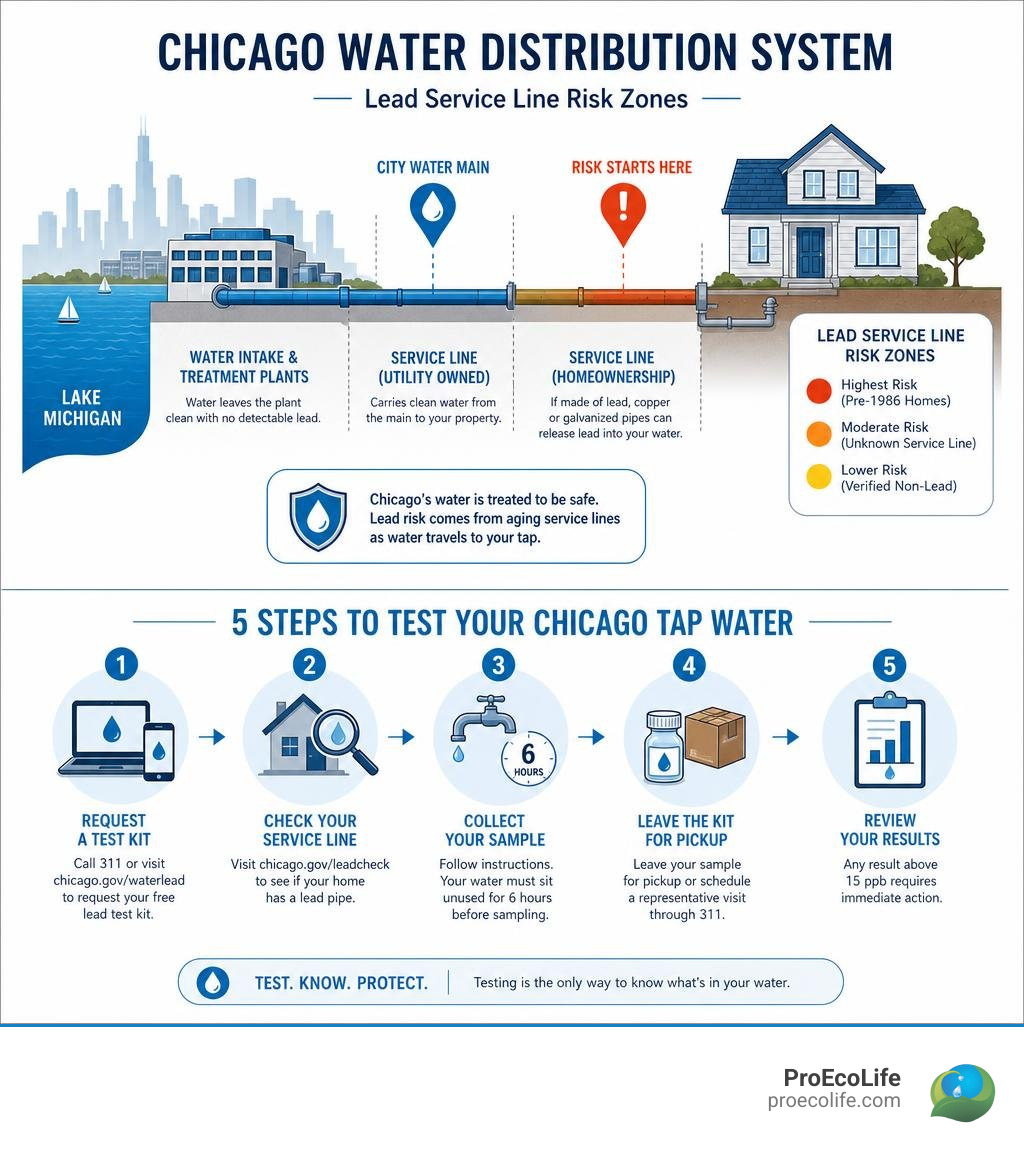
Requesting a chicago water test is one of the most important steps you can take to protect your family — especially if you live in a home built before 1986.
Here’s how to get your Chicago water tested quickly:
- Call 311 or visit chicago.gov/waterlead to request a free lead test kit from the Chicago Department of Water Management (DWM)
- Check your service line at chicago.gov/leadcheck to see if your home has a lead pipe
- Collect your sample following DWM instructions (requires 6 hours of no water use before sampling)
- Leave the kit for pickup or schedule a DWM representative visit through 311
- Review your results — any reading above 15 ppb requires immediate action
Chicago’s drinking water starts out clean. Lake Michigan supplies one of the largest municipal water systems in the world, and the city’s treatment plants deliver nearly one billion gallons of purified water every day — with no detectable lead leaving the plant.
The problem happens after the water leaves the plant.
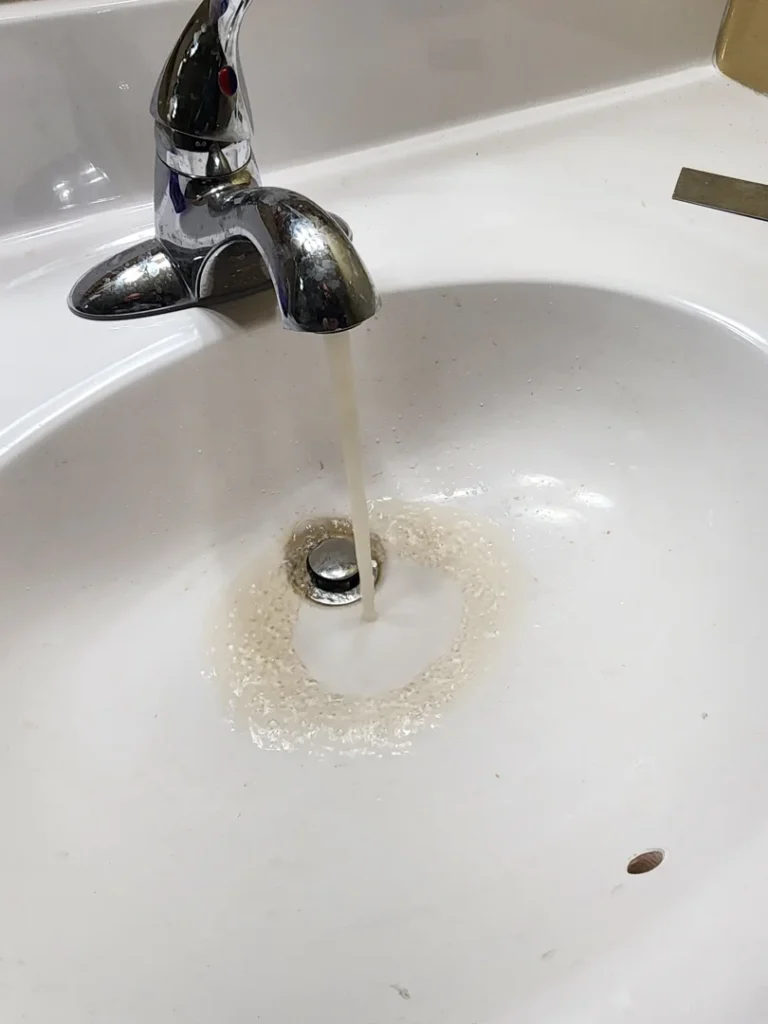
Chicago has more than 412,000 confirmed or suspected lead service lines — more than any other city in America. Most of these connect directly to homes built before 1986 in neighborhoods like Norwood Park, Jefferson Park, and Edison Park. As water sits in those pipes, it can pick up lead before it ever reaches your tap.
A 2024 Johns Hopkins study estimated that around 68% of Chicago children under 6 are exposed to lead-contaminated tap water. And as of mid-2025, only about 8% of the roughly 900,000 affected homeowners and renters had even been notified that their service line may be lead.
That’s why testing — and understanding your results — matters so much right now.
Chicago water test vocab explained:
Understanding Chicago’s Lead Pipe Crisis and Water Infrastructure
To understand why a chicago water test is so vital, we have to look beneath our streets. Chicago’s water infrastructure is a tale of two systems: world-class treatment facilities on the lakefront, and an aging network of underground pipes delivering that water to our homes.
Historically, Chicago municipal codes actually mandated the use of lead service lines for single-family homes and small multi-unit buildings until federal regulations finally banned the practice in 1986. Because of this historical policy, Chicago ended up with over 412,000 lead service lines, the highest concentration of any city in the United States.
If you live in older residential areas on the Northwest Side of Chicago—such as Norwood Park, Jefferson Park, or Edison Park—your home is highly likely to be connected to the water main via a lead service line. While the city adds orthophosphate during the treatment process to form a protective coating inside the pipes, this barrier is not foolproof. Ground vibrations, temperature shifts, and nearby construction can cause this coating to crack, allowing lead to leach directly into your drinking water.
This ongoing infrastructure challenge is explored deeply in our analysis of Chicagos Risky Water Problem. The scale of the issue has placed our state in a challenging position nationally, a topic we discuss in our guides on Stan Wody W Illinois Jednym Z Jest Najgorszych and why Illinois One Of Worst Contaminated Water States continues to be a major headline in 2026.
Need Clean, Safe Water at Home?
Get a free water test at your home or business. We install and service whole-house filtration and PEL75 reverse osmosis systems across Chicagoland. We also take select projects in Wisconsin and Indiana.
Book a Free Water TestCall (312) 889-8888How to Request and Complete a Chicago Water Test
The Chicago Department of Water Management (DWM) allows residents to request a water testing kit to check for lead. This program is designed to help residents identify potential risks at their specific taps.
To get started, you can request a kit by calling 311 or visiting the official municipal portal. For detailed information on the city’s kit, you can review the Water Lead Test Kit – Chicago 311 documentation.
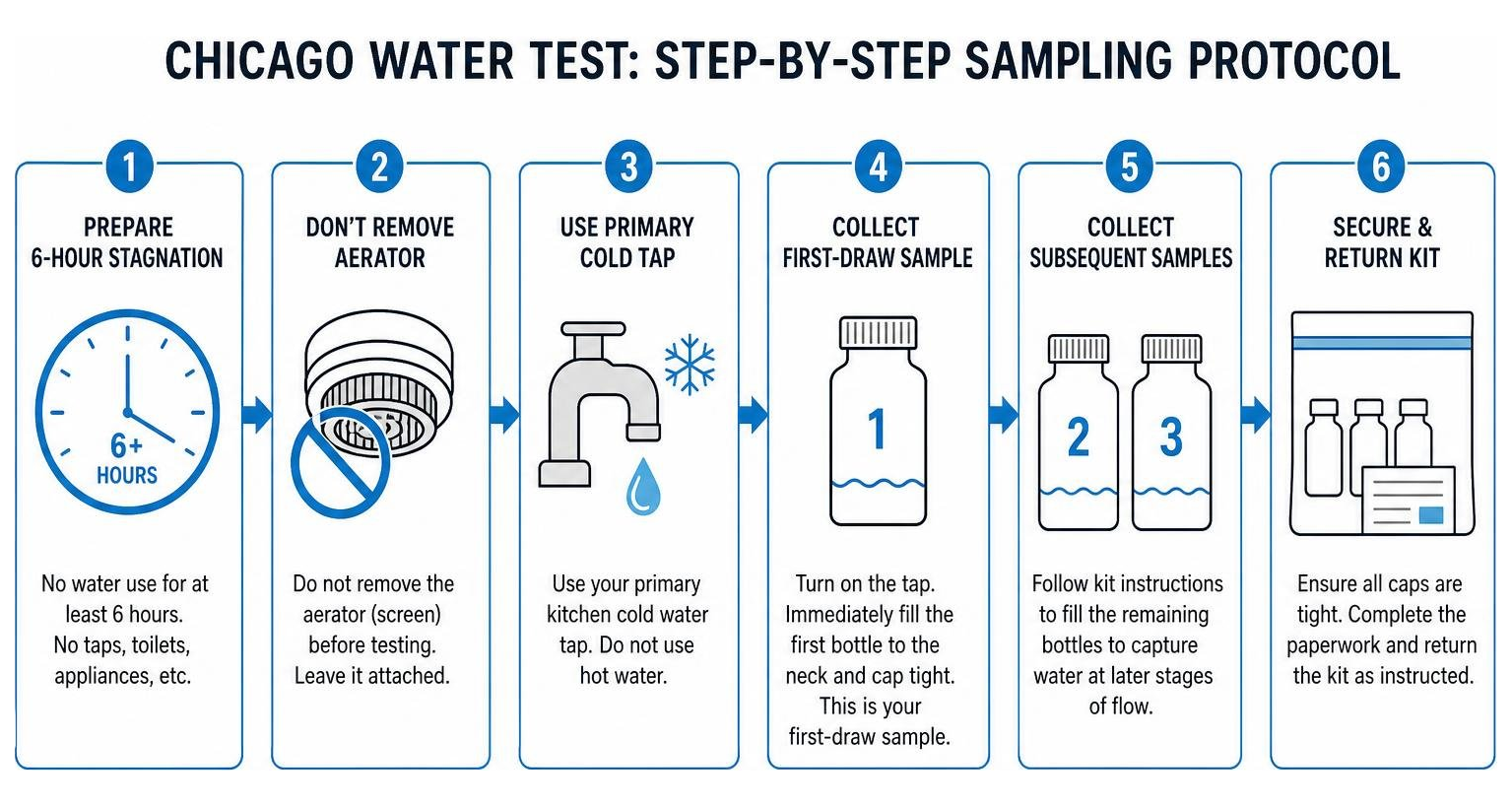
Once the kit is delivered to your home, the testing process requires strict adherence to instructions to ensure an accurate reading. The most critical requirement is a 6-hour stagnation period. This means no water can be used in your home—no running faucets, no flushing toilets, no running dishwashers or washing machines—for at least six hours prior to collecting your sample. Most residents find it easiest to perform this stagnation period overnight or while they are away at work.
For those who want to ensure their testing is handled with professional precision, we offer comprehensive guidance on how to Test Your Water to achieve the most accurate and reliable results.
Step-by-Step Instructions for Your Chicago Water Test
When you are ready to collect your sample after the six-hour stagnation window, follow these precise steps based on the Water Testing Recommendations for Chicago Residents | US EPA guidelines:
- Do not remove the aerator (the small screen at the tip of your faucet) before testing. Removing it can shake loose accumulated metal debris, which will skew your results.
- Locate your primary cold water tap in the kitchen. Do not use hot water for testing, as hot water naturally leaches more metals from plumbing.
- Prepare your collection bottles. The standard DWM kit typically includes three separate bottles to capture water at different stages of flow.
- Collect the first-draw sample. Immediately upon turning on the faucet, fill the first bottle to the neck and cap it tightly. This captures the water that has been sitting directly in your faucet fixture and immediate home plumbing.
- Collect subsequent samples. Follow the kit’s instructions to fill the remaining bottles, which help determine if lead is leaching from your service line further down the pipe system.
- Secure and return the kit. Ensure all caps are tight, fill out the included paperwork, and place the kit at your designated pickup spot or schedule a collection.
Interpreting the Results of Your Chicago Water Test
Once your results are processed, you will receive a report indicating the lead concentration in parts per billion (ppb).
- Under 1 ppb: This is the ideal target. While the EPA states there is no safe level of lead exposure, very low single-digit numbers indicate minimal leaching.
- 9.1 ppb: This is Chicago’s current 90th-percentile lead level. While this is technically below the EPA regulatory action level, it indicates that lead is actively present in many local homes.
- 15 ppb or higher: This is the EPA Action Level. If your test returns a result above 15 ppb, the city recommends immediate mitigation steps, such as regular flushing and installing certified filtration. Recent municipal data shows that approximately 7.1% of homes receiving new water meters recorded lead levels exceeding this 15 ppb threshold.
If your report reveals elevated levels, it is crucial to investigate further. Learn more about identifying these risks in our detailed article: Is Your Water Contaminated.
Need Clean, Safe Water at Home?
Get a free water test at your home or business. We install and service whole-house filtration and PEL75 reverse osmosis systems across Chicagoland. We also take select projects in Wisconsin and Indiana.
Book a Free Water TestCall (312) 889-8888Other Contaminants of Concern in Chicago Tap Water
While lead remains the most prominent headline, a thorough chicago water test often reveals other chemical and mineral components that impact water quality.

- PFAS (Per- and Polyfluoroalkyl Substances): Known as “forever chemicals,” these synthetic compounds do not easily break down in the environment or the human body. Recent monitoring has detected trace levels of PFAS in source water across the region.
- Chromium-6: This industrial byproduct has been detected in local water supplies at levels exceeding independent health guidelines, even while remaining within legacy federal limits.
- Disinfection Byproducts (DBPs): To keep water safe from harmful bacteria across thousands of miles of water mains, Chicago uses chloramine. However, the reaction of disinfectants with organic matter in the water creates byproducts like Trihalomethanes (TTHMs) and Haloacetic Acids (HAAs).
- Hard Water Minerals: Chicago’s municipal water averages 130 to 150 ppm of hardness (roughly 8 grains per gallon). This classifies our water as hard, which can lead to scale buildup on appliances, dry skin, and dull laundry. This mineral profile is particularly noticeable in neighboring areas like Park Ridge, Niles, and Des Plaines.
For those interested in the historical and scientific tracking of these emerging chemical traces, the EDC-PPCP Final Report Web Intro Page r2 provides a comprehensive look at how endocrine-disrupting chemicals and pharmaceuticals interact with our local water systems. You can also explore local water parameters via the Water Quality portal for Park Ridge.
To understand how these cumulative factors affect our state’s overall standing, read our deep dive on why Illinois One Of Worst Contaminated Water States remains a critical topic for local families.
Long-Term Solutions: Advanced Filtration for Chicago Homes
Relying on basic pitcher filters or refrigerator filters is often insufficient for comprehensive protection. Most standard pitchers are only certified to NSF/ANSI Standard 42 (which covers taste and odor, like removing chlorine), but they do not remove heavy metals, PFAS, or disinfection byproducts.
To protect your household from lead, any filtration system you choose must be certified to NSF/ANSI Standard 53 for lead reduction or NSF Standard 58 for reverse osmosis systems.
For homeowners seeking a comprehensive, permanent solution, a reverse osmosis system is the gold standard. These systems push water through a semi-permeable membrane, filtering out contaminants at the molecular level.
To help you navigate the process of upgrading your home’s water quality, we have put together several essential resources:
- Learn how to identify the signs that your home needs help with How To Tell If You Need A Water Filter.
- Understand the technical differences between various systems in How To Choose A Water Filter.
- Find Chicago-specific advice in How To Choose The Best Lead Water Filter In Chicago A 2026 Guide.
- For clean water on the go, check out our tips on How To Choose The Best Water Bottle.
Frequently Asked Questions About Chicago Water Quality
How long does it take to get Chicago water test results?
After the Chicago Department of Water Management collects your water samples, the laboratory analysis typically takes several weeks. Once completed, the results are mailed to your home and updated in the 311 system. During periods of high demand, residents may experience notification delays, which is why many local homeowners choose to work with private, certified laboratories for faster turnaround times.
How do I know if my Chicago home has a lead service line?
If your home was built before 1986, there is a high probability that it has a lead service line. You can verify this by using the city’s online lookup tool at chicago.gov/leadcheck. Alternatively, you can locate where the water pipe enters your home (usually in the basement or utility closet near the water meter) and perform a simple scratch test. Lead is a soft metal; if you scratch the pipe gently with a key or coin and it reveals a bright, shiny silver color, it is likely lead.
Can boiling water remove lead or PFAS?
No. Boiling water does not remove lead, PFAS, or other chemical contaminants. In fact, boiling water causes some of the water to evaporate, which actually concentrates the level of lead and chemicals remaining in the pot. The only way to remove these substances is through certified physical filtration, such as carbon block or reverse osmosis systems.
Conclusion: Secure Your Home’s Water Quality with ProEcoLife
Testing your water is the first step, but securing peace of mind requires a reliable, long-term solution. Since 2014, our founder Karol Dolega has led ProEcoLife with deep Chicago roots, helping families across the city and suburbs protect their households from local water quality issues.
We specialize in advanced water treatment systems designed specifically for our region’s unique water profile. Our flagship PEL75 9-Stage RO System provides unmatched multi-stage filtration to target lead, PFAS, chromium-6, and disinfection byproducts at your kitchen tap. For comprehensive, whole-home protection, our Whole House Filtration systems and Well Water Conditioning units handle everything from hard water minerals to sediment. We also offer specialized Shower Filter Systems to protect your skin and hair, as well as robust Commercial Water Filtration Systems for local businesses.
Whether you are located in Chicago’s Northwest Side neighborhoods or in surrounding communities like Skokie, Glenview, Arlington Heights, or Morton Grove, our team is here to help. We provide expert guidance, professional installation, and precise testing services tailored to your property.
To learn more about our local services, explore our Reliable Water Testing Service In Chicago For Your Home Or Business. You can also discover the science behind our filtration technology by reading How does reverse osmosis work?.
Take control of your home’s water quality today. Contact ProEcoLife to schedule a professional water quality assessment at (312) 889-8888 or visit us online at proecolife.com.