
How to Choose a Water Filter to Remove Lead
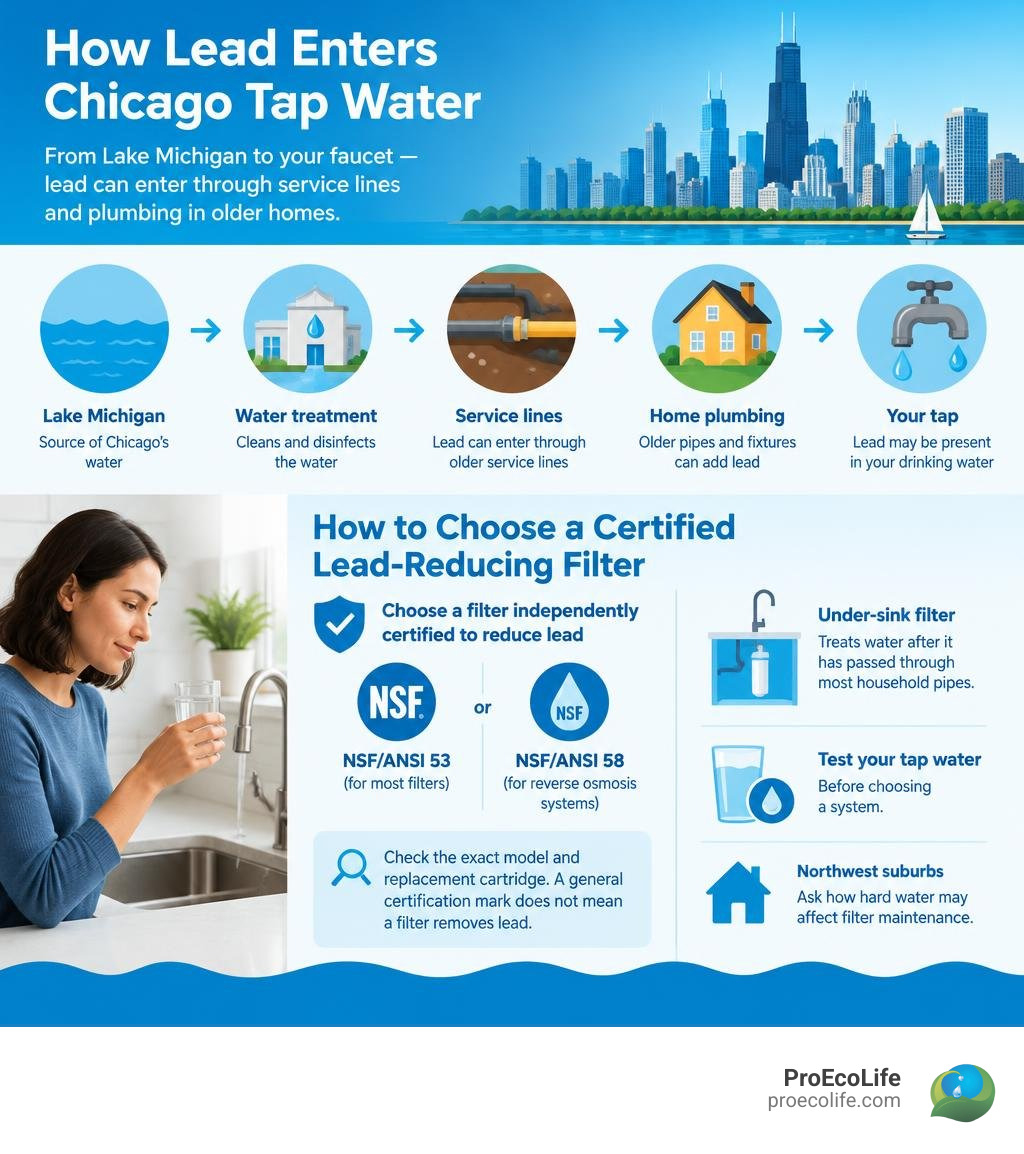
Choose a filter independently certified to reduce lead under NSF/ANSI 53, or a reverse osmosis system certified for lead reduction under NSF/ANSI 58. Check the exact model and replacement cartridge: a general certification mark does not mean a filter removes lead.
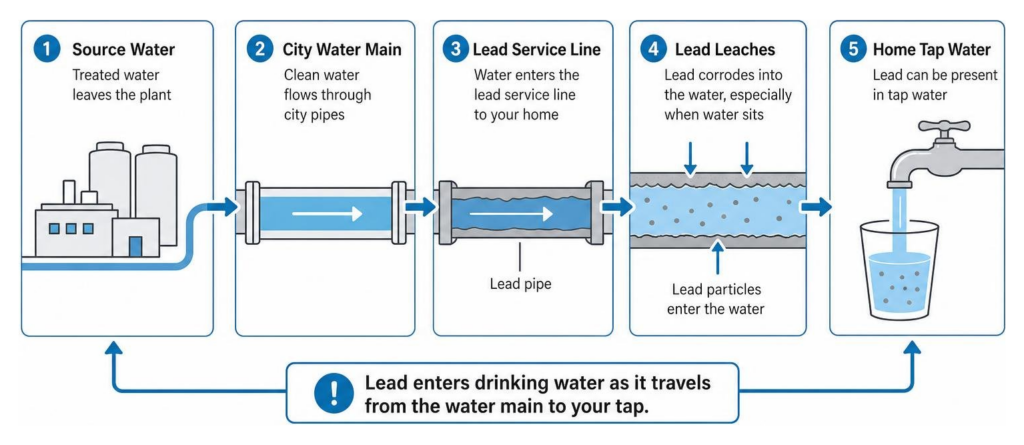
Chicago draws its water from Lake Michigan, but lead can enter it later through service lines and plumbing in older homes. Test the water at your kitchen tap before choosing a system. For drinking and cooking, an under-sink filter treats water after it has passed through most household pipes. If you live in the Northwest suburbs, ask how hard water may affect filter maintenance, too.
Handy water filter remove lead terms:
- NSF Certified Water Filters List
- Reverse Osmosis System Lead
- Best Way to Remove Lead from Drinking Water
The Hidden Threat: Why Lead in Drinking Water Requires Immediate Action
Lead is a potent neurotoxin that presents severe health hazards even at trace concentrations. Unlike many other drinking water contaminants that cause temporary gastrointestinal distress, lead bioaccumulates in bones, teeth, and soft tissues over time. The United States Environmental Protection Agency (EPA) has set the maximum contaminant level goal (MCLG) for lead in drinking water at zero because medical science has established that no safe blood level exists for humans.
The Centers for Disease Control and Prevention (CDC) currently sets its blood lead reference value at 3.5 micrograms per deciliter (µg/dL), an update from the previous 5.0 µg/dL standard. Roughly 500,000 children across the United States sit at or above this threshold. Developing bodies absorb heavy metals at substantially higher rates than adults, making infants and young children extraordinarily vulnerable. Exposure can result in permanent central nervous system damage, lowered IQ, shortened attention spans, speech impairments, and behavioral complications.

Formula-fed infants face the steepest risk. The EPA estimates that tap water used to reconstitute powdered baby formula can account for 40 to 60 percent of an infant’s total lead intake. In adults, chronic low-level ingestion may contribute to cardiovascular issues, reduced kidney function, and reproductive complications.
For a deeper look into the medical research, read the comprehensive guide to lead health risks and testing. Because lead solder was only federally banned in 1986, older housing stock throughout our region—from bungalows in Norwood Park and Jefferson Park to vintage residences in Evanston and Skokie—remains susceptible. Learning about protecting your household from heavy metals is an essential step in safeguarding your home’s water quality.
Why Tap Testing Outweighs Municipal Water Reports
Many homeowners review their municipal water quality reports and assume their indoor taps deliver pristine water. While utilities treating Lake Michigan water comply with regional standards at the treatment plant, tap water quality changes dramatically between the street and your glass.
The primary regulatory mechanism for water utilities is the EPA’s Lead and Copper Rule. Under current guidelines, the action level is 15 parts per billion (ppb). This standard is slated to drop to 10 ppb on November 1, 2027, under the Lead and Copper Rule Improvements. However, this action level is calculated using a 90th percentile compliance model across an entire service territory. That means up to 10 percent of sampled homes within a municipality can exceed the action level without triggering mandatory utility remediation.
Furthermore, the largest source of lead contamination is the underground service line running from the water main into the foundation, alongside interior copper pipe solder installed before the 1986 ban. Because lead leaching varies wildly based on water stagnation, pipe vibration, temperature, and local galvanic corrosion, a neighborhood test cannot substitute for a point-of-use analysis. To learn more about neighborhood testing parameters, explore our guide on testing tap water for lead. Professional tap testing remains the only definitive way to measure the actual heavy metal load reaching your plumbing fixtures.
Need Clean, Safe Water at Home?
Get a free water test at your home or business. We install and service whole-house filtration and PEL75 reverse osmosis systems across Chicagoland. We also take select projects in Wisconsin and Indiana.
Book a Free Water TestCall (312) 889-8888Does Your Water Filter Remove Lead? Critical Certifications to Check
Not all filtration media capture dissolved heavy metals. Many common off-the-shelf pour-through pitchers or refrigerator filters hold basic NSF/ANSI Standard 42 certifications. Standard 42 evaluates aesthetic effects only—meaning it verifies the reduction of chlorine taste and odor, but does nothing to verify heavy metal removal.
To confirm that a water filter will actually remove lead, you must verify that the product has been tested and certified under specific health-effect protocols:
- NSF/ANSI Standard 53 (Health Effects): This standard tests point-of-use filtration systems for the reduction of specific health-related contaminants. When evaluating for lead, testing bodies challenge the filter using water contaminated at 150 ppb—ten times higher than the EPA’s 15 ppb action level—to ensure it reduces lead concentrations down to safe thresholds.
- NSF/ANSI Standard 58 (Reverse Osmosis): This standard specifically evaluates reverse osmosis units, confirming their ability to reject dissolved heavy metals, nitrates, and total dissolved solids (TDS) under high-pressure testing.
- Third-Party Certification Marks: Trustworthy systems carry validation from accredited testing organizations such as NSF International, the Water Quality Association (WQA Gold Seal), or the International Association of Plumbing and Mechanical Officials (IAPMO Platinum Seal).

Always review the performance data sheet to verify that lead is specifically listed alongside its certified reduction percentage. For detailed third-party consumer ratings, see the Consumer Reports guide on certified lead filters. To evaluate different filtration media for your home, review our resource on evaluating filters for lead removal.
How Reverse Osmosis Systems Eliminate Heavy Metal Contamination
Reverse osmosis (RO) is among the most comprehensive methods for heavy metal purification. These systems operate by driving pressurized tap water across a dense, semi-permeable membrane containing microscopic pores roughly 0.0001 microns in diameter.
Dissolved lead exists in water primarily as ionic species (such as divalent lead ions). Because these ions are physically larger than water molecules and carry an electrostatic charge, the RO membrane rejects them, flushing them away while allowing purified water molecules to pass through. Discover more about how reverse osmosis filtration for tap water protects against microscopic contaminants.
At ProEcoLife, founded by Karol Dolega with deep Chicago roots dating back to 2014, we developed our flagship PEL75 9-Stage RO System. This advanced point-of-use system pairs sub-micron pre-filtration with high-rejection membrane technology and remineralization stages. Multi-stage RO configurations deliver clean drinking water while maintaining balanced mineral profiles and efficient recovery ratios.
Solid Carbon Block Adsorption and Physical Filtration
Solid carbon block technology provides another certified pathway for lead extraction. These filters combine mechanical filtration with specialized chemical adsorption:
- Mechanical Trapping: Compressed, sub-micron carbon blocks physically capture insoluble particulate lead that has flaked off aging interior pipes.
- Ion-Exchange Adsorption: Specially treated carbon media chemically bind dissolved, soluble lead ions onto the carbon surface through active adsorption sites.
Because water must maintain sufficient contact time with the carbon to ensure complete adsorption, flow rate regulation is vital. Rushing water through an undersized carbon cartridge diminishes lead capture efficiency.
Need Clean, Safe Water at Home?
Get a free water test at your home or business. We install and service whole-house filtration and PEL75 reverse osmosis systems across Chicagoland. We also take select projects in Wisconsin and Indiana.
Book a Free Water TestCall (312) 889-8888Point-of-Use vs. Whole-House: Finding the Right Filtration Setup
A common question among homeowners in older suburbs like Park Ridge, Niles, Des Plaines, and Arlington Heights is whether to choose a point-of-use (POU) filter or a point-of-entry whole-house setup. Understanding where lead enters your water system helps clarify the right approach.
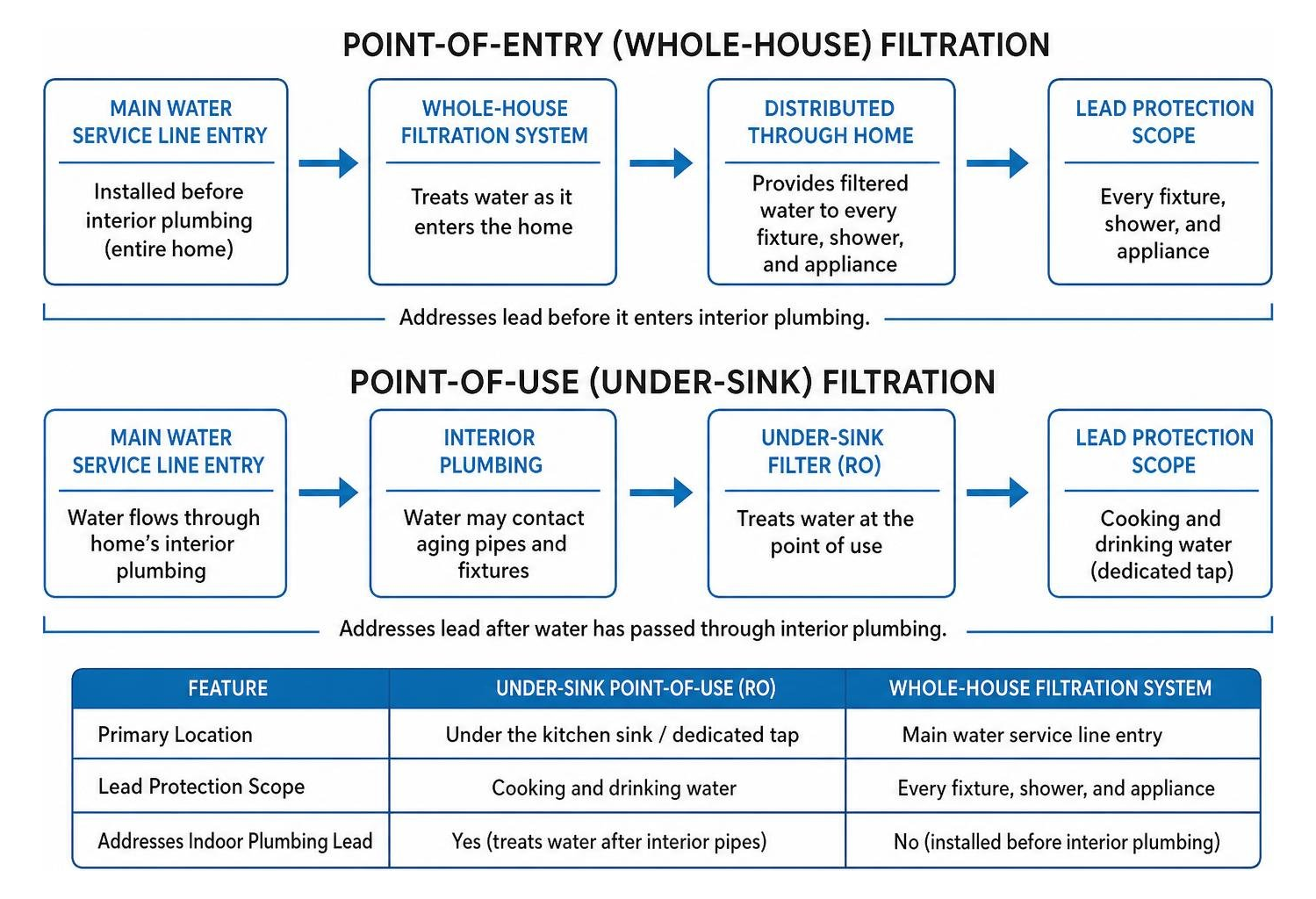
| Feature | Under-Sink Point-of-Use (RO) | Whole-House Filtration System |
|---|---|---|
| Primary Location | Under the kitchen sink / dedicated tap | Main water service line entry |
| Lead Protection Scope | Cooking and drinking water | Every fixture, shower, and appliance |
| Addresses Indoor Plumbing Lead | Yes (treats water after interior pipes) | No (installed before interior plumbing) |
| TDS & Heavy Metal Reduction | Comprehensive via semi-permeable membrane | Broad-spectrum sediment and chemical reduction |
| Ideal Application | High-purity ingestion safety | Whole-home plumbing and fixture protection |
Point-of-entry Whole House Filtration systems treat all incoming water as it enters the building, removing chlorine, volatile chemicals, and sediment before the water reaches your water heater or appliances. For suburban areas dealing with municipal mineral variations, pairing this with Well Water Conditioning or softening media may help prevent scale buildup. However, because whole-house systems sit at the point of entry, they cannot capture lead leached from interior copper pipes or vintage brass fixtures located further downstream.
Conversely, point-of-use systems treat water right at the kitchen tap, capturing any lead dissolved along the entire pipe run. For households wanting comprehensive whole-building coverage alongside high-purity drinking water, combining a whole-home system with an under-sink unit offers balanced protection. We also provide dedicated Shower Filter System options and robust Commercial Water Filtration Systems tailored to larger facilities. You can read more about whole house water filtration options to weigh your installation priorities.
Choosing an Under-Sink Water Filter to Remove Lead
Under-sink systems connect directly to your cold water supply line, routing purified water through a dedicated, lead-free faucet. This setup ensures that water used for drinking, brewing coffee, and preparing food bypasses untreated interior pipe pathways.
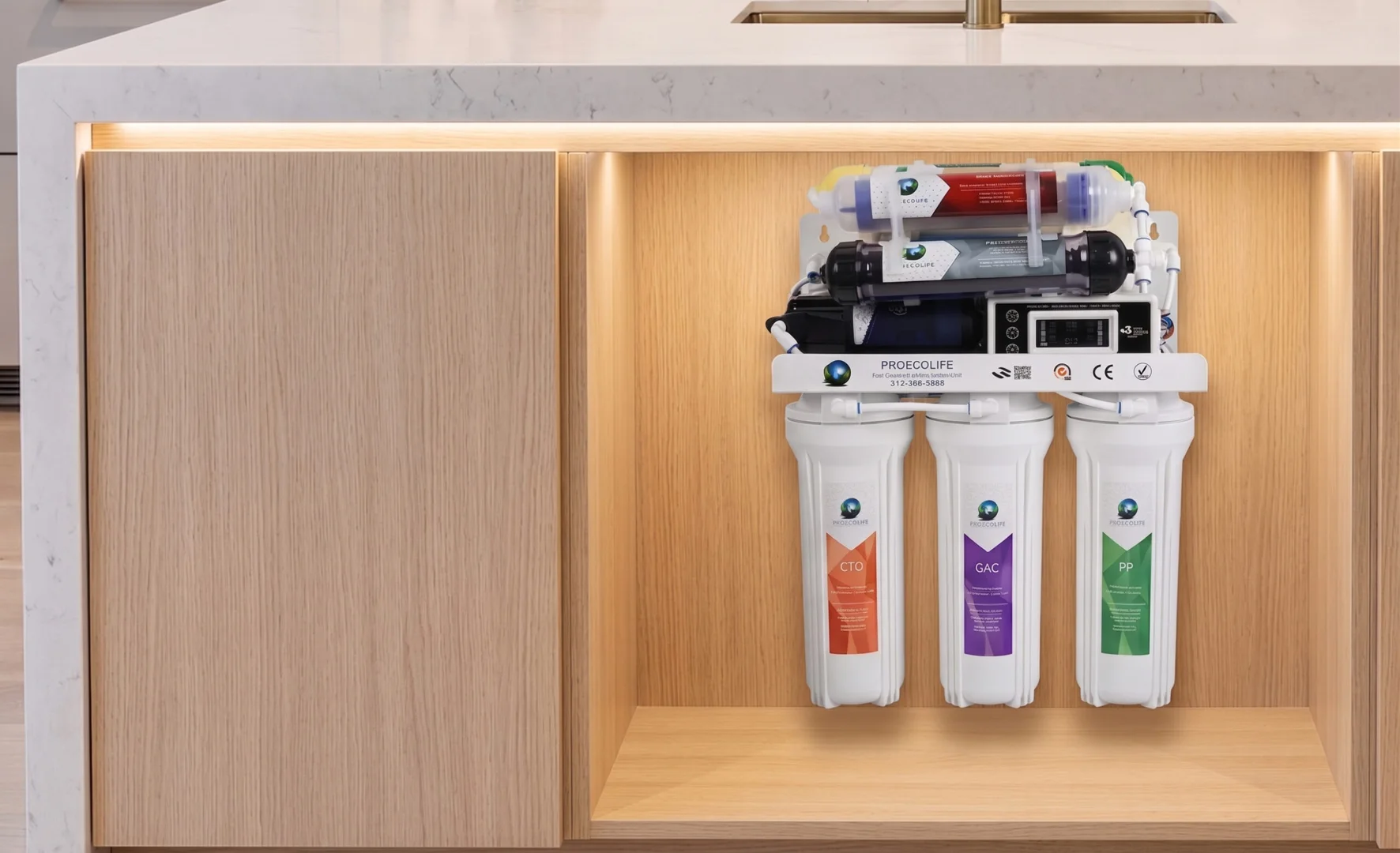
Unlike gravity pitchers that require frequent manual filling and hold limited gallon capacities, dedicated under-sink filters deliver high-volume daily filtration with minimal counter clutter. For an in-depth breakdown of configuration choices, consult our guide comparing under sink vs inline filter systems.
Essential Rules for Operating and Maintaining Lead Filters
Purchasing a certified filter is only half the battle; maintaining proper operating conditions is essential to ensure long-term heavy metal removal.
- Use Cold Water Exclusively: Always run cold water through lead-rated filters. Hot water dissolves lead from plumbing at higher rates and can degrade carbon adsorption bonds, causing trapped contaminants to break free.
- Avoid Filter Overloading: Particulate lead and sediment can clog cartridge pores over time. Without scheduled replacements, flow rates drop and bypass risks increase.
- Prevent Thermal Shock: Never route water from your hot-water line or hot-water recirculation loop into carbon or RO cartridges.
For official government guidelines on safe filtration use, review the EPA instructions for lead filter safety.

How to Properly Maintain Your Water Filter to Remove Lead
Maintaining a filtration system requires consistent upkeep habits:
- Monitor Filter Life: Track cartridge replacement schedules using built-in LED indicators, flow totalizers, or calendar alerts.
- Morning Line Flushing: If water has sat stagnant in your pipes for over six hours, run the cold tap for 30 seconds to two minutes until the water feels noticeably colder before drawing water for consumption.
- Clean Faucet Aerators: Unscrew and rinse faucet aerator screens weekly to clear trapped particulate lead and mineral debris.
- Professional Servicing: Have a qualified technician inspect and sanitize multi-stage RO housings during annual filter changes.
For further operating best practices, review our guide on safe practices for household lead removal.
Critical Mistakes That Compromise Lead Filtration
Homeowners often make simple mistakes that unintentionally increase their heavy metal exposure:
- Boiling Water to Remove Lead: Boiling evaporates pure water into steam while leaving heavy metals behind, concentrating the lead in your pot.
- Running Hot Water Through Carbon Blocks: Hot water strips adsorbed contaminants off active carbon sites and risks structural damage to filter membranes.
- Using Uncertified Replacement Cartridges: Generic, budget cartridges may fit the housing but often lack the certified binders required to trap dissolved lead.
- Improper Aerator Maintenance: Clogged aerator screens trap lead flakes, which slowly dissolve into water passing through the spout.
Frequently Asked Questions About Lead Water Filtration
Does boiling water remove lead?
No. Boiling water does not remove lead or other dissolved heavy metals. Because water evaporates during boiling while heavy metals remain behind, boiling actually increases the concentration of lead in the water. Always use cold, filtered water for drinking and food preparation.
How often should lead filter cartridges be replaced?
Replacement timelines depend on your system design, household consumption, and source water sediment levels. Standard faucet cartridges typically require replacement after roughly 100 gallons, while multi-stage under-sink RO pre-filters and carbon blocks generally require replacement every 6 to 12 months. Operating an expired cartridge risks contaminant breakthrough and reduced flow.
Can a whole-house filter eliminate lead from older indoor plumbing?
A whole-house (point-of-entry) system treats water as it enters the home, removing contaminants coming from the municipal main. However, if your home contains older copper pipes with lead solder or older brass fixtures, lead can leach into the water after it leaves the whole-house filter. For complete protection at the tap, an under-sink point-of-use filter is recommended for drinking water.
Conclusion
Eliminating heavy metals from your tap water requires verified, certified equipment and consistent maintenance. When selecting a system, verify that it holds independent NSF/ANSI Standard 53 or Standard 58 certifications specifically evaluated for lead reduction. Whether you live in Edison Park, Skokie, Lincolnwood, Morton Grove, Glenview, or beyond, addressing aging pipe infrastructure starts with knowing what is in your water.
For complete details on choosing the ideal setup for your household, read our comprehensive 2026 guide to choosing the best lead water filter.
Ready to verify your tap water quality? Contact the team at ProEcoLife to schedule a professional water test by calling (312) 889-8888 or visiting proecolife.com. Our local water specialists are here to help you find the right filtration solution for your home.