Find a Certified Filter That Reduces Lead
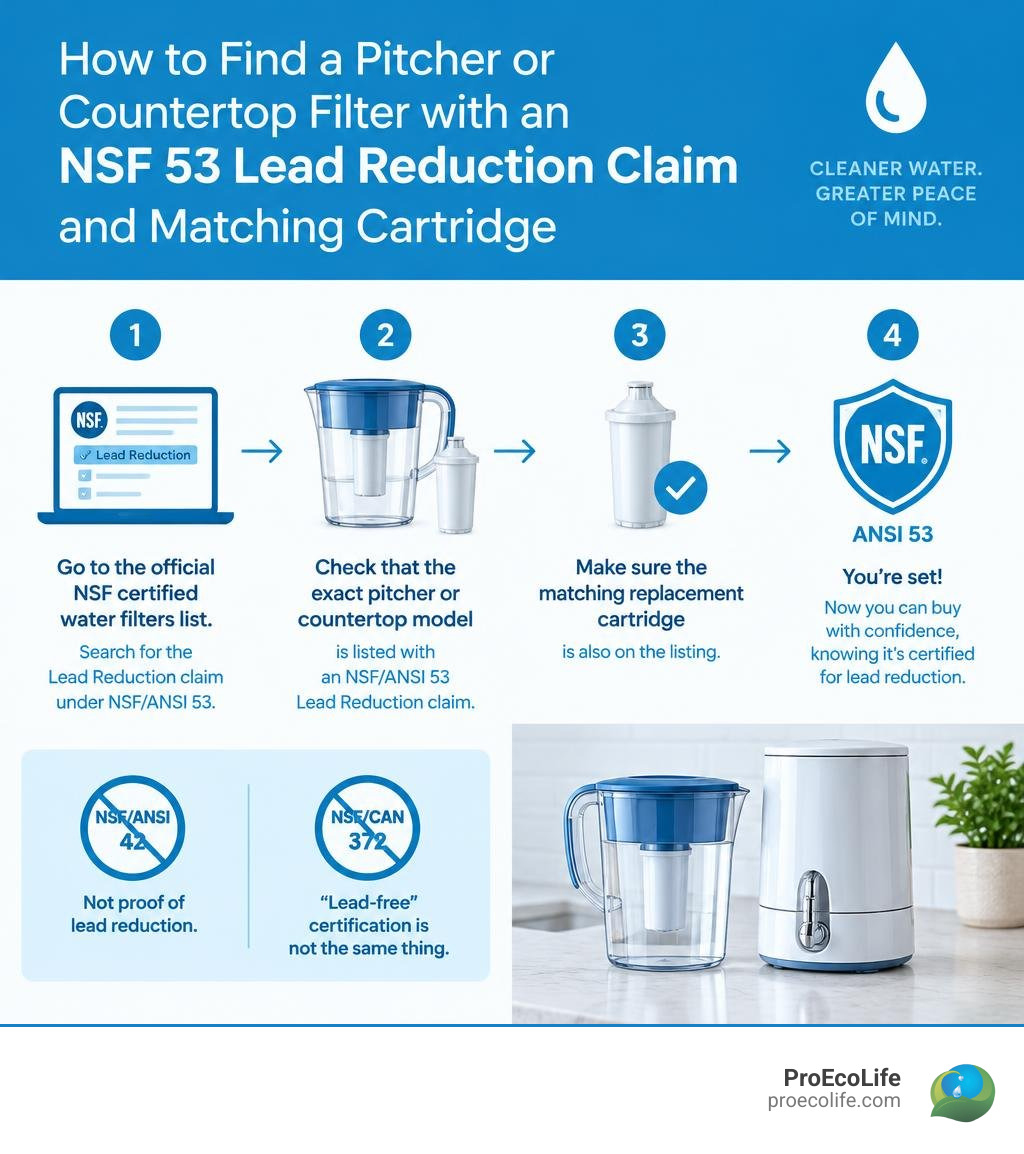
Need a filter for lead concerns? Chicago homeowners can use the NSF certified water filters list through the official NSF drinking water treatment unit database to confirm a product’s documented reduction claims. Look for a lead-reduction certification under NSF/ANSI 53 and compare the listing with the model and cartridge number on the package. Certifications for taste and odor improvement under NSF/ANSI 42, or material compliance under NSF/ANSI/CAN 372, do not by themselves show that a filter reduces lead in tap water.
Chicago gets its water from Lake Michigan, but aging pipes in older homes can still be a source of lead at the tap. Hard water in the Northwest suburbs brings a different concern: mineral buildup. The right filter depends on your water, so this list focuses on certified lead-reduction claims you can verify before you buy.
Nsf certified water filters list terminology:
Understanding Standards on the NSF Certified Water Filters List
Navigating water treatment can feel daunting when every brand claims to deliver pure, crystal-clear water. To know whether a pitcher or countertop device actually removes hazardous impurities, independent verification is essential. This is where standards developed by NSF International and the American National Standards Institute (ANSI) come in.
NSF protocols establish strict laboratory testing procedures, material safety reviews, and structural integrity evaluations. When you look at an official Contaminant Reduction Claims Guide, you will find that NSF does not just hand out a blanket approval. Instead, units are certified for specific contaminants under individual standards. Learning how to choose a water filter begins with understanding the difference between non-health aesthetic claims and vital health-related performance metrics.
Aesthetic vs Health Effects: Standard 42 vs Standard 53
A common misconception among homeowners in Chicago neighborhoods like Norwood Park, Edison Park, and Jefferson Park is that any certified filter protects against heavy metals. In reality, NSF divides its standards into distinct categories:
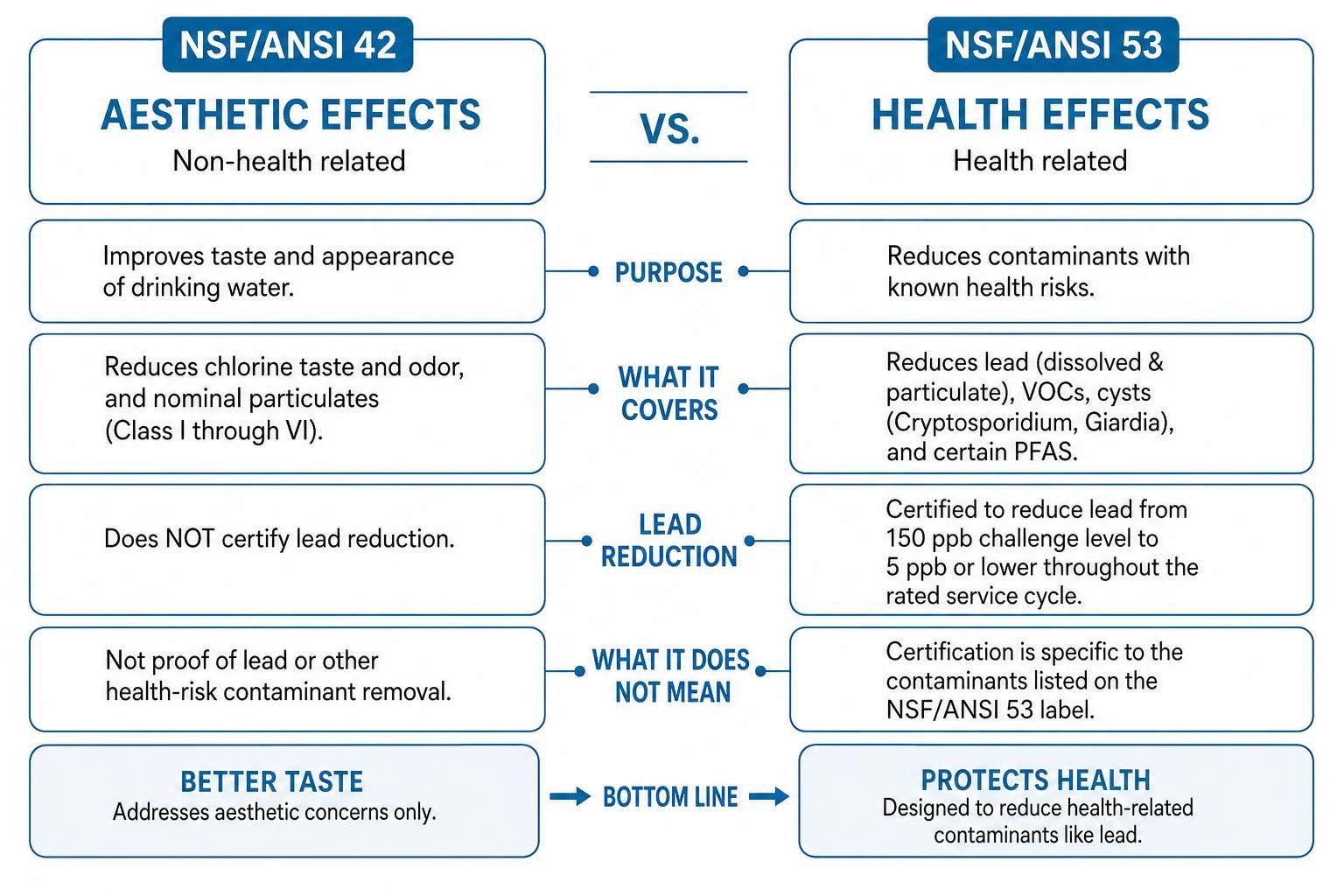
- NSF/ANSI Standard 42 (Aesthetic Effects): Covers non-health-related contaminants. It verifies that a system can reduce chlorine taste, odor, and nominal particulates (Class I through VI). While municipal Lake Michigan water is thoroughly disinfected, chlorine can leave an unpleasant chemical smell or taste. A Standard 42 filter may help make your drinking water taste crisp, but it does not address toxic heavy metals.
- NSF/ANSI Standard 53 (Health Effects): Evaluates a filter’s ability to extract contaminants with known health risks. This includes dissolved and particulate lead, volatile organic compounds (VOCs), microscopic cysts (such as Cryptosporidium and Giardia), and certain PFAS compounds. Testing for Standard 53 lead reduction requires reducing lead concentrations from an incoming challenge level of 150 parts per billion (ppb) down to 5 ppb or lower throughout the entire rated service cycle.
The Role of NSF/ANSI 372 Lead-Free Compliance
Another critical standard to check is NSF/ANSI/CAN 372. This standard evaluates the materials used to construct the filter housing, diverter valves, internal tubing, and fittings. Under the U.S. Safe Drinking Water Act and state plumbing regulations, drinking water devices must maintain a weighted average lead content of 0.25% or less on wetted surfaces.
A mark showing NSF/ANSI 372 simply verifies that the system components will not leach lead into your treated water. It does not mean the filter extracts lead from incoming tap water. For true household defense against heavy metals in older infrastructure across Skokie, Niles, and Des Plaines, you must verify both NSF/ANSI 372 material compliance and NSF/ANSI 53 lead reduction performance.
Need Clean, Safe Water at Home?
Get a free water test at your home or business. We install and service whole-house filtration and PEL75 reverse osmosis systems across Chicagoland. We also take select projects in Wisconsin and Indiana.
Book a Free Water TestCall (312) 889-8888Top Categories on the NSF Certified Water Filters List for Lead Reduction
When reviewing the official database for point-of-use units, most certified countertop and pitcher models rely on specialized filtration media. These designs combine fine mesh activated carbon blocks to trap sediments and organic chemicals with specialized ion-exchange resins engineered to bind dissolved lead ions. Understanding different types of water filters at home helps clarify which form factor matches your daily kitchen routine.
| Filtration Category | Primary NSF Standards | Typical Service Life | Target Contaminants | Best Application |
|---|---|---|---|---|
| Pour-Through Pitcher Filters | NSF 42, NSF 53, NSF 372 | 40 – 120 Gallons (approx. 1–2 months) | Dissolved lead, chlorine, taste, odor, fine particulates | Small households, rental apartments, low-volume drinking water |
| Countertop / Gravity Systems | NSF 42, NSF 53, NSF 372 | 200 – 1,000+ Gallons (approx. 6–12 months) | Lead, cysts, chlorine, selected VOCs, sediment | Medium households, renters wanting countertop continuous supply |
| Multi-Stage Reverse Osmosis | NSF 42, 53, 58, 372, 401 | 1,000+ Gallons (Membrane: 2–3 years) | Total dissolved solids (TDS), lead, nitrates, PFAS, heavy metals | Whole-family drinking water, total kitchen protection, high mineral reduction |
Certified Water Pitcher Filtration Systems
Pour-through pitcher units provide a compact, entry-level approach to water filtration. Water flows by gravity through an upper reservoir, passing through a multi-layer cartridge containing granular activated carbon and ion-exchange resin beads before collecting in the lower pitcher.
Many basic pitcher models only carry NSF 42 certification for chlorine reduction with a 40-gallon service life. However, advanced models certified under NSF 53 capture dissolved lead species and fine suspended particles. Because their cartridge volume is relatively small, these systems require frequent replacement element swaps to avoid channelization or media exhaustion.
Certified Countertop and Gravity Filtration Systems
Countertop units sit directly next to your kitchen sink or on a utility counter. They fall primarily into two formats:
- Faucet-Diverter Countertop Units: These connect directly to your kitchen aerator via a diverter valve and flexible tubing. Water pressure pushes municipal water through an internal solid carbon block and specialty media cartridge, delivering continuous on-demand flow without waiting for a pitcher reservoir to drain.
- Gravity Countertop Systems: These large stainless steel or BPA-free reservoirs sit freely on the counter. They hold several gallons of water and utilize larger gravity-fed composite filter elements that offer higher service capacities (often hundreds to over 1,000 gallons) before requiring element replacement.
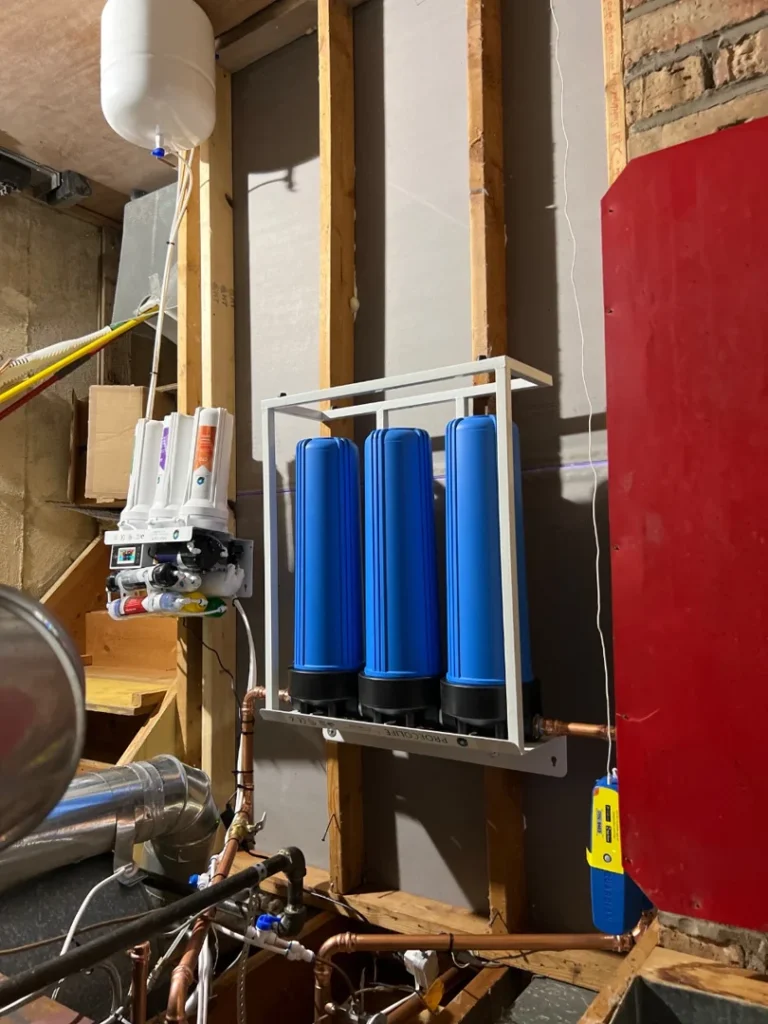
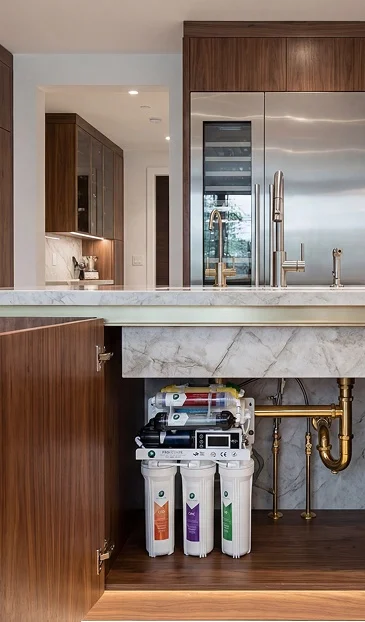
While countertop units provide convenient batch treatment, larger families dealing with severe plumbing corrosion or hard water across suburbs like Park Ridge, Arlington Heights, and Glenview often evaluate comprehensive options. In our experience providing water solutions since 2014, founder Karol Dolega has noted that households seeking permanent protection often transition from batch countertop filters to under-sink systems like our PEL75 9-Stage RO System, our Whole House Filtration setups, or our targeted Shower Filter System.
Need Clean, Safe Water at Home?
Get a free water test at your home or business. We install and service whole-house filtration and PEL75 reverse osmosis systems across Chicagoland. We also take select projects in Wisconsin and Indiana.
Book a Free Water TestCall (312) 889-8888How to Verify and Evaluate Models on an NSF Certified Water Filters List
Marketing terms like “tested according to NSF standards” or “manufactured with NSF-approved media” can be misleading. To confirm a product’s actual credentials, homeowners should cross-reference claims directly against public certification registries.

How to Search the NSF Certified Water Filters List for Lead Reduction
To locate an authentic product listing, follow these verification steps using the official registry:
- Navigate directly to the Search for NSF Certified Drinking Water Treatment Units portal.
- In the search form, locate the Reduction Claim field and select Lead Reduction.
- Select the relevant standard, such as NSF/ANSI 53.
- Optionally enter the exact brand name or filter housing manufacturer.
- Review the search results carefully. Confirm that both the system model number and the replacement cartridge part number match the product packaging. Certification is only valid when using the exact tested cartridge model.
For homeowners exploring broader treatment configurations, reviewing the complete guide to 3-stage water filter housings and systems or evaluating top-rated reverse osmosis systems to remove lead from your home provides valuable context on multi-barrier filtration technologies.
Key Performance Metrics on an NSF Certified Water Filters List
When reading an official NSF listing, pay attention to these technical parameters:
- Service Cycle (Capacity): The total number of gallons (or liters) the cartridge is certified to treat before its lead-binding capacity degrades. Pitcher units often list 40 to 100 gallons, while solid block countertop filters range from 200 to over 1,000 gallons.
- Rated Service Flow Rate: Measured in gallons per minute (gpm). Faucet-mounted and countertop diverter systems typically operate between 0.4 and 0.8 gpm. Operating above the certified flow rate can reduce contact time and compromise contaminant reduction.
- Replacement Element Code: Certified systems specify the exact cartridge model number required. Using non-certified aftermarket replacement elements voids the system’s NSF certification.
- Influent Challenge and Effluent Limits: Official listings detail the maximum allowable contaminant concentration remaining in treated water under continuous laboratory stress testing.
Frequently Asked Questions About NSF Certified Filters
How often are products on an NSF certified water filters list re-tested?
NSF certification is not a one-time approval. To maintain an active listing, manufacturers must undergo regular compliance oversight. This includes mandatory annual audits of manufacturing facilities, unannounced plant inspections, and periodic re-testing of certified product samples selected from production lines. If a manufacturer alters raw material suppliers, binder resins, or structural components without prior re-testing and authorization, the product listing is promptly revoked.
Can an NSF certified pitcher filter remove 100% of lead?
No water filter removes 100% of all contaminants under all operating conditions. NSF/ANSI Standard 53 requires certified lead filters to reduce incoming lead challenge concentrations of 150 ppb down to 5 ppb or lower, representing a certified reduction efficiency of roughly 97% to 99% or higher. Pitcher filters rely on finite ion-exchange media. If users exceed the manufacturer’s rated service cycle (such as running 80 gallons through a 40-gallon rated cartridge), the media may become saturated, allowing dissolved lead to pass through.
What is the difference between NSF certified and tested to NSF standards?
The phrase “tested to NSF standards” often means a manufacturer sent a prototype to an independent or internal laboratory for a single test run, without ongoing regulatory oversight. In contrast, “NSF Certified” means the product has earned the official NSF mark through comprehensive laboratory validation, continuous factory audits, material extraction safety testing, and active inclusion in the public NSF certification directory.
Conclusion

Choosing an independently tested filter from an authentic certification registry ensures your family is protected against hazardous drinking water contaminants. While Lake Michigan provides freshwater to our region, older service lines and interior plumbing in historic Chicago homes, combined with hard water conditions across nearby suburbs like Morton Grove, Niles, and Park Ridge, mean that water quality challenges vary from block to block. Point-of-use pitchers and countertop units provide a helpful first step, but comprehensive household protection often requires a robust, whole-home approach. For an in-depth breakdown of local infrastructure challenges, explore our guide on how to choose the best lead water filter in Chicago.
To assess your tap water and explore treatment options tailored to your home—including our advanced PEL75 9-Stage RO System, Whole House Filtration, Well Water Conditioning, and Commercial Water Filtration Systems—contact ProEcoLife today to schedule a water test at (312) 889-8888 or visit proecolife.com.