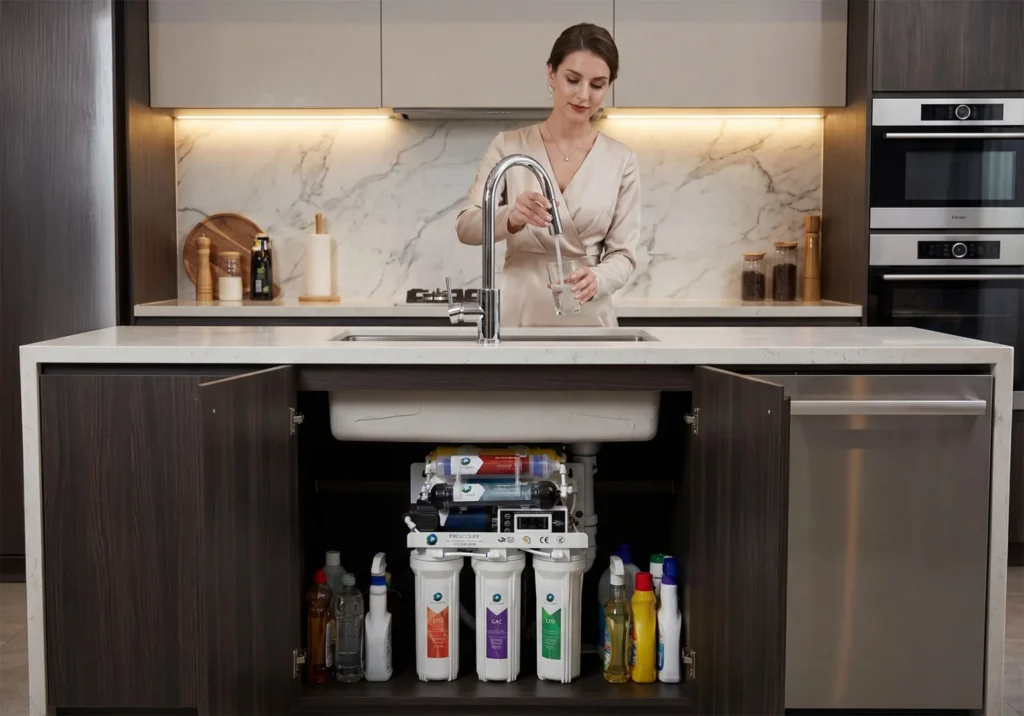
Choosing an Under-Sink Lead Filter for a Chicago Home
For drinking and cooking water, choose a filter certified to reduce lead under NSF/ANSI 53, or an under-sink reverse osmosis system certified for lead reduction under NSF/ANSI 58. A professional installation typically includes shutting off the cold-water valve, connecting the system as its instructions show, checking for leaks, and flushing the new cartridge before use. Because supply-line fittings and countertop drilling require precise work, many Chicago homeowners choose to have a licensed plumber handle the installation.
Older Chicago homes can still have lead service lines, legacy fixtures, or plumbing connections that affect water quality after it leaves Lake Michigan. A lead water filter under sink gives households a dedicated filtered-water source for drinking and cooking, while an inline unit treats water delivered through the main cold-water faucet. In the Northwest suburbs, hard water can also influence cartridge life and the maintenance needs of either configuration.
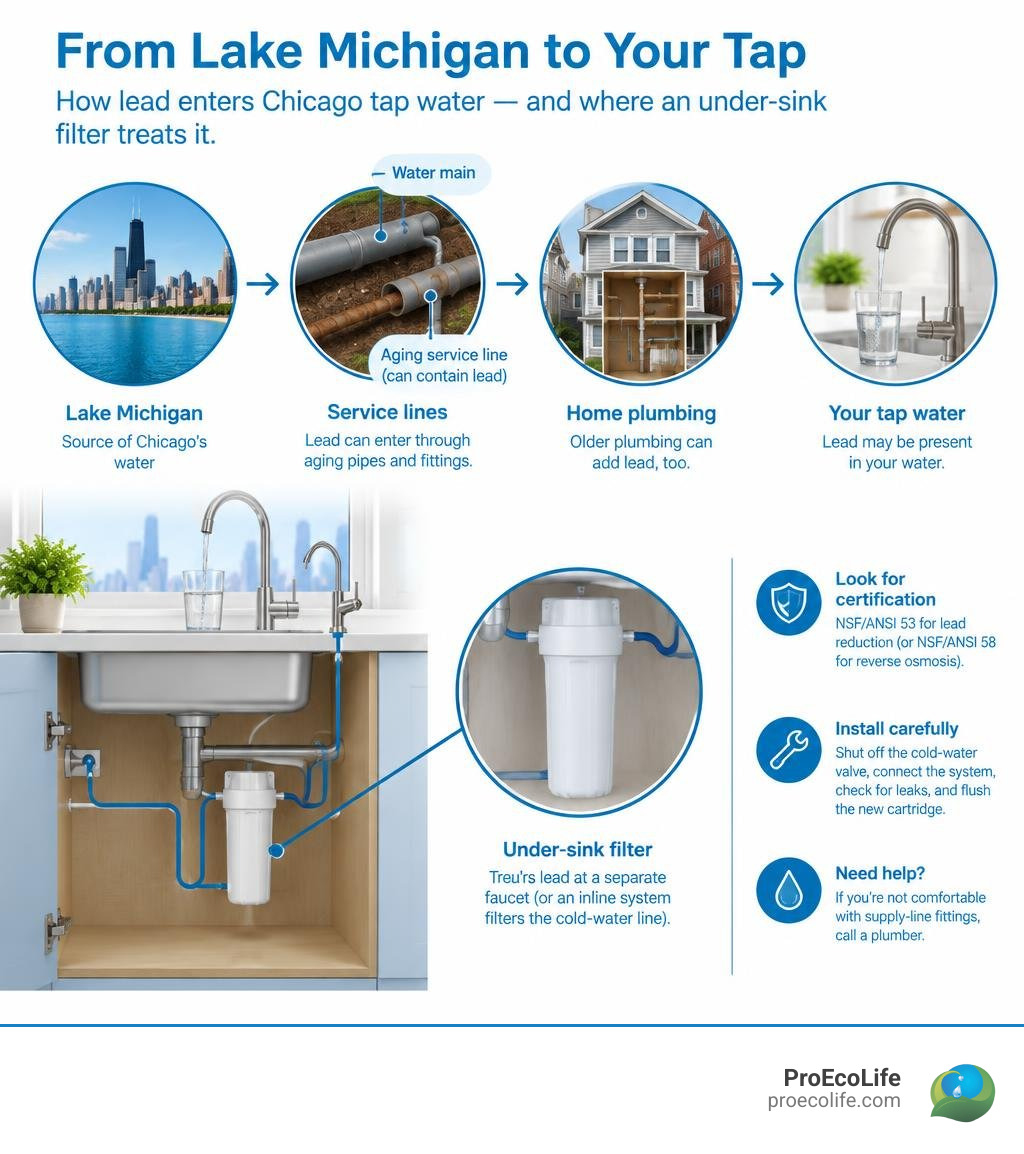
When exploring options for the best under sink lead filter, homeowners often evaluate whether a dedicated lead filter for faucet dispensing tap or a multi-stage reverse osmosis filter lead configuration best fits their daily household needs.
Understanding Lead Contamination and Filter Technologies
Health Risks and Lead Corrosion in Home Plumbing
While Lake Michigan serves as a reliable freshwater source, the journey water takes from the treatment plant to your kitchen tap often passes through aging infrastructure. In classic Chicago bungalows and brick two-flats across Norwood Park, Edison Park, and Jefferson Park, older lead service pipes and interior plumbing fixtures remain widespread. Homes constructed before the 1986 Safe Drinking Water Act ban frequently contain lead pipes, brass fixtures, and lead-based solder.
When water rests inside these aging pipes, chemical reactions can cause corrosive leaching, allowing microscopic heavy metal particles to dissolve directly into your drinking supply. According to the Environmental Protection Agency (EPA), the action level threshold for lead is set at 15 parts per billion (ppb). However, medical consensus confirms that no level of lead exposure is considered safe for human consumption, especially for infants and developing children. Lead accumulates in body tissues over time, potentially impacting cognitive development, nervous system function, and cardiovascular health. Navigating local initiatives for safe water access highlights how critical point-of-use filtration has become for residential households.
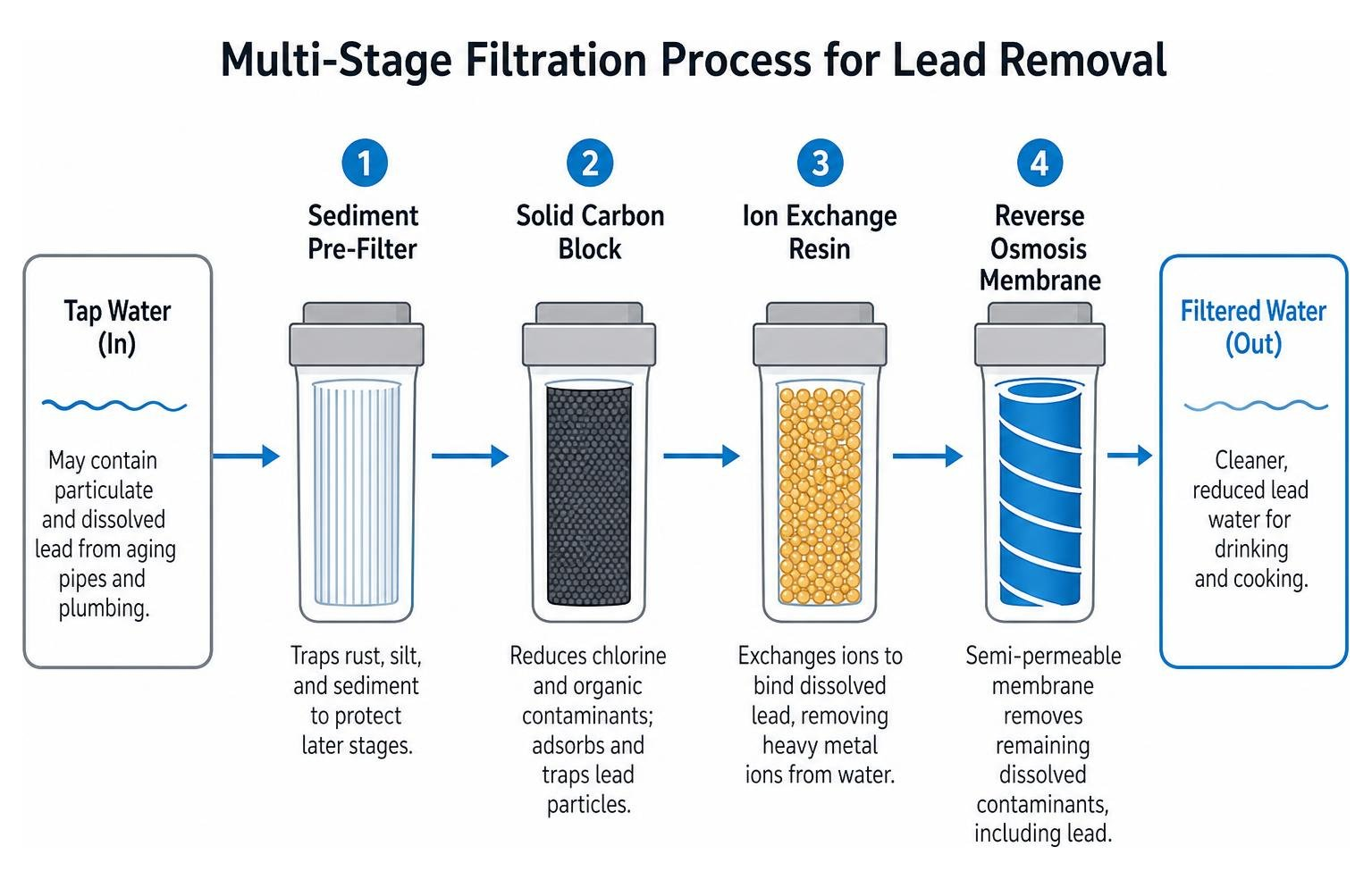
Filtration Media: Activated Carbon, Ion Exchange, and RO
Addressing lead contamination requires specialized media designed to capture both particulate lead (tiny physical flakes) and dissolved lead (soluble metal ions). Standard pitcher filters often lack the contact time or density to manage heavy concentrations.
- Sub-Micron Solid Carbon Blocks: Highly compressed activated carbon blocks physically trap particulate matter while employing chemical adsorption to bind toxic heavy metals to the carbon surface.
- Ion Exchange Resins: These synthetic media beads exchange harmless ions (like potassium or sodium) for positively charged dissolved lead ions, binding the heavy metals within the filter matrix.
- Multi-Stage Reverse Osmosis (RO): A semi-permeable membrane forces water molecules through microscopic pores under line pressure. Combining sediment pre-filtration, solid carbon blocks, and reverse osmosis represents a proven approach when evaluating the best way to remove lead from water.
Need Clean, Safe Water at Home?
Get a free water test at your home or business. We install and service whole-house filtration and PEL75 reverse osmosis systems across Chicagoland. We also take select projects in Wisconsin and Indiana.
Book a Free Water TestCall (312) 889-8888Choosing a Lead Water Filter Under Sink vs. Inline Systems
Dedicated Faucet Lead Water Filter Under Sink Configurations
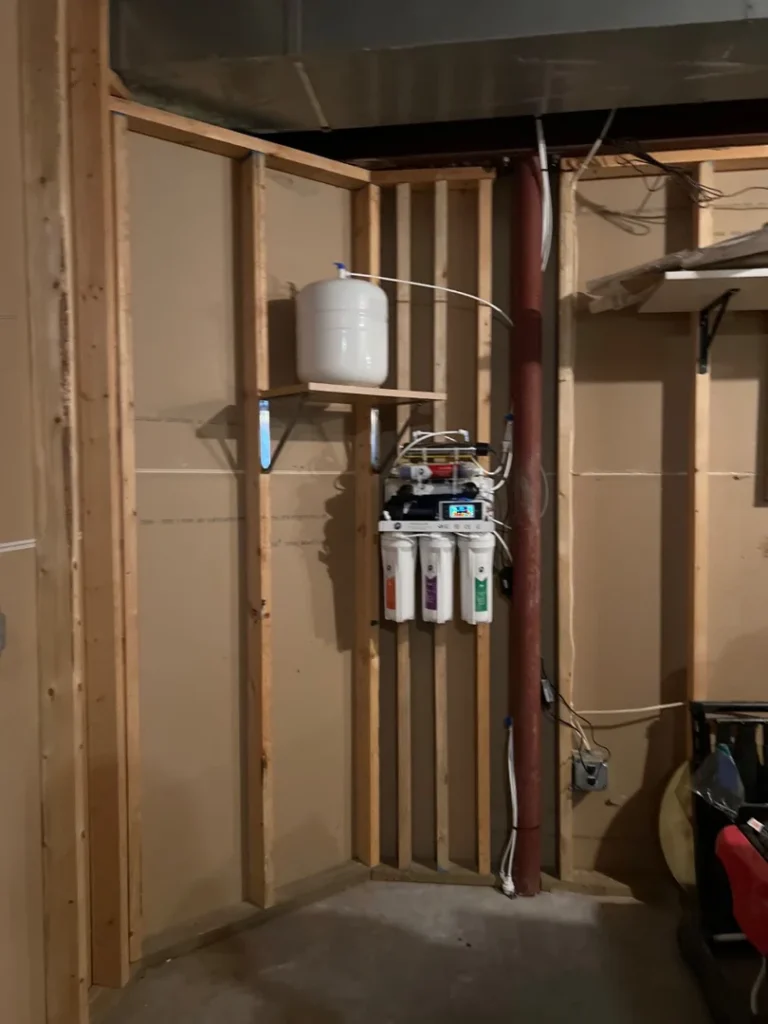
A point-of-use lead water filter under sink with a dedicated dispenser isolates your drinking and cooking water from your general utility water. In this configuration, the multi-stage system mounts neatly inside your cabinet and routes filtered water to a secondary, lead-free designer faucet installed right on your countertop.
Our PEL75 9-Stage RO System utilizes this specialized setup. By utilizing a separate tap, you avoid exhausting high-capacity filtration media on routine tasks like washing dishes or rinsing sponges. These advanced units carry independent certifications under NSF/ANSI Standard 53 for health effects (specifically heavy metals) or NSF/ANSI Standard 58 for reverse osmosis units, ensuring verified performance. Choosing an engineered system remains an essential step in finding dependable under-sink lead filters.
Inline Filter Systems: Full Flow vs. Direct Line
Inline filtration systems connect directly across your primary cold-water line without requiring a dedicated secondary faucet. Every drop exiting the cold side of your main kitchen faucet passes through the filter cartridge. Inline units can also be integrated along refrigerator lines to feed clear water to ice makers and built-in water dispensers.
While inline units eliminate countertop drilling, they process significantly higher volumes of water each day. In areas with heavier municipal particulates or hard mineral content, inline cartridges may experience faster flow rate reductions as they filter general utility water alongside drinking water. Selecting robust heavy metal water filters ensures proper protection without causing extreme pressure drops at the main sink.
Feature and Performance Comparison
| Feature | Dedicated Under-Sink RO System (e.g., PEL75) | Inline Direct-Line Filter |
|---|---|---|
| Dispensing Method | Dedicated secondary countertop faucet | Existing primary cold-water faucet |
| Target Contaminants | Lead, heavy metals, TDS, chlorine, VOCs | Lead, chlorine, taste, odor, sediment |
| Flow Rate | 0.5 to 0.8 GPM (optimized for drinking) | 1.5 to 2.2 GPM (matches plumbing flow) |
| Typical Cartridge Lifespan | 6 to 12 months (multi-stage intervals) | 6 to 9 months (handles total cold volume) |
| Cabinet Space Requirement | Moderate (holds filtration module & tank) | Compact (single or dual inline canister) |
| Suburban Hard Water Resilience | High (membrane separates dissolved minerals) | Moderate (scale can coat carbon blocks) |
For Chicago homeowners weighing both approaches, a professionally installed lead water filter under sink setup, whether a dedicated RO system or an inline cartridge, remains one of the most reliable ways to address lead at the point where water is actually consumed.
Need Clean, Safe Water at Home?
Get a free water test at your home or business. We install and service whole-house filtration and PEL75 reverse osmosis systems across Chicagoland. We also take select projects in Wisconsin and Indiana.
Book a Free Water TestCall (312) 889-8888Step-by-Step Installation and Plumbing Requirements
Plumbing Assessment and Preparation
Under-sink plumbing configurations vary across Chicagoland, from historical threaded galvanized pipes in older city homes to modern copper and PEX lines throughout Park Ridge, Niles, and Des Plaines. Professional installation ensures seamless integration with existing plumbing fixtures, such as dedicated RO dispensers or standard connections from manufacturers like Moen.

A certified plumbing technician typically assesses:
- Cold-water shut-off valve integrity (angle stop valve)
- Cabinet clearance and clearance around garbage disposals
- Countertop material (granite, quartz, or stainless steel) for secondary faucet positioning
- Feed water pressure and drain connection points
Professional System Integration
Installing an advanced point-of-use filtration system involves precise mechanical connections to maintain line pressure and avoid water damage. ProEcoLife’s team handles the full installation process for homeowners across Chicago’s Northwest Side and nearby suburbs.
- Water Supply Isolation: The cold-water angle stop is isolated and depressurized.
- Feed Adapter Integration: A specialized brass tee adapter is positioned between the angle stop and the flexible riser line.
- Dispenser Mounting: A dedicated lead-free drinking tap is secured into an existing accessory opening or precision-drilled port.
- Tubing and Manifold Placement: High-pressure food-grade tubing connects the supply line to the multi-stage filter manifold.
- System Purging and Testing: The technician flushes the initial carbon fines and performs strict pressure testing across every fitting.
Homeowners looking for comprehensive system options can explore modern under-sink water filters designed specifically for urban and suburban municipal water profiles.
Filter Maintenance, Lifespan, and Water Source Compatibility
Cartridge Lifespan and Routine Maintenance Tips
To maintain reliable heavy metal reduction, filtration cartridges must be serviced periodically. Over time, trapped sediment and adsorbed contaminants saturate the media channels.
- Replacement Schedules: Pre-filters and post-carbon blocks generally require replacement every 6 to 12 months, depending on household water consumption and incoming particulate levels.
- Monitoring Pressure Changes: A noticeable drop in water stream volume from your dedicated faucet often indicates that sediment pre-filters have reached maximum capacity.
- Sanitization and Seals: Routine service visits should include inspecting O-rings for structural integrity and sanitizing the filter housing bowls to prevent internal biofilm formation.
Municipal Supplies vs. Private Well Water Performance
While urban areas rely on Lake Michigan, homeowners in outlying regions or private properties often utilize well water systems. Well water carries distinct water chemistry challenges, such as elevated iron, varying pH levels, and heavy sediment, which can prematurely foul standard lead filtration media.
In these environments, integrating specialized Well Water Conditioning upstream shields sensitive sub-micron carbon blocks and reverse osmosis membranes from mineral fouling. For city water, a point-of-use under-sink filter pairs exceptionally well with centralized solutions like Whole House Filtration, protecting indoor air and plumbing while ensuring your drinking water remains thoroughly purified.
Frequently Asked Questions About Under-Sink and Inline Filters
Does boiling water remove lead as effectively as an under-sink filter?
No. Boiling water does not remove lead. Because water evaporates during the boiling process while heavy metal elements remain behind, boiling actually concentrates the lead levels in your cooking pot. Physical, certified filtration is necessary to remove dissolved and particulate metals.
What are the ongoing costs of an under-sink lead filter?
Ongoing expenses are limited to periodic filter cartridge replacements, typically once or twice per year. Compared to the continuous expense and plastic waste of bottled water delivery, point-of-use systems provide significant long-term economic value. To review long-term system configurations, explore our guide on how to choose a filter for lead in water.
What certifications guarantee lead reduction performance?
Look for systems certified to NSF/ANSI Standard 53 (Health Effects) specifically for lead reduction, or NSF/ANSI Standard 58 for reverse osmosis units. These independent laboratory testing standards verify that the filter can reduce lead levels from high concentrations down well below the federal action threshold.
Conclusion
Protecting your household from drinking water contaminants starts with understanding your plumbing infrastructure and selecting the right filtration technology. Whether you opt for an inline system or an advanced multi-stage under-sink reverse osmosis system, point-of-use filtration provides peace of mind for your family.
Since 2014, ProEcoLife founder Karol Dolega has led our mission to deliver pure, dependable water across Chicagoland. From our high-performance PEL75 9-Stage RO System to whole-home conditioning and Commercial Water Filtration Systems, we tailor every solution to regional water profiles. If you are comparing local options, review our insights on choosing the best lead water filter in Chicago for 2026.
Contact ProEcoLife today to schedule your comprehensive water test by calling (312) 889-8888 or visiting proecolife.com.