What a Reverse Osmosis Tap Does for Your Drinking Water
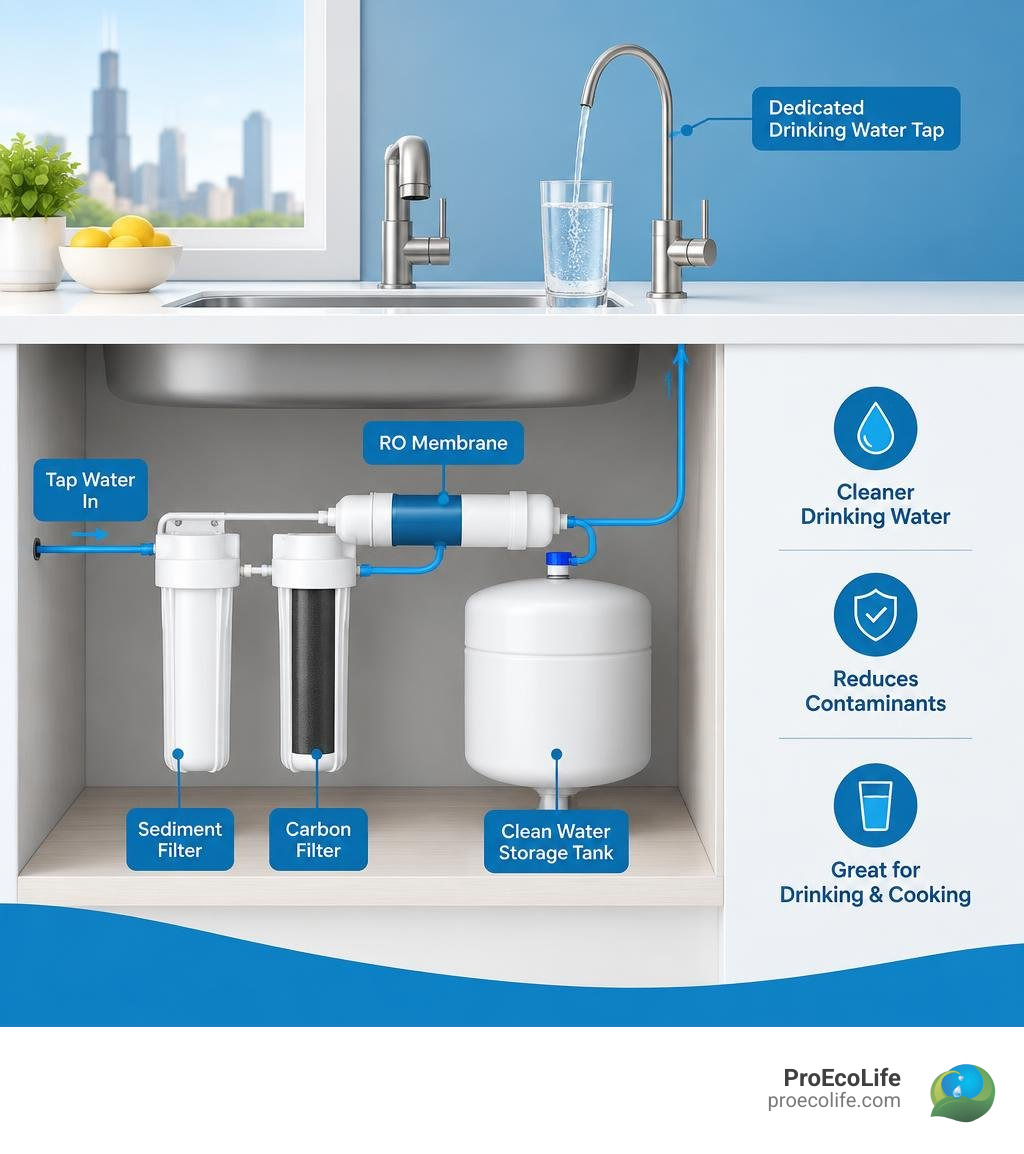
A reverse osmosis tap is a dedicated faucet that serves water cleaned by an under-sink filtration system. The faucet does not filter water on its own. The system pushes water through filters and a membrane that reduce dissolved minerals and many contaminants. Look for NSF/ANSI 58 certification and check which contaminants the specific system is certified to reduce.
That matters in Chicago. Our water starts in Lake Michigan, but lead can enter through aging service lines and plumbing in older homes. In the Northwest suburbs, hard water is another common concern. An RO tap can improve water used for drinking and cooking; it will not treat water throughout the house.
Key reverse osmosis tap vocabulary:
What Is a Reverse Osmosis Tap and How Does It Work?
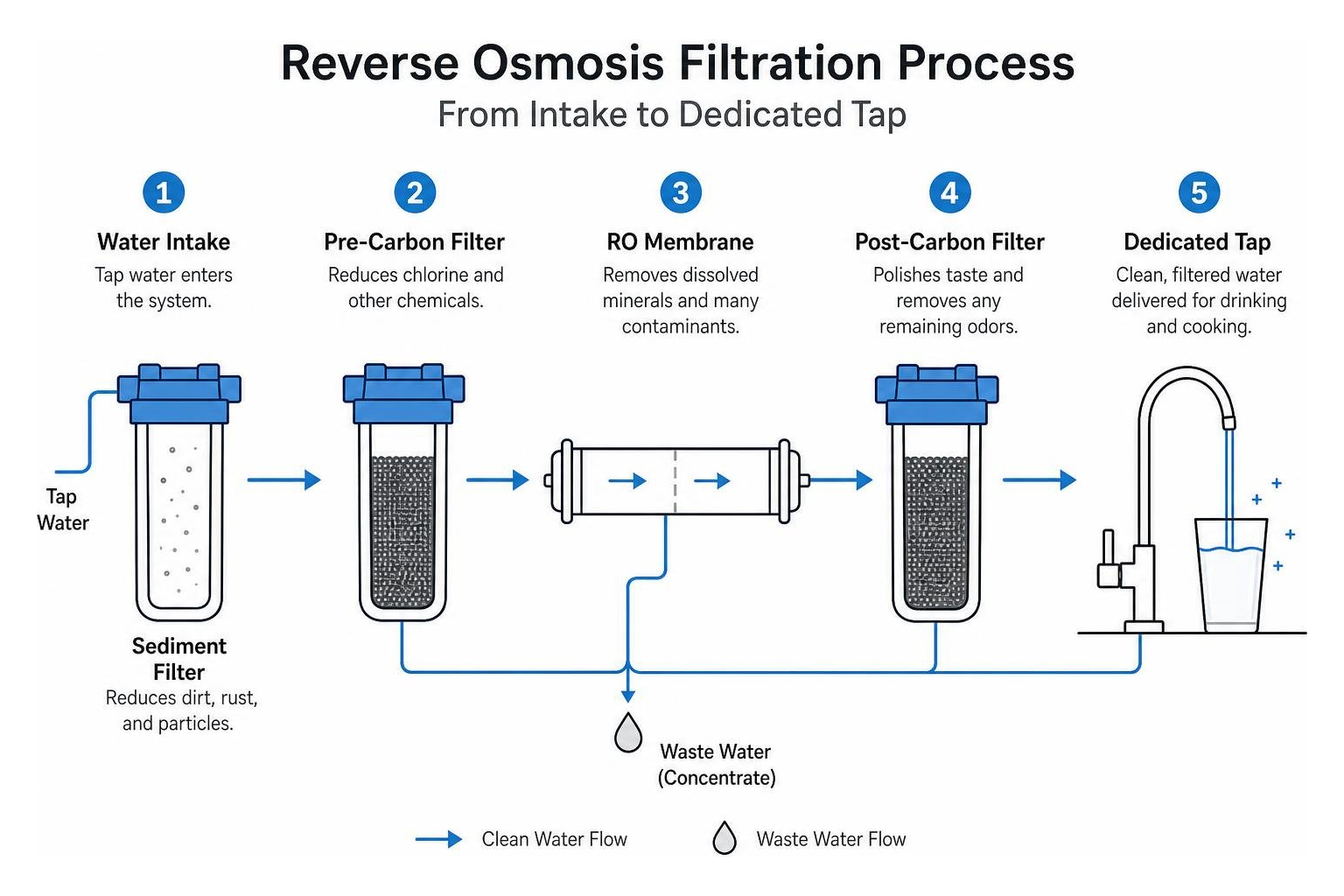
To understand how a dedicated drinking water faucet operates, it helps to look under the sink where the actual purification takes place. When exploring demystifying reverse osmosis technology, you find that pressure forces water through a dense, semipermeable barrier.
This process relies on an ultra-fine membrane filtering down to 0.0001 microns. At this microscopic level, the system separates pure water molecules from dissolved solids, heavy metals, chlorine byproducts, and persistent chemicals like PFAS.
For homeowners across our service areas—from city neighborhoods like Norwood Park, Edison Park, and Jefferson Park to suburbs like Skokie and Niles—this level of purification addresses genuine local concerns. Many older properties in Chicago still connect to aging lead service pipes, creating notable lead contamination risks in tap water. While municipal treatment plants manage water at the source, contaminants can leach into the stream before it reaches your glass. A dedicated faucet system acts as a final defense, delivering crisp water directly at the sink.
Key Components of a Reverse Osmosis Tap System
A complete residential setup comprises several specialized components working together:
- Dedicated Dispensing Faucet: The visible fixture mounted on your countertop or sink rim, engineered with non-corrosive waterways to keep purified water clean.
- Sediment Pre-Filter: Traps rust, silt, and larger particles commonly found in older distribution networks.
- Carbon Block Pre-Filters: Adsorb chlorine, chloramines, bad tastes, and odors to protect the sensitive membrane downstream.
- Semipermeable RO Membrane: The primary filtration barrier that rejects heavy metals, dissolved salts, and micro-pollutants.
- Pressurized Storage Tank: Holds purified water so it dispenses at a steady, convenient rate whenever the handle is turned.
- Remineralization Post-Filter: Rebalances the water’s pH and restores essential minerals like calcium and magnesium for optimal taste.
Since 2014, ProEcoLife founder Karol Dolega has focused on engineering systems built for our region’s specific water profiles. Our proprietary PEL75 9-Stage RO System incorporates these multi-stage barriers to help manage local water challenges, ensuring that every glass poured from your counter meets high standards of clarity and freshness.
Reverse Osmosis Tap vs. Standard Kitchen Faucet
A dedicated drinking water tap differs significantly from the main kitchen fixture:
| Feature | Standard Kitchen Faucet | Dedicated Reverse Osmosis Tap |
|---|---|---|
| Primary Purpose | High-volume washing, rinsing, and cleaning | Low-volume, purified drinking and cooking water |
| Flow Rate | Typically 1.5 to 2.2 gallons per minute (GPM) | Approximately 0.5 to 0.8 GPM |
| Water Source | Direct municipal cold and hot water lines | Pressurized storage tank or point-of-use RO unit |
| Tubing Size | Standard 3/8-inch or 1/2-inch braided supply lines | Dedicated 1/4-inch or 3/8-inch food-grade poly tubing |
| Material Construction | Standard brass, zinc, or stainless alloys | Lead-free waterways, inert plastics, or stainless steel |
| Filtration Routing | Delivers unfiltered municipal water | Dedicated path preventing contact with raw tap water |
Need Clean, Safe Water at Home?
Get a free water test at your home or business. We install and service whole-house filtration and PEL75 reverse osmosis systems across Chicagoland. We also take select projects in Wisconsin and Indiana.
Book a Free Water TestCall (312) 889-8888Key Types and Features of Modern RO Faucets
Modern drinking water fixtures come in an array of styles and finishes designed to match contemporary kitchen designs. Whether your kitchen in Glenview features brushed nickel, matte black, polished chrome, or oil-rubbed bronze, you can find a dedicated faucet that coordinates with your primary fixture. Many units feature a 120-degree swivel spout, making it easy to fill large stockpots or electric kettles on the counter.
Air Gap vs. Non-Air Gap Reverse Osmosis Tap Designs
When selecting a faucet, you will choose between air gap and non-air gap designs. Understanding the difference is vital for proper plumbing integration and code compliance:
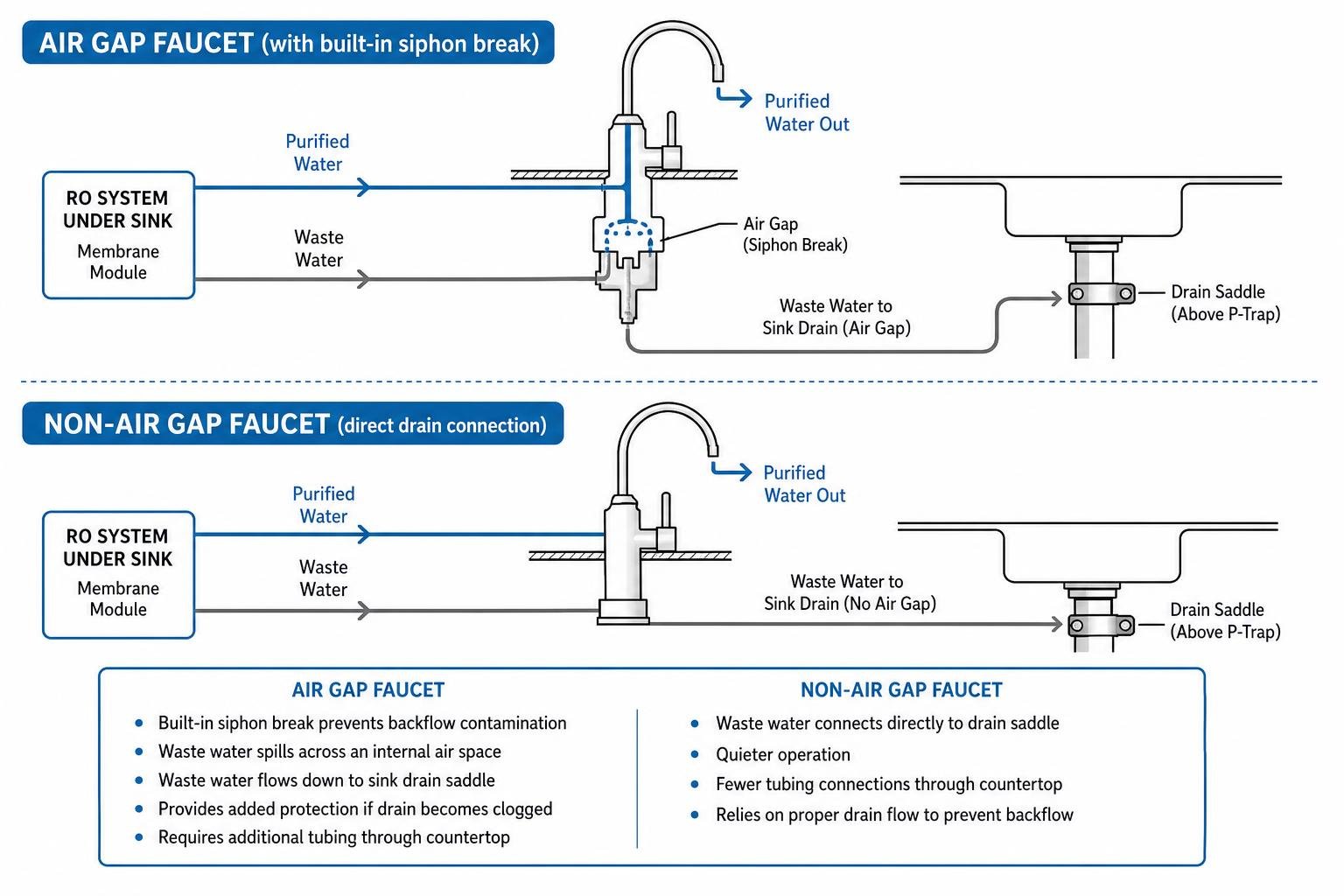
An air gap faucet incorporates a physical siphon break within the fixture body. As the system produces purified water, waste brine travels up to the faucet, spills across an internal air space, and flows down into the sink drain saddle. This physical separation prevents dirty sink water from ever siphoning backward into your clean water supply if the drain clogs.
A non-air gap faucet routes wastewater directly from the under-sink membrane module to the drain saddle beneath the sink. This design is quieter during operation and requires fewer tubing connections through the countertop.
| Feature | Air Gap Faucet | Non-Air Gap Faucet |
|---|---|---|
| Backflow Protection | Physical air break built into the faucet body | Relies on external check valves |
| Plumbing Codes | Required by many local municipal codes | Permitted in select jurisdictions or with separate gap |
| Countertop Hole Size | Usually requires a larger hole (1-1/4″ to 1-1/2″) | Fits standard smaller knockouts (1/2″ to 7/8″) |
| Operating Sound | May produce a slight gurgling sound as brine drains | Virtually silent operation |
| Tubing Connections | Three lines (feed, brine in, brine out) | Single line (pure water delivery) |
Smart Dispensing Features and Temperature Presets
Advanced point-of-use systems now offer electronic and smart dispensing capabilities. Certain modern fixtures incorporate multi-temperature presets directly on the spout interface, allowing instant preparation for infant formula, green tea, or French press coffee without a separate kettle.
For whole-home water needs beyond the kitchen sink, many families pair under-sink purification with a Whole House Filtration setup, a targeted Shower Filter System, or dedicated Well Water Conditioning for private wells in the outlying areas.
Need Clean, Safe Water at Home?
Get a free water test at your home or business. We install and service whole-house filtration and PEL75 reverse osmosis systems across Chicagoland. We also take select projects in Wisconsin and Indiana.
Book a Free Water TestCall (312) 889-8888Comparing Residential RO Faucets with Industrial Desalination
The physical principles underlying your under-sink system mirror those used in massive municipal and industrial facilities worldwide. However, the engineering scale, energy requirements, and operational parameters differ substantially.
Industrial systems treat millions of gallons per day (MGD) of high-salinity water containing roughly 35 grams of dissolved salts per liter. These plants use massive high-pressure pumps operating above 800 psi, specialized energy recovery devices (like isobaric pressure exchangers operating at 95% efficiency), and thousands of square meters of membrane surface area to achieve water recovery.
In places like Park Ridge, Des Plaines, and surrounding communities, reviewing public testing summaries via the Des Plaines EWG Tap Water Database or the Park Ridge water quality reports highlights why point-of-use filtration remains so practical. Rather than needing industrial-scale desalination, local homes benefit most from compact, multi-stage systems that target trace heavy metals, treatment chemical residuals, and mineral hardness right at the tap. For local business operations, commercial-grade options like Commercial Water Filtration Systems provide similar high-capacity purification scaled specifically for food service, healthcare, and office environments.
Installation, Maintenance, and Performance Standards
Installing a dedicated drinking water fixture requires precise alignment with your plumbing lines and countertop materials.

When planning your layout, it is helpful to understand the principles of choosing the right home filtration setup. A typical under-sink installation involves securing the faucet stem through an existing sink knockout hole (or drilling through granite, quartz, or stainless steel), tightening the threaded shank extender and wingnut fittings beneath the basin, and running dedicated tubing to the storage tank and membrane manifold.
Critical certifications to verify include:
- NSF/ANSI 58: The benchmark standard evaluating reverse osmosis systems for material safety, structural integrity, and verified contaminant reduction claims.
- WaterMark (AS/NZS 3497): An international performance standard certifying drinking water treatment units for reliable pressure containment and material extraction safety.
Over time, sediment accumulation or pressure fluctuations can occur. If you ever observe reduced flow rates, reviewing our guide on troubleshooting low faucet water pressure can help you identify whether a filter change or tank pressure adjustment is needed.
Because proper installation requires handling pressurized water connections, drain saddles, and delicate membrane housings, having a licensed professional complete the setup ensures your system remains leak-free and fully compliant with local plumbing codes.
Frequently Asked Questions About Reverse Osmosis Faucets
How much does a dedicated RO faucet cost?
The standalone fixture cost varies depending on materials, internal valving, and aesthetic finish. Entry-level, chrome-plated spouts sit at the lower end of the pricing spectrum, while designer solid-brass, matte black, or smart digital dispensing faucets with integrated heaters command higher price points. The total investment also reflects the multi-stage filtration system powering the tap.
Do I need a professional plumber to install an RO tap?
Professional installation is strongly advised. Installing an RO tap requires making clean cuts into existing cold-water supply lines, drilling sink materials without cracking delicate stone surfaces, mounting drain saddles correctly, and balancing pressure across the tank and filtration manifold. Professional installation protects your cabinetry against water damage and ensures compliance with regional plumbing regulations.
How often do I need to replace parts on an RO faucet?
The faucet hardware itself (spout, handle, internal ceramic disc valving, and base O-rings) can last for many years with minimal care. However, the underlying filtration components require regular scheduled maintenance:
- Sediment and carbon pre-filters: Typically replaced every 6 to 12 months.
- RO membrane: Typically serviced every 2 to 3 years, depending on local water hardness and total dissolved solids (TDS).
- Post-carbon and remineralization cartridges: Replaced annually to maintain optimal taste and balanced pH.
Conclusion
Installing a dedicated drinking water tap transforms your daily routine, providing pristine water for drinking, brewing morning coffee, and cooking right at your kitchen sink. By combining advanced pre-filtration with high-grade semipermeable membranes, these systems reduce heavy metals, chlorine, and emerging chemical pollutants that may enter your plumbing.
Understanding how reverse osmosis purification works gives you peace of mind regarding what your family consumes every day.

At ProEcoLife, we take pride in helping homeowners throughout the Chicago area—including Des Plaines, Park Ridge, Arlington Heights, Morton Grove, and surrounding Northwest suburbs—enjoy clean water straight from the tap.
Contact ProEcoLife today to schedule your comprehensive water test by calling (312) 889-8888 or visiting proecolife.com.