

Why a Reverse Osmosis Water Filter for Fridge Water and Ice Can Matter
A reverse osmosis water filter for fridge use sends water through multiple filter stages and a fine membrane before it reaches the refrigerator’s dispenser and ice maker. Unlike a basic in-line carbon filter, it can reduce many dissolved contaminants, including lead and other heavy metals, as well as chlorine-related taste and odor. For Chicago homes with older plumbing, that added level of filtration may be worth considering.
Before installing one, confirm three things:
- Your refrigerator can receive water from an external filtered line.
- You have space for a point-of-use RO unit, usually under the sink or in a nearby cabinet.
- The system can provide enough water pressure and flow for the dispenser and ice maker.
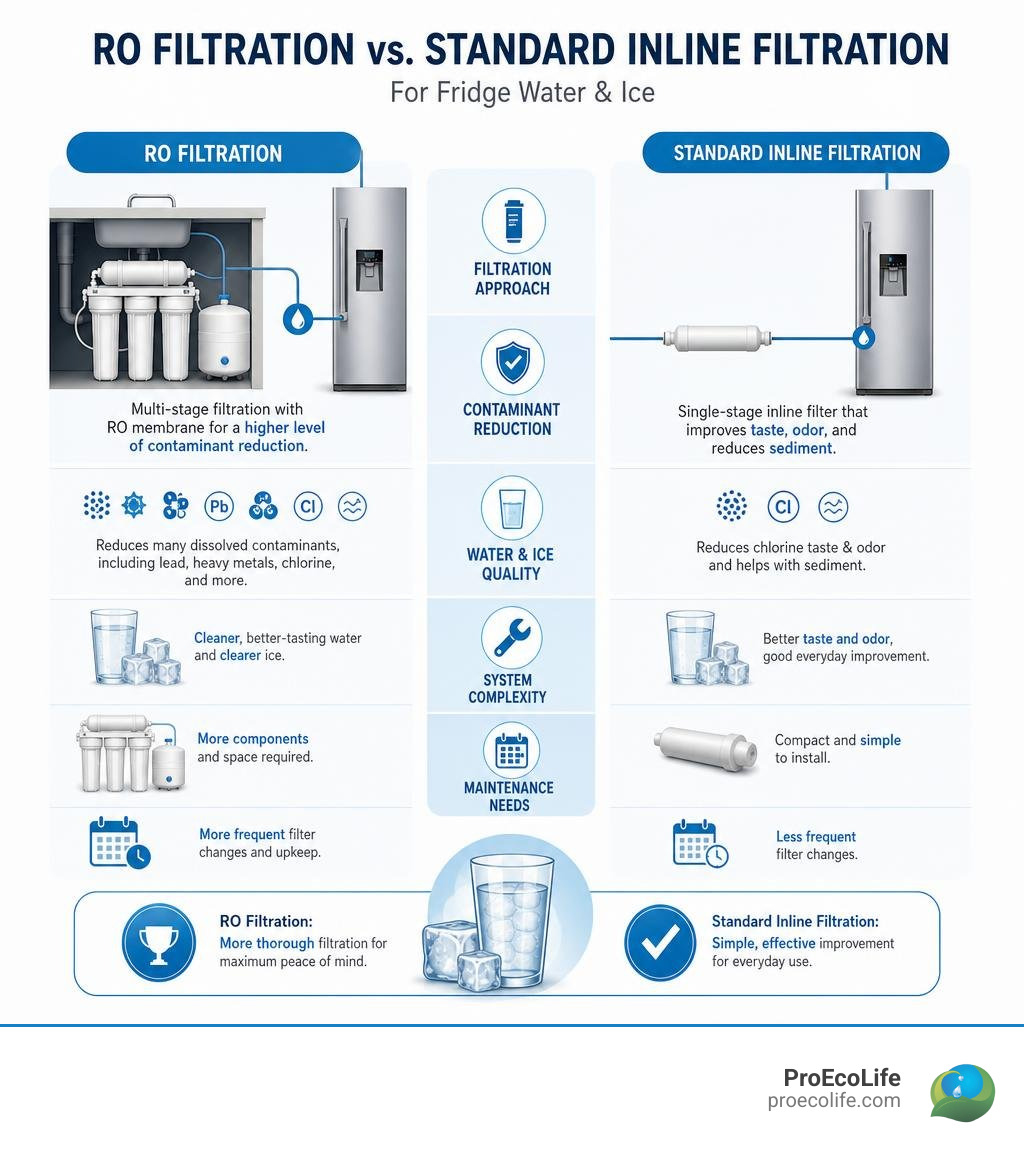
A standard in-line refrigerator filter is compact and simple, but its job is usually more limited: improving taste, odor, and sediment. Reverse osmosis is a larger system with more maintenance, yet it offers a more thorough approach to water quality.
This guide compares RO and in-line refrigerator filters, explains installation and replacement needs, and helps you decide whether connecting RO water to your fridge makes practical sense.
Simple reverse osmosis water filter for fridge glossary:
How Refrigerator Reverse Osmosis Works vs. Standard In-Line Filters
When we evaluate kitchen water treatment across Chicago, we find that many homeowners assume their refrigerator’s built-in cylinder or an exterior in-line filter provides complete purification. In reality, these standard options rely primarily on activated carbon, whereas a reverse osmosis setup utilizes mechanical separation at the molecular level.
A standard in-line cartridge, such as a traditional carbon block, allows water to flow through porous media at typical household line speeds. In contrast, an RO system forces pressurized tap water through a semi-permeable membrane with pores as minuscule as 0.0001 microns. Because this process is deliberate, the purified water is collected in a pressurized bladder storage tank before being routed to your kitchen faucet or refrigerator dispenser.
| Feature | Standard In-Line Fridge Filter | Multi-Stage Reverse Osmosis System |
|---|---|---|
| Primary Technology | Single carbon block / sediment mesh | Multi-stage pre-filters, semi-permeable membrane, post-carbon |
| TDS Reduction | Minimal to none | High reduction (often 90%–95%+) |
| Lead & Heavy Metal Removal | Varies widely; often limited | Thoroughly addresses dissolved metals and lead |
| Flow Rate Capability | ~0.5 GPM directly from line | Dependent on pressurized storage tank or delivery booster |
| Space Footprint | Compact (approx. 2″ x 10″) | Under-sink module (approx. 12″ x 11″ x 4.5″) plus storage tank |
| Filter Lifespan | 6 months to several years depending on model | Pre/post filters: 6–12 months; RO membrane: 2–3+ years |
Multi-Stage Membrane Purification vs. Single Carbon Block
A single carbon block excels at aesthetic water improvement. It catches coarse sediment and absorbs volatile organic compounds, yielding a standard chlorine taste and odor reduction (often around 73.93% in conventional long-life inline cylinders). However, standard carbon media cannot efficiently trap microscopic dissolved minerals, nitrates, or heavy metals dissolved in municipal lines.
By comparison, advanced reverse osmosis employs multiple targeted barriers. The water first traverses sediment and granular carbon pre-filters to remove larger rust flakes and chlorine that could degrade the main synthetic membrane. Next, the semi-permeable membrane strips away the vast majority of Total Dissolved Solids (TDS).
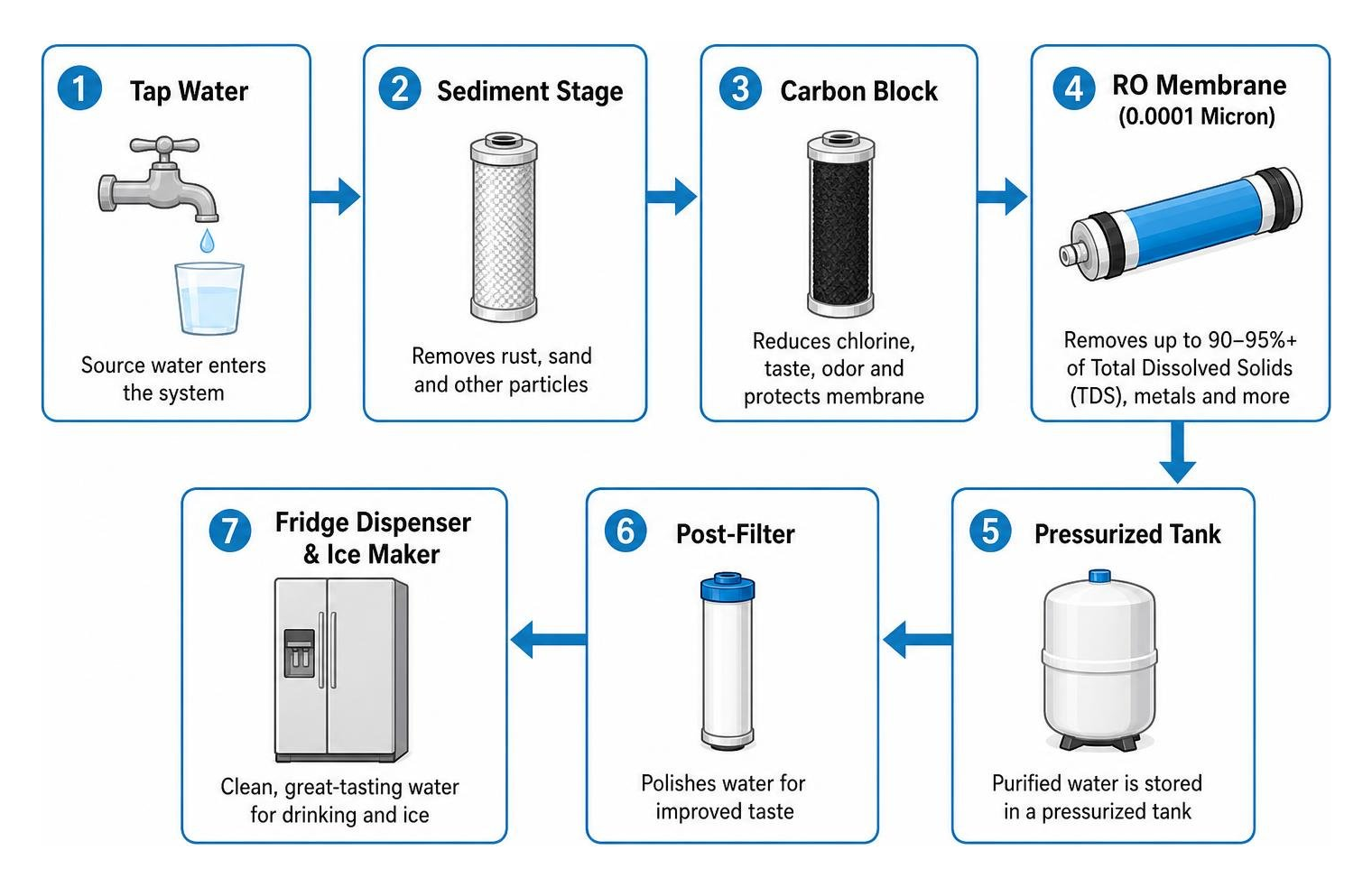
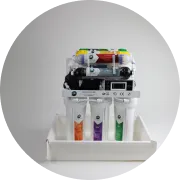
Systems engineered for comprehensive residential purification, such as our PEL75 9-Stage RO System, incorporate remineralization and polishing stages to balance pH before delivery. To understand the underlying physics behind this separation, explore demystifying reverse osmosis. While basic setups meet baseline in-line filter flow rate and pressure standards, multi-stage systems offer deeper purification for household drinking water.
Point-of-Use Under-Sink Units vs. Whole-House Filtration
Homeowners often ask whether they should install a dedicated point-of-use unit or a central whole-home setup. Both serve vital roles, but their applications differ:
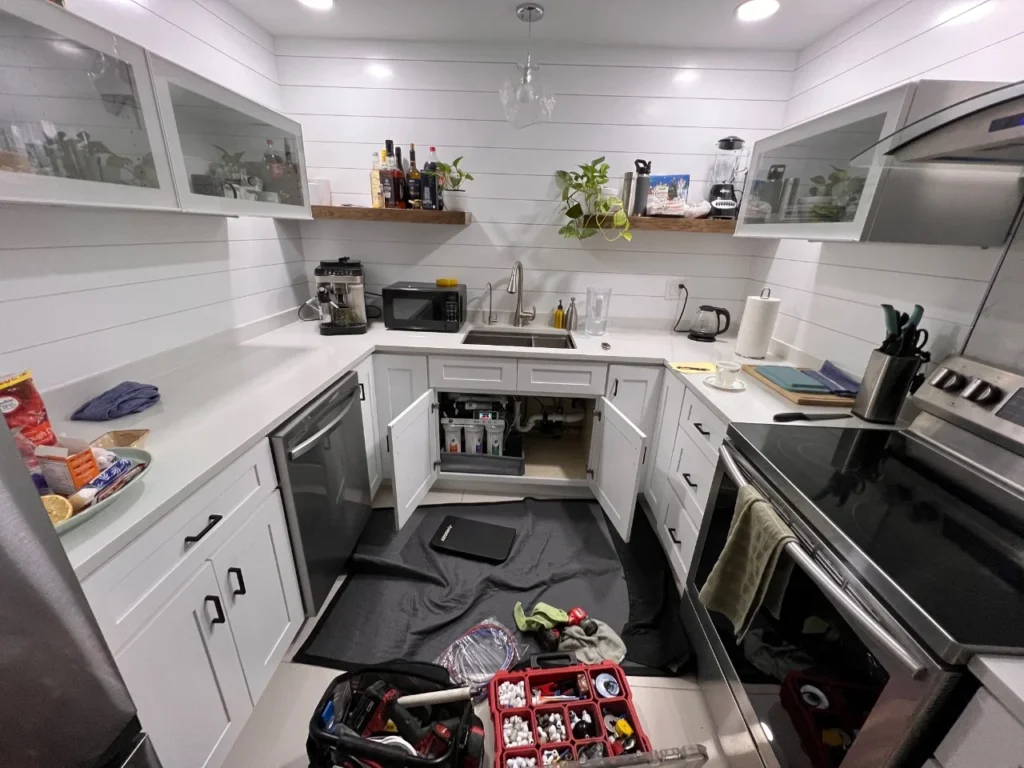
- Point-of-Use Under-Sink Units: Positioned inside the cabinet beneath your kitchen sink, these dedicated under sink water filters focus purely on drinking and cooking water. By running a 1/4-inch poly line from the under-sink storage tank to the refrigerator inlet, your ice maker and cold-water door dispenser receive deeply purified water without treating the entire home’s utility supply.
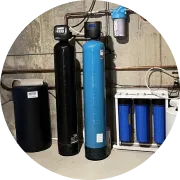
- Whole House Filtration: A central system treats water entering the home, removing sediment, chlorine, and hardness before it reaches water heaters, showers, and laundry appliances. While great for preventing scale and protecting plumbing fixtures, whole-house systems operate at higher flow rates and typically do not use hyper-fine RO membranes for the entire home.
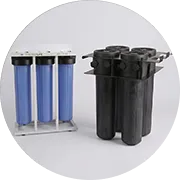
Evaluating the different types of water filters at home helps determine whether a point-of-use unit, a central Whole House Filtration setup, Well Water Conditioning, or a specialized Shower Filter System aligns best with your property’s plumbing infrastructure.
Need Clean, Safe Water at Home?
Get a free water test at your home or business. We install and service whole-house filtration and PEL75 reverse osmosis systems across Chicagoland. We also take select projects in Wisconsin and Indiana.
Book a Free Water TestCall (312) 889-8888Why Choose a Reverse Osmosis Water Filter for Fridge and Ice Dispensers?
Upgrading your refrigerator supply line to reverse osmosis water provides noticeable improvements in both taste and purity.

Comprehensive Contaminant and Heavy Metal Removal
Municipal water across the Chicagoland area originates from Lake Michigan, providing a consistent surface water baseline. However, the path that water takes to reach your glass matters immensely. Throughout historic Northwest Side neighborhoods like Norwood Park, Edison Park, and Jefferson Park, as well as nearby suburbs such as Park Ridge, Niles, Des Plaines, Skokie, and Evanston, thousands of homes receive water through vintage lead service lines or aging copper plumbing joined with lead solder.
Hard water conditions in many Northwest suburbs, including Glenview, Arlington Heights, Morton Grove, Mount Prospect, Wheeling, and Northbrook, can also leave elevated mineral content in the refrigerator line. While hardness is not the same issue as lead, those dissolved minerals may contribute to cloudy ice, scale buildup, and higher Total Dissolved Solids, so an RO connection may help improve fridge water and ice quality. Results vary depending on the home’s plumbing, incoming water chemistry, and system maintenance.
Standard refrigerator filters may saturate quickly when exposed to fluctuating particulate levels and dissolved metals. Reverse osmosis provides a reliable barrier against dissolved lead, copper, chromium, microplastics, and industrial chemical residues. Reviewing top rated reverse osmosis systems to remove lead from your home highlights why microscopic filtration remains the benchmark for heavy metal mitigation. To learn how reduced contaminant levels benefit daily hydration, see whether is reverse osmosis water really better for you.
Ice Clarity and Taste Benefits
Have you ever noticed that freezer ice cubes often look cloudy, white, and soft in the middle? That cloudiness is caused by dissolved minerals, gases, and microscopic impurities freezing inward and trapping air pockets at the center of each cube. Furthermore, ice readily absorbs lingering freezer odors.
Connecting an RO unit to your refrigerator’s ice maker removes these dissolved solids, yielding dense, slow-melting, crystal-clear cubes that do not alter the flavor of beverages. Exploring what are the benefits of drinking reverse osmosis water reveals how clean water enhances everything from cold drinks to morning coffee.
Need Clean, Safe Water at Home?
Get a free water test at your home or business. We install and service whole-house filtration and PEL75 reverse osmosis systems across Chicagoland. We also take select projects in Wisconsin and Indiana.
Book a Free Water TestCall (312) 889-8888Installation Requirements and Water Pressure Essentials
Integrating an advanced filtration unit with a modern refrigerator requires careful attention to line pressure and cabinet space.

Connecting a Reverse Osmosis Water Filter for Fridge Line Hookups
Standard refrigerator water valves, internal chillers, and automatic ice makers require steady water pressure to operate properly—typically between 25 and 125 psi. Reverse osmosis units naturally drop incoming tap pressure across their semi-permeable membrane, relying on a dedicated pressurized expansion tank to push water outward.
When running dedicated lines, professional installers account for appliance spacing and plumbing clearances. Modern French-door refrigerators with internal beverage centers, auto-fill pitchers, and dual ice makers require adequate rear space—often a minimum of 2 inches clearance—to prevent 1/4-inch poly supply tubing from kinking when the appliance is pushed back against the wall. Reviewing official refrigerator plumbing clearance specifications alongside a guide on how to choose a water filter ensures your kitchen layout accommodates both the filtration equipment and the refrigerator line connections.
If an existing refrigerator includes an internal carbon filter cartridge, technicians often replace that cartridge with an official manufacturer bypass plug. Running RO-purified water through a secondary, aging internal carbon block is unnecessary and causes an unneeded pressure drop at the dispenser.
Maintaining Your Reverse Osmosis Water Filter for Fridge Systems
Proper maintenance keeps your system operating smoothly and prevents pressure loss at the refrigerator door:
- Sediment & Pre-Carbon Stages: Replace every 6 to 12 months to protect the main membrane from chlorine degradation and sediment clogging.
- RO Membrane: Typically lasts 2 to 3 years or more depending on incoming water hardness and total dissolved solids.
- Post-Carbon Polishing & Remineralization Filters: Refresh every 12 months to maintain fresh taste.
- Annual System Sanitization: Disinfect filter housings and line connections during scheduled cartridge updates.
- Tank Pressure Calibration: Check the bladder tank pre-charge pressure annually (typically 7–10 psi when completely empty of water) to ensure consistent flow to your ice maker.
Following our in-depth guide to reverse osmosis systems will help you track key maintenance intervals and protect your kitchen appliances over the long term.
Frequently Asked Questions About Fridge Filtration
Does reverse osmosis cause slow refrigerator water dispensing?
Because reverse osmosis produces water gradually, it stores purified water in an expansion tank containing a pressurized air bladder. If the tank pressure drops or the distance between the under-sink system and the refrigerator is extensive, dispensing speed may decrease. In homes with lower baseline water pressure or long plumbing runs across basements, installing a dedicated delivery booster pump ensures crisp, rapid flow to both the dispenser and ice maker.
Can I connect an existing under-sink RO system to my refrigerator?
Yes. Professional technicians can install a quick-connect tee fitting on the post-filter output line of your existing under-sink RO unit. One line supplies the dedicated sink faucet, while the secondary line runs through cabinets or beneath the subfloor directly to the refrigerator’s 1/4-inch water inlet.
How often should the RO membrane and pre-filters be replaced?
Under typical Chicago water conditions, sediment and carbon pre-filters require replacement every 6 to 12 months. The reverse osmosis membrane generally lasts between 2 and 3 years before mineral scaling reduces its filtration efficiency. Routine testing of Total Dissolved Solids (TDS) confirms exactly when membrane performance begins to decline.
Conclusion
Upgrading the water supply to your refrigerator ensures that every glass of cold water and every batch of ice is crisp, clear, and thoroughly purified. While standard inline cartridges offer basic chlorine reduction, a multi-stage reverse osmosis system provides comprehensive protection against heavy metals, dissolved solids, and urban infrastructure contaminants.
Since 2014, ProEcoLife founder Karol Dolega has helped homeowners across Chicago’s Northwest Side—including Norwood Park, Edison Park, and Jefferson Park—as well as northern and western suburbs like Park Ridge, Niles, Des Plaines, Skokie, Glenview, Arlington Heights, Morton Grove, Harwood Heights, Norridge, and Elmwood Park, address local water quality challenges with confidence. Whether you are interested in an advanced under-sink unit, Whole House Filtration, or Commercial Water Filtration Systems, our team is here to assist.
To learn more about how advanced filtration works, explore how does reverse osmosis work. Contact ProEcoLife today to schedule a water test at proecolife.com.