
Lead in Chicago Water Is a Real Problem — Here’s What to Do About It
If you need to remove lead from your water right now, here are the most effective steps:
- Test your water first — use a certified lab, not a home dip strip
- Use a point-of-use filter certified to NSF/ANSI Standard 53 (such as a reverse osmosis system) for drinking and cooking water
- Run cold water only — never use hot tap water for drinking or making formula
- Flush your tap for 30 seconds to 2 minutes before drinking if lead pipes are suspected
- Contact your water utility to check whether you have a lead service line
- Replace lead pipes — filtration is a bridge, not a permanent fix
Lead is invisible. It has no taste. No smell. And yet it can cause irreversible neurological damage — especially in children under six and developing fetuses.
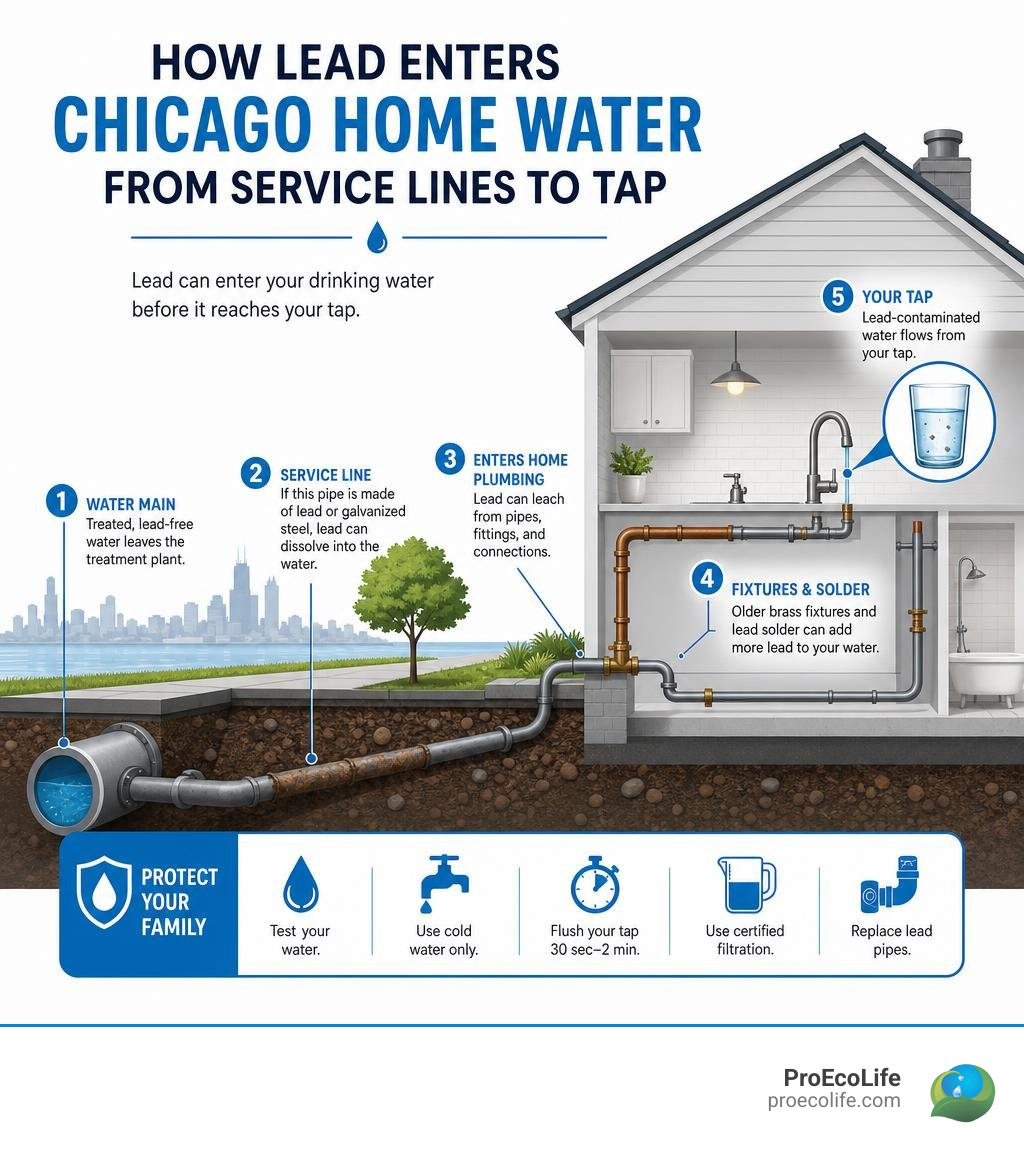
Chicago homeowners face a specific challenge here. While Lake Michigan source water itself is treated and lead-free when it leaves the plant, it picks up lead on the way to your tap — traveling through aging service lines, older brass fixtures, and lead solder joints common in homes built before 1986. In neighborhoods like Norwood Park, Edison Park, and Jefferson Park, many homes still have original plumbing that dates back decades.
The Flint, Michigan water crisis made national headlines, but lead contamination in older Chicago-area homes is an ongoing, quieter crisis that affects thousands of families every day.
The good news? You can take action today. Reliable filtration, proper testing, and — where needed — pipe replacement can dramatically reduce your family’s exposure.
Easy remove lead water glossary:
- best faucet water filter for lead removal
- best way to remove lead from drinking water
- reverse osmosis filter lead
The Chicago Lead Crisis: Why You Must Remove Lead Water
For decades, we’ve enjoyed the beautiful views of Lake Michigan, knowing it provides our city with an abundant source of fresh water. But once that water leaves the purification plant, it begins a long journey through a massive underground maze of pipes. In the Chicago area, that journey often ends with a trip through outdated plumbing.
Why is this a big deal? Lead is a highly poisonous neurotoxin that accumulates in soft tissues and bones over time. When it enters our bodies, it doesn’t just pass through; it stays. The health risks associated with lead exposure are severe and well-documented. According to the CDC, there is no safe blood lead level that has been identified for young children. Even incredibly small quantities of lead can trigger irreversible damage to the brain, kidneys, and nervous system.
In infants and children, lead exposure causes:
- Lowered IQ and learning disabilities
- Hyperactivity and behavioral issues
- Delayed physical and mental development
- Damage to red blood cells and hearing loss
For pregnant women, the risks are equally terrifying. Lead can cross the placental barrier, exposing the developing fetus to the neurotoxin, which can lead to premature birth, reduced birth weight, or developmental delays. You can read more about these critical health risks in the CDC’s guide on About Lead in Drinking Water | Childhood Lead Poisoning Prevention | CDC.
This isn’t just a concern for historic city brownstones, either. Nearby areas face similar infrastructure struggles. For instance, testing has shown that older suburban homes can also have hidden risks, as detailed in our report on Lead Found in Bartlett Drinking Water.

How to Identify Lead Pipes and Test Your Water
If you live in classic Northwest Side Chicago neighborhoods like Norwood Park, Edison Park, or Jefferson Park, or in neighboring suburbs, your home likely has a rich history—and potentially aging pipes.
To determine if your home has a lead service line, you can perform a quick visual inspection. Locate where the water main enters your basement or utility room (usually near the water meter).
- The Scratch Test: Use a flathead screwdriver or a key to gently scratch the pipe. If the scraped area turns shiny and silver (like a new nickel), and a magnet does not stick to it, the pipe is likely lead.
- The Plastic or Copper Test: If the pipe is copper-colored or made of rigid blue or black plastic, you’re in better shape for that specific section.
However, even if your main service line isn’t lead, older brass faucets and lead-containing solder (which was legal to use until 1986) can still leach heavy metals into your drinking supply.
The only way to know for sure is to test your tap water. We strongly advise against relying on cheap, over-the-counter home dip strips, which are notoriously inaccurate for detecting low parts-per-billion (ppb) concentrations of lead. Instead, water samples should be analyzed by a certified laboratory.
Municipalities across our service area have programs to help residents identify their plumbing materials. For example, you can explore the city guidelines on the Water Service Line Replacement | City of Des Plaines, IL page or check the inventory resources provided for residents via Lead Water Service Lines | Skokie, IL to see how local governments are tracking these lines in 2026.
Need Clean, Safe Water at Home?
Get a free water test at your home or business. We install and service whole-house filtration and PEL75 reverse osmosis systems across Chicagoland. We also take select projects in Wisconsin and Indiana.
Book a Free Water TestCall (312) 889-8888How Lead Enters Chicago Plumbing and the Impact of the EPA LCRI
Lead rarely, if ever, occurs naturally in our source water. Instead, it enters our drinking supply through a chemical reaction called corrosion. When acidic or low-pH water sits in lead pipes, brass fixtures, or copper lines connected with lead solder, it dissolves the metal directly into the water.

Lead service lines—the pipes connecting the municipal water main under the street to your home’s private plumbing—are the single largest contributors to this issue. Industry data shows that lead service lines contribute an average of approximately 50 to 75 percent of the total lead mass measured at the tap.
To combat this, public utilities use corrosion control treatments, such as adding orthophosphate to the water. This chemical forms a protective mineral scale barrier along the inside of the pipes to prevent lead from leaching. However, physical disturbances—such as nearby street construction, water main repairs, or replacing a water meter—can break this delicate scale loose, causing a sudden spike in lead levels.
This issue is widespread across our local communities. In Park Ridge, the city actively manages plumbing risks through its dedicated Lead Service Line Replacement – Park Ridge program. Meanwhile, neighboring Niles provides detailed local updates on its infrastructure through the Water Service Distribution Information | Niles, IL – Official Website portal.
The EPA Lead and Copper Rule Improvements (LCRI) Mandate
To address the persistent threat of heavy metals in municipal supplies, the U.S. Environmental Protection Agency (EPA) finalized the historic Lead and Copper Rule Improvements (LCRI). Under this federal mandate, community water systems across the country must replace all lead service lines under their control within a strict 10-year timeline.
The LCRI also lowers the regulatory “action level” from 0.015 mg/L (15 ppb) down to 0.010 mg/L (10 ppb). This means water systems must take aggressive corrective actions much sooner if elevated lead levels are detected during routine testing.
Furthermore, the LCRI places a heavy emphasis on environmental justice and equity. Historically, lower-income neighborhoods and communities of color have faced slower pipe replacement timelines. The new mandate ensures that water systems must prioritize replacement programs equitably, regardless of a neighborhood’s socioeconomic status.
For a deep dive into the official federal text of this regulation, you can review the 86418 document. To understand how these changing federal standards impact your home filtration options right now in 2026, take a look at our comprehensive guide, No Lead No Worries: Your Guide to Lead-Free Drinking Water.
Need Clean, Safe Water at Home?
Get a free water test at your home or business. We install and service whole-house filtration and PEL75 reverse osmosis systems across Chicagoland. We also take select projects in Wisconsin and Indiana.
Book a Free Water TestCall (312) 889-8888Effective Filtration Technologies to Remove Lead from Water
Because full infrastructure replacement will take years to complete across the Chicago area, installing a high-quality home filtration system is the most reliable way to protect your family today. However, not all water filters are created equal. Some basic carbon pitcher filters only target taste and odor (chlorine), leaving dissolved heavy metals completely untouched.
When looking to remove lead from water, you must select a system that is independently tested and certified to NSF/ANSI Standard 53 (for lead reduction) or NSF/ANSI Standard 58 (for reverse osmosis). NSF-certified systems have been independently verified to reduce lead from a highly contaminated 150 ppb down to 10 ppb or less.
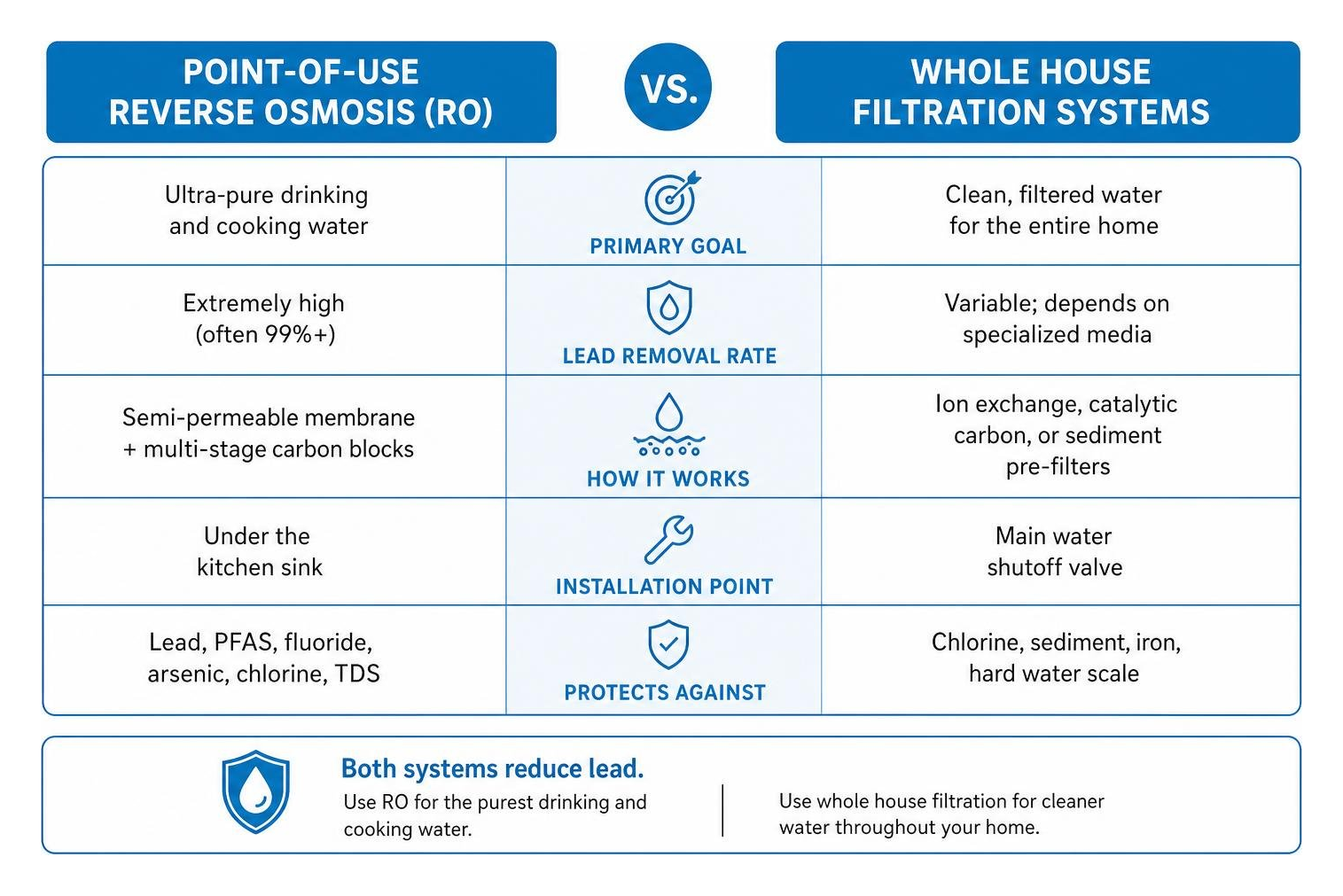
Let’s look at how the two most popular configurations compare:
| Feature | Point-of-Use Reverse Osmosis (RO) | Whole House Filtration Systems |
|---|---|---|
| Primary Goal | Ultra-pure drinking and cooking water | Clean, filtered water for the entire home |
| Lead Removal Rate | Extremely high (often 99%+) | Variable; depends on specialized media |
| How it Works | Semi-permeable membrane + multi-stage carbon blocks | Ion exchange, catalytic carbon, or sediment pre-filters |
| Installation Point | Under the kitchen sink | Main water shutoff valve |
| Protects Against | Lead, PFAS, fluoride, arsenic, chlorine, TDS | Chlorine, sediment, iron, hard water scale |
Why Point-of-Use Reverse Osmosis is the Best Way to Remove Lead Water
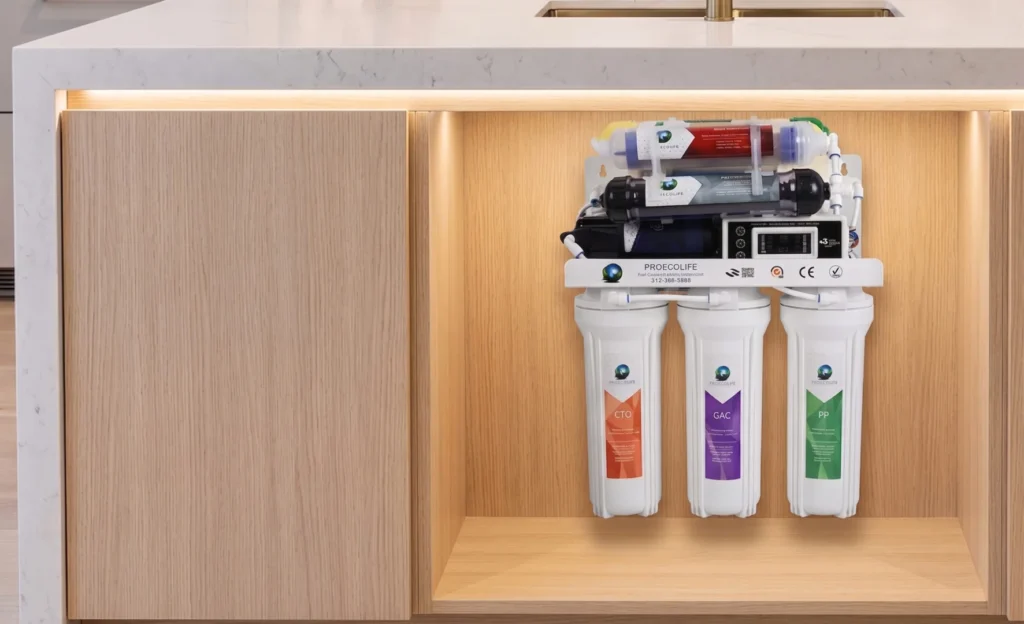
If your primary goal is to ensure that the water you drink, cook with, and use to wash vegetables is completely safe, a point-of-use reverse osmosis (RO) system is the gold standard.
Reverse osmosis works by forcing pressurized water through an incredibly fine, semi-permeable membrane. This membrane has pores so microscopic that they block dissolved lead ions, heavy metals, chemical residues, and microplastics, allowing only pure water molecules to pass through.
Our premier PEL75 9-Stage RO System is designed specifically to tackle the tough water conditions found in the Chicago area. Because Northwest suburban water often carries a heavy load of hard water minerals alongside potential lead risks, the PEL75 uses a multi-stage approach. It doesn’t just filter; it pre-treats the water to protect the membrane, removes chlorine, strips out lead, and then re-mineralizes the water with beneficial minerals so it tastes crisp and natural.
Using an RO system under your kitchen sink provides absolute peace of mind. You can learn more about how this process works by reading our detailed breakdown, Get the Lead Out: How Reverse Osmosis Filters Save Your Tap.
Can Whole House Filtration Systems Remove Lead Water?
A common question we hear from homeowners in Park Ridge, Niles, and Skokie is: “Can I just install a Whole House Filtration system to remove lead from every tap?”
The answer is nuanced. While we offer robust Whole House Filtration and Well Water Conditioning systems that do an incredible job of removing chlorine, sediment, iron, and chemical contaminants throughout your home, treating lead at the “point of entry” (where the water main enters your home) has limitations.
If you have lead pipes, lead solder, or older brass fixtures inside your home’s walls, a whole-house filter installed at the main shutoff cannot protect you from lead that leaches into the water after it passes through the filter.
For comprehensive protection, many of our customers choose to pair a Whole House Filtration system (which protects appliances, showers, and skin from chlorine and hard water) with a dedicated point-of-use RO system at the kitchen sink for drinking water. For a detailed look at the pros and cons of whole-home heavy metal filtration, check out our resource, Heavy Metal Meltdown: The Best Way to Remove Lead from Drinking Water.
Frequently Asked Questions about Lead in Drinking Water
Does boiling water remove lead?
No. This is one of the most dangerous misconceptions about water safety. Boiling water kills biological pathogens like bacteria and viruses, but it does not remove heavy metals. In fact, because boiling causes some of the water to evaporate, it actually concentrates the remaining lead, making the water more contaminated than it was before. Never boil water in an attempt to remove lead.
Is it safe to shower in lead-contaminated water?
Yes. Bathing, showering, and washing your hands in water containing lead is considered safe. Lead is not absorbed through the skin, and it does not pose an inhalation hazard during a warm shower. However, you should still avoid swallowing shower water, and we recommend using a Shower Filter System to remove chlorine and other synthetic chemicals that can dry out your skin and hair.
How often should I replace my lead-removal filter?
It depends on the system and your household’s water usage, but general manufacturer guidelines recommend replacing carbon block pre-filters every 6 to 12 months, and the reverse osmosis membrane every 2 to 3 years. Running water through an expired filter drastically reduces its effectiveness. If you notice a drop in water pressure or a change in taste, it’s time to have your system serviced.
Conclusion
Protecting your family from the dangers of lead in your drinking water doesn’t have to be a source of constant stress. Since 2014, ProEcoLife—founded by Karol Dolega—has been deeply rooted in the Chicago community, helping homeowners navigate our unique local water challenges.
Whether you are dealing with the hard water of the Northwest suburbs or the aging lead service lines of Chicago’s historic neighborhoods, we are here to help. We don’t believe in one-size-fits-all solutions. Our team provides professional water testing and expert installation of our advanced systems, including the PEL75 9-Stage RO System, customized to your home’s specific plumbing profile.
To learn more about selecting the perfect system for your household, read our in-depth guide on How to Choose the Best Lead Water Filter in Chicago: A 2026 Guide.
Ready to secure clean, lead-free water for your home? Contact ProEcoLife to schedule a professional water test at (312) 889-8888 or visit us online at proecolife.com.