


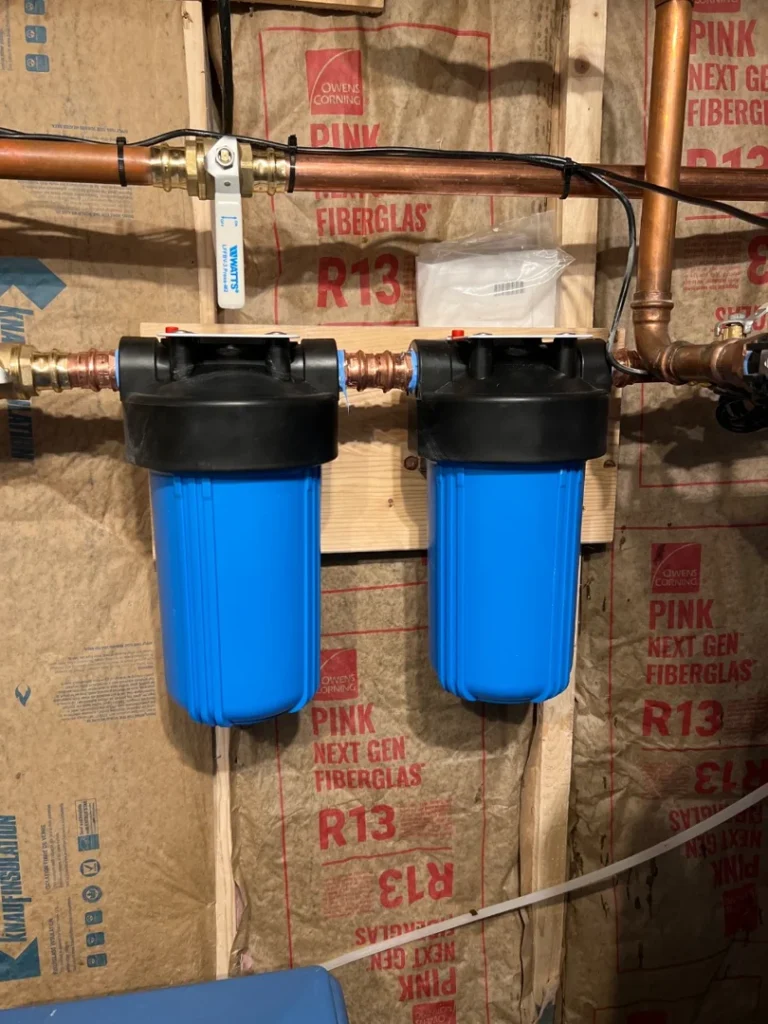
Why an Ion Exchange Whole House Water Filter Matters for Chicago Homes
An ion exchange whole house water filter treats water where it enters your home. It uses charged resin beads to pull certain dissolved minerals and metals from the water and replace them with less troublesome ions. Most commonly, it is used to reduce hardness minerals such as calcium and magnesium, helping limit scale on fixtures, pipes, and appliances.
For Chicago homeowners, the important detail is this: standard water softening resin is designed mainly for hardness, not every water-quality concern. Some specialized ion exchange media can target contaminants such as lead, iron, nitrate, or radium, but the system must be selected based on a current water test and the specific source of the water.
In practical terms, a whole-home ion exchange system may help you:
- Reduce hard-water scale in water heaters, dishwashers, and plumbing
- Improve soap lathering and reduce mineral spotting
- Address certain dissolved metals with the right resin and system design
- Protect household plumbing while pairing with carbon filtration or reverse osmosis for contaminants ion exchange does not handle well
For homes with aging plumbing, especially where lead exposure is a concern, ion exchange can be one part of a broader treatment plan. It does not automatically remove chlorine, sediment, bacteria, PFAS, or all forms of lead. The right setup depends on your water chemistry, plumbing, and treatment goals.
Similar topics to ion exchange whole house water filter:
How an Ion Exchange Whole House Water Filter Works
At ProEcoLife, founded by Karol Dolega with deep Chicago roots since 2014, we have helped countless families navigate the unique quirks of our local water supply. Whether your home receives municipal Lake Michigan water or relies on a private well in outlying areas, understanding how water treatment works begins right at the molecular level.
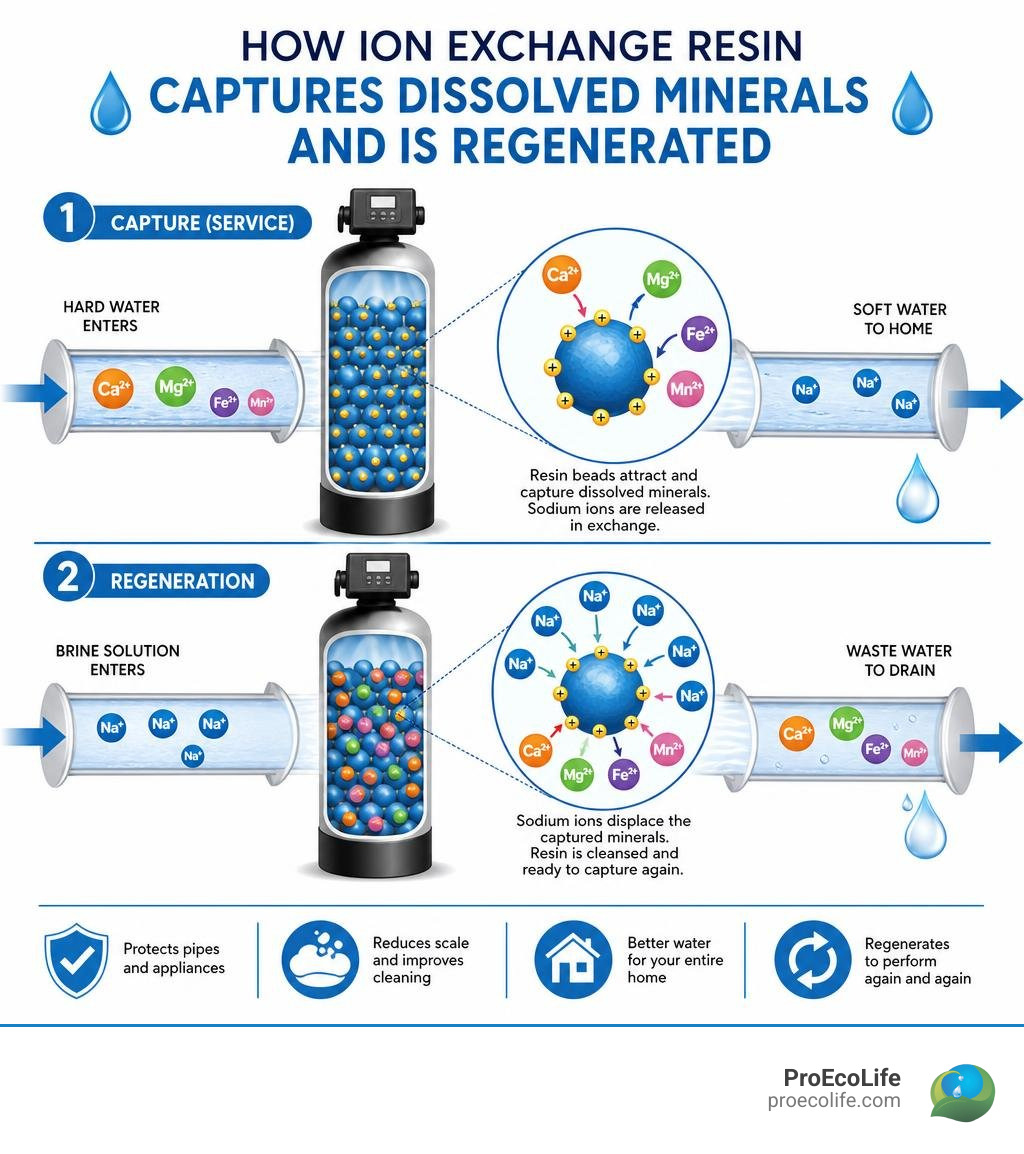
Ion exchange relies on electrostatic attraction. Inside a pressurized mineral tank sits a densely packed bed of microscopic, porous synthetic resin beads. These beads carry fixed electrical charges. As raw tap water flows through the resin bed, dissolved ions with a stronger positive or negative charge displace harmless, weakly bonded ions resting on the beads’ surfaces.
In a traditional cation softening process, the resin holds loosely bound sodium or potassium ions. When hard water carrying dissolved calcium ($Ca^{2+}$) and magnesium ($Mg^{2+}$) passes through, the resin exhibits a higher physical affinity for these divalent ions. The resin captures the calcium and magnesium, releasing an equivalent balance of sodium ($Na^+$) into the water stream. The water leaves the tank softened and chemically balanced, significantly reducing scale potential throughout your pipes.

The Science of Cation vs Anion Resin Beads
The exact contaminants an ion exchange media can target depend entirely on whether the resin is cationic or anionic:
- Cation Exchange Resins: These beads carry permanent negative charges and attract positively charged ions (cations). Standard strong acid cation (SAC) resins excel at removing calcium, magnesium, ferrous iron, and dissolved radium. Specialized cation resins can also be engineered to attract positively charged heavy metal species such as dissolved lead ($Pb^{2+}$).
- Anion Exchange Resins: These beads carry permanent positive charges and attract negatively charged ions (anions). Strong base anion (SBA) resins are specifically deployed to target nitrates ($NO_3^-$), sulfates, arsenic compounds, and certain forms of dissolved organic tannins.
By selecting the appropriate functional groups on these polymer beads, our water specialists can tailor resin formulations to address the exact mineral composition revealed by water testing.
The Regeneration Cycle in an Ion Exchange Whole House Water Filter
Resin beads have a finite capacity. Once all available exchange sites are occupied by hardness minerals or heavy metals, the media becomes exhausted and cannot capture additional ions. An automated control valve initiates a periodic regeneration sequence to restore the media bed:
- Backwash Step: Water rushes upward through the resin bed in reverse, expanding the beads and flushing out trapped physical particulates, sediment, and channel paths.
- Brine Draw (Regeneration): The control valve siphons a concentrated sodium chloride (or potassium chloride) brine solution from an adjacent storage tank into the resin bed. The overwhelming concentration of sodium forces the captured calcium, magnesium, and heavy metals off the resin sites, recharging the beads with fresh sodium ions.
- Slow and Fast Rinse: Clean water flushes through the tank to strip away residual brine and released hardness minerals, directing the waste safely down the household drain line.
- Brine Tank Refill: The system adds fresh water back to the salt tank to prepare the brine solution for the next scheduled regeneration.
Modern units utilize metered, demand-initiated regeneration, calculating household water volume to regenerate only when necessary, preventing wasted salt and water.
Need Clean, Safe Water at Home?
Get a free water test at your home or business. We install and service whole-house filtration and PEL75 reverse osmosis systems across Chicagoland. We also take select projects in Wisconsin and Indiana.
Book a Free Water TestCall (312) 889-8888Key Benefits and Contaminants Removed by Ion Exchange Filtration
Hard water creates constant friction inside household plumbing. Across Chicago’s Northwest Side neighborhoods like Norwood Park, Edison Park, and Jefferson Park, as well as nearby suburbs including Park Ridge, Niles, Des Plaines, Skokie, Glenview, Arlington Heights, and Morton Grove, homeowners routinely struggle with hard water issues.
Installing a comprehensive Whole House Filtration setup incorporating ion exchange offers several tangible improvements:
- Plumbing and Appliance Protection: Eliminating scale deposits helps preserve heat exchangers, extends the operating life of water heaters, and keeps dishwasher spray arms clear.
- Soap and Detergent Efficiency: Softened water allows soaps and shampoos to lather cleanly, reducing the amount of cleaning products required for laundry and dishwashing.
- Skin and Hair Hydration: Bathing in water free of abrasive calcium minerals helps minimize skin dryness and prevents brittle hair.
- Dedicated Well Treatment: For properties using private wells, specialized systems like our well water conditioning units prevent severe iron staining and mineral buildup.

Target Contaminants: Hardness, Heavy Metals, and Nitrates
Ion exchange handles dissolved ionic substances with exceptional efficiency. Target contaminants include:
- Hardness Minerals: Calcium carbonate and magnesium ions are captured, preventing stubborn limescale rings on bathroom fixtures.
- Ferrous Iron: Clear-water (dissolved) iron is pulled from the water stream before it can oxidize and produce red-orange rust stains on sinks and laundry.
- Radium and Barium: Naturally occurring radioactive isotopes and alkaline earth metals present in deep bedrock aquifers exchange readily onto cation resins.
- Nitrates: Anion exchange configurations capture agricultural runoff and fertilizer derivatives, which is especially beneficial for semi-rural well systems.
- Dissolved Heavy Metals: When paired with selective media, systems can support overall Chicago lead-safe filtration initiatives by reducing dissolved heavy metal loads.
Limitations and What Ion Exchange Cannot Remove
While ion exchange excels at managing dissolved mineral charges, it is not a standalone cure-all. Homeowners should understand what standard ion exchange resin cannot remove:
- Sediment and Turbidity: Silt, sand, and pipe rust will foul resin beds rather than be filtered by them, requiring a dedicated pre-filter.
- Disinfection Byproducts and Chlorine: Municipal disinfectants degrade synthetic polystyrene beads over time and pass through without reduction.
- Volatile Organic Compounds (VOCs) and Industrial Solvents: Uncharged synthetic chemicals do not interact with electrostatic resin sites.
- Microplastics and Particulate Lead: Solid physical particles require physical barrier media rather than ionic exchange.
- Microbiological Pathogens: Bacteria, cysts, and viruses cannot be neutralized by ion exchange resin.
To achieve total residential purification, ion exchange should serve as an integrated component within a broader, multi-stage filtration strategy.
Need Clean, Safe Water at Home?
Get a free water test at your home or business. We install and service whole-house filtration and PEL75 reverse osmosis systems across Chicagoland. We also take select projects in Wisconsin and Indiana.
Book a Free Water TestCall (312) 889-8888Comparing Whole House Filtration Technologies
Every filtration technology addresses a distinct category of water contaminants. Choosing the best setup requires matching the media’s strengths to your home’s water profile.
| Filtration Technology | Primary Mechanism | Best For | What It Leaves Behind |
|---|---|---|---|
| Ion Exchange | Electrostatic ion swap via charged polymer resin | Hardness minerals (Ca/Mg), dissolved iron, nitrates, radium | Chlorine, VOCs, sediment, bacteria, PFAS, particulate lead |
| Activated Carbon | Physical adsorption and chemical reduction | Chlorine, taste, odor, VOCs, pesticides, disinfection byproducts | Hardness minerals, dissolved heavy metals, nitrates, fluoride |
| Reverse Osmosis (RO) | Semi-permeable membrane separation under pressure | Total Dissolved Solids (TDS), heavy metals, arsenic, nitrates, microplastics | Requires wastewater discharge; primarily sized for point-of-use drinking water |
| Sediment Filtration | Mechanical sieving and depth filtration | Sand, rust flakes, pipe scale, silt | Dissolved minerals, chemicals, odors, heavy metals |
Integrating Carbon and Reverse Osmosis with Ion Exchange
Rather than relying on a single mechanism, high-performance residential water treatment pairs complimentary technologies. Reading all about whole house filters reveals that multi-barrier designs yield the most reliable results.
In an integrated home setup, municipal water first encounters a sediment and catalytic carbon whole-house system. The carbon media strips out chlorine and chloramines, protecting downstream plumbing and preventing harsh disinfectants from oxidizing the delicate polymer bonds inside the ion exchange resin tank. The ion exchange stage then removes hardness minerals and heavy metals.
For the highest standard of culinary and drinking water, a point-of-use unit like our proprietary PEL75 9-Stage RO System is installed at the kitchen sink. This system removes fine dissolved solids, lead traces, and emerging contaminants like PFAS, while an integrated Shower Filter System further safeguards personal care routines from residual irritants.
Sizing, Installation, and Maintenance for Residential Systems
Proper sizing and configuration are essential for reliable operation. An improperly sized system can cause disruptive pressure drops during peak morning routines across multi-bathroom households.

Connecting a whole-home system involves tying into the main water service line before branches reach the water heater, installing a three-valve bypass manifold, running a dedicated brine discharge line to a floor drain with an approved air gap, and wiring the digital metering valve. Ensuring complete code compliance and leak protection requires expert water softener installation managed by licensed professionals.
How to Size an Ion Exchange Whole House Water Filter for Your Home
Determining the proper capacity requires reviewing three primary factors:
- Water Hardness Level: Measured in Grains per Gallon (GPG). A water test pinpoints this baseline figure.
- Daily Household Usage: Calculated by multiplying the number of residents by the standard consumption baseline (typically 75 to 80 gallons per person per day).
- Peak Flow Rate: Measured in Gallons Per Minute (GPM), representing the maximum simultaneous water demand from showers, laundry, and appliances running at once.
To establish the required grain capacity:
$$text{Daily Hardness Load (Grains)} = text{People} times 75text{ Gallons} times text{GPG Hardness}$$
Sizing the system to regenerate roughly once every 6 to 8 days prevents unnecessary wear and optimizes salt consumption. Reviewing our guide on how to choose a water filter can help clarify capacity calculations for your floor plan.
Long-Term Maintenance, Lifespan, and Operating Costs
A quality ion exchange system provides durable performance when properly cared for:
- Resin Bed Durability: Premium cross-linked polystyrene resin beads typically last 10 to 15 years on chlorinated municipal water when shielded by upstream carbon filtration, and up to 20 years on private well water.
- Salt Replenishment: Checking the brine tank monthly and keeping salt levels above the water line ensures uninterrupted regeneration cycles.
- Resin Cleaning: Using a specialized resin bed cleaner once or twice annually helps strip stubborn iron and mineral deposits that standard brine flushes leave behind.
- Valve Maintenance: Inspecting internal piston seals, spacers, and injector screens every few years ensures smooth operation and prevents continuous drain line leaks.
Frequently Asked Questions About Whole House Ion Exchange Systems
Does an ion exchange filter make tap water taste salty?
No, softened water does not taste like salt water. The system does not add table salt (sodium chloride) into your drinking supply; it exchanges hardness minerals for trace sodium ions at a molecular level.
For water with moderate hardness (around 10 grains per gallon), the process adds approximately 75 milligrams of sodium per quart of water—comparable to the sodium found in a single slice of white bread. However, homeowners following strict medically prescribed low-sodium diets can either utilize potassium chloride pellets in the brine tank or install a reverse osmosis drinking system to remove residual sodium at the tap.
Can ion exchange resin remove lead and PFAS from tap water?
Standard water softening resin is formulated specifically for calcium and magnesium and does not provide reliable protection against dissolved or particulate lead, nor can it capture PFAS “forever chemicals.”
However, specialized ion exchange media featuring heavy-metal-selective cation resins or specialized anion resins can target specific contaminants when properly engineered. Because Chicago homes built before 1986 frequently connect to city mains via legacy lead service lines, relying solely on a conventional water softener for lead abatement is not recommended. Comprehensive lead and PFAS protection requires integrating multi-barrier catalytic carbon blocks and reverse osmosis filtration.
How often does a whole house ion exchange system need maintenance?
Routine homeowner maintenance is minimal: checking the brine tank once a month to replenish salt pellets is usually all that is required. The digital control valve manages backwashing and regeneration automatically based on actual gallon usage. Having a professional technician inspect the system annually to sanitize the resin bed, test raw and treated water hardness, and clean the brine injector will keep the system operating at peak efficiency for years.
Protect Your Home with Custom Water Treatment Solutions
Water quality varies significantly throughout our region, from aging lead service lines across older Chicago properties to hard, mineral-laden aquifer supplies throughout the northwest suburbs. At ProEcoLife, we take the guesswork out of home water treatment by engineering tailored Whole House Filtration System packages that address your home’s unique water chemistry.
Whether you need a dedicated ion exchange conditioner, multi-stage carbon filtration, or Commercial Water Filtration Systems for your business, our experienced local team is here to assist. Contact ProEcoLife today through proecolife.com to schedule a water test and learn how we can help protect your plumbing and improve your water quality.