

Chicago’s Lead Pipe Crisis: What Every Homeowner Needs to Know Right Now
If you’re looking for information on lead service line replacement in Chicago, here’s a quick overview of your main options:
| Program | Who It’s For | Cost to You |
|---|---|---|
| Equity Lead Service Line Replacement Program | Homeowners with income below 80% AMI, children under 18 OR elevated lead levels | Free (valued $16,000–$30,000) |
| Homeowner-Initiated Program | Any Chicago homeowner who hires a licensed contractor | Permit fees waived up to $5,000 |
| Breaks and Leaks Program | Homes with a service line break or active leak | City-coordinated |
| Block-Long Replacement Program | Homes on a block with active water main construction | City-coordinated |
To apply or check eligibility, call 312.742.2406 or visit LeadSafeChicago.org.
Chicago has a water problem that most residents don’t even know about yet.
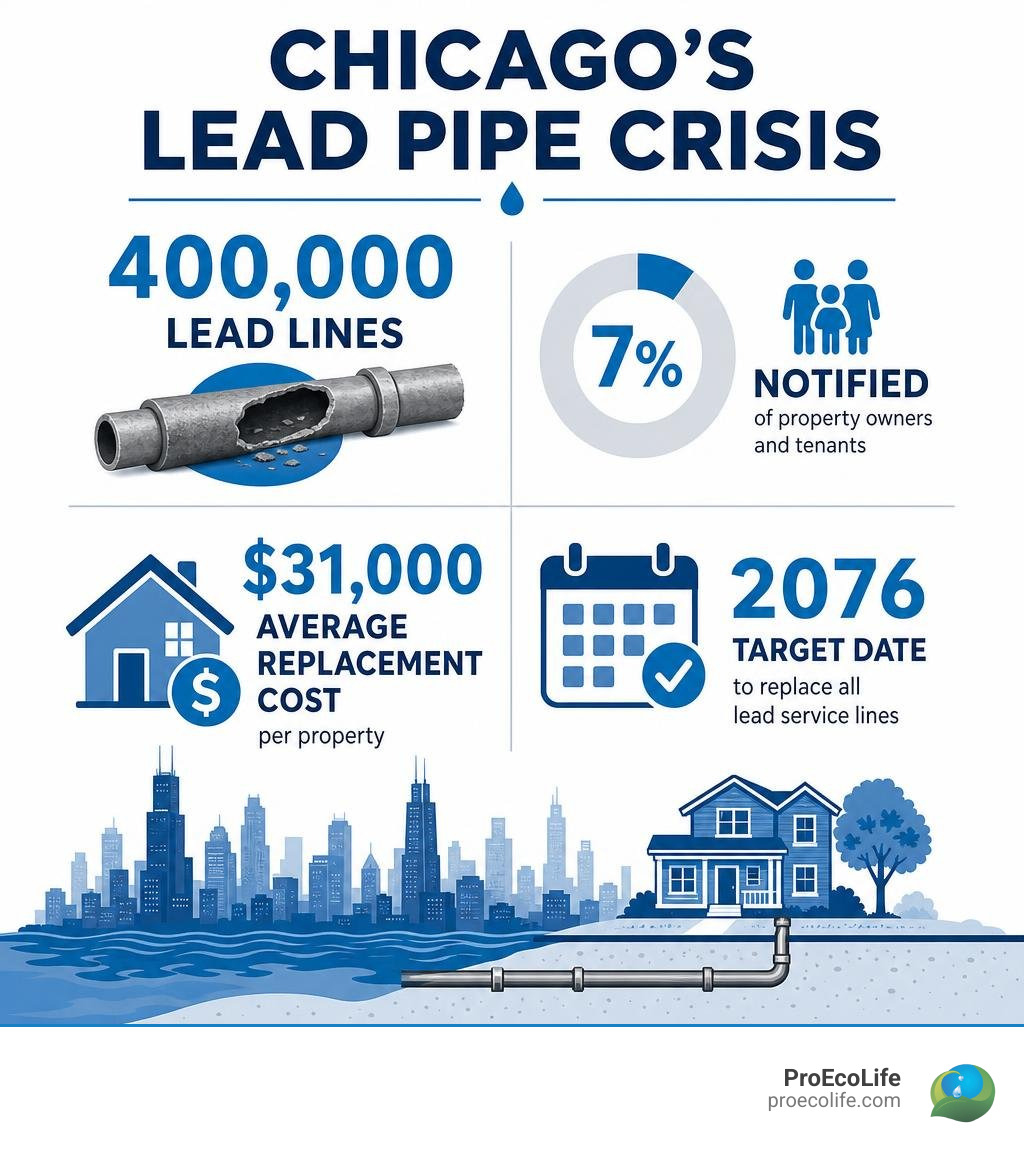
The city has approximately 400,000 lead service lines — more than any other city in the United States. These are the pipes that carry water from the street main directly into your home. If your house or two-flat was built before 1986, there is a strong chance that pipe is made of lead.
What makes this especially troubling is the timeline. The city’s current target for replacing all of these lines is 2076 — a full 30 years behind the federal mandate. As of July 2026, the city has only notified about 7% of the roughly 900,000 homeowners, landlords, and tenants who are legally required to be informed about their lead pipes.
One city council member called the situation “a ticking time bomb” putting children’s brains at risk. That’s not an overstatement. There is no safe level of lead exposure for children, and Chicago’s aging infrastructure puts families across the city — especially on the South and West Sides — at ongoing risk every time they turn on the tap.
The good news: there are real programs available right now to help Chicago homeowners replace their lead service lines, some at no cost. And while you wait for city action, there are immediate steps you can take to protect your family’s water.
This guide walks you through everything — from how to check if you have a lead service line, to which replacement programs you may qualify for, to what you can do today to reduce your family’s exposure.
Lead service line replacement chicago vocab to learn:
The Scale of Chicago’s Lead Pipe Crisis

To truly understand why we are dealing with this massive headache, we have to look at the sheer numbers. Chicago’s lead water pipe network is not just a minor municipal oversight; it is an infrastructure crisis of historic proportions.
While Lake Michigan provides us with a beautiful, abundant source of fresh water, the journey that water takes from the lake filtration plants to your kitchen faucet is where things get risky. The city has over 400,000 lead service lines still in active use. To put that in perspective, New York City—which has more than double Chicago’s population—only has about 100,000 lead lines.
This toxic legacy places Illinois near the top of the list when it comes to water safety concerns. In fact, you can read more about how our state compares nationally in our detailed report on Illinois One of Worst Contaminated Water States.
Why Chicago Has the Most Lead Service Lines in the U.S.
How did we end up with this crown of lead? It wasn’t an accident. It was actually the law.
Up until the federal government banned lead pipes in public water systems in 1986, Chicago’s municipal building code explicitly mandated the installation of lead service lines for homes and two-flats. While other cities were transitioning to safer materials like copper, Chicago’s political influence and strong ties to local plumbing industries kept lead as the legal standard.
If your home in Norwood Park, Edison Park, or Jefferson Park was built before 1986, there is a exceptionally high probability that the pipe connecting your basement to the water main under the street is made of solid lead. This historical policy created a structural hazard that now impacts hundreds of thousands of families. For a deeper dive into how this happened, check out our analysis of Chicago’s Risky Water Problem.
The 2076 Timeline for Lead Service Line Replacement Chicago
Under the U.S. Environmental Protection Agency’s (EPA) Lead and Copper Rule Improvements (LCRI), most cities across the United States are legally required to find and replace every single lead service line within a strict 10-year window.
However, because our local inventory is so massive, the EPA granted Chicago a special 20-year exception starting in 2027. This means the city has until 2047 under federal rules. Yet, local officials and water department planners have admitted that the city is actually on pace to finish the job by 2076.
This 30-year delay beyond the federal target means that an entire generation of Chicago children will grow up before the city manages to pull the last toxic pipe out of the ground. Environmental advocates and investigative journalists have voiced serious concerns about this extended timeline, as detailed by EPA Gives Chicago Decades to Replace Lead Pipes, Leaving Communities at Risk – Inside Climate News .
City-Assisted Programs for Lead Service Line Replacement Chicago
Knowing that the city has a mountain of pipes to replace, you might be wondering how you can fast-track your own home’s replacement. The city has established several pathways to help residents, depending on their income level, neighborhood, and plumbing conditions.
If you are trying to figure out how to navigate these municipal pathways without getting lost in the paperwork, we have compiled a step-by-step guide on How to Qualify for Free Lead Pipe Replacement in Chicago.
The Equity Lead Service Line Replacement Program
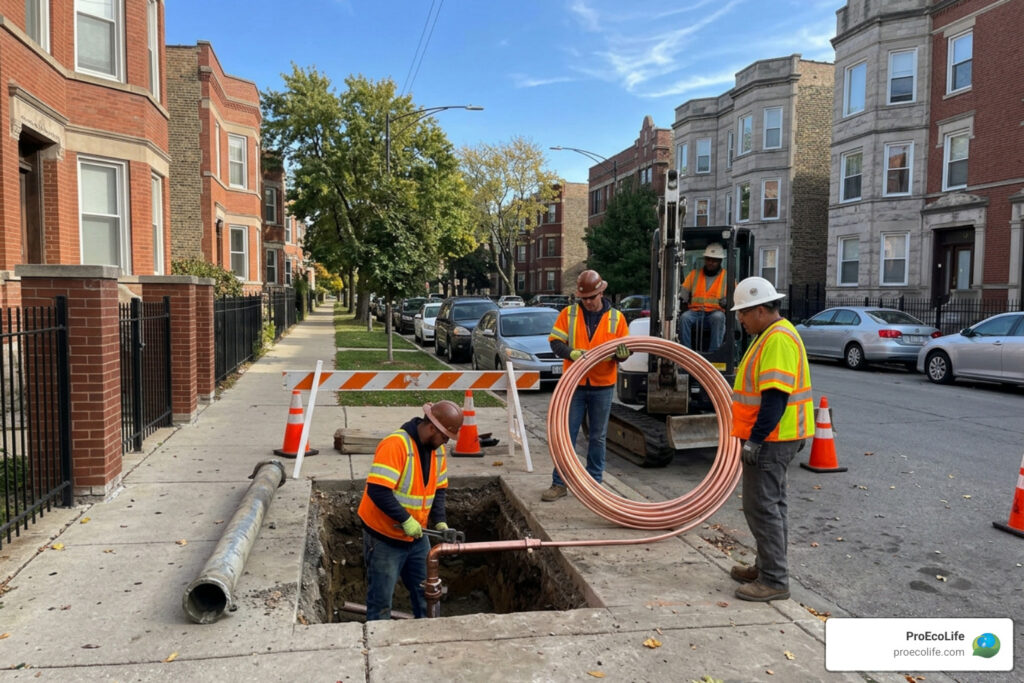
For low-to-moderate-income homeowners, the city offers a fully subsidized pathway. The Equity Lead Service Line Replacement Program provides a complete, free replacement of both the public and private portions of your water line—a service valued between $16,000 and $30,000.
To qualify for this program, you must meet the following criteria:
- You must own and reside in a single-family home, two-flat, or three-flat within the city limits.
- Your household income must be below 80% of the Area Median Income (AMI), which translates to $83,350 for a family of four.
- Your household must either include a child under the age of 18 OR your home must have tested positive for elevated lead levels (above 15 parts per billion) through a city-approved water testing kit.
If you meet these requirements, the city will coordinate the engineering, excavation, pipe installation, and water meter hookup at no cost to you. You can read the official guidelines and start your application on the Equity Lead Service Line Replacement Program portal.
The Homeowner-Initiated Program and Permit Fee Waivers
What if your income is above the 80% AMI threshold, but you still want that toxic pipe out of your house immediately? You can take matters into your own hands through the Homeowner-Initiated Program.
Under this initiative, you hire a private, licensed plumbing contractor to perform the physical replacement. To make this more affordable, the City of Chicago agrees to waive municipal permit fees, saving you up to $5,000 in administrative costs. Additionally, the city will install a free water meter during the process.
However, there is a catch: the permit fee waiver only applies if the replacement is a standalone project. If you are doing a major home renovation, adding an extension, or doing other work that requires a water main tap, the city may deny the waiver. This program is legally outlined in the Municipal Code of Chicago: ARTICLE IX. LEAD SERVICE LINE REPLACEMENT PROGRAMS (11-12-900 et seq.) . You can find registered contractors and application forms directly on the Homeowner-Initiated Program website.
Why Replacing Chicago’s Lead Pipes is Unusually Expensive
If you look at cities like Newark or Denver, they managed to replace thousands of lead lines quickly and at a fraction of the cost. So why does lead service line replacement in Chicago feel like trying to fund a space mission?
In Chicago, the average cost to replace a single lead service line is approximately $31,000. Compare that to the EPA’s national average estimate of $4,700 per line. Replacing all 400,000 lines is projected to cost taxpayers a staggering $14 billion. This massive price gap has drawn national media attention and local outrage, as explored by Why is it so unusually expensive to replace lead pipes in Chicago? | Grist .
High Labor Costs and Permitting Bottlenecks
Several factors drive up Chicago’s replacement bills. First, we have high labor standards. The base prevailing wage for a union plumber in the Chicago area is $99.52 per hour, reflecting the high level of skill required to navigate our complex, historic underground utilities.
Second, the city has historically relied on a piecemeal “breaks and leaks” approach. Instead of systematically replacing pipes block-by-block—which allows crews to open one long trench and replace dozens of lines at once—the city has spent years responding to emergency leaks. This means mobilizing heavy machinery, cutting through asphalt, and restoring the street for just one single house, only to repeat the process three doors down a month later.
Furthermore, obtaining permits from the Department of Water Management, Department of Transportation, and Department of Buildings involves navigating a labyrinth of red tape that adds thousands of dollars in administrative overhead to every single project.
Federal Funding and the Unspent Millions
The tragedy of this financial bottleneck is that the money is sitting there. Through the federal Bipartisan Infrastructure Law, Chicago secured a $325 million low-interest loan earmarked specifically for lead service line replacements.
Yet, between the finalization of that loan in 2023 and mid-2025, the city had only managed to spend between $70 million and $90 million of those funds. Because the city is borrowing this money but failing to spend it quickly on actual construction, taxpayers are paying interest on millions of dollars of unspent debt while the toxic pipes remain in the ground.
Health Risks and Environmental Disparities on the South and West Sides
While the financial and political debates drag on in City Hall, the real-world consequences of lead exposure are felt by families every single day. Lead is a potent neurotoxin, and when it enters our drinking water, it poses a direct threat to human health.
If you want to understand how lead behaves in our plumbing systems and what levels are considered dangerous, read our Practical Guide to Chicago Lead Water Levels.
Neurotoxic Effects of Lead on Children
Medical professionals agree on one critical fact: there is absolutely no safe level of lead exposure for the human body.
Children under the age of six and pregnant women are the most vulnerable. In developing young brains, even low levels of lead exposure can cause permanent neurological damage, leading to:
- Reduced IQ and learning disabilities
- Attention deficit disorders and behavioral issues
- Delayed physical and cognitive development
- Hearing and speech problems
Because lead mimics calcium in the body, it is absorbed directly into the bones and organs, where it can remain for decades. Protecting your children from this silent threat is paramount. Learn more about the health implications and how to keep your home safe in our guide, No Lead, No Worries: Your Guide to Lead-Free Drinking Water.
Systemic Disparities and the WBEZ Lead Map
The lead pipe crisis is not distributed evenly across Chicago. It is a stark environmental justice issue. Majority Black and Latino neighborhoods on the South and West Sides—such as Belmont Cragin, Austin, and Englewood—bear a disproportionate share of the burden.
An investigative mapping project by WBEZ Chicago paired city water data with census records, revealing that lower-income neighborhoods are far more likely to have high densities of lead service lines. At the same time, homeowner-initiated replacements (which require upfront private capital) are heavily clustered on the wealthier North Side.
To see how your neighborhood compares and find out where the hot spots are, read How we mapped Chicago’s lead service lines and what we learned – WBEZ Chicago . We also have a guide on How to Use the WBEZ Lead Pipe Map to Check Your Chicago Home to help you navigate their interactive tool.
Barriers to Replacement and the Stalled Notification Process
With all the federal attention and state laws mandating action, you might expect every Chicagoan to have received a clear warning about their water pipes. Unfortunately, the public outreach campaign has been incredibly slow.
Why Only 7% of Residents Have Been Notified
Under state and federal law, water utilities are required to notify all residents served by lead water lines. Yet, as of mid-2025, the city had only notified 7% of the approximately 900,000 homeowners, landlords, and tenants on its list.
Why the delay? City officials argue that mailing physical letters to all 900,000 residents would cost upwards of $10 million—money they believe is better spent on physical pipe replacement. Furthermore, the Department of Water Management deliberately limits its notifications to around 3,000 letters per month. They do this because they know that sending letters triggers a wave of requests for free water testing kits, and their laboratory only has the capacity to process a limited number of samples per week.
Access Issues and Tenant Rights
Even when residents know they have lead pipes, getting them replaced faces massive logistical hurdles. To replace a service line, plumbers must gain physical access to the private property, which requires digging through yards and drilling through basement walls.
For renters—who make up a huge portion of the South and West Sides—the situation is even more complicated. Tenants do not have the legal authority to sign off on municipal construction agreements; only the property owner can. Many landlords, particularly those managing older, low-cost housing, are reluctant to invite city inspectors onto their properties out of fear that they will be cited for unrelated building code violations.
Additionally, in immigrant communities, there is a deep-seated distrust of government workers entering homes, fueled by fears that municipal inspections could lead to immigration status checks. These layers of fear and legal red tape keep the most vulnerable Chicagoans drinking contaminated water.
Immediate Steps: How to Test Your Water and Protect Your Home
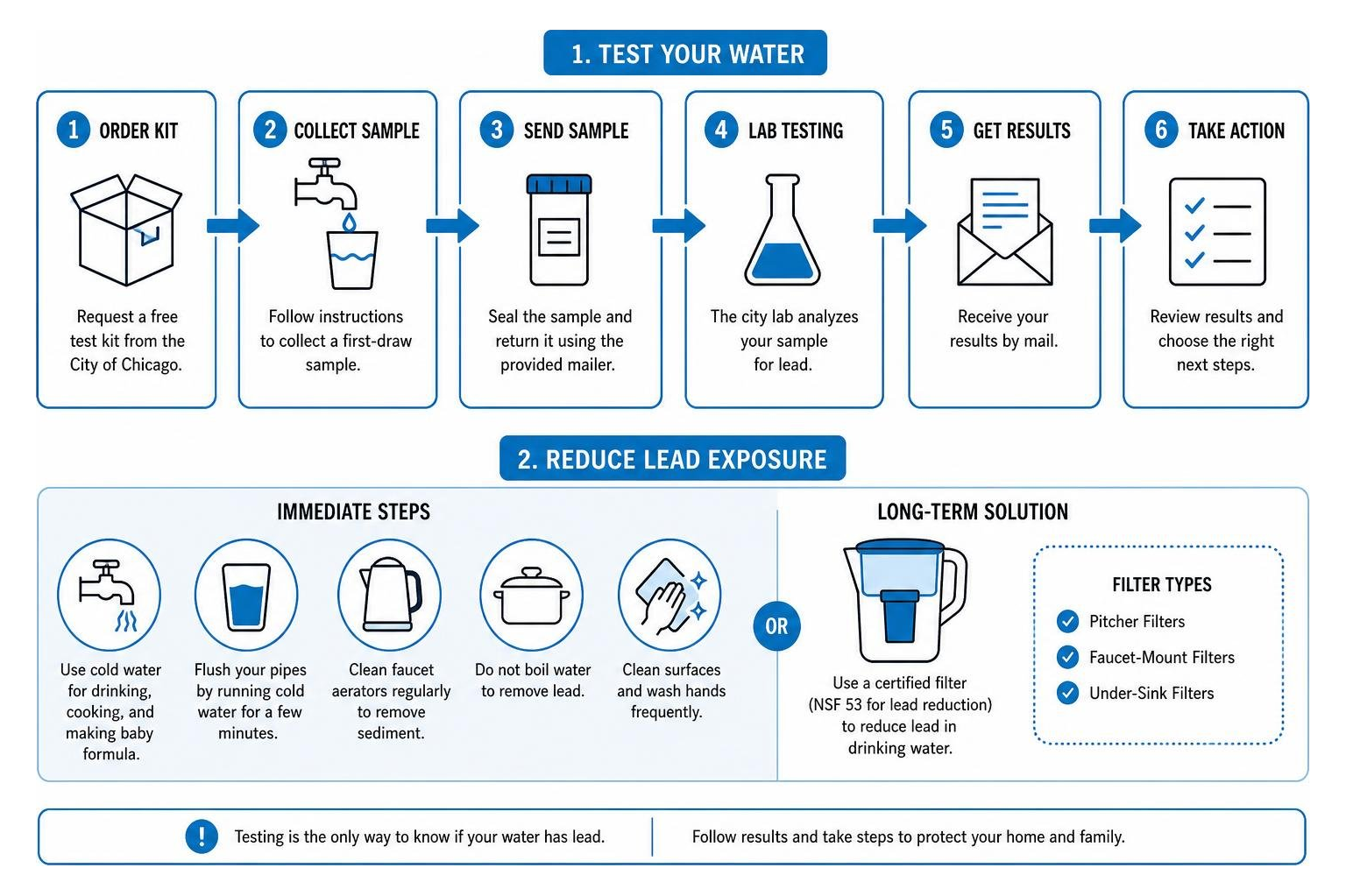
You do not have to sit around waiting for the city to reach your street in 2047 or 2076. There are practical, immediate actions you can take to understand your risk and protect your household.
If you are ready to take control of your tap, start by reading our comprehensive guide on Get the Lead Out: A Guide to Chicago Water Testing Requirements.
Ordering a Chicago DWM Water Test Kit
The first step in any water safety plan is testing. The Chicago Department of Water Management offers a free water quality test kit to all residents.
To get your kit, call 311 or submit a request online. The city will mail you a box containing exactly three bottles. To ensure an accurate reading, you must follow the instructions carefully:
- Let your water sit completely unused for at least 6 hours (overnight is usually easiest). Do not run the dishwasher, flush toilets, or use the tap during this time.
- Fill the three bottles sequentially from your kitchen tap without running the water beforehand. This captures the water that has been sitting stagnant in different parts of your home’s plumbing.
- Pack the bottles back into the box and place it on your porch or entryway for a DWM representative to pick up.
For a detailed walkthrough of this process, see our guide on DWM Water Test Kit: How to Test Your Chicago Tap Water.
How to Apply for Lead Service Line Replacement Chicago
If your test results come back showing elevated lead levels (above 15 ppb), or if you already know your home has lead pipes, you should immediately check your eligibility for replacement.
Use the city’s online Service Line Lookup tool. You will need your water account number or your property address. This tool will tell you if your pipe is classified as Lead, Galvanized Requiring Replacement, Suspected Lead, or Not Lead.
Under Illinois law enacted in 2023, partial replacements are banned. If work is done, the entire line from the water main under the street to the b-box (the shut-off valve near your sidewalk) and all the way into your basement must be replaced. To start your application or schedule a verification, visit Test Your Water.
Advanced Filtration as an Immediate Shield
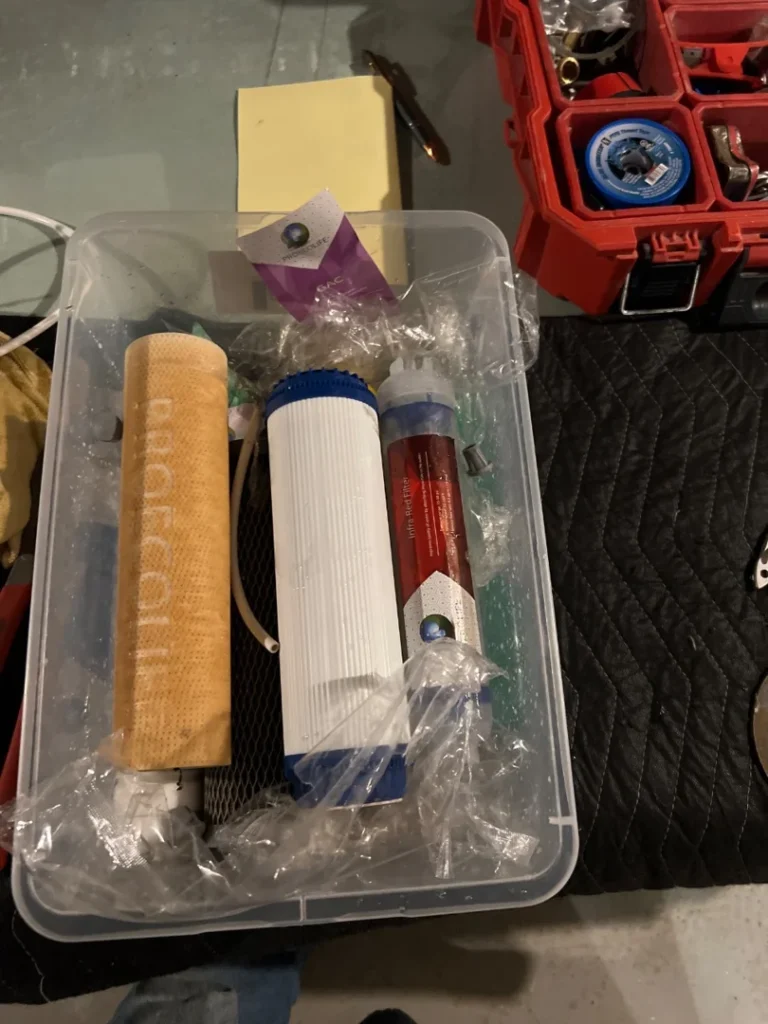
Because municipal pipe replacement can take decades, relying solely on city programs leaves your family exposed in the meantime. Installing a high-quality water filtration system in your home is one of the most effective ways to establish an immediate barrier against lead.
At ProEcoLife, we have been helping Chicago families secure clean, safe drinking water since 2014. Founded by Karol Dolega, we specialize in advanced water treatment systems designed specifically to handle the unique water chemistry of Lake Michigan and the hard water common in our Northwest suburbs.
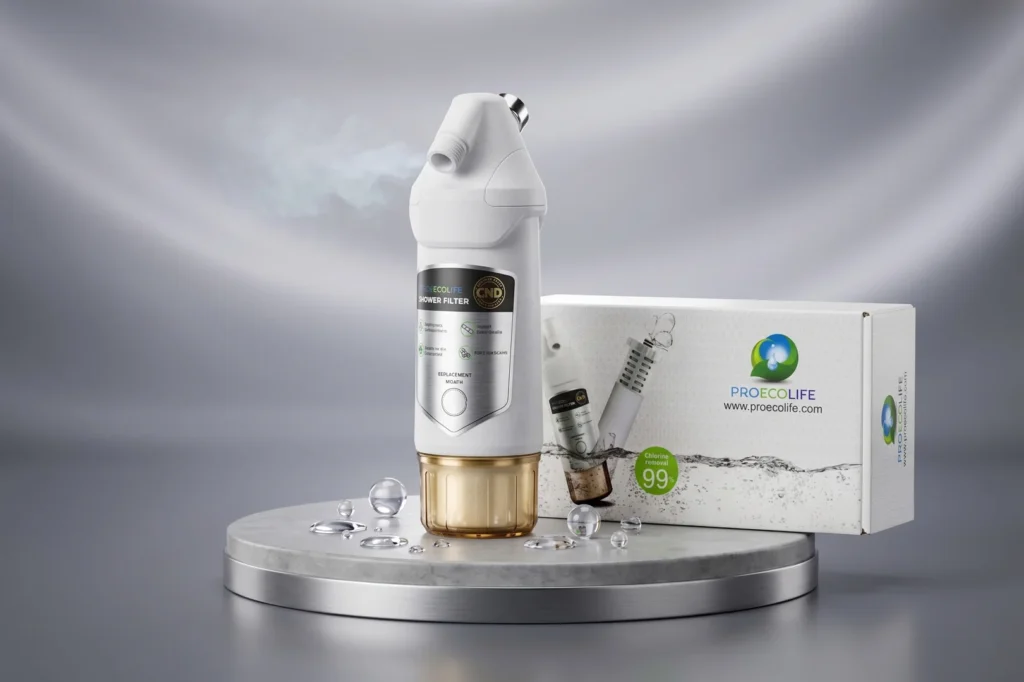
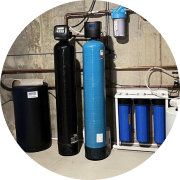
Our PEL75 9-Stage RO System is a reverse osmosis system that may help reduce lead, chlorine, and other heavy metals from your drinking water. For complete peace of mind, our Whole House Filtration systems protect every tap in your home, ensuring that the water you use for bathing, washing dishes, and cooking is clean. We also offer specialized Shower Filter System options to protect your skin and hair, as well as Commercial Water Filtration Systems for local businesses.
To explore which filtration options are right for your home, take a look at our guides on Heavy Metal Detox: Best Water Filters for Lead in 2026 and How to Choose the Best Lead Water Filter in Chicago: A 2026 Guide.
Frequently Asked Questions About Lead Service Line Replacement Chicago
Who qualifies for the free Equity Lead Service Line Replacement Program?
The Equity program is designed for low-income Chicagoans who own and live in a single-family home, two-flat, or three-flat. Your household income must be below 80% of the Area Median Income ($83,350 for a family of four), and you must have a child under 18 living in the home OR have tested positive for lead levels above 15 ppb.
Why is Chicago’s lead pipe replacement timeline so far behind other cities?
Because of our massive scale. With over 400,000 lead service lines, Chicago has more lead infrastructure than any other city in the country. Combined with high local construction costs, complex permitting, and a historical reliance on piecemeal repairs, the city requires much more time and funding to complete the work.
What should I do immediately after my lead service line is replaced?
Physical construction can disturb settled lead particles, causing temporary spikes in lead levels. For at least three months following any service line work, you should flush your pipes regularly and use an NSF-53 certified water filter for all drinking, cooking, and baby formula preparation.
Conclusion
The Chicago lead pipe crisis is a complex, long-term challenge, but you do not have to wait for the city’s 2076 target date to protect your home. By understanding your options—whether through the Equity Program, the Homeowner-Initiated Program, or by installing independent filtration—you can take immediate steps to secure your family’s health.
At ProEcoLife, we are proud of our deep Chicago roots. From our headquarters on Higgins Avenue, we have spent over a decade serving our neighbors across Chicago’s Northwest Side—including Norwood Park, Edison Park, and Jefferson Park—as well as nearby suburbs like Park Ridge, Niles, Des Plaines, Skokie, Glenview, Arlington Heights, and Morton Grove.
If you want to ensure your water is safe, consider exploring The Best Whole House Water Filtration Systems in Chicago for Crystal Clear Water to see how our PEL75 9-Stage RO System or Whole House Filtration systems may help.
To protect your family from lead contamination while waiting for city action, contact ProEcoLife to schedule a water test at (312) 889-8888 or visit proecolife.com.