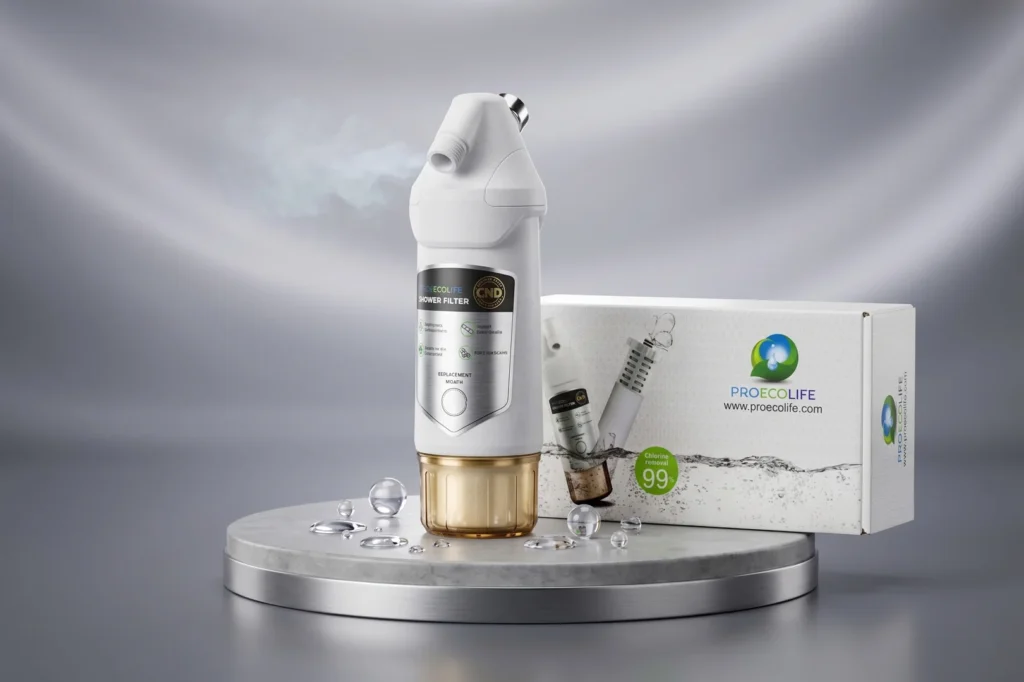
Why Your Chicago Shower Water Deserves a Closer Look
If you’re dealing with a shower filter hard water problem in your Chicago home, here’s the short answer:
Shower filters do NOT soften hard water. No shower filter removes calcium and magnesium — the minerals that cause hard water. However, a good shower filter can meaningfully reduce chlorine, disinfection byproducts (DBPs), and potentially lead and PFAS, which are real concerns for Chicago homeowners.
Quick Answer: What Can a Shower Filter Do for Hard Water?
| Goal | Shower Filter | Water Softener |
|---|---|---|
| Remove chlorine | Yes — up to 99% | No |
| Remove DBPs | Yes (select filters) | No |
| Soften hard water (calcium/magnesium) | No | Yes |
| Reduce scale buildup | Partially | Yes |
| Remove lead or PFAS | Yes (NSF-certified only) | No |
Chicago’s tap water comes from Lake Michigan — one of the cleaner municipal sources in the country. But by the time it travels through aging infrastructure on the Northwest Side (think Norwood Park, Edison Park, and Jefferson Park), it picks up chlorine, DBPs, and in older homes, lead from corroded pipes. Hard water is also a real issue across the Chicago metro area.
Many homeowners reach for a shower filter hoping it will solve all of these problems at once. The reality is more nuanced — and knowing the difference could save you money and frustration.
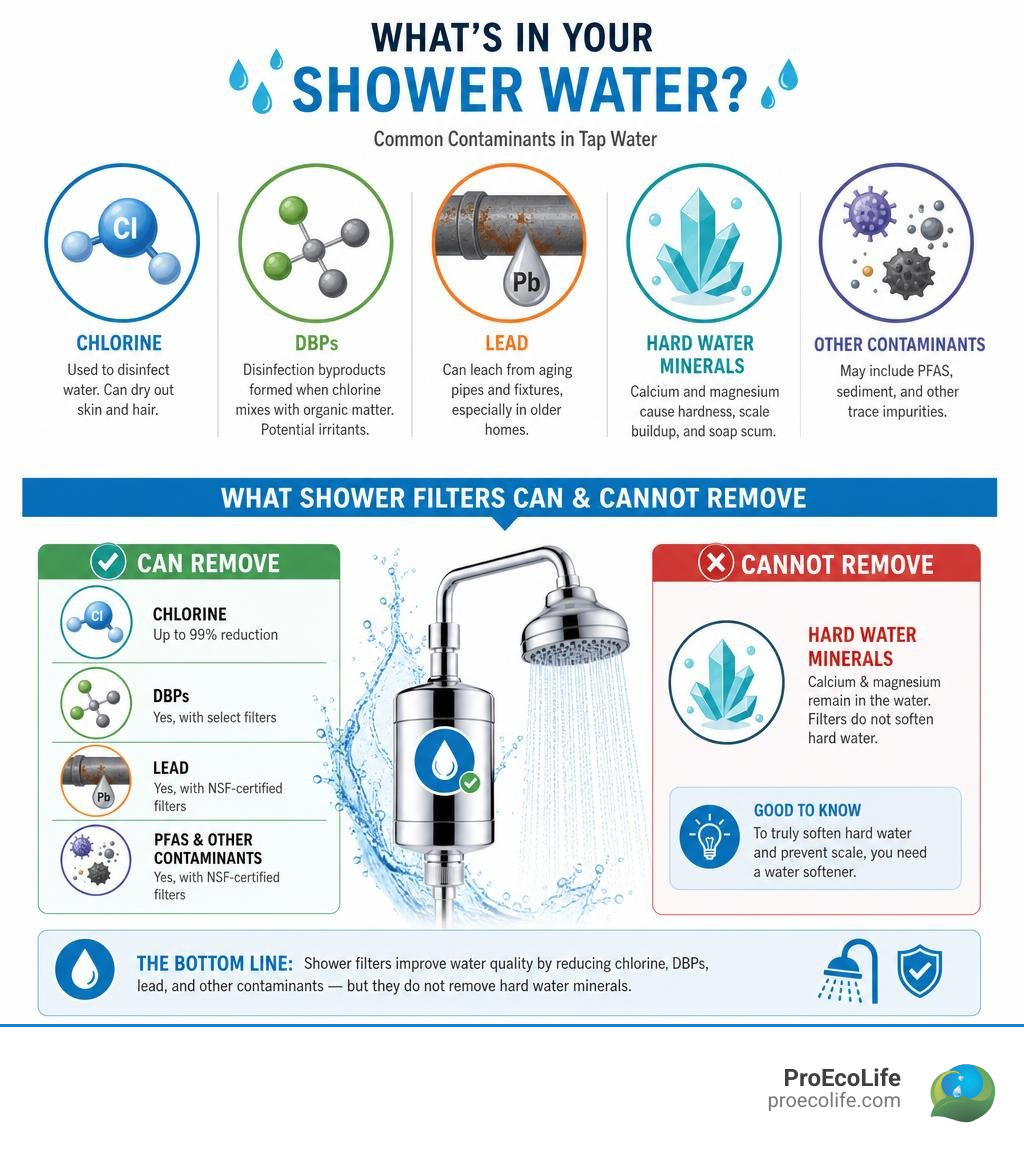
Shower filter hard water glossary:
Debunking the Myth of the Shower Filter Hard Water Solution
Many of today’s shower filters make big promises when it comes to removing minerals and softening your water. But if we look at the actual science, standard filtration media simply cannot remove dissolved hardness minerals.
Water hardness is defined by the concentration of dissolved calcium and magnesium ions. According to the EPA, roughly 85% of American homes have hard water. To understand how severe your water is, we look at the standard water hardness scale:
- Moderately Hard: 60 to 120 ppm (3.5 to 7 gpg)
- Hard: 120 to 180 ppm (7 to 10.5 gpg)
- Very Hard: Over 180 ppm (10.5 gpg)
In the Chicago area, municipal water sourced directly from Lake Michigan typically registers as moderately hard to hard. However, in the Northwest suburbs—including Park Ridge, Niles, Des Plaines, Skokie, Glenview, Arlington Heights, and Morton Grove—well water and localized blending can push those numbers much higher, frequently entering the “very hard” territory.
When you purchase a retail product like a Hard Water Shower Filter | Water Softening & Filtration , the packaging might promise “soft, mineral-free water.” Independent laboratory testing, however, reveals that none of these point-of-use shower filters actually reduce total water hardness.
While some high-end filters may reduce carbonate (temporary) hardness by up to 69% by causing the minerals to precipitate out of the solution, the total (permanent) hardness remains unchanged—and in some tests, even slightly increases. If you are trying to figure out how to address your home’s unique water profile, learning how to choose a water filter is an important first step. For a deep dive into what various filtration systems can achieve, you can read the Best Shower Filters for Hard Water: 2025 Expert Reviews .
Shower Filters vs. Water Softeners: What is the Difference?
To understand why a shower filter hard water solution is a misnomer, we have to look at the differences in how these systems operate.
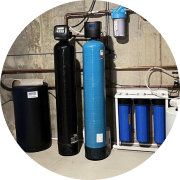
True water softening requires a chemical process called ion exchange. A water softener contains resin beads charged with sodium or potassium ions. As hard water passes through the resin tank, the calcium and magnesium ions chemically bind to the beads, displacing the sodium ions. This physically removes the hardness minerals from the water supply. Because of the size and salt-regeneration cycle required for ion exchange, this process cannot be shrunk down into a small plastic pod that screws onto your shower arm.
In contrast, a point-of-use shower filter relies on physical and chemical filtration media designed to target chlorine and synthetic chemicals.
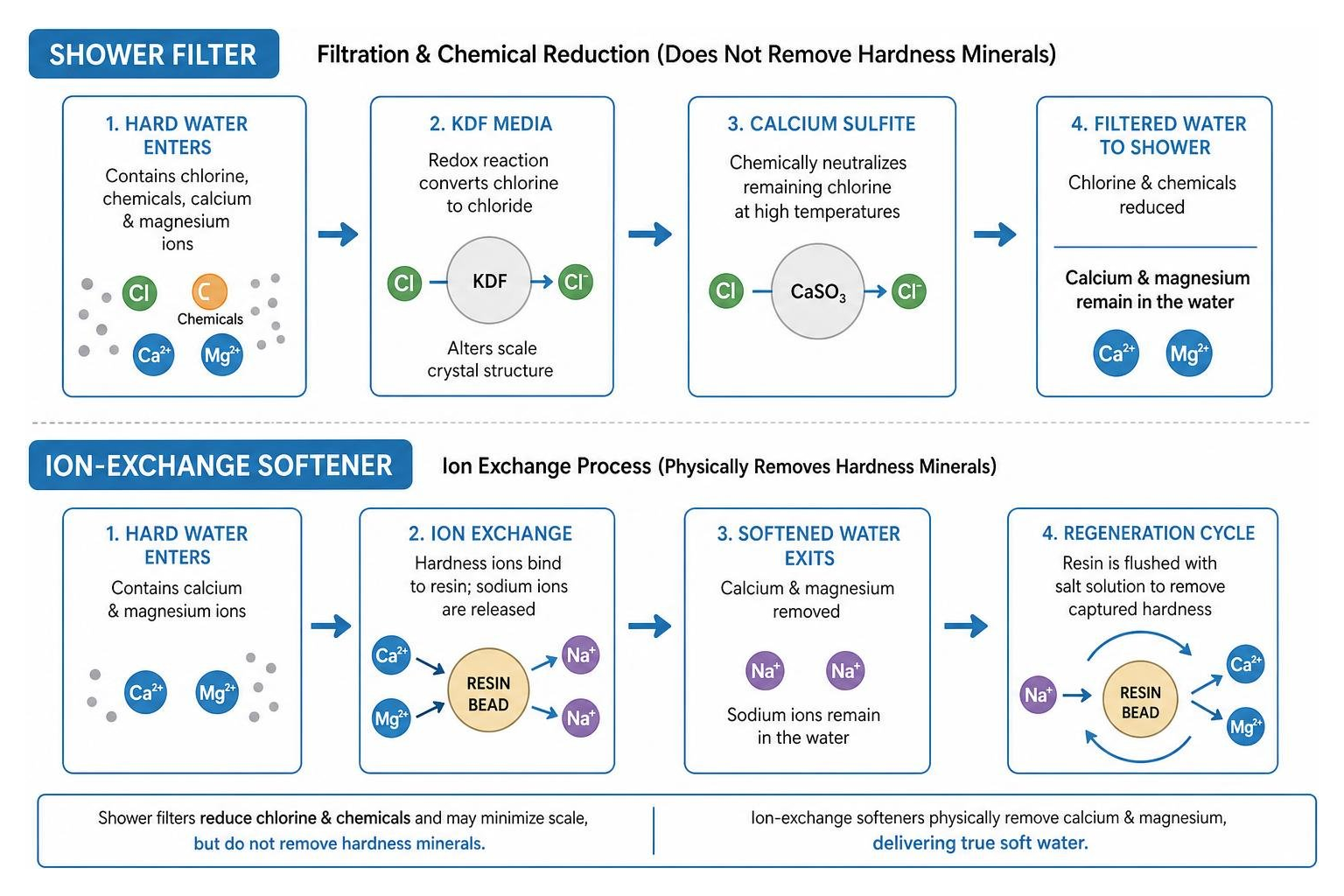
Most shower filters utilize a combination of Kinetic Degradation Fluxion (KDF) media and calcium sulfite:
- KDF-55 and KDF-85: These copper-zinc granules use redox (oxidation-reduction) reactions to convert free chlorine into harmless chloride ions. While KDF does not remove calcium and magnesium, it alters the crystalline structure of these minerals. This change may help prevent them from binding tightly to surfaces, which partially reduces the crusty scale buildup on your showerhead and glass door.
- Calcium Sulfite: While activated carbon is popular in drinking water systems, it loses its effectiveness in hot water (typically above 85°F). Because most of us enjoy a hot shower between 98°F and 110°F, calcium sulfite is used instead. It remains highly stable and effective at neutralizing chlorine at high temperatures.
If you are looking for a comprehensive solution to hard water, installing a whole-house filtration system or a dedicated water softener is the only way to physically strip minerals from your water before it reaches your plumbing. For those who want targeted filtration at the point of use, our ProEcoLife Shower Filter System provides highly effective chlorine and chemical reduction.
To help weigh your options, here is a comparison of point-of-use filtration and whole-house systems:
| Feature | Point-of-Use Shower Filter | Whole-House Filtration & Softening |
|---|---|---|
| Primary Technology | KDF, Calcium Sulfite, Carbon | Ion-Exchange Resin, Multi-stage Carbon |
| Mineral Removal | None (only alters scale structure) | Removes 100% of Calcium & Magnesium |
| Chlorine Reduction | High (at the showerhead) | Comprehensive (every tap in the house) |
| Appliance Protection | None | Protects water heaters, pipes, and laundry |
| Installation | Point-of-use attachment | Professional plumbing integration |
Many retail products, such as the Heavy-Duty No BS Removable Shower Head Filter for Hard Water, Chlorine, Water Softener Shower Head Filter (1-Pack) or the Filtered Shower Head Water Softener – 3 Rainfall & … , are marketed as “water softeners.” In reality, they are inline filters that reduce chemical impurities rather than altering the mineral hardness of your water. To learn more about how comprehensive systems protect your entire home, read our guide on whole-house filtration and discover all about whole house filters.
What Contaminants Can a Shower Filter Actually Remove?
If shower filters do not actually soften water, are they still worth installing? Absolutely.
The health risks associated with shower water are different from drinking water. When you take a hot shower, your pores open, and you inhale steam filled with vaporized chemicals. This makes inhalation and skin absorption the primary pathways for exposure to municipal water contaminants.
A high-quality shower filter is highly effective at removing:
- Chlorine: Used by municipal plants to disinfect water, chlorine strips natural oils from your skin and hair, leaving you with a dry, itchy scalp and brittle hair.
- Disinfection Byproducts (DBPs): When chlorine reacts with organic matter in water, it creates toxic DBPs like trihalomethanes. These compounds are easily inhaled in a steamy shower.
- Heavy Metals and Lead: Aging water mains and lead service lines in older Chicago neighborhoods can release trace heavy metals into your water supply.
- PFAS (Per- and Polyfluoroalkyl Substances): Known as “forever chemicals,” these synthetic compounds are increasingly found in municipal water supplies and can be absorbed through the skin.
By removing chlorine and synthetic chemicals, many customers notice a significant improvement in skin and hair hydration. If you struggle with eczema, dry skin, or color-treated hair that fades too quickly, a shower filter may help restore your skin’s natural barrier. For a deeper look at protecting your family from heavy metals in the bathroom, check out our article on how a clean shower clear mind best shower filters to remove lead.
Some cosmetic shower filters, like the VOOSH – Bergamot & Neroli Glow Shower Filter with Vitamin C & Hyaluronic Acid | Ulta Beauty , use ascorbic acid (Vitamin C) to neutralize chlorine while infusing the water with hydrating ingredients. While these provide a spa-like experience, they require frequent cartridge changes to maintain their performance.
Choosing a Shower Filter Hard Water System for Chlorine and Lead
When shopping for a shower filter, look for systems that carry NSF/ANSI Standard 177 certification. This independent certification verifies that the filter has been rigorously tested to reduce free chlorine by at least 50% over its rated life.
If you are looking at multi-stage options like the Amorix 15 Stage Shower Head Filter Water Filter for Hard … or the AISMIHO 30 Stage Shower Filter, Shower Filter for Hard Water , keep in mind that more stages do not always mean better filtration. Many of these stages contain minimal amounts of media. A robust, dual-stage or heavy-duty single-stage filter with high-grade KDF and calcium sulfite will almost always outperform a “30-stage” filter filled with cheap ceramic balls.
Additionally, pay attention to the physical build. Bulky shower filters can lower the height of your showerhead, which can make showering awkward for taller family members. To ensure your filter is installed securely without leaks, cracking the housing, or reducing your clearance, we always recommend professional installation.
How a Shower Filter Hard Water Cartridge Performs Over Time
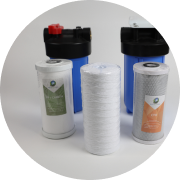
Every filter cartridge has a limited lifespan. Over time, the KDF and carbon media inside the filter become saturated with impurities, and their chemical reduction efficiency drops.
While a new filter might remove 95% to 99% of chlorine, that number can drop significantly after a few months of heavy use. Some budget filters, such as the Shower Head Filter – bwdm Hard Water Filter, Remove … , claim to last up to six months, but local water quality and household size will ultimately dictate how long a cartridge remains effective.
As the filter traps sediment and rust from aging municipal pipes, you may also notice a gradual drop in water pressure. Scheduling regular professional maintenance and cartridge replacements ensures your system continues to deliver clean, high-pressure water.
Frequently Asked Questions About Shower Filtration
Do shower filters reduce water pressure?
A high-quality, clean shower filter should have a minimal impact on your water pressure, usually maintaining a standard flow rate of 2.0 to 2.5 gallons per minute (GPM). However, as the filter media traps physical sediments, rust, and pipe scale over time, the flow path becomes restricted. If you notice a sudden drop in water pressure, it is a clear sign that your cartridge is clogged and needs to be replaced.
Can a shower filter remove Chicago’s lead and PFAS?
Standard retail shower filters are not designed to remove dissolved lead or PFAS. While some high-end, specialized shower filters carry NSF certifications for these contaminants, point-of-use shower filters should not be relied upon as your primary defense against lead.
For the older plumbing infrastructure found in Northwest Side neighborhoods like Norwood Park, Edison Park, and Jefferson Park, we recommend a multi-pronged approach. While our Shower Filter System may help reduce physical sediment in the bathroom, our PEL75 9-Stage RO System is the gold standard for removing lead, PFAS, and other microscopic contaminants from the water you drink and use for cooking.
How often should I replace my shower filter cartridge?
Most shower filter cartridges last between 2 and 6 months, or roughly 8,000 to 10,000 gallons of water. If you live in an area with high sediment levels, or if you have a large family taking daily showers, you will need to replace the cartridge more frequently. If your filter housing is clear, you can visually monitor the media for discoloration; otherwise, keep an eye out for dry skin, the return of chlorine odors, or a drop in water pressure.
Conclusion: Finding the Right Water Solution for Your Chicago Home
If you are struggling with dry skin, chlorine odors, and scale buildup in your bathroom, a point-of-use shower filter is an excellent, targeted step toward improving your daily routine. However, if you want to truly soften your water and eliminate hard water scale throughout your entire home, a whole-house water softening and filtration system is the only complete solution.
At ProEcoLife, founded in 2014 by Karol Dolega, we have deep Chicago roots. We understand the unique challenges of our local water—from the moderately hard Lake Michigan water on the Northwest Side to the highly mineralized well water in the surrounding suburbs. We design advanced water treatment systems tailored specifically to northeastern Illinois homes.
Whether you need our Shower Filter System to protect your skin and hair, our PEL75 9-Stage RO System for pristine drinking water, or a comprehensive Whole House Filtration system, we are here to help. You can explore our full range of water filter products for your home and learn more about the best whole-house water filtration systems in chicago for crystal clear water. To better understand your options, discover what can you use a water filter for and read our comprehensive guide to choosing a home water filter.
For homes using private wells in the collar counties, we also offer specialized Well Water Conditioning and heavy-duty Commercial Water Filtration Systems for local businesses.
To address hard water, chlorine, or lead issues in your home, contact the local Chicago water experts at ProEcoLife to schedule a water test at (312) 889-8888 or visit proecolife.com.