

Are Carbon Water Filtration Systems Worth It for Chicago Homes?
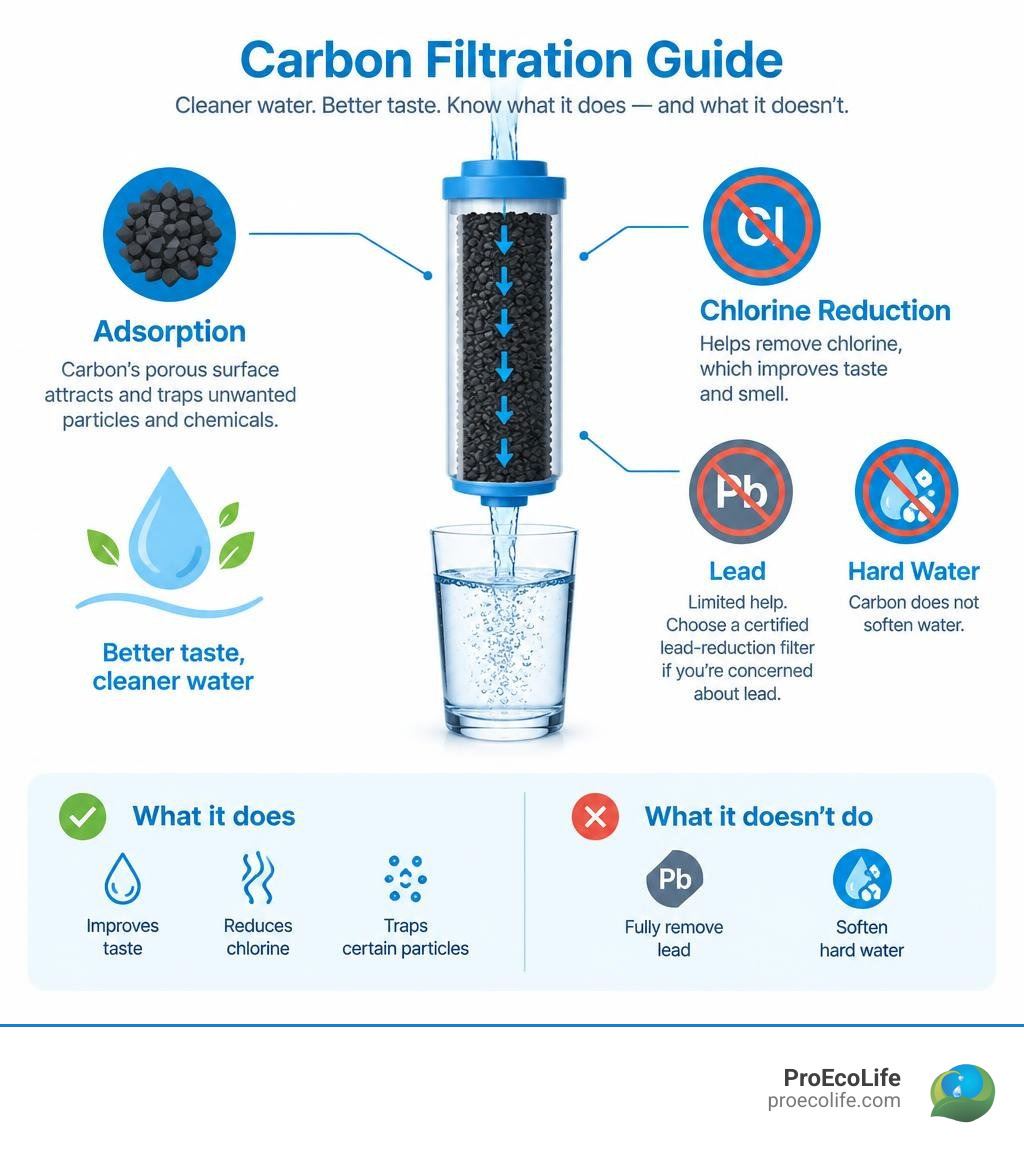
Yes, if your main goal is better taste and less chlorine. A carbon filter can help with both, but it will not solve every water problem. If you are worried about lead from aging pipes in an older Chicago home, choose a drinking-water filter certified for lead reduction. Do not assume a whole-house carbon tank removes lead.
Chicago’s water comes from Lake Michigan, but the pipes between the treatment plant and your tap matter, too. In the Northwest suburbs, hard water is another concern: carbon does not soften it. Start with a water test or your utility’s water report, then match the filter’s certified claims to what you need removed. For many households, carbon water filtration systems for home use are a practical first step toward cleaner, better-tasting tap water.
Carbon water filtration systems for home word roundup:
How Carbon Water Filtration Systems for Home Work and What They Remove
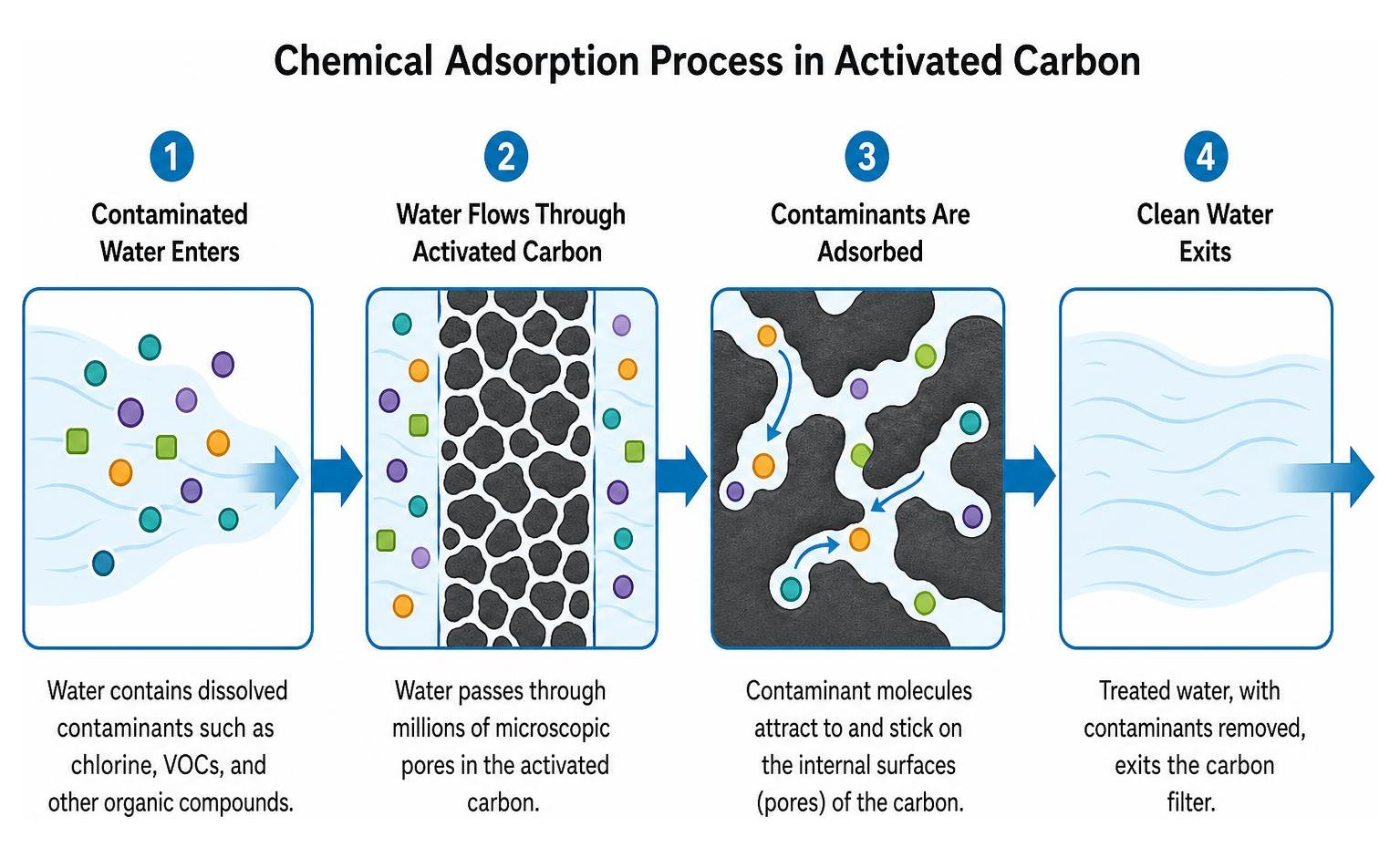
To understand why carbon filters are so widely used across Chicagoland, it helps to look at the underlying science. Activated carbon works through a process called chemical adsorption. Unlike a simple mechanical strainer that catches floating particles, carbon attracts and binds specific dissolved molecules to its internal surfaces as water flows through.
Think of activated carbon as an ultra-porous sponge. Manufacturers heat organic materials—most commonly coconut shell, wood, or coal—to extremely high temperatures without oxygen. This creates millions of microscopic pores. A single gram of high-grade activated carbon can have a surface area exceeding 1,000 square meters. The quality and density of these microscopic pores are often measured by an “iodine number.” Higher numbers (such as 1,000 or more) indicate higher adsorption capacity for smaller organic compounds.
When exploring the different types of water filters at home, you will find that carbon is the primary workhorse for capturing synthetic chemicals, chlorine, unpleasant odors, and volatile organic compounds (VOCs).
Granular Activated Carbon vs. Carbon Block Media
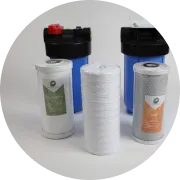
In residential systems, activated carbon generally comes in two distinct physical forms: Granular Activated Carbon (GAC) and solid Carbon Block. Each has strengths and structural trade-offs.
- Granular Activated Carbon (GAC): GAC consists of loose, sand-like carbon granules. Water flows freely through the bed, which allows high flow rates with very low pressure drop. However, loose granules can shift over time, creating “channels” where water travels the path of least resistance without full contact with the carbon.
- Carbon Block: Carbon block filters are made by binding finely powdered carbon into a dense, solid matrix. This structure forces every drop of water through microscopic channels. It maximizes contact time and surface area, making carbon block filters generally more effective at capturing finer particles and organic chemicals. The trade-off is a higher restriction on water flow, which requires careful sizing.
| Feature | Granular Activated Carbon (GAC) | Solid Carbon Block |
|---|---|---|
| Physical Structure | Loose, porous granules | Compressed solid cylinder |
| Contact Time | Lower (water flows quickly around granules) | Higher (water forced through dense matrix) |
| Risk of Channeling | Moderate to high over time | Virtually zero |
| Flow Rate / Pressure Drop | High flow, minimal pressure drop | Lower flow, noticeable pressure restriction |
| Primary Use Case | Whole-house tank systems & high-flow entry points | Point-of-use under-sink filters & specialized cartridges |
Contaminants Removed vs. Contaminants Left Behind
While carbon filtration is effective for aesthetic and chemical improvements, it is not a cure-all. In older neighborhoods like Norwood Park, Jefferson Park, and Edison Park, legacy infrastructure and pipe materials present complex challenges that standard carbon media alone cannot fully solve.
What Carbon Filtration Typically Reduces:
- Free chlorine and taste/odor compounds added during municipal treatment
- Certain chloramines (when catalytic carbon media is used)
- Volatile Organic Compounds (VOCs) and agricultural chemical residues
- Disinfection byproducts like trihalomethanes (THMs)
- Coarse sediment and rust particles (acting as a basic physical barrier)
What Carbon Media Leaves Behind:
- Dissolved Heavy Metals: Standard activated carbon does not reliably remove dissolved lead, copper, or arsenic without specialized additives.
- Inorganic Dissolved Solids: Carbon will not reduce total dissolved solids (TDS), nitrates, perchlorate, or 1,4-dioxane.
- Hardness Minerals: Calcium and magnesium pass straight through carbon beds without any reduction.
- Microbiological Contaminants: Carbon does not reliably eliminate viruses or bacteria.
Need Clean, Safe Water at Home?
Get a free water test at your home or business. We install and service whole-house filtration and PEL75 reverse osmosis systems across Chicagoland. We also take select projects in Wisconsin and Indiana.
Book a Free Water TestCall (312) 889-8888Comparing Carbon Filters to Reverse Osmosis and Multi-Stage Systems
Homeowners often ask whether a carbon filter is enough, or if they need a more comprehensive system. To make the right choice, it helps to understand how water treatment works when comparing simple adsorption to advanced physical separation.
Carbon Adsorption vs. Membrane Separation
Carbon filters rely on chemical attraction, whereas reverse osmosis (RO) uses high pressure to push water through a semi-permeable membrane with microscopic pores down to 0.0001 microns.
RO systems reject dissolved inorganic salts, heavy metals, and fluoride, washing these rejected contaminants down the drain. While reverse osmosis produces exceptional drinking water, standard residential units produce a small stream of drain water and reduce flow rates, which is why RO is typically installed for drinking taps rather than entire houses.
Combining Carbon with Multi-Stage Stages
For complete protection, the best strategy is combining multiple technologies into a cohesive system. Relying solely on a single carbon stage can quickly exhaust the media, especially if water carries sediment from old cast-iron municipal mains.

A multi-stage design pairs sediment pre-filters, high-purity carbon blocks, and advanced separation. For example, our PEL75 9-Stage RO System utilizes multi-stage sediment and carbon filtration alongside advanced membrane separation and remineralization to provide thorough drinking water purification. If you are reviewing structural setups, checking our complete guide to 3-stage water filter housings explains how staged cartridges shield delicate media and extend equipment lifespan.
Whole-House vs. Point-of-Use Systems: Which Is Right for You?
Deciding between point-of-entry (whole-house) and point-of-use (under-sink or countertop) depends on what you want to achieve in your home. Reviewing how to choose a water filter helps clarify your household priorities before investing in equipment.
Choosing Whole-House Carbon Water Filtration Systems for Home Protection
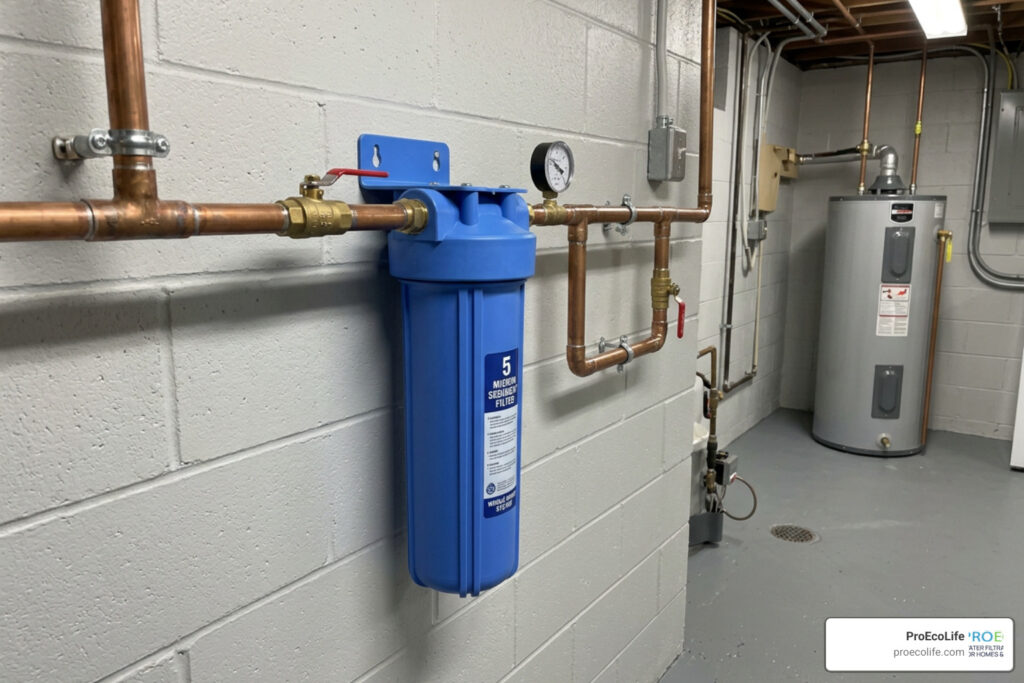
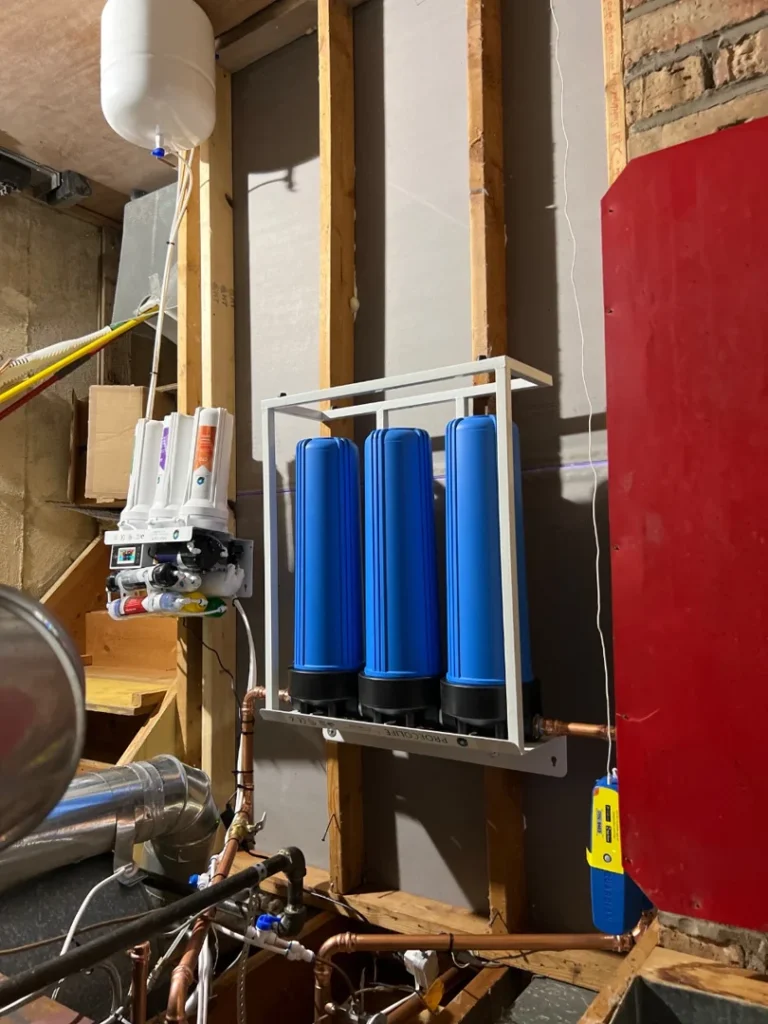
A whole-house setup is installed where the main water line enters the building. This ensures that every fixture—from the kitchen faucet to the upstairs shower and laundry room—receives treated water.
- Shower Comfort: Inhaling vaporized chlorine during hot showers can irritate respiratory passages and dry out sensitive skin. A whole-house carbon filter reduces chlorine before it reaches your showerhead.
- Appliance Protection: Removing chlorine and oxidized sediment may help protect internal rubber seals in dishwashers and washing machines from premature degradation.
- Plumbing Consideration: Whole-house systems must handle high flow demands (such as two showers and a washing machine running at once) without causing a noticeable pressure drop.
Point-of-Use Countertop and Under-Sink Alternatives
Point-of-use (POU) systems treat water at a single dedicated location, typically beneath the kitchen sink.
Countertop or under-sink water filters focus their filtration power entirely on water consumed for drinking and cooking. Because these units treat smaller daily volumes, they can employ denser carbon blocks and specialized membrane stages without restricting the general household plumbing supply.
Need Clean, Safe Water at Home?
Get a free water test at your home or business. We install and service whole-house filtration and PEL75 reverse osmosis systems across Chicagoland. We also take select projects in Wisconsin and Indiana.
Book a Free Water TestCall (312) 889-8888Key Sizing Factors: Capacity, Flow Rate, and Water Source Compatibility
Properly sizing a filtration system requires matching the unit’s technical specifications to your plumbing infrastructure and source water chemistry. Maintaining overall household utility performance depends on balancing water and air quality parameters, much like following efficient home utility maintenance standards throughout the changing seasons.

Flow Rates, GPM Sizing, and Media Longevity
When selecting a whole-house unit, the key metric is gallons per minute (GPM). If a system’s service flow rate is too low for your home, taking a shower while someone runs the tap in a second bathroom can cause water pressure to drop sharply.
- 1–2 Bathrooms: Requires an 8 to 10 GPM service flow rate.
- 3–4 Bathrooms: Requires an 11 to 15 GPM peak service flow rate.
- Media Lifespan: Whole-house carbon tanks generally hold enough media to treat hundreds of thousands of gallons before the carbon beds become saturated and lose adsorption capability.
For smaller homes or targeted setups, reviewing our ultimate guide to 2-stage domestic water filtration provides useful sizing benchmarks for cartridge-based systems.
Municipal Water vs. Private Well Applications
Your water source dictates what pre-treatment is required before carbon media can do its job.
Across Chicago, Skokie, Evanston, and Niles, municipal water drawn from Lake Michigan contains disinfectant chemicals like chlorine that carbon systems target effectively. However, in outer pockets or properties relying on private wells, untreated well water carrying soluble iron, sulfur, or heavy sediment will quickly foul carbon pores. In those cases, a dedicated Well Water Conditioning setup or iron-reduction stage must be installed upstream of any carbon filter.
System Costs, Lifespan, and Maintenance Requirements
A comprehensive water filtration setup involves the initial equipment, professional plumbing integration, and periodic service to replace exhausted media.
Costs, Installation, and Upkeep for Carbon Water Filtration Systems for Home
The total investment varies depending on capacity, valve automation, and the complexity of your home’s main utility line.
| System Type | Typical Capacity Range | Maintenance Frequency | Key Maintenance Tasks |
|---|---|---|---|
| Point-of-Use Carbon Block | 500 – 1,500 Gallons | Every 6 to 12 Months | Replace under-sink drop-in cartridges |
| Standard Multi-Cartridge Whole House | 50,000 – 100,000 Gallons | Every 6 to 12 Months | Replace sediment pre-filter & carbon blocks |
| Heavy-Duty Backwashing Tank System | 600,000 – 1,500,000+ Gallons | Every 3 to 5+ Years | Periodic backwash cycle check & media rebedding |
Professional installation ensures proper bypass valving, maintains compliance with local plumbing codes, and prevents leaks around main service connections. Because media beds naturally load up with trapped organics, neglecting routine cartridge or tank service can lead to pressure drops and bacterial colonization within the depleted carbon.
Essential NSF Certifications and Replacement Timelines
When evaluating equipment claims, always verify independent testing and certifications:
- NSF/ANSI Standard 42: Certifies aesthetic effects, specifically the reduction of chlorine taste and odor.
- NSF/ANSI Standard 53: Certifies health effects, validating the reduction of specific contaminants such as VOCs or lead.
If tap water begins developing a faint chemical odor, or if you notice a gradual drop in household water pressure, your carbon media has likely reached its absorption threshold and needs service.
Frequently Asked Questions About Carbon Water Filters
What contaminants do carbon filters fail to remove?
Standard activated carbon filters do not remove dissolved inorganic compounds and minerals, including calcium, magnesium, nitrates, fluoride, arsenic, and total dissolved solids (TDS). They also do not reliably remove viruses or bacteria without an auxiliary UV or membrane stage.
How often do you need to replace carbon filter media in a whole-home system?
In backwashing tank systems, high-capacity activated carbon media often lasts between 3 and 5 years, depending on household water consumption and incoming chlorine levels. Cartridge-based whole-house filters typically require replacement every 6 to 12 months to prevent channeling and pressure drops.
Can activated carbon filtration handle hard or iron-heavy well water?
No. Activated carbon does not soften hard water or remove dissolved calcium and magnesium. Furthermore, iron levels exceeding 0.3 ppm can foul the carbon pores within weeks. Well water containing hardness or iron requires a dedicated water softener or iron filtration system installed ahead of the carbon unit.
Conclusion
Carbon filtration remains one of the most effective ways to remove chlorine, unpleasant odors, and synthetic chemicals from residential tap water. However, every home’s plumbing and water supply are unique.
Since 2014, our founder Karol Dolega and the team at ProEcoLife have helped homeowners across Chicago—from Northwest Side neighborhoods like Norwood Park, Edison Park, and Jefferson Park to surrounding communities like Park Ridge, Niles, Des Plaines, Skokie, Glenview, Arlington Heights, and Morton Grove—diagnose their water quality challenges. Whether you need whole-home protection with our Whole House Filtration systems or advanced kitchen purification using the PEL75 9-Stage RO System, the right choice starts with knowing what is in your water.
Contact ProEcoLife today to schedule a comprehensive water test for your home at (312) 889-8888 or visit proecolife.com to speak with our local water experts.