What Is a UV Whole House Water Filtration System and How Does It Work?
A uv whole house water filtration system relies on ultraviolet germicidal irradiation (UVGI) to purify water as it enters a home. Since establishing ProEcoLife’s Chicago roots in 2014, our founder Karol Dolega has emphasized that understanding how each stage of water treatment operates is essential for making informed decisions about home health. Water treatment is not a single process; to see how UV disinfection fits into a broader multi-barrier defense, read our guide on how water treatment works the 5 essential stages explained.
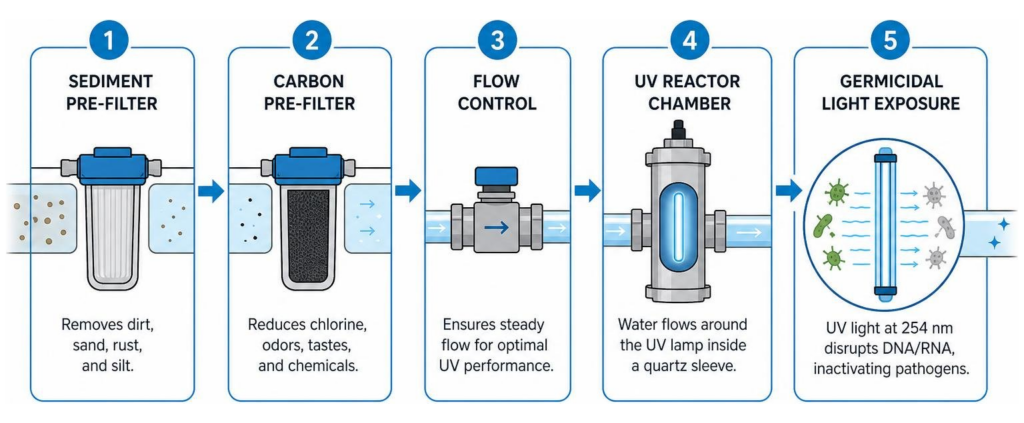
At the heart of a whole-house UV system is a specialized low-pressure mercury or amalgam lamp housed inside a high-purity quartz sleeve, which is submerged within a stainless steel reactor chamber. As water flows through this chamber, the lamp emits shortwave ultraviolet light—specifically at the germicidal 254-nanometer wavelength.
When biological organisms pass through this intense UV light, the energy penetrates their outer cell walls and disrupts their nuclear structure, damaging their DNA and RNA chains. Once their genetic material is altered, these organisms lose their ability to replicate and cause infection. UV disinfection can achieve up to a 99.99% (4-log) reduction of biological pathogens, effectively neutralizing dangerous microorganisms such as Escherichia coli (E. coli), Giardia lamblia, and Cryptosporidium.
How a UV Whole House Water Filtration System Neutralizes Biological Threats
The mechanics of germicidal UV-C rays center on molecular disruption. Unlike traditional chemical disinfectants like chlorine or chloramines, ultraviolet light adds zero chemicals to your water supply, leaves no chemical byproducts, and does not alter the natural mineral composition, pH, or taste of tap water.
To ensure biological safety, a system must match the home’s peak water flow rate. If water passes through the stainless steel chamber too quickly, the microbes may not receive a sufficient germicidal dose (measured in millijoules per square centimeter, or mJ/cm²). Professional sizing ensures every drop receives the optimal duration and intensity of UV exposure, bringing a reliable shutdown of cellular reproduction for harmful biological threats before water reaches any faucet, shower, or appliance in your home.
Contaminant Removal: What UV Can and Cannot Eliminate
While a uv whole house water filtration system provides biological protection, it is important to recognize its operational boundaries. UV energy is strictly a biological sanitizer; it does not filter physical particles or dissolved chemistry out of solution.
| Contaminant Category | Target Contaminant | UV Disinfection Efficacy | Recommended Companion Filtration |
|---|---|---|---|
| Microorganisms | E. coli, Cryptosporidium, Giardia, Viruses | High (99.99% Inactivation) | Pre-filter required for clarity |
| Heavy Metals | Lead, Copper, Mercury | No Effect (0%) | Carbon block / PEL75 9-Stage RO System |
| Disinfectant Byproducts | Chlorine, Chloramines | No Effect (0%) | Activated Carbon / Whole House Filtration |
| Volatile Organics | VOCs, Pesticides, Herbicides | No Effect (0%) | Granular Activated Carbon (GAC) |
| Minerals & Sediments | Calcium, Magnesium, Rust, Silt | No Effect (0%) | Well Water Conditioning / Sediment Filter |
For homeowners in older Chicago homes, aging service lines and lead infrastructure present major water quality concerns. While municipal water drawn from Lake Michigan is treated to eliminate microbial outbreaks, older plumbing in neighborhoods like Norwood Park, Edison Park, or Jefferson Park may leach lead or suffer from chlorine taste. Conversely, homes relying on private wells in surrounding suburban areas like Glenview or Park Ridge often face volatile biological counts along with iron or hardness minerals.
Because UV rays bypass heavy metals, chemical additives, volatile organic compounds (VOCs), and dissolved sediment, pairing UV light with specialized media filters—such as carbon systems or our PEL75 9-Stage RO System for point-of-use drinking water—ensures full spectrum protection across all contaminant classes.
Combining Pre-Filtration with a UV Whole House Water Filtration System
Ultraviolet disinfection relies on clear, unimpeded light transmission through the water stream. If raw water contains physical particles such as rust, sand, silt, or organic decay—a condition known as turbidity—these particles create a phenomenon called “shadowing.” Microorganisms can hide behind or within floating suspended solids, blocking the germicidal UV-C rays from reaching them.

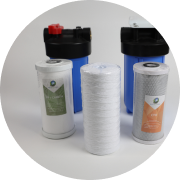
To guarantee germicidal effectiveness, every whole-home UV light system requires robust pre-filtration. A high-efficiency sediment pre-filter rated at 5 microns or smaller is standard to capture suspended matter before water enters the quartz reactor chamber. To learn how particle size ratings impact clarity and flow rate, explore the ultimate guide to micron ratings for whole house water filters.
In addition to sediment removal, pre-filtration preserves high UV Transmittance (UVT)—the measure of light energy that successfully penetrates the water column. Pre-treatment also prevents mineral scale from building up on the exterior of the quartz sleeve, maintaining optical clarity so germicidal energy flows freely into the chamber.
Key Benefits, Costs, and Energy Usage of UV Disinfection
A primary advantage of choosing a uv whole house water filtration system is its efficient, chemical-free operation. Unlike traditional chemical sanitation systems that require dosing pumps, retention tanks, and recurring chemical purchases, UV systems disinfect instantly without introducing chlorine taste or producing harmful trihalomethanes (THMs). Furthermore, UV treatment generates zero wastewater, preserving water conservation efforts across both city connections and suburban private wells.
From an energy standpoint, residential whole-house UV systems are remarkably economical. Operating continuously, a typical chamber draws between 60 to 100 watts of electrical power—roughly equivalent to keeping a standard household incandescent light bulb lit.
When evaluating equipment safety and performance, look for third-party regulatory standards such as NSF/ANSI Standard 55:
- NSF Standard 55 Class A: Certified to deliver a minimum germicidal UV dose of 40 mJ/cm², designed to sanitize water that may contain pathogenic microorganisms from unsafe sources.
- NSF Standard 55 Class B: Certified to deliver a minimum dose of 16 mJ/cm², intended for supplemental micro-reduction on already disinfected municipal supplies.
Equipment and installation investments vary depending on peak household flow requirements (measured in gallons per minute, or GPM), control features, and pre-filtration complexity. Systems designed for high flow rates ensure you never lose water pressure again with these 20 gpm whole house filters, making high-flow UV equipment an investment in long-term safety and peace of mind.
Ideal Candidates, Installation, and Annual Maintenance
Over 15 million households across the nation rely on private well water, making homeowners on rural or suburban private wells primary candidates for whole-house UV disinfection. Well water sources are susceptible to surface runoff, seasonal high-water tables, and agricultural infiltration, which may introduce biological pathogens into raw well supplies. Residents in communities like Des Plaines, Niles, Skokie, Morton Grove, or Arlington Heights who rely on private or shared well lines often utilize UV units as their core biological defense alongside specialized Well Water Conditioning systems.
Municipal water customers also benefit from point-of-entry UV units. During main break events, aging distribution repairs, or unexpected boil water advisories, a whole-house UV system acts as a continuous safety net for kitchen taps, bathroom sinks, and shower lines. To compare this technology with other home treatment options, read our overview on different types of water filters at home.

Professional installation ensures the UV system is located directly after main pressure tanks and mechanical pre-filters, but before water softeners or branch distribution lines. Maintaining peak biological protection requires routine service:
- Annual Lamp Replacement: UV lamps experience natural germicidal intensity decay over time. Standard residential lamps operate effectively for approximately 9,000 continuous hours (about 12 months) before requiring replacement, even if the bulb continues to glow visibly.
- Quartz Sleeve Cleaning Protocol: Periodic wiping or chemical descaling of the quartz sleeve prevents mineral scale build-up from hard Suburban Chicago water, ensuring maximum light transmittance.
- Pre-Filter Cartridge Changes: Sediment cartridges should be replaced every 3 to 6 months depending on incoming water turbidity to keep light pathways clear.
Frequently Asked Questions About UV Water Purification
Does a UV water system render tap water safe to drink instantly?
Yes, inactivation occurs immediately as water flows through the illuminated reactor chamber. Because germicidal light acts at the speed of light, there is no contact time or retention tank required. However, the system only neutralizes living organisms; if your water contains heavy metals like lead or volatile chemicals, those contaminants remain unless paired with appropriate carbon or reverse osmosis technologies.
How often do UV lamps require replacement?
UV lamps must be changed after 9,000 hours of continuous operation (roughly once every 12 months). Although the bulb may still emit visible blue light past one year, the invisible germicidal UV-C light intensity decays past certified protective thresholds, reducing its ability to neutralize pathogens effectively.
Will a UV filtration system alter the taste or odor of home water?
No, UV light does not alter the physical composition, mineral balance, taste, or odor of your water. If your tap water has an unpleasant chlorine scent or an earthy taste, pairing a UV system with carbon block pre-filtration provides the aesthetic improvements you desire. For advice on selecting balanced system pairings, check out our guide on how to choose a water filter.
Conclusion

A uv whole house water filtration system provides biological defense, helping protect your entire residence against biological threats without chemical additives or water waste. Whether securing private well water in suburban communities or adding continuous protection against municipal infrastructure fluctuations on Chicago’s Northwest Side, UV technology offers high-speed peace of mind.
Because UV disinfection targets biological organisms rather than dissolved heavy metals or hard mineral scale, achieving balanced home water health often involves combining UV light with targeted pre-treatment. Explore our comprehensive whole-house filtration system options to build a multi-stage defense tailored to your home’s unique water composition.
Ready to confirm your household’s water safety? Results vary depending on your water source and home plumbing, so start with an accurate assessment. Contact ProEcoLife today to schedule a comprehensive water test at proecolife.com.