Why Every Chicago Home Needs a Water Filter in 2026
Choosing the right chicago water filter is one of the most important decisions you can make for your family’s health — and if you live on the Northwest Side or in suburbs like Park Ridge, Niles, or Des Plaines, the stakes are higher than most people realize.
Quick answer: The best water filters for Chicago homes in 2026
| Filter Type | Best For | Addresses Lead? | Addresses PFAS? | Addresses Chloramine? |
|---|---|---|---|---|
| Under-sink Reverse Osmosis (e.g., PEL75 9-Stage RO) | Homeowners, families | Yes (NSF/ANSI 58) | Yes | Yes |
| Whole House Filtration | Full-home protection | Partial | Partial | Yes |
| Countertop Carbon Block | Renters, small spaces | Yes (NSF/ANSI 53) | Partial | Yes (catalytic carbon) |
| Pitcher Filter | Budget option | Only if NSF/ANSI 53 certified | No | No |
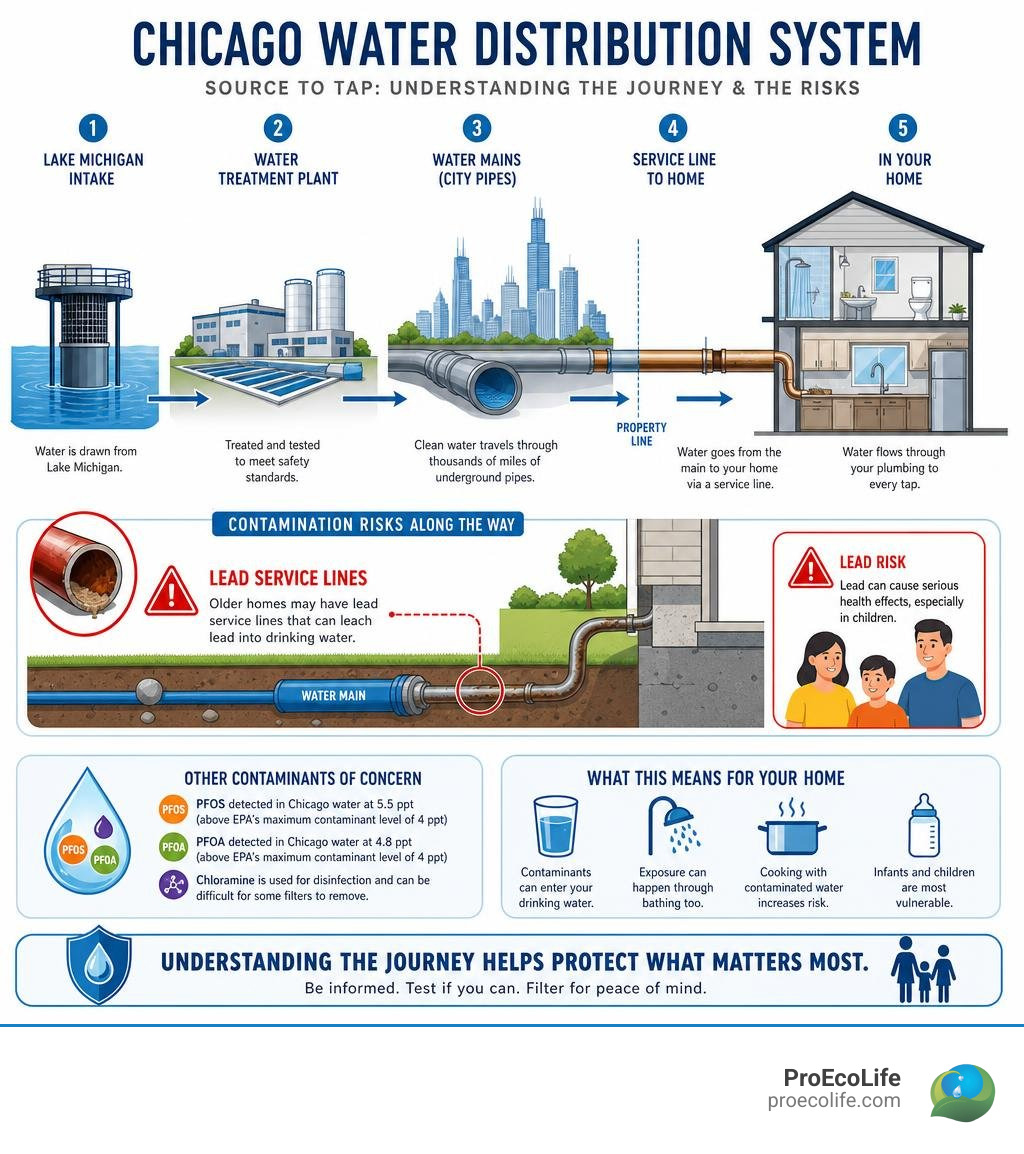
Chicago has a serious water problem that most residents don’t fully understand. The city draws its water from Lake Michigan — one of the cleanest sources in the country. The treatment plants do their job well. But the water’s journey doesn’t end at the plant.
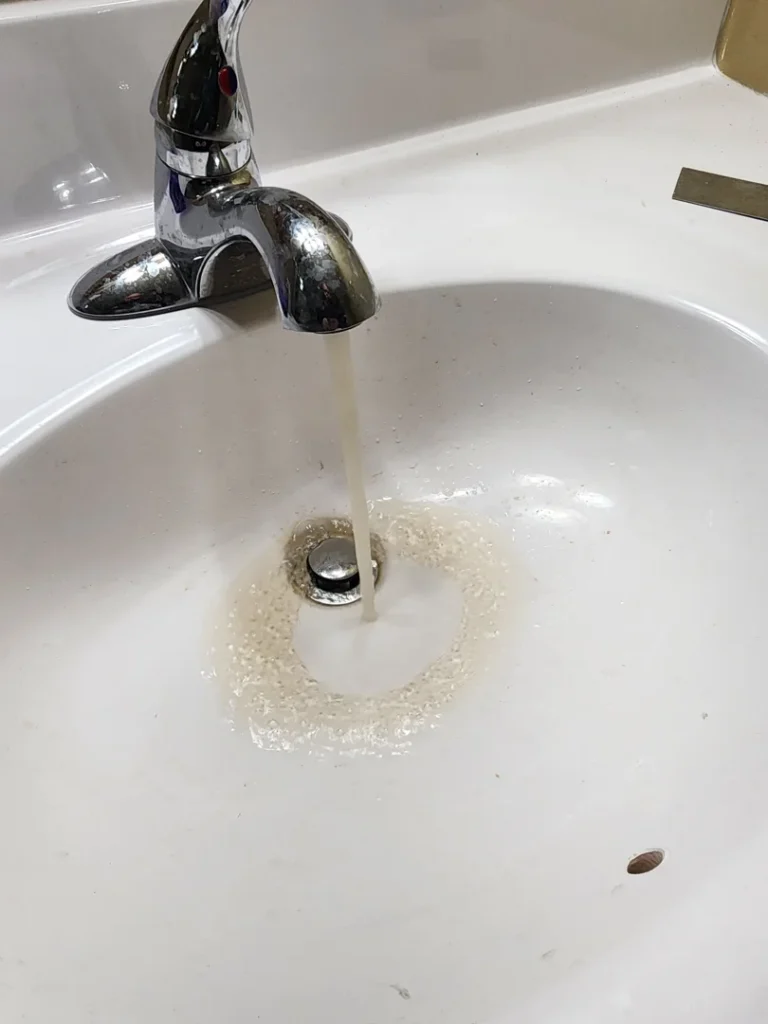
An estimated 412,000 lead service lines still connect Chicago’s water mains to homes across the city. That’s more than any other city in the United States. Full replacement isn’t expected until 2076. And in older neighborhoods like Norwood Park, Edison Park, and Jefferson Park — where homes built before 1986 are common — lead can leach into your glass every single day.
Lead isn’t the only concern. EPA testing has detected PFOS at 5.5 ppt and PFOA at 4.8 ppt in Chicago’s water supply — both above the EPA’s maximum contaminant level of 4 ppt. Chicago also uses chloramine instead of chlorine for disinfection, which most standard filters struggle to remove.
ProEcoLife founder Karol Dolega has worked with Chicago homeowners on exactly these issues since 2014. The problems are real — but the right filtration system, properly installed and maintained, may help protect your household significantly.
Understanding Chicago’s Water Quality and Contaminant Risks
To understand why a high-quality chicago water filter is essential, we have to look closely at what happens to Lake Michigan water after it leaves the massive Jardine or Sawyer purification plants. While the city’s Department of Water Management performs over 600,000 tests per year on drinking water, the water must travel through thousands of miles of aging underground pipes before reaching your kitchen faucet.
During this journey, several major water quality issues arise:
1. The Lead Service Line Crisis
Lead is a powerful neurotoxin with no safe level of exposure, particularly for developing children and pregnant mothers. Because Chicago’s building codes actually mandated the use of lead service lines until Congress banned them in 1986, our city now has the highest concentration of lead pipes in the nation. This means that even if the municipal water is lead-free when it leaves the treatment plant, it can absorb high levels of lead as it sits in the service line connecting the water main to your home.
This ongoing risk is why many local communities, including those outlined in the Water Quality – Park Ridge reports, continuously monitor local tap water for heavy metal leaching. To learn more about this widespread regional challenge, you can read about Chicago’s Risky Water Problem and see why experts rank Illinois One of Worst Contaminated Water States for historical lead pipe infrastructure.
2. PFAS (Forever Chemicals)
Per- and polyfluoroalkyl substances (PFAS) are man-made chemicals used in industrial manufacturing and consumer products. Because they do not break down naturally, they accumulate in the environment and our bodies. Recent EPA UCMR5 testing detected PFOS at 5.5 parts per trillion (ppt) and PFOA at 4.8 ppt in Chicago’s drinking water. Both levels exceed the EPA’s maximum contaminant level (MCL) of 4.0 ppt. Standard carbon pitcher filters are simply not designed to remove these microscopic chemical bonds.
3. Chloramine Disinfection
Unlike cities that use standard chlorine, Chicago uses chloramine (a combination of chlorine and ammonia) to disinfect its water. Chloramine is highly stable and lasts much longer in the distribution system, which is helpful for a massive city. However, it is also much harder to remove than chlorine. Standard refrigerator filters and basic pitchers will quickly become exhausted when trying to break down chloramine, often leaving a distinct chemical taste and smell in your morning coffee.
4. Hard Water and High TDS
Chicago’s water hardness sits at approximately 145 mg/L, which is classified as moderately hard. Additionally, the average total dissolved solids (TDS) level is around 280 mg/L. While these minerals (such as calcium and magnesium) are not directly harmful to your health, they cause scale buildup in water heaters, spotty dishes, and dry skin, and they can impact the performance of your household appliances.
How to Check Your Lead Risk and Access Municipal Assistance
If you are concerned about lead in your home’s water, there are several concrete steps you can take today to check your risk and protect your family:
- Consult the City’s Service Line Inventory: Chicago has published an interactive service line map. By entering your address, you can see whether your home is connected to a lead, copper, or galvanized iron service pipe.
- Request a Municipal Water Testing Kit: Chicago residents can request a water testing kit from the city. The city will mail you sample bottles, which you fill and return for laboratory analysis. If your water tests over 15 parts per billion (ppb) for lead, or if you live on a block undergoing water main or sewer replacements, you may qualify for a basic municipal filter set.
- Implement Safe Water Practices: While you wait for a permanent filtration solution or service line replacement, always use cold water for drinking, cooking, and preparing baby formula, as hot water dissolves lead from plumbing much faster. Additionally, run your tap for 1 to 2 minutes (flushing the line) if the water has sat unused for more than six hours, and clean your faucet aerators monthly to remove trapped lead solder particles.
For detailed community guides and resources on navigating municipal programs, you can consult Water – Lead-Safe Chicago. If you prefer a highly accurate, independent analysis of your tap water’s exact contaminant makeup, we recommend utilizing a professional Reliable Water Testing Service in Chicago for Your Home or Business.
Choosing the Right Chicago Water Filter for Your Home
When shopping for a chicago water filter, you will quickly find a confusing array of options. To ensure a filter will actually protect your family from local contaminants like lead and PFAS, you must look for independent, third-party certifications.
Understanding Key Filter Certifications
- NSF/ANSI Standard 53: This is the gold standard certification for point-of-use filters. It verifies that the system is certified to reduce contaminants with specific health effects, such as lead, heavy metals, and volatile organic compounds (VOCs).
- NSF/ANSI Standard 58: This certification applies specifically to Reverse Osmosis (RO) systems. It guarantees that the RO membrane and system components effectively reduce lead, copper, PFAS, and total dissolved solids.
- NSF/ANSI Standard 42: This covers aesthetic effects, ensuring the filter successfully removes chlorine, chloramine, and particulate matter to improve taste and odor.
- IAPMO Platinum Seal: This certification indicates that the product has undergone rigorous testing and complies fully with the strictest industry standards for material safety and performance.
A word of caution: The market is flooded with cheap, uncertified, or counterfeit filters sold online. These systems often use low-grade carbon block materials that quickly channel, allowing unfiltered water—and lead—to pass straight into your glass. Always purchase from a trusted local provider to ensure your system is fully certified.
For a deeper dive into choosing the right system for your home’s specific plumbing, check out our comprehensive guides on How to Choose the Best Lead Water Filter in Chicago: A 2026 Guide and the Top Home Water Treatment Options in Chicago for Clean and Safe Drinking Water.
Comparison: Point-of-Use vs. Whole-House Filtration
| Operational Feature | Point-of-Use (PEL75 9-Stage RO) | Whole-House Filtration |
|---|---|---|
| Primary Goal | Ultra-pure drinking, cooking, and ice water | Clean, sediment-free water for the entire home |
| Lead Reduction | Outstanding (certified to NSF/ANSI 58) | Moderate (primarily reduces sediment-bound metals) |
| PFAS & VOC Removal | Outstanding (9-stage multi-barrier design) | Good (utilizes high-capacity carbon media) |
| Chloramine & Odor | Complete removal | Excellent removal from every tap |
| Appliance Protection | N/A (serves dedicated drinking faucet) | High (prevents scale and pipe corrosion) |
| Installation Location | Under the kitchen sink | Main water shutoff valve |
Point-of-Use Chicago Water Filter Systems
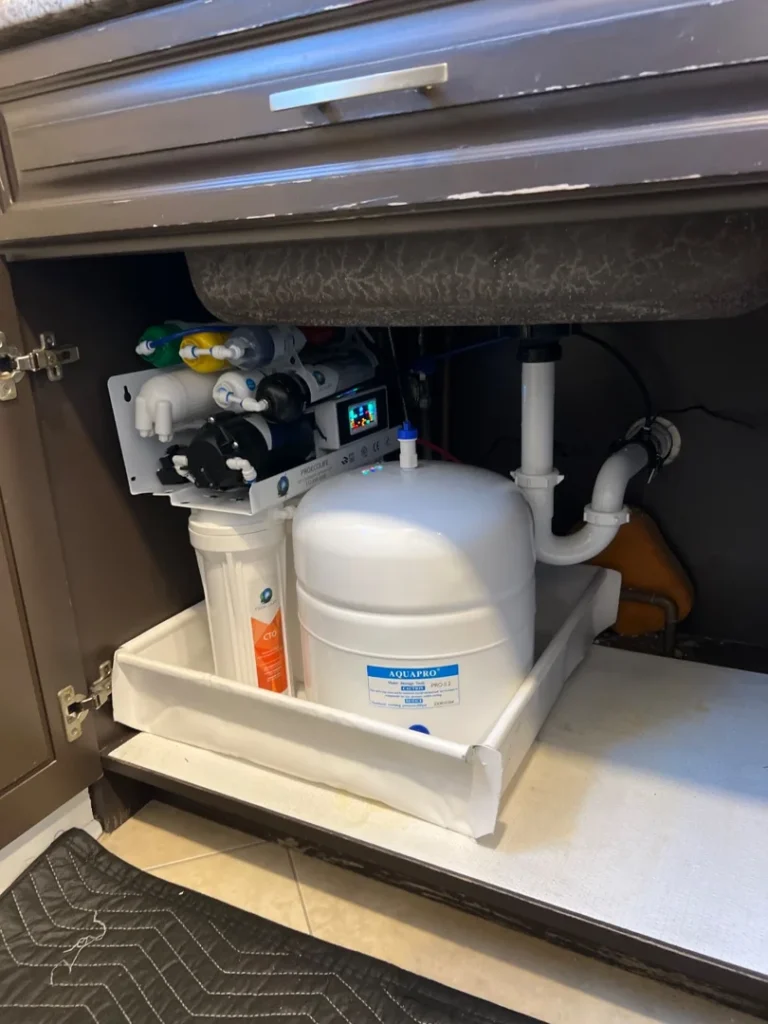
For the absolute highest level of drinking water purity, point-of-use systems installed directly under your kitchen sink are the industry benchmark. Because these systems treat water right before it exits the faucet, they eliminate any contaminants picked up along the municipal transit lines or from your home’s internal brass fixtures.
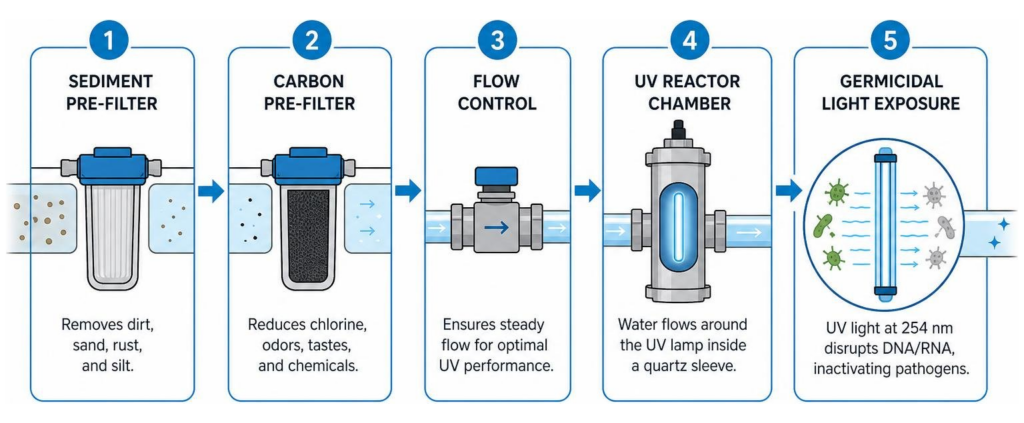
Our signature PEL75 9-Stage RO System is engineered specifically to handle Chicago’s unique water chemistry. While standard reverse osmosis systems typically use 3 to 5 stages, the PEL75 utilizes a proprietary 9-stage process. This includes a catalytic carbon pre-filter to break down stubborn chloramines, a high-rejection RO membrane to strip out lead and PFAS, and a final remineralization stage that adds back essential minerals like calcium and magnesium. This ensures your drinking water is not only safe but also tastes crisp and refreshing.
Many local families find that an under-sink system provides the perfect balance of convenience and long-term security. You can read more about these systems in our Best Under Sink Water Filter Chicago Reviews and Buying Guide or explore the technical advantages of our Top Reverse Osmosis System Options in Chicago for Pure Water.
Whole-House Chicago Water Filter Solutions
While point-of-use systems are perfect for drinking and cooking, they do not address the water you use to shower, wash clothes, or brush your teeth in the bathroom. This is where a Whole House Filtration system comes in.
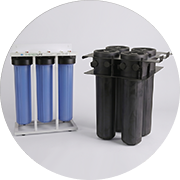
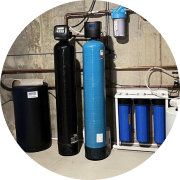
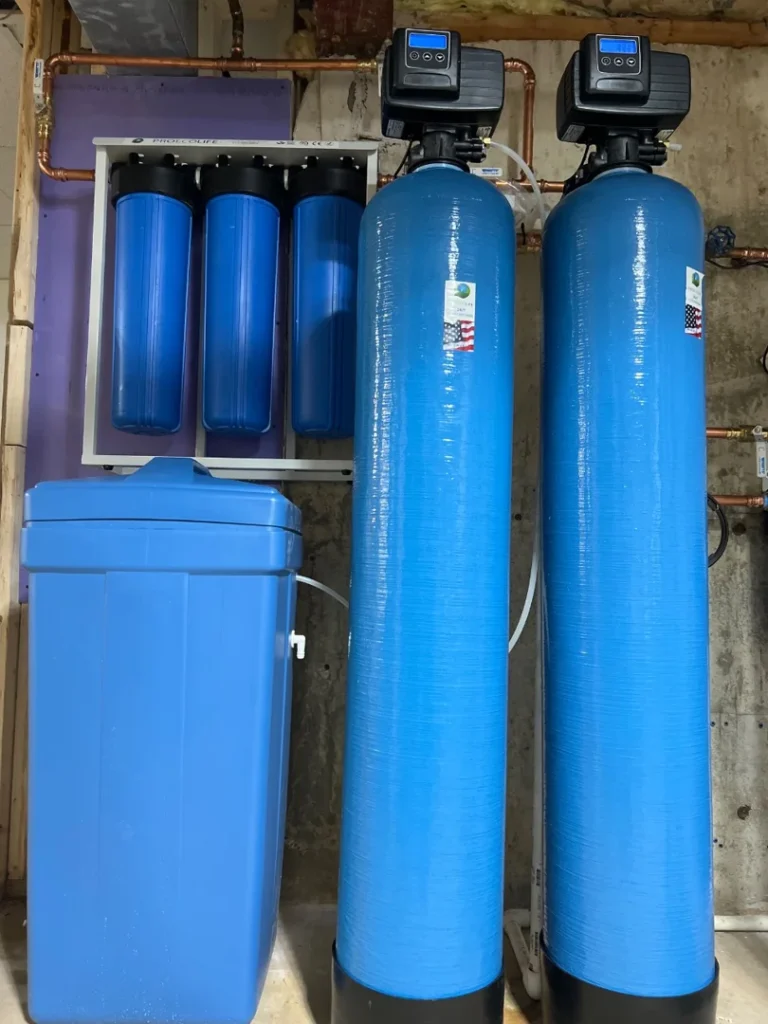
By installing a whole-house system at your home’s main water entry point, you can ensure that every single faucet in your house delivers clean, filtered water. These systems utilize heavy-duty sediment pre-filters and massive carbon media beds to strip out rust, dirt, chlorine, and chloramines.
Many of our customers notice a dramatic improvement in skin and hair dryness after installing a whole-house system, especially when paired with a specialized Shower Filter System or a Well Water Conditioning system (crucial for homes in the outer Northwest suburbs that rely on private well water). For businesses, we also design and install heavy-duty Commercial Water Filtration Systems tailored to meet strict commercial water standards.
To see how a whole-house system can transform your home’s water profile, read The Best Whole House Water Filtration Systems in Chicago for Crystal Clear Water.
Maintenance and Cartridge Replacement Best Practices
Even the most advanced water filter is only as good as its maintenance schedule. Over time, the filtration media inside your cartridges becomes saturated with the very contaminants it is designed to trap.
When a filter cartridge reaches its capacity, several things can happen:
- Flow Rate Reduction: As physical sediment and particles clog the microscopic pores of the filter, you will notice a gradual drop in water pressure at the faucet.
- Contaminant Breakthrough (Desorption): When a carbon block becomes completely saturated, it can no longer chemical-bond with new contaminants. In worst-case scenarios, previously trapped chemicals can actually leach back into the passing water.
- Bacterial Growth: Damp, organic-rich carbon blocks that are left in place past their expiration date can become breeding grounds for harmless but foul-smelling bacteria.
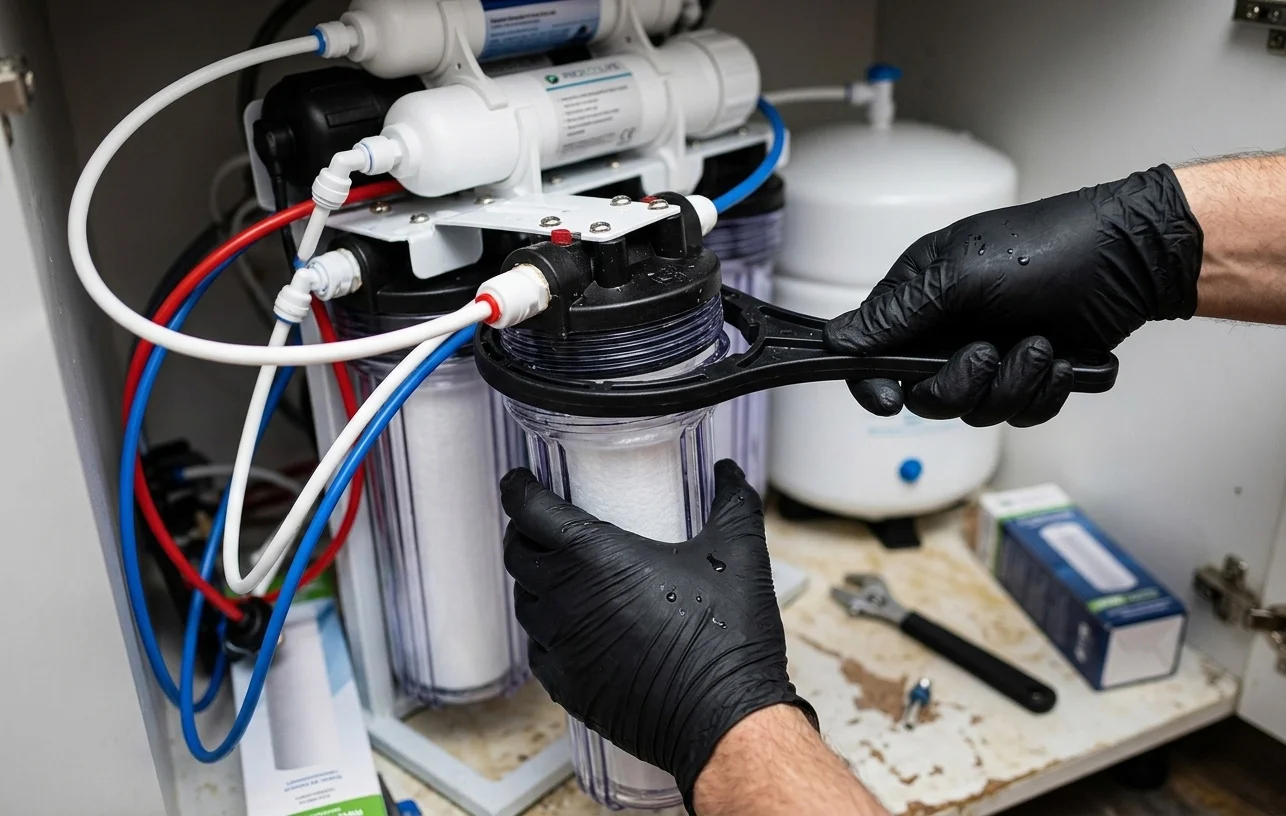
Because of these risks, we strongly advise against attempting DIY cartridge replacements. Mishandling delicate O-rings or failing to sanitize the filter housings during a change can lead to slow, hidden water leaks or secondary bacterial contamination.
At ProEcoLife, our experienced service team provides comprehensive, professional maintenance. We handle everything from checking system pressure to sanitizing lines and ensuring your PEL75 9-Stage RO System or Whole House Filtration system is running at peak performance. Learn more about our professional maintenance and Expert Water Filter Installation Services in Chicago.
Frequently Asked Questions About Chicago Water Filtration
Does standard boiling remove lead from Chicago tap water?
No, boiling water does not remove lead. In fact, it does the exact opposite. Because lead is a heavy metal, it does not evaporate. When you boil lead-contaminated water, some of the water turns to steam, which actually increases the concentration of lead in the remaining liquid. Never boil tap water in an attempt to make it safe from heavy metals.
How does chloramine affect my choice of water filter?
Standard activated carbon filters (commonly found in basic refrigerator filters and pitcher systems) are highly effective at removing free chlorine, but they lack the contact time and chemical structure required to break the strong bond of chloramine (chlorine combined with ammonia). To successfully remove chloramine, a filter must utilize specialized catalytic carbon. This material is engineered to catalyze the breakdown of chloramine, ensuring your water is free of chemical tastes and odors.
Why are counterfeit water filters a risk for Chicago residents?
Counterfeit or uncertified water filters are a massive health risk. Many online retailers host third-party sellers offering cheap, knock-off cartridges that claim to fit major brand systems. These filters often contain little to no active carbon, or use low-grade materials that do not filter out microscopic lead or PFAS particles. Using an uncertified filter gives a false sense of security while leaving your family exposed to toxic contaminants. Always buy your replacement cartridges directly from an authorized, professional dealer.
Conclusion
Navigating Chicago’s complex water quality landscape can feel overwhelming, but you do not have to do it alone. Since 2014, ProEcoLife and our founder, Karol Dolega, have been helping families across the Northwest Side and surrounding suburbs secure clean, delicious, and safe tap water.
Whether you are dealing with the lead service line crisis in Norwood Park, hard water scale in Niles, or forever chemicals in Skokie, we have a tailored solution to fit your home’s unique needs. From our advanced PEL75 9-Stage RO System to our robust Whole House Filtration systems, we handle every step of the process with local expertise and professional care.
Take the first step toward total water security today. Explore our complete Chicago Water Filter System options, and contact ProEcoLife to schedule a comprehensive water test at (312) 889-8888 or visit us online at proecolife.com.