
Is Your Chicago Home’s Water as Safe as You Think?
A 3/4 inch whole house water filter is the most common whole-home filtration solution for Chicago-area residences — and for good reason. Most homes built before the 1980s in neighborhoods like Norwood Park, Edison Park, and Jefferson Park were plumbed with 3/4″ main service lines. That means a 3/4″ filter connects directly to your home’s incoming water supply, filtering every drop before it reaches your faucets, showers, and appliances.
Quick answer — is a 3/4 inch whole house filter right for your home?
- Pipe size: Your main water line is 3/4″ (most common in Chicago homes with 1-3 bathrooms)
- Flow rate: These systems typically deliver 12–15 GPM — enough for standard residential demand
- What they filter: Sediment, chlorine, rust, VOCs, and in multi-stage systems, lead and heavy metals
- Pressure range: Most systems operate between 30–100 psi, compatible with Chicago city water
- Replacement schedule: Filter cartridges typically need changing every 3–6 months depending on local water quality
Chicago’s water comes from Lake Michigan — one of the cleaner municipal sources in the country. But that doesn’t tell the whole story. By the time that water travels through aging distribution mains and the lead service lines still found in tens of thousands of older Chicago homes, it can pick up sediment, rust, chlorine byproducts, and lead along the way.
That’s the challenge ProEcoLife has been helping Chicago homeowners solve since 2014. Founded by Karol Dolega, ProEcoLife was built specifically around the water quality realities of this city — not generic filtration advice that could apply anywhere.
A properly sized whole house filter is one of the most effective first steps toward protecting your family, your pipes, and your appliances from what Chicago’s aging infrastructure can introduce into your water supply.
What is a 3/4 Inch Whole House Water Filter and How Does It Work?
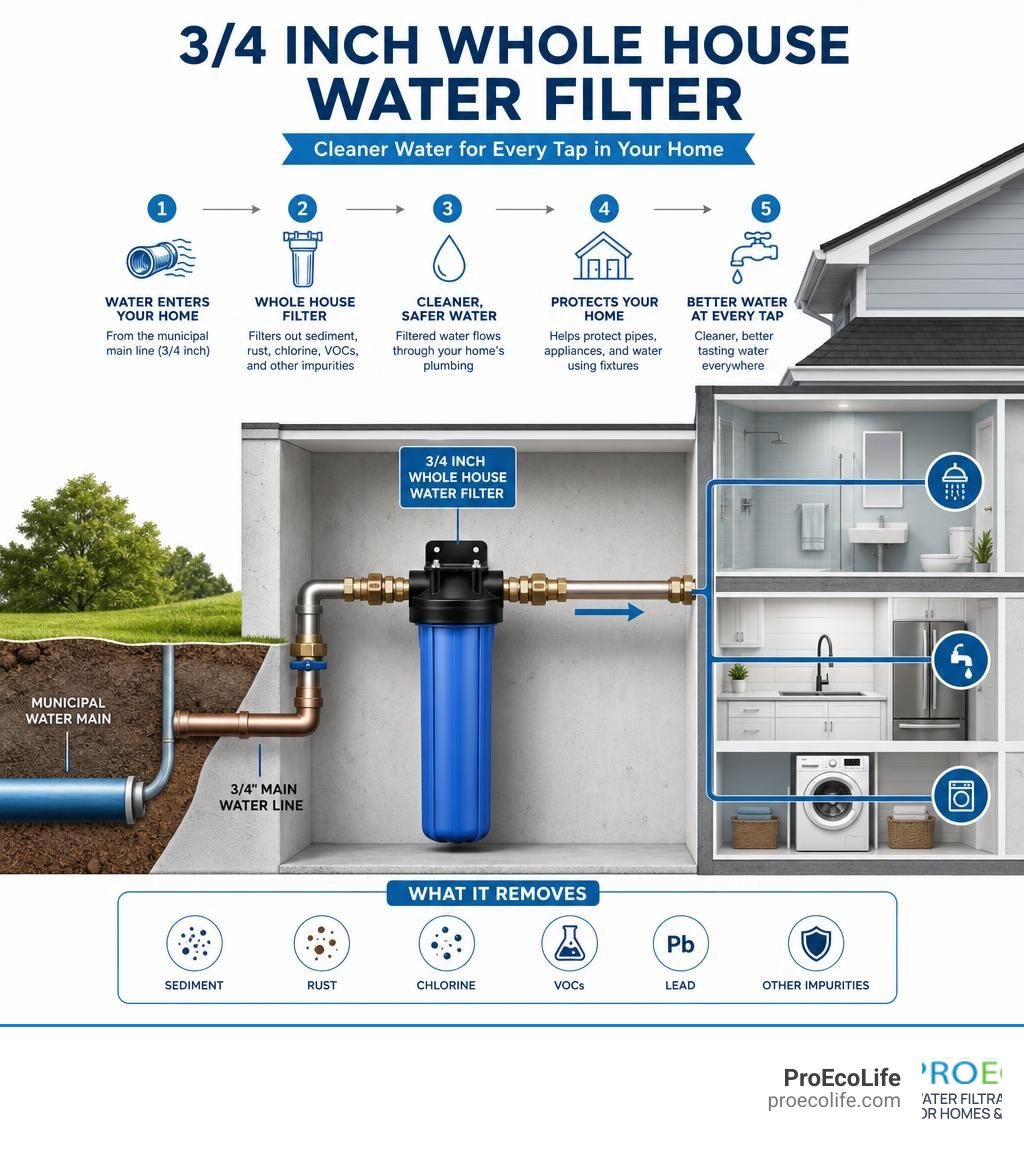
To understand how a 3/4 inch whole house water filter works, we first need to look at how water enters your home. In a typical Chicago bungalow or suburban split-level, water enters through a main copper or galvanized pipe. For the vast majority of standard residential properties, this main pipe has an outer diameter or nominal size of 3/4 of an inch.
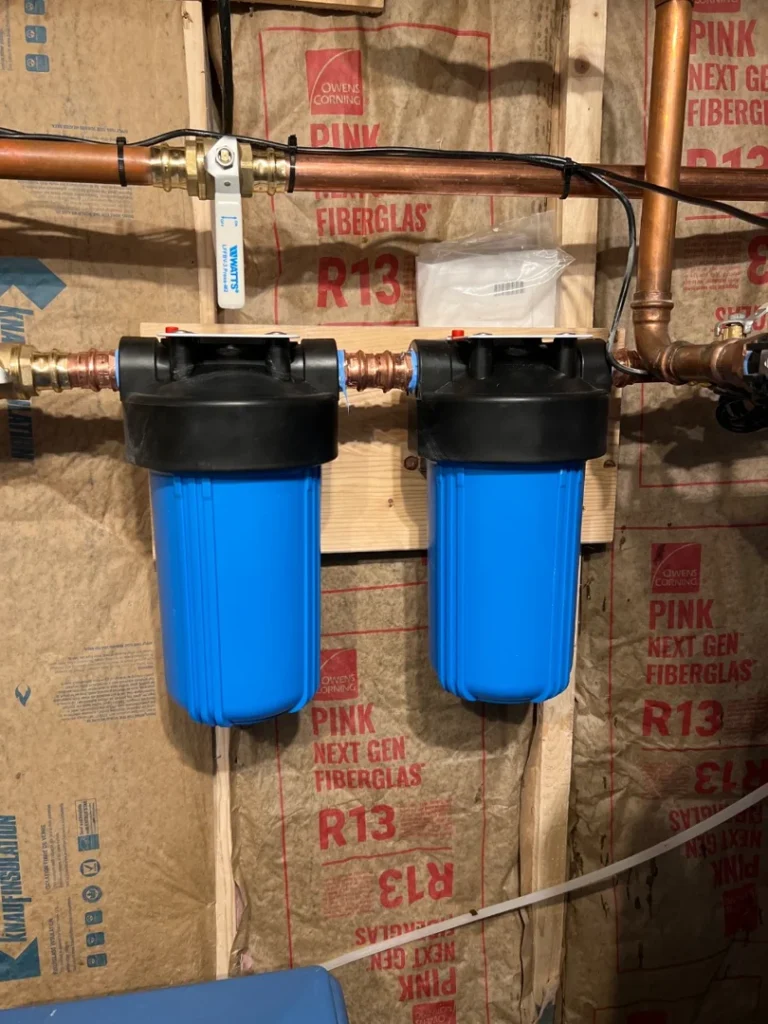
When we install a whole house filtration system, we slice into this main line right after the water meter. The filter system is designed with 3/4-inch inlet and outlet ports, allowing it to connect directly to your plumbing without restricting the natural flow of water.
The Filtration Journey: Step-by-Step
Once installed, the system acts as a gatekeeper. Before water can travel to your kitchen faucet, water heater, washing machine, or bathroom showers, it must pass through the filtration media. To learn more about this process, you can read all about whole house filters to see how they protect your entire plumbing ecosystem.
Generally, the filtration process occurs in distinct stages:
- The Sediment Stage: Water first flows through a sediment pre-filter. This stage physically traps suspended solids like sand, silt, clay, and rust flakes. This is particularly important in older Chicago neighborhoods where municipal water mains are frequently undergoing repairs, which can stir up debris.
- The Carbon Stage: Next, the water moves through an advanced carbon block or granular activated carbon filter. This stage utilizes adsorption to capture dissolved chemicals. It targetedly reduces chlorine, chloramines, volatile organic compounds (VOCs), and industrial solvents that municipal plants use for treatment but leave behind chemical odors and tastes.
- The Specialized Treatment Stage: In advanced configurations, a third stage may target heavy metals like lead. This is crucial for older properties with aging service lines.

By integrating our specialized Whole House Filtration systems directly into these 3/4-inch service lines, we ensure that every fixture in your home delivers cleaner, more refreshing water.
Need Clean, Safe Water at Home?
Get a free water test at your home or business. We install and service whole-house filtration and PEL75 reverse osmosis systems across Chicagoland. We also take select projects in Wisconsin and Indiana.
Book a Free Water TestCall (312) 889-8888Key Benefits of 3/4″ Filtration for Chicago Homes
If you live on Chicago’s Northwest Side — in neighborhoods like Norwood Park, Edison Park, or Jefferson Park — you are likely familiar with the unique character of our historic homes. However, those beautiful brick bungalows often hide aging water infrastructure.
Installing a 3/4 inch whole house water filter offers several key benefits tailored specifically to our local water conditions:
1. Mitigating Lead and Heavy Metal Risks
Many older homes in Chicago still receive their water through lead service lines. While municipal treatment centers work hard to manage water chemistry and minimize lead leaching, construction, water main breaks, and temperature fluctuations can still cause lead particles to slough off into your tap water. A multi-stage whole house system designed for 3/4-inch lines may help reduce heavy metals, providing an extra layer of defense for your family. To find out which setups work best, check out our guide on the best whole house water filtration systems in chicago for crystal clear water.
2. Protecting Expensive Household Appliances
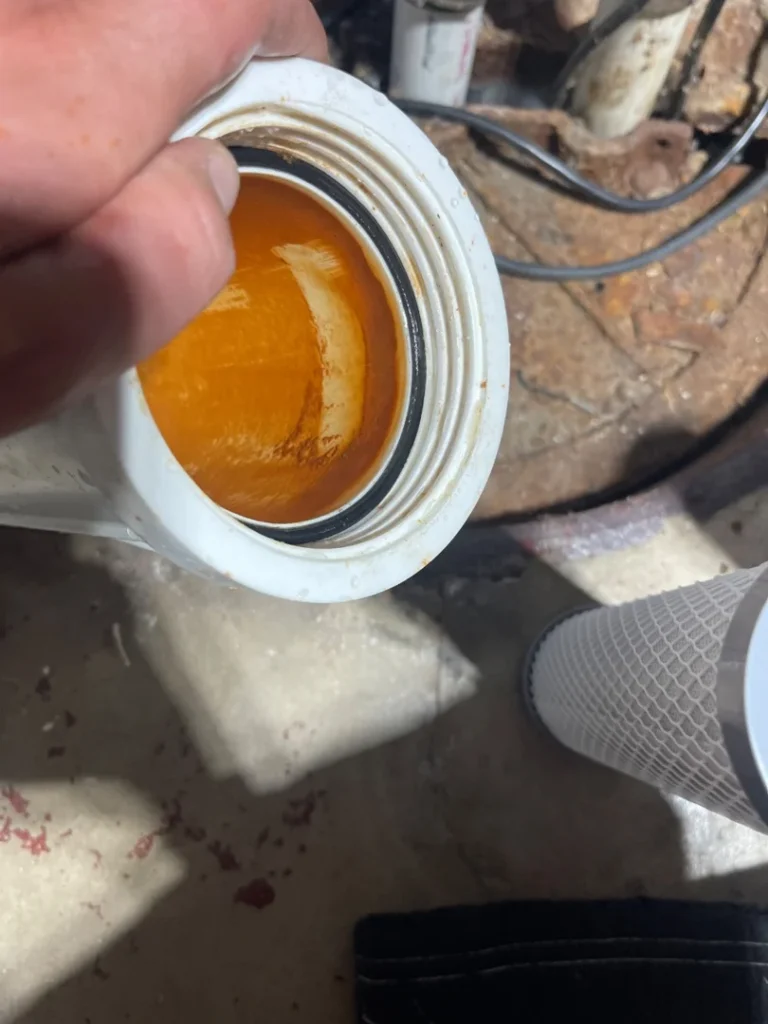
Sediment and rust are abrasive. When they enter your water heater, washing machine, and dishwasher, they cause premature wear and tear. Over time, sediment settles at the bottom of your water heater, creating an insulating layer that forces the system to work harder, increasing your energy bills. A whole house sediment filter captures these particles before they can damage your appliances.
3. Eliminating Chlorine Taste and Chemical Odors
Have you ever turned on your tap and noticed a smell resembling a swimming pool? Municipalities use chlorine to keep water sanitary during its long journey from the lake to your tap. While necessary for public health, you don’t necessarily want to drink it or inhale its vapors while showering. Carbon filtration effectively removes chlorine, which many customers notice dramatically improves the taste of drinking water and eliminates harsh odors.
Need Clean, Safe Water at Home?
Get a free water test at your home or business. We install and service whole-house filtration and PEL75 reverse osmosis systems across Chicagoland. We also take select projects in Wisconsin and Indiana.
Book a Free Water TestCall (312) 889-8888Choosing the Right System: 3/4 Inch vs. 1 Inch and Larger Ports
One of the most common questions we receive is whether a homeowner should choose a 3/4-inch port system or opt for a larger 1-inch or 1.5-inch configuration. The answer depends on two main factors: your home’s existing plumbing size and your household’s peak water demand.
To help visualize the differences, we have compiled a quick comparison table:
| Feature / Specification | 3/4-Inch Filter System | 1-Inch Filter System | 1.5-Inch Filter System |
|---|---|---|---|
| Typical Pipe Compatibility | 3/4″ copper, PEX, or galvanized | 1″ copper or PEX | 1.25″ to 1.5″ commercial lines |
| Average Flow Rate | 10 – 15 GPM | 15 – 25 GPM | 25+ GPM |
| Ideal Household Size | 1 – 3 Bathrooms | 3 – 5 Bathrooms | Large estates / Commercial |
| Pressure Drop Risk | Minimal (if sized correctly) | Extremely low | Virtually zero |
| Common Applications | Standard residential homes | Larger homes / High-demand | Light commercial / Multi-family |
While systems with larger ports exist, such as those found on Lowe’s Whole-House Water Filtration Systems, installing a system that is larger than your home’s incoming pipe size requires adapters and won’t actually increase your flow rate beyond what your 3/4-inch main line can deliver.
On the other hand, trying to adapt a 3/4-inch filter onto a 1-inch main line will restrict your water flow, leading to a noticeable drop in water pressure when multiple showers or appliances are running simultaneously.
For standard residential homes in our service area, a dedicated 3/4-inch system like our whole house filtration system is typically the perfect match, balancing excellent contaminant reduction with the flow rates required for daily household activities.
Professional Installation and Maintenance Requirements
When it comes to installing a whole-house water treatment system, there is no substitute for professional expertise. Because a whole house filter must be spliced directly into your main cold water line, proper installation requires specialized plumbing knowledge.

Why Professional Installation is Required
An incorrectly installed system can lead to serious issues, including:
- Water Leaks: Main lines are under constant high pressure (often 40-80 psi). A minor connection error can lead to catastrophic basement flooding.
- Pressure Drop Issues: If the bypass valves are not configured correctly, you may experience a severe drop in household water pressure.
- Voided Warranties: Many high-quality filtration systems require professional installation to keep their manufacturer warranties valid.
Our professional technicians at ProEcoLife ensure that your system is installed with a dedicated three-valve bypass loop. This allows you to bypass the filter easily if you ever need to perform maintenance or water your lawn with unfiltered water. We also install pressure release valves and pressure gauges on either side of the system, allowing us to monitor the system’s health accurately over time.
To keep your system performing optimally, ongoing care is required. You can learn more about how we handle these setups by reading about our whole house filtration services.
Frequently Asked Questions About 3/4″ Filtration Systems
How often should I replace the cartridge in my 3 4 inch whole house water filter?
The lifespan of your filter cartridges depends heavily on your local water quality and overall household water usage. On average, standard sediment and carbon cartridges need to be replaced every 3 to 6 months.
However, in older areas of Chicago where water main construction is common, high levels of sediment can clog a filter faster. If you notice a sudden drop in water pressure or a change in the taste and smell of your water, it is usually a sign that the cartridges have reached their capacity and require professional replacement.
Will a 3 4 inch whole house water filter reduce my home’s water pressure?
A high-quality, professionally installed 3/4 inch whole house water filter should not cause a noticeable drop in your daily water pressure. Most standard residential systems are rated for flow rates of 12 to 15 GPM (gallons per minute).
Since a typical showerhead uses about 2.0 GPM and a kitchen faucet uses around 1.5 GPM, a 12 GPM system can easily support multiple fixtures running at the same time. Some popular 3-stage systems on the market, such as those featured on Amazon’s Whole House 3-Stage Filtration Systems or the high-flow iSpring Whole House Systems, are specifically engineered to minimize pressure drop while maintaining high contaminant extraction rates.
Do I need a water softener alongside my 3/4″ filtration system?
While a whole house water filter is excellent at removing chemicals, sediment, and heavy metals, it does not soften water. In many of Chicago’s Northwest suburbs — including Park Ridge, Niles, Des Plaines, Skokie, Glenview, Arlington Heights, and Morton Grove — the water contains elevated levels of calcium and magnesium minerals.
Hard water leads to scale buildup inside your pipes, leaves white spots on your glassware, and can dry out your skin and hair. If you live in these areas, pairing your whole house filter with a ProEcoLife Well Water Conditioning or softening system is highly recommended to protect your plumbing and improve your overall water quality.
Conclusion: Partner with Chicago’s Trusted Water Experts
Investing in a 3/4 inch whole house water filter is one of the smartest decisions you can make to protect your home, your appliances, and your family’s health. By intercepting sediment, chlorine, rust, and heavy metals at your home’s point of entry, you ensure that every tap delivers cleaner, safer, and better-tasting water.
Since 2014, ProEcoLife has been dedicated to delivering premium, localized water treatment solutions across the Chicago area. Under the leadership of founder Karol Dolega, we have developed a comprehensive family of products engineered to tackle our region’s specific water challenges. Whether you need our advanced PEL75 9-Stage RO System for pristine drinking water, our robust Whole House Filtration for comprehensive home protection, a targeted Shower Filter System, specialized Well Water Conditioning for suburban hard water, or high-capacity Commercial Water Filtration Systems, we have the expertise to design the perfect configuration for your property.
To see where we are located or to read more about our local presence, you can visit our Proecolife Water Corp – Chicago, IL – MapQuest page.
Don’t guess when it comes to your water quality. Contact the experts at ProEcoLife today to schedule a professional in-home water analysis and take the first step toward crystal-clear water.
Call us at (312) 889-8888 or visit proecolife.com to schedule your water test today!