

Why Chicago School Water Testing Matters for Every Family in the City
Chicago school water testing is something every parent in this city deserves to understand — because the risks are real, and the data backs that up.
Here’s what you need to know right away:
- CPS tests approximately 25% of its schools each year for lead in drinking water across all 634 schools in the district.
- The action level is 5 ppb — stricter than the federal EPA limit of 15 ppb.
- Since 2019, about 9.6% of water samples collected by CPS have exceeded the Illinois Department of Public Health (IDPH) limit.
- When a fixture fails, it is taken out of service immediately and cannot return until retesting confirms it is safe.
- You can look up your child’s school on the CPS Water Quality Dashboard to see specific fixture-level results.
Now here’s the bigger picture that connects school safety to your home.
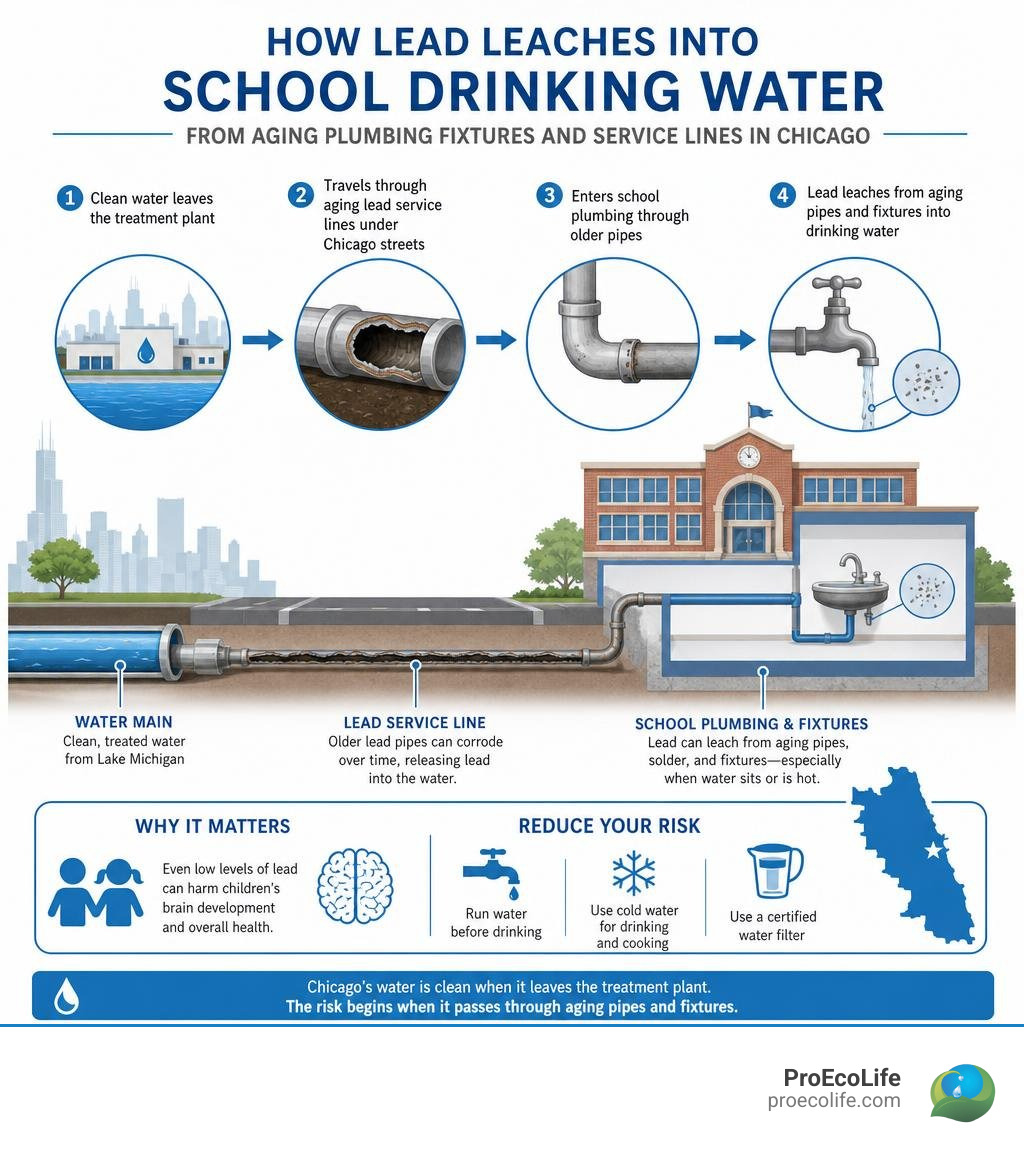
Chicago’s water is clean when it leaves the treatment plant on Lake Michigan. Lead-free, in fact. The problem starts the moment that water travels through aging pipes — inside school buildings, inside your home, and through the estimated 400,000 lead service lines running under Chicago streets.
A Johns Hopkins study estimated that 68% of Chicago children under age 6 live in homes with tap water containing detectable levels of lead. That means the risk doesn’t end at the school door.
Understanding how the district tests, what the numbers mean, and what you can do at home is the first step to protecting your family.
Chicago school water testing definitions:
The Current State of Chicago School Water Testing and District Protocols
As of July 2026, Chicago Public Schools (CPS) operates an ongoing water quality monitoring program designed to track and mitigate lead levels across its massive academic infrastructure. The district’s current testing phase runs through Fall 2026, with a systematic schedule that ensures approximately 25% of all 634 schools are sampled annually. This rotating schedule represents a proactive commitment to monitoring, especially considering that municipal water chemistry and building conditions fluctuate over time.
To ensure the accuracy of these tests, CPS employs a highly specific sequential sampling method. Unlike standard municipal tests that might only take a single large draw of water, the district’s environmental consultants collect five consecutive 250-milliliter (mL) samples from each targeted fixture.
This micro-sampling approach serves two critical purposes:
- Accurate representation of child consumption: A 250 mL volume closely matches the amount of water a young child actually drinks in a single serving from a fountain or sink.
- Pinpointing the source of contamination: By analyzing five sequential draws, technicians can trace exactly where the lead is leaching from. The first draw represents water sitting directly in the faucet or bubbler mechanism, while subsequent draws capture water from the internal riser pipes and the main service lines deeper in the building’s plumbing.
For these samples to be valid, the water must remain completely stagnant in the pipes for a minimum of 8 hours, but no more than 18 hours, prior to collection. This is why testing is almost always conducted in the early morning hours, typically between 5:00 a.m. and 6:00 a.m., before students and staff enter the building. If a school building has been inactive for more than three days, engineers must execute a thorough pre-flushing routine exactly 8 to 18 hours before the actual test samples are drawn.
To learn more about the administrative structure of these efforts, you can review the official WATER QUALITY TESTING PROGRAM documentation.

Prioritizing High-Risk School Buildings
With hundreds of campuses spread across Chicago’s Northwest Side neighborhoods like Jefferson Park, Portage Park, and Norwood Park, as well as the rest of the city, CPS cannot test every single water outlet simultaneously. To manage this logistically, the district prioritizes schools based on a matrix of known risk factors:
- Building Age: Facilities constructed before the 1986 federal lead ban are heavily prioritized. In Chicago, older buildings are highly likely to contain lead-bearing solder, brass fixtures, or galvanized pipes.
- Student Age: Campuses hosting pre-Kindergarten and Kindergarten programs are prioritized because children under the age of six are the most vulnerable to the developmental neurotoxins of lead.
- Fixture Type and Location: Outlets used directly for drinking or food preparation—such as kitchen sinks, classroom bubblers, nurse’s stations, and hallway water coolers—are tested first. Utility sinks and restroom handwashing faucets are generally excluded from the primary potable water testing pool.
- Infrastructure Conditions: Buildings with a history of plumbing repairs, water pressure issues, or known service line vulnerabilities are moved to the front of the queue.
School engineers play a pivotal role in this process, guiding environmental contractors through the layout of each building to map out every single potable water outlet. To understand the exact technical guidelines followed during these site evaluations, you can refer to the district’s Phase III Testing protocol sheet.
How Chicago School Water Testing Compares to State and Federal Mandates
When it comes to water safety, the legal landscape can be confusing. Nationally, the United States Environmental Protection Agency (EPA) sets the Lead and Copper Rule action level at 15 parts per billion (ppb). However, Illinois state law is more stringent. Under Illinois Public Act 099-0922 (often associated with Senate Bill 550), schools constructed on or before January 1, 2000, are required to test their potable water sources and directly notify parents and guardians of any results that meet or exceed 5 ppb.
CPS voluntarily goes beyond these state and federal mandates in several key ways:
- Stricter Mitigation Threshold: While state law only mandates notification at 5 ppb, CPS uses 5 ppb as its absolute action level. This means the district does not just send a letter home; it immediately shuts down the fixture, takes it out of service, and begins physical remediation.
- Ongoing Voluntary Testing: Illinois law does not require continuous, recurring testing cycles once a school has completed its initial rounds. CPS, however, has committed to its voluntary 25% annual testing rotation through Fall 2026 to catch plumbing degradation that occurs as buildings age.
- Rigorous Sampling Volume: While state protocols only require two sequential samples, CPS mandates the five-sample sequential draw method to ensure no localized lead pockets are missed.
For a deeper dive into how these various regional and national standards compare, you can read our A Practical Guide to Chicago Lead Water Levels.
Need Clean, Safe Water at Home?
Get a free water test at your home or business. We install and service whole-house filtration and PEL75 reverse osmosis systems across Chicagoland. We also take select projects in Wisconsin and Indiana.
Book a Free Water TestCall (312) 889-8888Action Levels, Exceedance Rates, and Remediation Steps
When a school water outlet is tested, the laboratory results are measured in parts per billion (ppb) or micrograms per liter (μg/L). Understanding the difference between regulatory compliance and true safety is critical for families in neighborhoods like Edison Park and suburbs like Park Ridge or Niles.
Since the second major wave of district-wide testing began in 2019, the average rate of water samples exceeding the IDPH limit of 5 ppb has hovered around 9.6%. This means nearly one out of every ten fountains or sinks tested in Chicago schools has required immediate shutoff and repair.
Maintaining this massive safety net is an expensive undertaking. Over a recent seven-year period, the CPS water testing and remediation program cost the district approximately $3.14 million. These funds are allocated directly toward laboratory analysis, environmental consulting fees, fixture replacements, and the intensive labor required to execute flushing protocols.
| Standard / Agency | Lead Action Level (ppb) | Required Response |
|---|---|---|
| Federal EPA | 15 ppb | Public education, system-wide corrosion control adjustments |
| Illinois State Law (IDPH) | 5 ppb | Direct parental notification within 7 business days |
| Chicago Public Schools (CPS) | 5 ppb | Immediate fixture decommissioning, physical remediation, and sequential retesting |
| Licensed Child Care Facilities (Illinois) | 2.00 ppb | Immediate mitigation and alternative water source provision |
If you want to ensure your own home or commercial property’s water meets the highest safety standards, you can learn about professional diagnostic options through our Reliable Water Testing Service in Chicago for Your Home or Business page.
The 56-Hour Flushing and Retesting Protocol
When a water fixture fails a lead test by registering at or above 5 ppb, CPS Facilities must execute a strict, multi-step remediation process. The fixture is immediately wrapped in plastic, tagged with bilingual “Out of Service” signage, and disconnected from the physical water supply lines.
The primary mechanical treatment used to clear localized lead buildup is an intensive flushing protocol:
- The 56-Hour Flush: The affected line is flushed for 8 hours a day for 7 consecutive days, totaling 56 hours of active water movement. This process helps strip away loose lead particulate and scale that may have accumulated inside the local pipe walls.
- The Stagnation Rest: After the 7-day flushing cycle is complete, the water is turned off and allowed to sit completely still in the plumbing for a period of 8 to 18 hours.
- Clearance Testing: Technicians return early in the morning to collect another round of five sequential 250 mL samples.
- Verification and Re-commissioning: The fixture remains offline until the certified laboratory confirms that all five new samples register well below the 5 ppb threshold.
- Long-Term Follow-Up: Once returned to service, the fixture is flagged for mandatory follow-up testing 90 to 120 days later to ensure the lead levels remain low under normal usage conditions.
If simple flushing fails to bring the lead levels down, building engineers must physically replace the faucet, bubbler, internal valves, or the underlying copper or brass supply lines. In older areas of the city and nearby suburbs like Des Plaines or Skokie, localized pipe replacement is often the only permanent way to eliminate lead leaching.
Need Clean, Safe Water at Home?
Get a free water test at your home or business. We install and service whole-house filtration and PEL75 reverse osmosis systems across Chicagoland. We also take select projects in Wisconsin and Indiana.
Book a Free Water TestCall (312) 889-8888School Water Safety vs. Chicago’s Residential Tap Water Crisis
While the lead levels in school buildings are closely monitored, the water quality in Chicago’s residential homes presents an even larger public health challenge. The root of this issue lies in our regional infrastructure. Chicago has an estimated 400,000 lead service lines supplying water to as many as 2.7 million people—more than any other city in the United States.
For decades, city building codes actually mandated the use of lead pipes for water service lines, a practice that was not banned until 1986. Consequently, if you live in a Chicago home or two-flat built before 1986, there is an exceptionally high probability that your water service line is made of solid lead.
A landmark study led by researchers at the Johns Hopkins Bloomberg School of Public Health brought the scale of this residential crisis to light. By analyzing data from nearly 40,000 households participating in the city’s voluntary testing program, researchers estimated that 68% of Chicago children under the age of six live in households with tap water containing detectable levels of lead (at or above 1 ppb). Furthermore, the study revealed that 9% of those residential tap water tests exceeded the EPA’s official action level of 15 ppb.
This residential exposure is particularly concerning because children spend more of their developmental years at home than at school. While CPS works to keep school fountains under 5 ppb, a child may go home to a house where the kitchen tap is delivering water with significantly higher lead concentrations.
To understand how this infrastructure crisis impacts your specific neighborhood, you can read our comprehensive overview of Chicago’s Risky Water Problem or learn How to Use the WBEZ Lead Pipe Map to Check Your Chicago Home.
How Parents Can Access Chicago School Water Testing Results
Transparency is vital when dealing with environmental health. Parents do not have to wonder or guess about the safety of the water fountains at their child’s school. CPS maintains an interactive public portal known as the Water Quality Dashboard. This tool allows you to search for any district campus and view historical and current lead testing results down to the individual room and fixture.
For instance, you can review the official Jun 24, 2026 NATIONAL TEACHERS 55 W CERMAK RD, Chicago IL 60616. report to see a real-world example of how the district documents initial failures, physical remediation, and successful clearance testing. In that specific case, an initial test of a classroom sink registered above the 5 ppb limit, was immediately taken offline, repaired, and successfully retested down to a safe 1.000 μg/L.
If you are concerned about your child’s potential lead exposure, the Chicago Department of Public Health (CDPH) operates a dedicated lead hotline at 312-747-5323 to provide guidance on pediatric blood testing. To take control of your household’s safety, you can also learn more about diagnostic testing for your home tap by visiting our Test Your Water page.
Frequently Asked Questions About Chicago School Water Quality
Why does lead get into school water if Lake Michigan source water is lead-free?
It sounds like a contradiction: Chicago’s municipal water treatment plants successfully remove lead, yet lead still appears at the school tap.
The explanation lies in the chemistry of water distribution. When purified water leaves the city’s massive treatment facilities, it is indeed lead-free. However, as it travels through miles of underground water mains, it eventually enters individual buildings through lead service lines. From there, it passes through interior plumbing systems that may contain lead solder or chrome-plated brass fixtures.
Over time, water—especially stagnant water that sits unused overnight or over the weekend—corrodes these metal surfaces, causing lead to leach directly into the water. Although the city adds food-grade orthophosphate as a corrosion control inhibitor to coat the inside of pipes, individual factors like water temperature, acidity, and building vacancy can still cause this protective barrier to break down. This phenomenon is thoroughly detailed in the USGS Chicago Water Quality Study, which confirmed that lead contamination in Chicago occurs almost entirely within the localized distribution infrastructure rather than at the source purification plants.
What are the health risks of lead exposure for school-aged children?
There is no safe level of lead exposure for humans, and young children are by far the most vulnerable. Because their nervous systems and brains are still actively developing, children absorb up to four to five times more lead than adults from a given dose.
According to the Centers for Disease Control and Prevention (CDC), even low levels of lead exposure in children can result in:
- Damage to the brain and nervous system
- Slowed growth and development
- Learning and behavior problems, including lower IQ and decreased attention span
- Underachievement in academic settings
- Hearing and speech difficulties
Because lead poisoning often occurs with no obvious, immediate symptoms, it frequently goes undetected unless a pediatrician performs a routine blood lead level test.
What should I do if my child’s school or my home tests positive for lead?
If your child’s school has fixtures that exceed the 5 ppb threshold, ensure they are actively decommissioned and that the school is providing alternative drinking water, such as bottled water or certified filtration stations. You can also encourage your child to carry a reusable water bottle filled with filtered water from home.
If your home tap water tests positive for lead, immediate action is highly recommended:
- Avoid drinking unfiltered tap water: Do not use unfiltered tap water for drinking, cooking, or preparing baby formula.
- Run the cold tap: If the water has sat unused for more than six hours, run your cold water faucet for at least five minutes before using it. This flushes stagnant water out of your local service lines. Hot water dissolves lead much faster than cold water, so never use hot tap water for cooking or drinking.
- Install certified filtration: Standard pitcher filters or basic faucet attachments often lack the capacity to handle heavy lead loads. To achieve peace of mind, many Chicago families opt for advanced point-of-use filtration, such as our PEL75 9-Stage RO System, or comprehensive Whole House Filtration systems designed to intercept contaminants before they reach your family’s cups.
Conclusion
At ProEcoLife, we have been dedicated to addressing Chicago’s unique water challenges since our founding in 2014 by Karol Dolega. We understand the specific environmental concerns that families face across Chicago’s Northwest Side — from Norwood Park, Edison Park, and Jefferson Park to nearby suburbs like Park Ridge, Niles, Des Plaines, Skokie, Glenview, Arlington Heights, and Morton Grove.
While municipal programs like chicago school water testing provide an essential safety net for students during the school day, protecting your family’s health requires a continuous commitment to clean water at home. Whether your property relies on municipal Lake Michigan water or private well systems in the outlying suburbs, our specialized water treatment solutions may help.
Our proprietary PEL75 9-Stage RO System utilizes advanced reverse osmosis technology to reduce lead and other microscopic impurities to virtually undetectable levels at your kitchen tap. For comprehensive protection, our Whole House Filtration systems and Commercial Water Filtration Systems provide a robust defense against heavy metals, chlorine, and sediment throughout your entire property.
To learn more about tailoring a filtration solution for your household, explore our guide on The Best Whole House Water Filtration Systems in Chicago.
Ready to secure your family’s water safety? Contact the local experts at ProEcoLife today to schedule a professional water quality inspection and analysis or visit us online at proecolife.com.