
Lead in Chicago Water Is a Real Risk — Here Are the Best Filters to Stop It
Finding the best under sink lead filter for your home is one of the most important decisions a Chicago homeowner can make right now.
Quick Answer: Best Under Sink Lead Filters for Lead Removal
| Filter Type | Best For | Key Certification |
|---|---|---|
| Reverse osmosis (RO) | Maximum lead removal | NSF/ANSI 58 |
| Multi-stage carbon block | Broad contaminant coverage | NSF/ANSI 53 |
| Customized under-sink systems | Address-specific water issues | NSF/ANSI 42, 53, 372 |
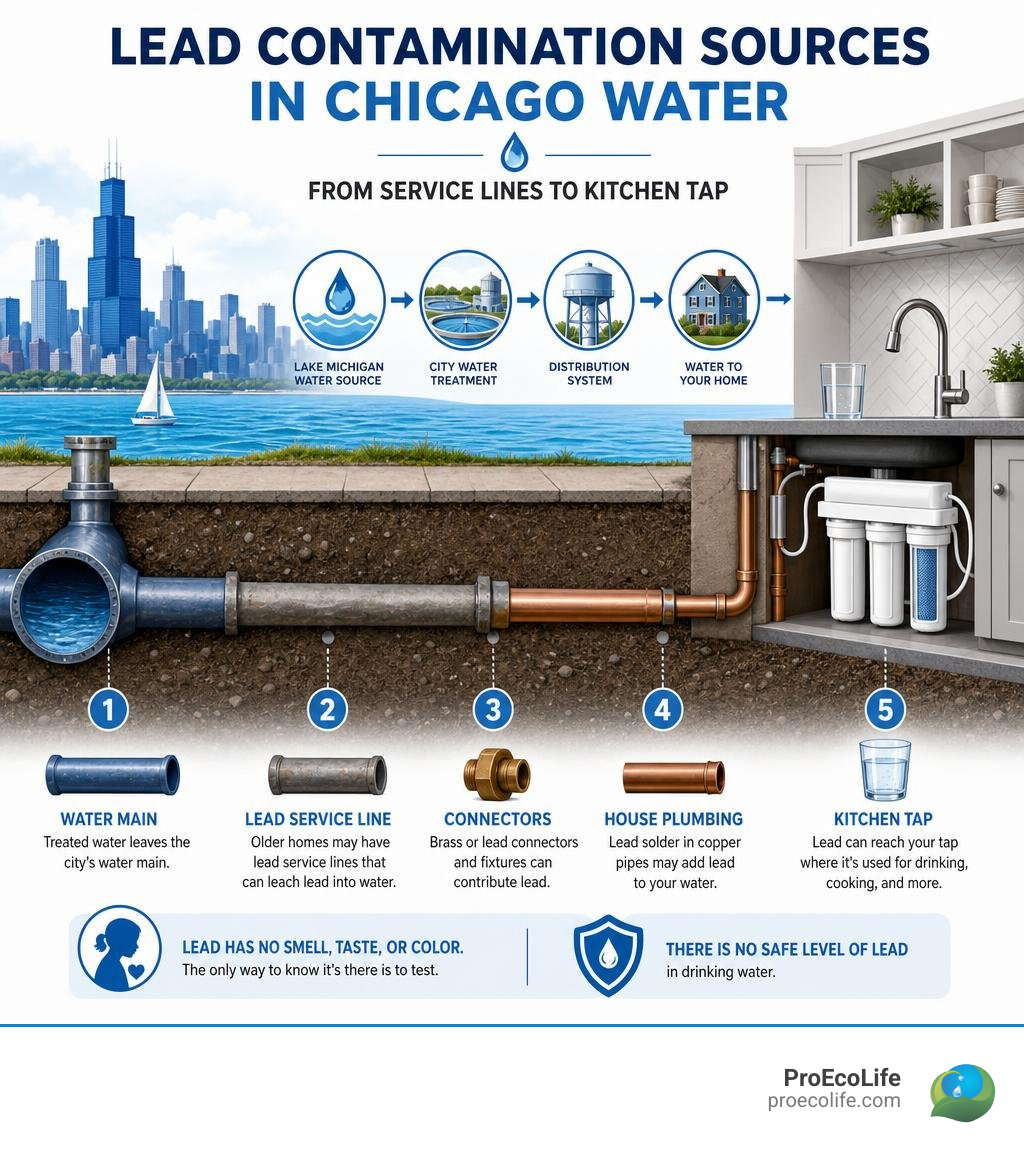
Chicago’s water comes from Lake Michigan and is treated by the city — but that doesn’t mean it arrives clean at your tap. Thousands of older homes across the Northwest Side, Norwood Park, Edison Park, Jefferson Park, and nearby suburbs like Park Ridge and Des Plaines still have lead service lines or lead solder in their plumbing.
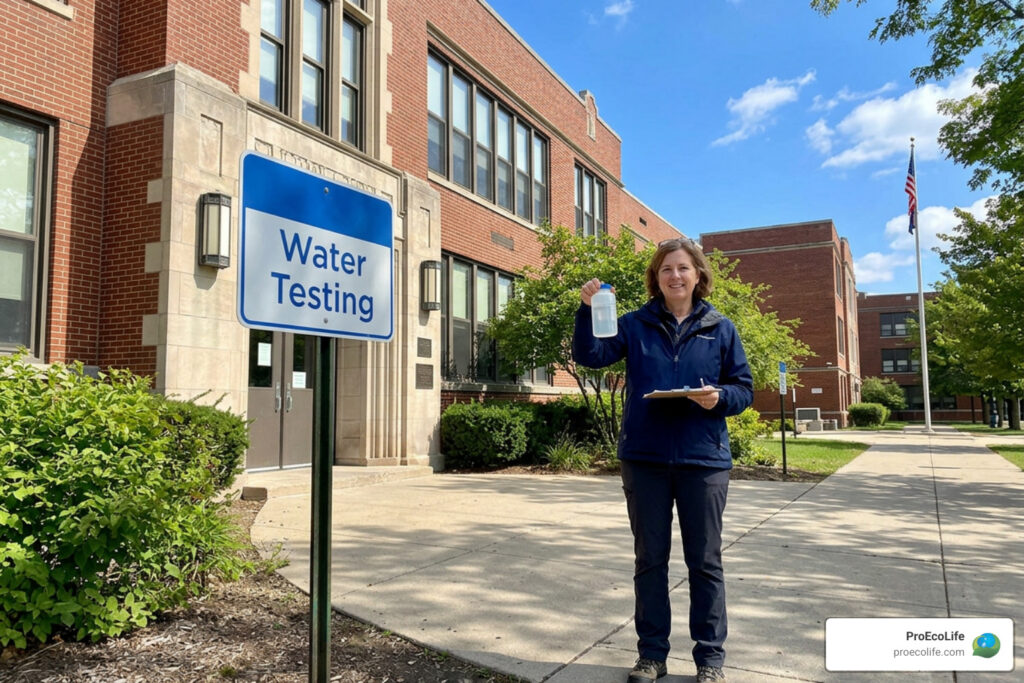
Lead cannot be seen, smelled, or tasted. The only way to know it’s there is to test.
The EPA and CDC agree: there is no safe level of lead in drinking water. Children and pregnant women face the highest health risks, including developmental delays and neurological damage.
An under-sink filter installed at your kitchen tap is one of the most effective point-of-use solutions available. But not all filters remove lead — and choosing the wrong one gives you false confidence.
This guide cuts through the noise and shows you exactly which systems work, what certifications to look for, and what Chicago homeowners specifically need to know.
Learn more about best under sink lead filter:
Why Chicago Homes Need the Best Under Sink Lead Filter
When we talk about water quality in the Chicago area, we are dealing with a unique historical paradox. On one hand, Lake Michigan provides an abundant supply of fresh water. On the other hand, Chicago has more lead service lines than any other city in the United States. For decades, local building codes actually mandated the use of lead pipes for service lines connecting street mains to residential properties. This practice only stopped in 1986.
If your home in Norwood Park, Edison Park, or Jefferson Park was built before the late 1980s, there is a very high probability that your drinking water passes through a lead pipe before it reaches your glass. Even in newer construction, lead solder in brass faucets and copper pipe joints can leach the heavy metal into your water supply.
While municipal water treatment plants adjust the pH of the water to create a protective scale inside the pipes, this coating is not foolproof. Construction, water main breaks, or changes in water chemistry can cause this scale to flake off, releasing concentrated lead directly into your home’s tap water.
This is why relying on a simple pitcher filter or an uncertified faucet attachment is often not enough. To truly safeguard your family, installing the best under sink lead filter is a critical step. These point-of-use systems treat the water right before it exits your kitchen faucet, ensuring that any lead leached from the city’s infrastructure or your home’s own plumbing is effectively captured.
For a deeper dive into navigating this local challenge, you can read more about how local communities are addressing this issue in this City Bureau guide on choosing a water filter for lead, or consult our comprehensive 2026 guide to choosing the best lead water filter in Chicago.
Need Clean, Safe Water at Home?
Get a free water test at your home or business. We install and service whole-house filtration and PEL75 reverse osmosis systems across Chicagoland. We also take select projects in Wisconsin and Indiana.
Book a Free Water TestCall (312) 889-8888Key Technologies and Certifications for Under-Sink Lead Removal
When searching for the best under sink lead filter, understanding the science behind the filtration is crucial. Lead exists in water in two primary forms: soluble (dissolved) lead and particulate (solid) lead. An effective filter must be engineered to address both.
Filtration Technologies Explained
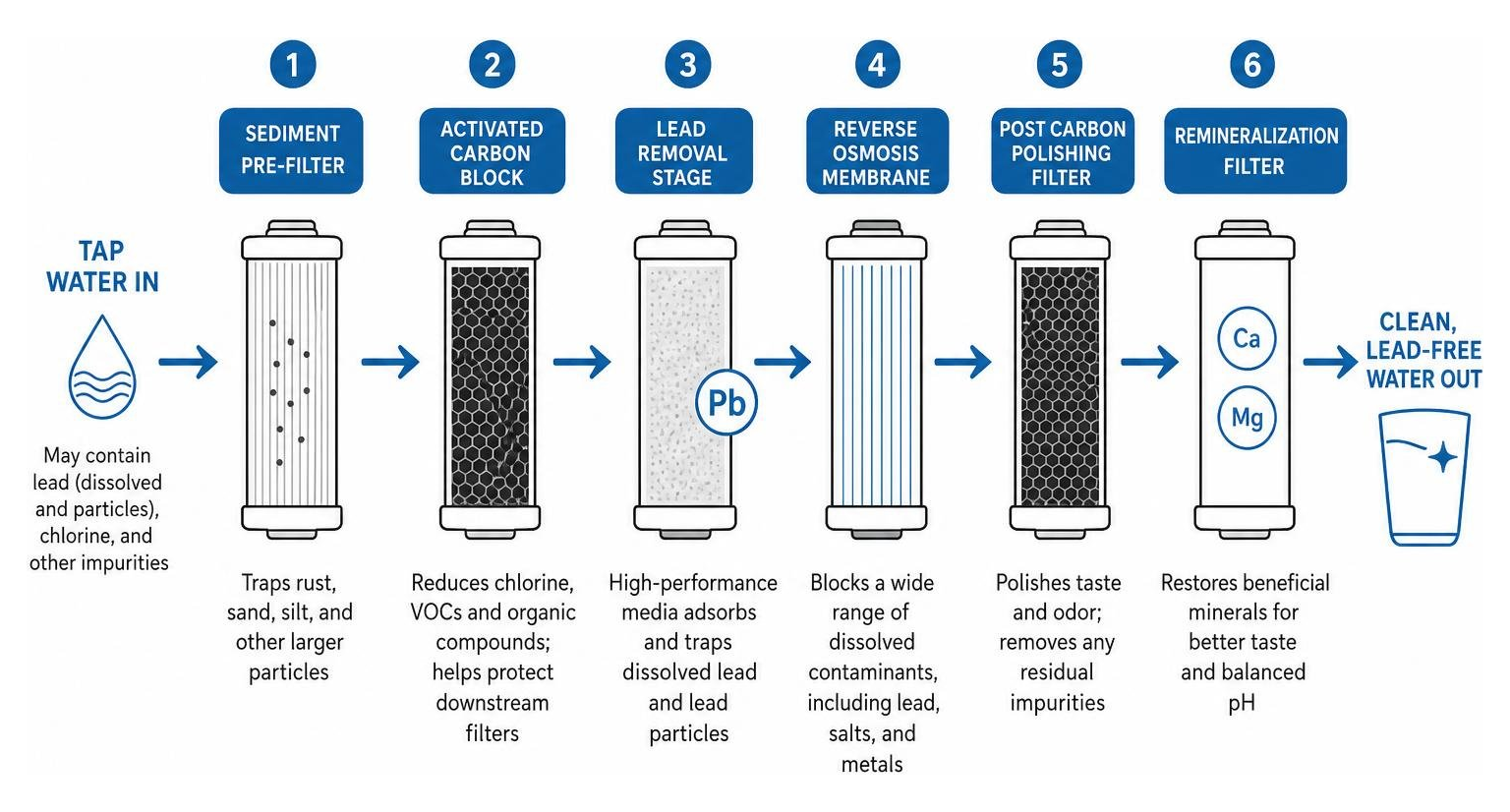
There are two dominant technologies used in under-sink systems to combat lead:
- Activated Carbon Block Filters: These filters work through mechanical filtration and physical adsorption. Solid lead particles are physically trapped in the microscopic pores of the carbon block, while dissolved lead chemically bonds to the carbon surface. High-quality carbon blocks are compressed to submicron pore sizes (often 0.5 microns or smaller) to ensure high reduction rates.
- Reverse Osmosis (RO) Systems: These systems push water through a semipermeable membrane with incredibly tiny pores (typically around 0.0001 microns). Because lead molecules are significantly larger than water molecules, the membrane blocks them with exceptional efficiency. RO systems represent the gold standard for heavy metal removal, as they strip away virtually all dissolved solids.
The Importance of Independent Certifications
You should never buy a water filter based solely on the manufacturer’s marketing claims. Instead, look for independent testing and certifications from trusted organizations like the National Sanitation Foundation (NSF), the Water Quality Association (WQA), or the International Association of Plumbing and Mechanical Officials (IAPMO).
When evaluating under-sink systems, look for these specific standards:
- NSF/ANSI Standard 53 (Health Effects): This is the crucial certification for active lead reduction. It verifies that the filter can reduce lead levels from an influent concentration of 150 parts per billion (ppb) down to below the EPA action level of 15 ppb (and often much lower).
- NSF/ANSI Standard 58 (Reverse Osmosis): This standard applies specifically to reverse osmosis systems, certifying that they effectively reduce lead, copper, arsenic, and other heavy metals under pressure.
- NSF/ANSI Standard 372 (Lead-Free Materials): This confirms that the system’s housing, fittings, and faucet are made of lead-free materials, ensuring the filter itself does not introduce contaminants to your water.
For a detailed analysis of how top performing systems are evaluated, you can review the latest testing insights from the Consumer Reports under-sink water filter guide.
Carbon Block vs. Reverse Osmosis for Lead Removal
| Feature | Carbon Block Filters | Reverse Osmosis Systems |
|---|---|---|
| Lead Removal Mechanism | Adsorption & physical trapping | Semi-permeable membrane barrier |
| Primary Certifications | NSF/ANSI 53 | NSF/ANSI 58 |
| Pore Size | 0.5 to 1.0 micron | ~0.0001 micron |
| Mineral Retention | Keeps natural minerals in the water | Strips minerals (remineralization needed) |
| Water Waste | Zero water waste | Produces some wastewater during process |
| Flow Rate | Higher flow rate directly to faucet | Slower flow (often requires a storage tank) |
To understand more about how these carbon materials interact with water chemistry, read our guide on water carbon filters and what they remove. If you are leaning toward maximum purification, explore how reverse osmosis filters save your tap and review our roadmap to achieving lead-free drinking water.
Need Clean, Safe Water at Home?
Get a free water test at your home or business. We install and service whole-house filtration and PEL75 reverse osmosis systems across Chicagoland. We also take select projects in Wisconsin and Indiana.
Book a Free Water TestCall (312) 889-8888Selecting the Best Under Sink Lead Filter for Suburban Hard Water
While residents within Chicago city limits primarily contend with aging lead service lines, those living in the surrounding suburbs face a dual water quality challenge.
In communities like Park Ridge, Niles, Des Plaines, Glenview, Arlington Heights, and Morton Grove, municipal water supplies frequently exhibit high levels of hardness. Hard water is characterized by elevated concentrations of dissolved calcium and magnesium.
Balancing Hard Water Minerals and the Best Under Sink Lead Filter
When hard water passes through a standard lead filter, the dissolved minerals can rapidly precipitate out of solution, forming solid scale deposits. This scale buildup can clog the fine pores of a carbon block filter prematurely, drastically reducing its lifespan and flow rate.
If you live in a hard water suburb, a standard carbon-based lead filter may need to be replaced far more frequently than the manufacturer’s estimated lifespan suggests.
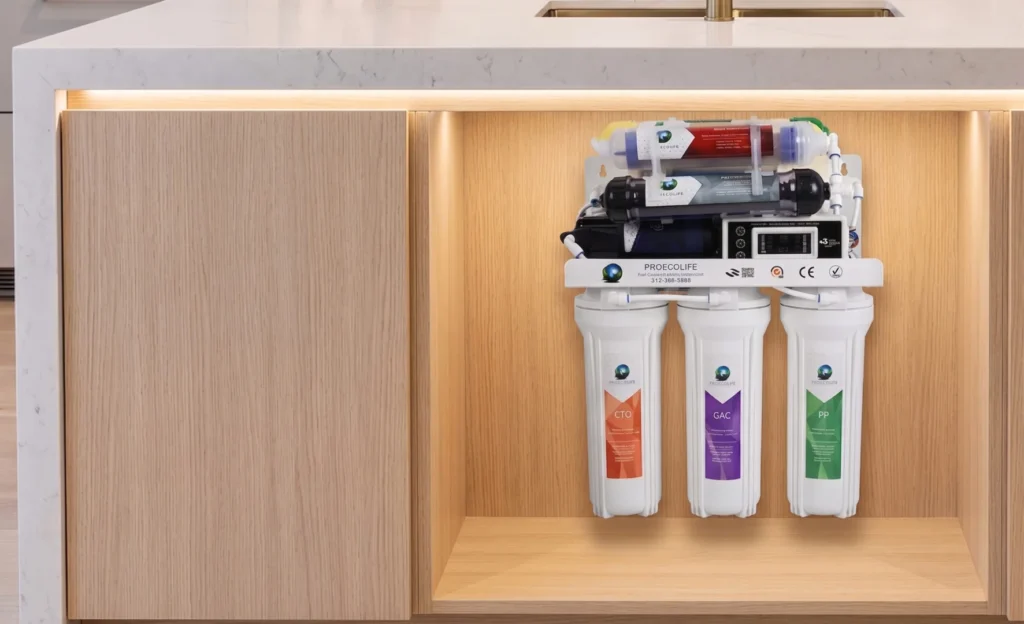
To combat this, we recommend utilizing advanced multi-stage systems. A high-quality reverse osmosis system, such as our PEL75 9-Stage RO System, is uniquely equipped to handle this environment.
The initial stages of the system filter out larger sediment and address hardness, protecting the delicate RO membrane and the specialized lead-reduction stages from scale buildup. This ensures consistent, high-flow lead removal while managing the heavy mineral load of suburban ground and lake water blends.
To understand the complex chemistry of heavy metals in hard water, read our expert analysis on the best way to remove lead from drinking water.
Professional Installation of the Best Under Sink Lead Filter
Under-sink water filtration systems require direct integration into your kitchen’s cold water supply line. This process involves securing precise plumbing connections, mounting the filter housings, and often installing a dedicated, lead-free faucet through your countertop.
In hard water areas, plumbing connections are highly susceptible to mineral scaling, which can cause micro-gaps and subsequent water leaks if not sealed with professional-grade hardware.
Because a minor installation error can result in costly water damage under your cabinetry, we strongly advise against DIY attempts. Professional installation ensures that all fittings are pressure-tested and that leak-prevention mechanisms are properly calibrated to the specific water pressure of your home.
Whether you are in Skokie or Niles, relying on professional plumbing and water treatment experts guarantees long-term system reliability. For professional support in the North suburbs, you can consult local water filtration installation services in Skokie or read our guide on how to choose the best under-sink water filter model.
Frequently Asked Questions About Under-Sink Lead Filtration
How do I know if there is lead in my Chicago tap water?
Because lead is completely odorless, tasteless, and invisible, you cannot rely on your senses to detect it. The only definitive way to know if lead is present is through certified laboratory water testing.
While the city of Chicago offers water testing kits to residents, a comprehensive, professional laboratory analysis provides a more detailed picture of your water’s overall profile, including hardness levels and other co-contaminants like PFAS or copper.
For more details on interpreting local water quality reports, check out our Chicago under-sink water filter reviews and buying guide.
Does reverse osmosis remove lead more effectively than carbon filters?
Yes, reverse osmosis is generally considered more robust for lead removal over the long term. While high-quality carbon block filters certified to NSF/ANSI 53 are highly effective, they rely on adsorption. Once the active bonding sites on the carbon are saturated, the filter’s lead-removal efficiency can decline.
Reverse osmosis, on the other hand, physically rejects lead ions at the membrane level based on molecular size. This physical barrier remains highly consistent throughout the lifespan of the membrane.
To learn more about comparing these methods, read our breakdown of the best faucet and under-sink water filters for lead removal.
How often do under-sink lead filters need to be replaced?
Filter lifespan depends heavily on your household’s daily water usage and the incoming water quality. For standard carbon block lead filters, manufacturers typically recommend replacement every 6 to 12 months. However, in Chicago suburbs with high sediment or hard water minerals, filters may become saturated sooner.
If you notice a significant drop in water flow at your drinking tap, it is a clear sign that the filter has captured a high volume of particulates and needs to be serviced.
For more tips on maintaining your system’s performance, see our lead faucet filter maintenance guide.
Conclusion
Protecting your family from lead exposure requires a reliable, scientifically proven solution tailored to local water conditions. At ProEcoLife, we have been proud of our deep Chicago roots since 2014. Founded by Karol Dolega, our mission has always been to deliver premium, high-performance water treatment systems designed specifically for the unique water challenges of the Chicago metropolitan area.
Our proprietary PEL75 9-Stage RO System provides unmatched multi-stage purification, effectively removing lead, heavy metals, and hard water minerals while restoring beneficial trace minerals for pristine, great-tasting water. For comprehensive protection throughout your entire home, we also offer custom-engineered Whole House Filtration systems.
Don’t guess when it comes to your family’s health. Let our local experts help you find the perfect system for your kitchen.
Contact ProEcoLife today to schedule a professional water test at (312) 889-8888 or visit proecolife.com to learn more.