




Is a Whole House Filter Right for Your Chicago Home?
If you’re researching a whole house filter for your Chicago home, here’s a quick summary of the top options to compare:
| System Type | Best For | Key Benefit |
|---|---|---|
| Multi-Stage Carbon + KDF | City water (chlorine, chloramines) | Removes chemicals from every tap |
| Iron & Manganese System | Well water users | Eliminates staining and sulfur odor |
| Anti-Scale / Salt-Free Conditioner | Hard water homes | Reduces scale without salt |
| UV Purification Add-On | Well water or aging infrastructure | Kills bacteria and viruses |
| Whole House + RO Combo | Maximum protection | Filtered water + ultra-pure drinking water |
Chicago’s water comes from Lake Michigan — one of the largest freshwater sources in the world. On the surface, that sounds reassuring. But by the time that water reaches a faucet in Norwood Park, Edison Park, or a 1920s bungalow on the Northwest Side, it has traveled through aging infrastructure that may include lead service lines, corroded galvanized pipes, and century-old water mains.
Municipal treatment adds chlorine and chloramines to kill bacteria. That’s necessary — but it also means your shower, your cooking water, and your kids’ bath water all carry those disinfectants right into your home.
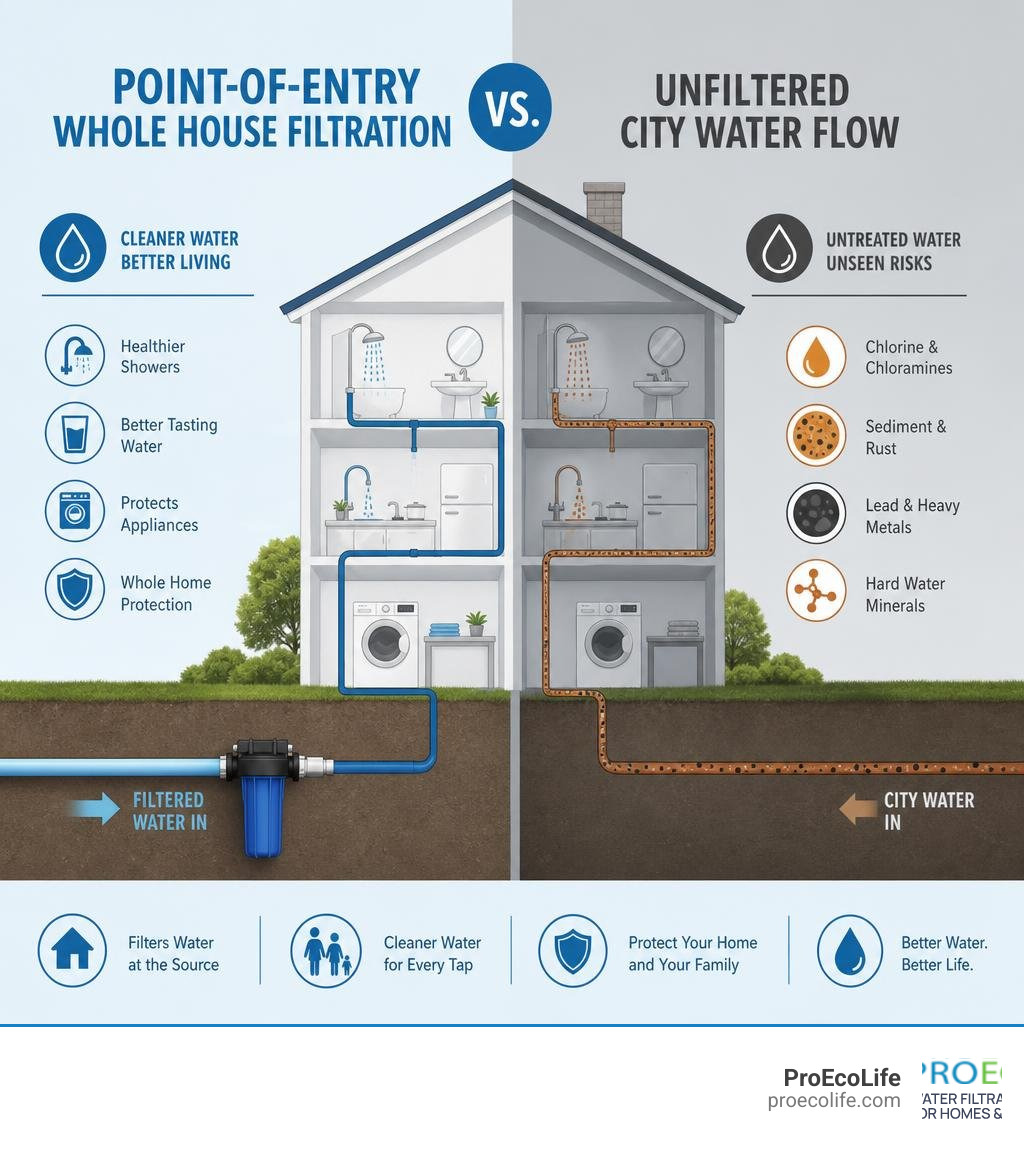
A whole house filter addresses this at the source. It’s installed where the main water line enters your home, so every tap, appliance, and showerhead gets filtered water — not just your kitchen sink.
For Chicago homeowners worried about lead, chlorine byproducts, and hard water common in the Northwest suburbs, this is often the single most impactful upgrade you can make to your home’s water quality.
What is a Whole House Filter and How Does It Work?
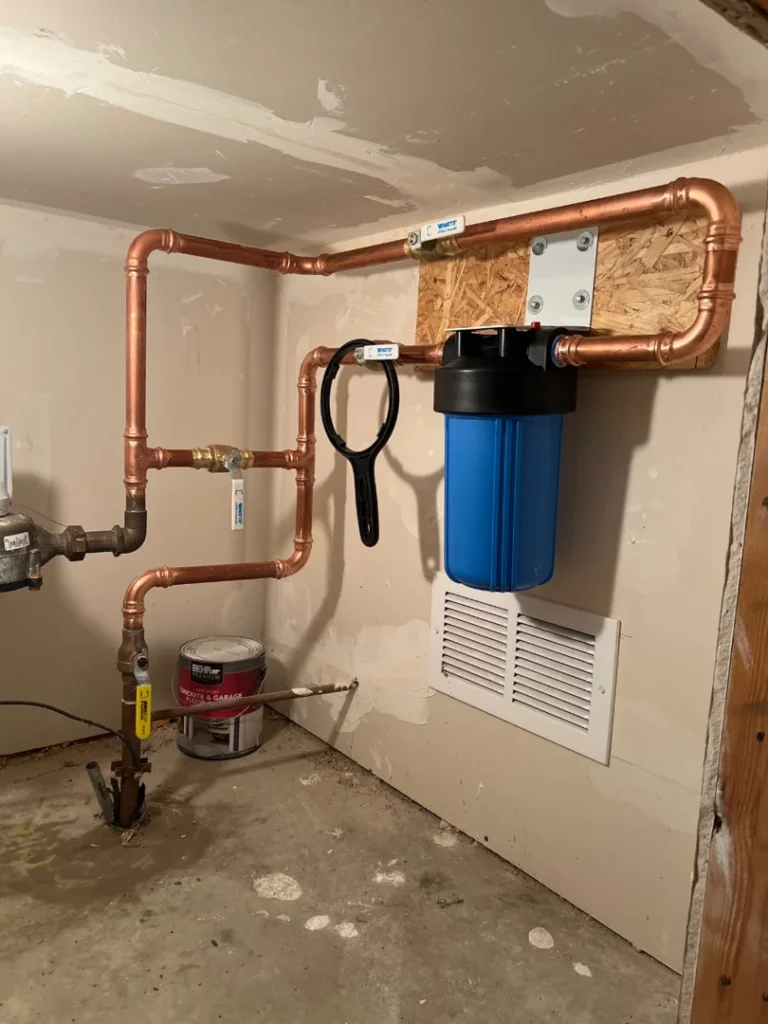
A whole house filter is a Point-of-Entry (POE) system. This means it is plumbed directly into your home’s main water line before the plumbing splits to supply your water heater, bathrooms, kitchen, and laundry. By intercepting water at its point of entry, the system ensures that every drop of water flowing through your home’s pipes is treated.
To understand how a Whole House Filtration System works, it helps to look at the typical multi-stage process we use to clean your water:
- Sediment Pre-Filter: The first line of defense is a high-capacity sediment filter. In older Chicago neighborhoods like Jefferson Park or Portage Park, water mains are constantly being repaired or replaced. This construction can kick up dirt, rust, silt, and sand. A 5-micron pre-filter catches these physical particles, protecting your plumbing and preventing the subsequent filtration stages from clogging.
- Kinetic Degradation Fluxion (KDF) Media: This copper-zinc formulation uses a basic chemical process known as redox (oxidation-reduction) to neutralize contaminants. It is highly effective at reducing chlorine, soluble heavy metals, and inhibiting the growth of bacteria and algae within the filter tank.
- Activated Carbon or Catalytic Carbon: Carbon media is the workhorse of chemical reduction. It features millions of microscopic pores that adsorb volatile organic compounds (VOCs), industrial chemicals, pesticides, and municipal disinfectants. While standard activated carbon handles chlorine well, we often utilize premium catalytic carbon to target chloramines—a stubborn combination of chlorine and ammonia increasingly used by municipal water treatment plants.
- Post-Filtration or Specialty Media: Depending on your local water profile, a final stage may include sub-micron filtration, UV sterilization, or specialized media to target specific regional issues.

By routing all incoming water through these specialized stages, a high-quality Whole House Filtration setup cleans the water you use for bathing, washing clothes, and cleaning dishes, while shielding your entire plumbing infrastructure from corrosion.
Need Clean, Safe Water at Home?
Get a free water test at your home or business. We install and service whole-house filtration and PEL75 reverse osmosis systems across Chicagoland. We also take select projects in Wisconsin and Indiana.
Book a Free Water TestCall (312) 889-8888Comparing Point-of-Entry and Point-of-Use Systems
When exploring home water treatment, you will encounter two main categories of systems: Point-of-Entry (POE) and Point-of-Use (POU). Understanding the differences in flow rates, placement, and target contaminants is essential when learning How to Choose a Water Filter for your household.
| Feature | Point-of-Entry (Whole House POE) | Point-of-Use (Under-Sink POU) |
|---|---|---|
| Installation Point | Main water supply line | Single faucet or appliance |
| Water Treated | 100% of water entering the home | Water from one designated tap |
| Primary Goal | Protect plumbing, appliances, skin, and air quality | Provide ultra-pure drinking and cooking water |
| Flow Rate | High (9 to 20+ Gallons Per Minute) | Low (0.5 to 1.5 Gallons Per Minute) |
| Typical Media | Sediment, Carbon, KDF, Anti-scale | Reverse Osmosis membrane, Carbon block |
| Key Targets | Chlorine, sediment, rust, VOCs, scale | Lead, fluoride, nitrates, heavy metals, TDS |
Evaluating your home’s specific issues will help you determine How to Tell if You Need a Water Filter at the main line, under the sink, or both.
Whole House Filter vs. Reverse Osmosis
A common question we hear from homeowners in Park Ridge and Niles is whether a whole house filter can replace a reverse osmosis (RO) system. The answer lies in the level of purification required.
Whole house systems are designed for high flow rates. Because they must supply multiple showers and appliances simultaneously, they cannot use ultra-fine filtration barriers like RO membranes, which restrict water flow to a trickle. Therefore, while a whole house system is excellent for removing chlorine, rust, and chemicals, it does not typically remove dissolved inorganic solids, fluoride, or heavy metals like lead at high flow rates.
For the ultimate home protection, we recommend a dual approach. We install a whole-house system to handle the bulk chemicals and sediment, protecting your skin, hair, and appliances. Then, we pair it with a point-of-use drinking water system, such as our proprietary PEL75 9-Stage RO System, under the kitchen sink. This dedicated system filters drinking and cooking water down to the molecular level, ensuring complete removal of lead, arsenic, and other microscopic contaminants. Explore our complete range of Residential Solutions and Water Filter Products for Your Home to see how these systems work in tandem.
Sizing and Flow Rates for Chicago Homes
Sizing a system correctly is critical to avoiding a frustrating drop in water pressure. System capacity and flow rates are measured in Gallons Per Minute (GPM). If your system is too small, running a shower on the second floor while the washing machine is running on the first floor will cause a noticeable drop in pressure.
- 1 to 3 Bathrooms: Typically requires a system rated for at least 9 to 10 GPM.
- 4 to 6 Bathrooms: Requires a system rated for 12 to 15 GPM.
- 7+ Bathrooms or High-Demand Homes: Requires a commercial-grade flow rate of 20 GPM or more.
In Chicago’s Northwest Side neighborhoods, where many multi-family homes or older bungalows have been renovated with modern, high-flow rainfall showerheads, choosing a system that maintains high GPM rates is essential for keeping your household running smoothly.
Need Clean, Safe Water at Home?
Get a free water test at your home or business. We install and service whole-house filtration and PEL75 reverse osmosis systems across Chicagoland. We also take select projects in Wisconsin and Indiana.
Book a Free Water TestCall (312) 889-8888Key Types of Whole House Water Filtration Systems
Not all water problems are created equal. The water supply in Skokie is quite different from a private well system in the far Northwest suburbs. Choosing the right system type ensures you are targeting the actual impurities in your water supply.

If you are looking at Whole House Filtration options near Chicago, you will find that systems generally fall into two primary categories based on your water source.
Multi-Stage Carbon and KDF Systems
If your home is connected to a municipal water supply, your primary concerns are chemical disinfectants, sediment, and trace industrial contaminants. Multi-stage carbon and KDF systems are the gold standard for city water.
These systems excel at removing chlorine and chloramines. This is particularly important for your health because chlorine doesn’t just affect the taste of your drinking water; it also evaporates in hot shower steam. When you take a warm shower, you inhale these vaporized chemicals, which can irritate your lungs and dry out your skin and hair.
Using a whole-house carbon filter, often paired with a specialized Shower Filter System, improves indoor air quality by removing these chemicals before they can vaporize.
Well Water Conditioning and Iron Removal
Approximately 15% of the U.S. population relies on private wells, and many homeowners in the outlying Northwest suburbs use private well systems. Well water is not treated by municipal plants and is highly susceptible to regional groundwater minerals.
Common well water issues include:
- Iron and Manganese: Causes orange, brown, or black staining on sinks, toilets, and laundry.
- Hydrogen Sulfide: Creates a highly unpleasant “rotten egg” odor.
- Hardness and Silt: Clogs plumbing fixtures and destroys water heaters.
For these homes, standard carbon filters are not enough. We utilize specialized Well Water Conditioning systems that oxidize and filter out dissolved iron, manganese, and sulfur compounds. If you are researching regional well concerns, it is important to understand how well water chemistry varies widely and demands custom-tailored filtration media.
Benefits of a Whole House Filter in the Chicago Area
Investing in a water filtration system provides immediate, tangible benefits for your home, your health, and your wallet.
When you look at the unique water challenges of Cook County, installing a comprehensive system is one of the smartest choices you can make. Reviewing The Best Whole House Water Filtration Systems in Chicago for Crystal Clear Water reveals how local homeowners protect their properties with high-quality Filtration System installations.
Why Install a Whole House Filter in Cook County?
- Protects Aging Plumbing: Older homes in Norwood Park, Edison Park, and Jefferson Park often feature historical copper or galvanized steel pipes. Chlorine and sediment accelerate the corrosion of these pipes. Removing these elements may help extend the lifespan of your home’s plumbing.
- Saves Money on Appliances: Hard water minerals and chemical disinfectants can degrade the heating elements in water heaters, washing machines, and dishwashers. A whole-house system helps keep these appliances running efficiently, which may reduce utility waste and premature replacement concerns.
- Improves Skin and Hair Health: Chlorinated water can strip natural oils from your skin and hair, contributing to dry skin, dry scalp, and brittle hair. Many customers notice softer-feeling skin and hair after installing a properly selected system, though results vary based on water chemistry and household use.
- Reduces Bottled Water Dependency: Filtering your home’s water allows you to enjoy better-tasting water from more taps in the house, which can reduce plastic waste and reliance on bottled water.
For specific local municipal water data, you can consult the City of Chicago’s published water quality reports or explore professional water filtration installation services to see how nearby communities like Skokie and Des Plaines are addressing these infrastructure challenges.
Frequently Asked Questions About Whole House Filtration
Will a whole house system reduce my home’s water pressure?
When properly sized and professionally installed, a high-quality system will not cause a noticeable drop in your home’s water pressure. We carefully calculate your home’s peak water demand based on bathroom count and plumbing size to select a system with an appropriate GPM rating.
However, if a system is left unmaintained, or if you attempt a DIY installation with mismatched fittings, you may experience a drop in PSI. This is why professional installation in suburbs like Park Ridge and Niles is highly recommended.
How often do filtration cartridges need to be replaced?
The lifespan of your filter media depends on your water usage and the sediment levels in your local supply.
- Sediment Pre-Filters: Typically need to be replaced every 6 to 9 months. In areas with frequent water main construction, they may need more frequent attention.
- Main Carbon/KDF Media: In high-capacity tank systems, the main media bed can last up to 10 years or 1 million gallons. In cartridge-based systems, these may need replacement every 12 months.
- UV Lamps: UV disinfection lamps must be replaced every 12 months to maintain their pathogen-killing efficacy, even if the bulb is still emitting light.
Regular maintenance ensures your water remains clean and safe in communities like Glenview and Arlington Heights.
Do these systems soften hard water or remove scale?
A standard whole house filter does not soften water in the traditional sense. Water softening requires the physical removal of calcium and magnesium minerals via ion exchange, which uses salt.
However, we offer advanced salt-free conditioning systems. These systems use Template Assisted Crystallization (TAC) to alter the structure of hardness minerals, preventing them from binding to pipes and appliances as scale. This provides the scale-prevention benefits of a softener without adding sodium to your water or stripping away beneficial minerals.
To learn more about how these technologies perform in local soils and water supplies, you can read about regional mineral challenges faced by homeowners in Morton Grove and Des Plaines, where hard water is a common concern.
Conclusion
At ProEcoLife, we have been proud of our deep Chicago roots since 2014. Founded by Karol Dolega, our mission has always been to provide our neighbors with honest expertise and dependable water treatment systems tailored to the unique challenges of Lake Michigan water and Cook County’s infrastructure.
Whether you are looking for a comprehensive Home Water Filter or want to learn more about a complete System Filtration Water in Home, we are here to help you make an informed decision. We do not believe in one-size-fits-all solutions; we believe in finding the exact system that fits your home, your family, and your local water chemistry.
Ready to take control of your home’s water quality? Contact ProEcoLife today to schedule a professional water test and consultation at proecolife.com.