
Choosing a Shower Filter for Chlorine Removal in Chicago
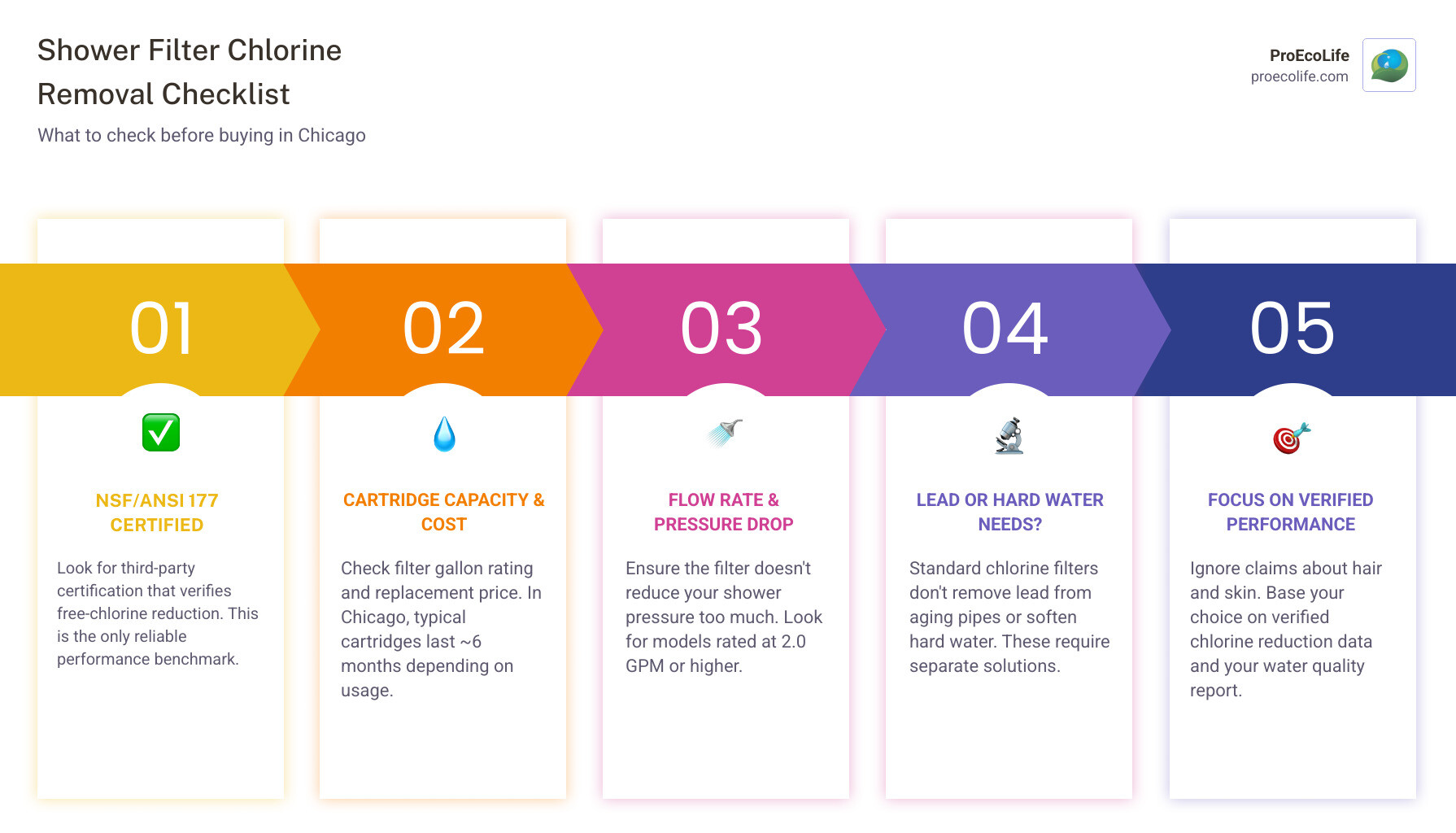
For shower filter chlorine removal, start with a model certified to NSF/ANSI 177. That certification verifies free-chlorine reduction. Then check the cartridge’s rated capacity, replacement cost, and fit with your shower. A filter can reduce chlorine without removing lead or softening water.
That distinction matters in Chicago. Treated Lake Michigan water reaches homes with a disinfectant residual, while aging pipes in older homes raise a separate concern about lead. Hard water in parts of the northwest suburbs is a separate issue, too. If dry skin or scalp irritation is driving your search, choose based on verified chlorine performance rather than promises about hair and skin.
I’m Maciej Spadlo, drawing on ProEcoLife’s experience providing water filtration for homes and businesses since 2014. I’ll use that background to help you assess shower filter chlorine removal and its limits.
Shower filter chlorine removal basics:
The Mechanics of Shower Filter Chlorine Removal
Understanding how point-of-use units clean your water begins with how city water is treated in the first place. Municipal utilities treat Lake Michigan water using multi-step disinfection routines before sending it through miles of underground mains. To understand the broader picture of municipal water chemistry, you can explore how municipal water treatment stages operate from intake to distribution. By the time water reaches your bathroom, it still carries residual disinfectants designed to keep bacteria at bay during transit.
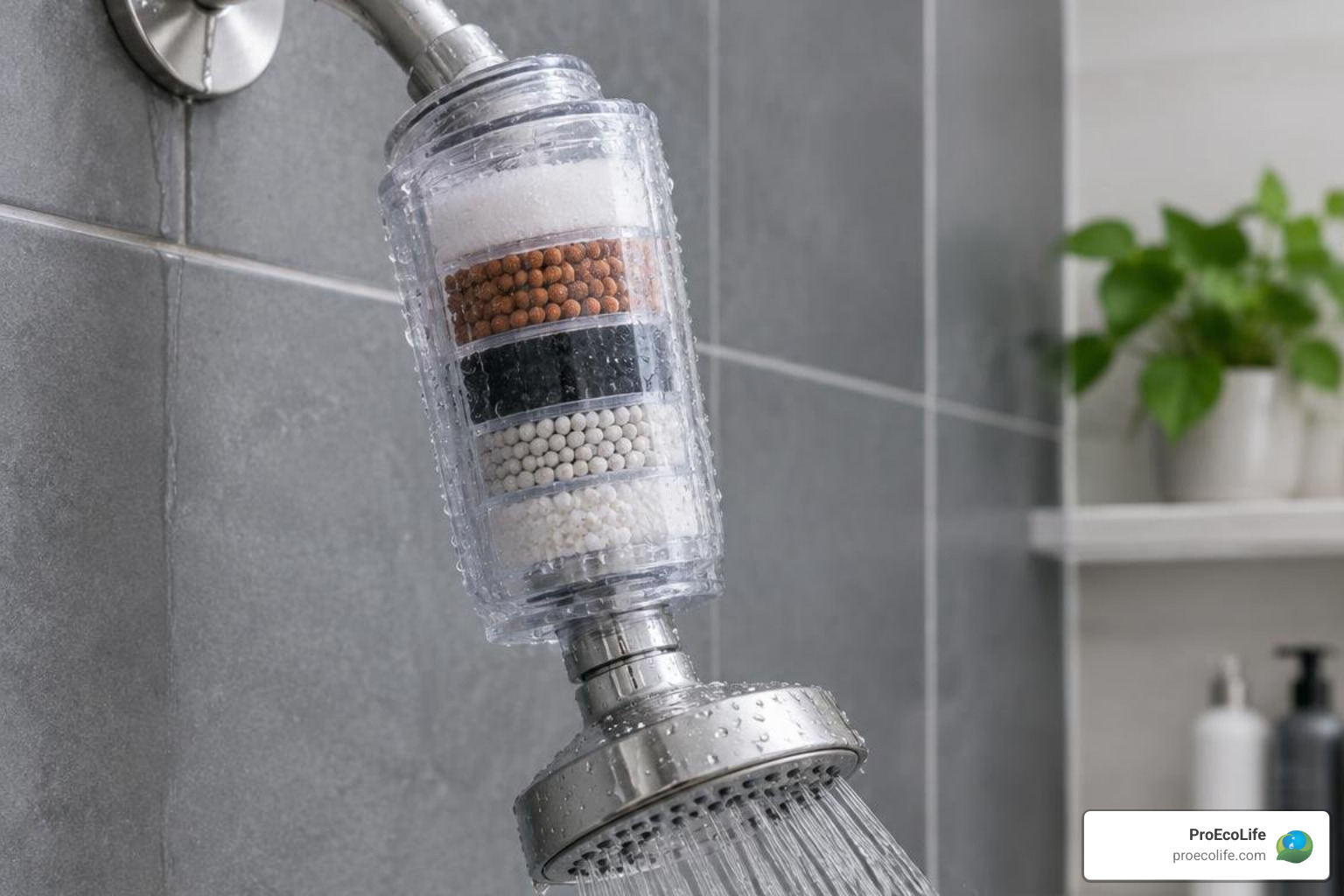
When hot water flows from your shower head, free chlorine rapidly vaporizes into the surrounding air. In a warm, enclosed stall, you are not just washing in chlorinated water; you are inhaling warm aerosolized steam that carries volatile organic compounds. Standard shower filtration works through specific media packed inside compact housings designed to neutralize these chemicals on contact.
A standard shower filter relies on one or more chemical or physical processes:
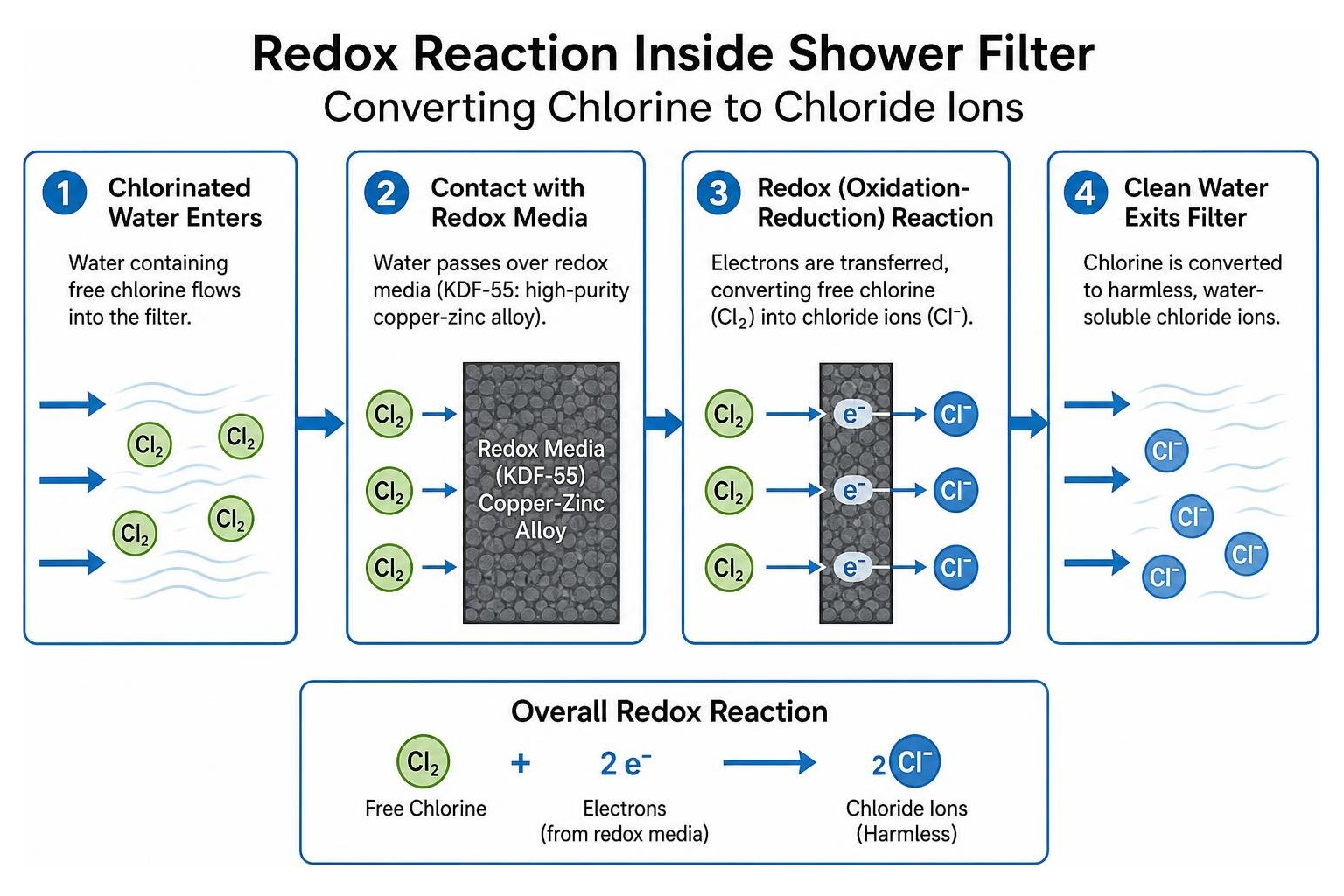
- Redox (Oxidation-Reduction): Media such as Kinetic Degradation Fluxion (KDF-55) use a high-purity copper-zinc alloy. When free chlorine passes across this alloy, an electrochemical reaction takes place, transferring electrons to convert free chlorine into harmless, water-soluble chloride ions.
- Adsorption: High-grade activated carbon traps chemical molecules inside microscopic pores. While carbon works well for organic compounds and odors, its efficiency can decrease at elevated shower temperatures and rapid flow rates.
- Chemical Neutralization: Granular calcium sulfite and ascorbic acid (Vitamin C) react chemically with chlorine molecules instantly, neutralizing them upon contact even under high-temperature conditions.
Comparing Media Types for Shower Filter Chlorine Removal
Different media excel under different water conditions, temperatures, and flow demands. Because a typical shower delivers 1.5 to 2.5 gallons per minute, the media inside a compact cartridge must act within fractions of a second.
| Filtration Media | Primary Reduction Target | Hot Water Tolerance | Typical Lifespan | Best Application |
|---|---|---|---|---|
| KDF-55 (Copper-Zinc) | Free Chlorine, Heavy Metals | High (performs well in hot water) | 6 to 12 months | General municipal chlorine reduction |
| Activated Carbon | Chlorine, VOCs, Chemical Odor | Moderate to Low (capacity drops in hot water) | 3 to 6 months | Cold-to-warm water, multi-stage blends |
| Calcium Sulfite | Free Chlorine | Very High (rapid reaction in high heat) | 4 to 8 months | High-temperature showers, targeted dechlorination |
| Ascorbic Acid (Vitamin C) | Free Chlorine & Chloramines | High (instant stoichiometric reaction) | 1 to 3 months | Sensitive skin, stubborn chloramines |
Multi-stage cartridges often combine KDF-55, calcium sulfite, and activated carbon to balance performance across changing temperatures while maintaining water flow.
Disinfection Byproducts and Water Hardness Realities
When chlorine reacts with natural organic matter present in surface water, it creates chemical compounds known as disinfection byproducts (DBPs), including trihalomethanes (THMs), haloacetic acids (HAAs), and chloroform gas. In a hot shower, these volatile byproducts vaporize quickly, contributing to that familiar sharp indoor pool aroma.
It is equally important to separate chlorine reduction from water softening. Many products marketed toward homeowners claim to soften water, remove total dissolved solids (TDS), and eliminate chlorine all at once. In reality, physical shower filters do not lower total hardness or act as ion-exchange softeners. To understand what these units can and cannot do for mineral deposits, read our breakdown on the effectiveness of shower filters on hard water minerals. While anti-scale ingredients like polyphosphate can help keep calcium and magnesium ions in suspension to reduce mineral crusting on fixtures, they do not remove the minerals themselves.
Need Clean, Safe Water at Home?
Get a free water test at your home or business. We install and service whole-house filtration and PEL75 reverse osmosis systems across Chicagoland. We also take select projects in Wisconsin and Indiana.
Book a Free Water TestCall (312) 889-8888Dermatological Impact: Rescuing Skin and Hair from Disinfected Water
Your skin and scalp rely on an acid mantle and a delicate layer of natural sebum to retain moisture and defend against environmental irritants. Free chlorine is a strong oxidizing agent designed to break down organic material. When applied daily under hot water, it strips away natural oils, leaving the skin barrier compromised.

Many homeowners dealing with chronic skin tightness or eczema flare-ups find that chlorinated water exacerbates irritation. By stripping the scalp’s natural oils, chlorine may lead to flaking and itchiness that is frequently mistaken for routine dandruff. For hair, chlorine oxidizes the protective protein matrix, lifting the cuticle layer and causing strands to become porous, brittle, and prone to breakage. For individuals who color their hair, chlorinated municipal water can accelerate color fading and shift brassy tones. Installing a targeted filter can help preserve hydration and maintain natural hair softness.
Need Clean, Safe Water at Home?
Get a free water test at your home or business. We install and service whole-house filtration and PEL75 reverse osmosis systems across Chicagoland. We also take select projects in Wisconsin and Indiana.
Book a Free Water TestCall (312) 889-8888Buyer’s Guide: Evaluating Performance, Pressure, and Value
When choosing a shower filter, consider both filtration performance and physical plumbing compatibility.
There are two primary form factors:
- Inline Filter Units: These canisters thread directly between your existing shower arm and your current shower head. They allow you to keep your preferred fixture, whether it is a fixed head or a handheld wand.
- Filtered Shower Heads: These units integrate the filtration chamber directly into the neck or face of the shower head.
Beyond aesthetics, check the internal cartridge build. If your home in an older neighborhood has aging service lines, you may also want to explore solutions for heavy metal shower filtration to capture dislodged sediment and trace metals before they reach your skin.
NSF/ANSI Standards and Certified Shower Filter Chlorine Removal
When evaluating manufacturer performance claims, independent third-party certification provides essential verification. Look for models certified to NSF/ANSI Standard 177, which specifically tests and validates a unit’s ability to reduce free available chlorine under continuous household flow conditions.
Certification confirms that the filter housing will not leach harmful substances, that the structural design withstands residential water pressure, and that the media achieves measurable chlorine reduction throughout its rated capacity. For homes seeking a verified point-of-use solution, investing in a dedicated Shower Filter System ensures your fixture operates within established safety and performance benchmarks.
Pressure Drops, Flow Rates, and Cartridge Longevity
A common concern among homeowners is whether adding filtration media will weaken shower spray pressure. A properly engineered filter with standard 1/2-inch National Pipe Thread (NPT) fittings typically maintains between 85% and 95% of your baseline flow rate, operating smoothly within standard residential water pressures (40 to 80 PSI).
However, as the media inside the cartridge captures fine sediment and oxidizes chlorine over time, flow resistance naturally increases. Cartridge capacity varies widely, generally ranging from 5,000 to 12,000 gallons. For an average household, this translates to replacing the cartridge every 4 to 6 months. To see how shower units fit into broader residential setups, review the different residential water filter configurations available for homes today.
Frequently Asked Questions
How often should shower filter cartridges be replaced to maintain chlorine removal?
Most shower filter cartridges should be replaced every 4 to 6 months, or after filtering roughly 5,000 to 10,000 gallons of water. In homes with higher daily usage or elevated sediment levels, the media can saturate faster. A noticeable drop in water pressure or the return of a faint chlorine smell is a clear indicator that the cartridge has reached the end of its useful lifespan.
Can a standard shower filter remove both chlorine and chloramines?
Standard shower filters built solely with basic activated carbon or low amounts of KDF-55 are primarily effective against free chlorine and may struggle with chloramines. Chloramine (a bonded compound of chlorine and ammonia) requires longer contact time or specialized media, such as ascorbic acid (Vitamin C) or advanced catalytic carbon, to break the chemical bond and neutralize both components effectively.
Does a shower filter soften hard water and remove calcium deposits?
No. A shower filter does not remove dissolved calcium and magnesium minerals or lower water hardness. True water softening requires an ion-exchange process, which cannot be achieved within a compact shower head cartridge. Some shower filters contain polyphosphate media that helps prevent scale from adhering to bathroom tile and glass, but the dissolved mineral content remains in the water.
Conclusion
While point-of-use shower filters offer an accessible first step for reducing chlorine exposure during daily grooming, they only treat a single fixture. They do not address the water used for brushing teeth, washing clothes, or running the dishwasher, nor do they solve comprehensive water quality challenges such as heavy metals or regional mineral hardness.
Since 2014, founder Karol Dolega and the team at ProEcoLife have helped homeowners across Chicago’s Northwest Side neighborhoods—including Norwood Park, Edison Park, and Jefferson Park—as well as nearby communities like Park Ridge, Niles, Des Plaines, Skokie, Glenview, Arlington Heights, and Morton Grove achieve balanced water throughout their homes.
From our advanced PEL75 9-Stage RO System for pristine drinking water to specialized Well Water Conditioning, Commercial Water Filtration Systems, and whole-home solutions, we engineer setups tailored to local water supplies. To protect every tap in your house from chlorine, sediment, and pipe contaminants, consider exploring a comprehensive whole-house water filtration system.
Schedule your comprehensive water assessment today by calling ProEcoLife at (312) 889-8888 or visiting proecolife.com.