
Understanding Pitcher Filters That Remove Lead and Chicago’s Water Crisis
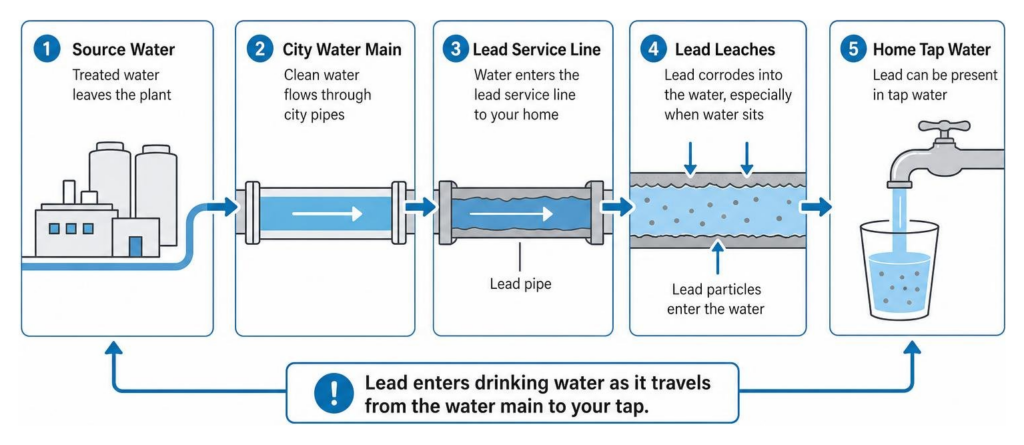
When we talk about tap water on Chicago’s Northwest Side—in neighborhoods like Norwood Park, Edison Park, and Jefferson Park—we are dealing with a unique historical legacy. Chicago plumbing codes actually mandated the use of lead service lines right up until they were banned federally in 1986. This means if your home was built before the late 1980s, there is an incredibly high chance that the pipe connecting your home to the city’s water main is made of pure lead.
Many local families ask us how to tell if you need a water filter when our Lake Michigan source water is treated so thoroughly. The truth is that while the water leaving the purification plants is clean, the journey through miles of aging infrastructure changes things. Organizations like Water – Lead-Safe Chicago work tirelessly to educate residents about this issue, but the immediate daily task of securing safe drinking water falls on homeowners.
Why Chicagoans Turn to Pitcher Filters That Remove Lead
For many living in suburbs like Park Ridge, Niles, and Des Plaines, a pitcher filter seems like the most straightforward, convenient, and budget-friendly step. It requires no plumbing modifications, fits neatly in the refrigerator, and provides an immediate sense of security.
Suburbs are actively addressing this issue; for example, you can read about local efforts on the Lead Water Service Lines | Skokie, IL page. While these municipal programs are fantastic long-term initiatives, service line replacement takes time—often years. In the meantime, families need a reliable stopgap. This is where pitcher filters that remove lead come into play. They act as a point-of-use barrier, catching lead particles right before the water lands in your glass.
How Lead Enters Local Tap Water
Lead does not typically dissolve into water at the source. Instead, it enters the stream through the corrosion of lead service lines, brass fixtures, and lead-containing solder in older home plumbing.
When water sits idle in these pipes overnight, lead can leach into it. If the water has high acidity or low mineral content, it corrodes the pipes even faster. You can learn more about this process on the FAQs | Lincolnwood Village, IL page. Because lead is completely odorless, tasteless, and invisible, many residents are left wondering: is it safe to drink tap water without some form of filtration? The answer is generally no, especially if you live in an older home with a known lead service line.

How Gravity-Based Pitcher Filtration Compares to Advanced Systems
While a pitcher filter is a great starting point, it is helpful to understand how gravity-based filtration stacks up against more robust systems like faucet-mounted units or under-sink reverse osmosis.
| Filtration System | Lead Removal Efficiency | Lifespan | Convenience | Total Protection |
|---|---|---|---|---|
| Pitcher Filter | 90% to 99.7% (model dependent) | 40 to 120 gallons | High (portable, no install) | Low (drinking water only) |
| Faucet-Mounted Filter | 99% (certified models) | 100 gallons | Medium (attaches to tap) | Low (single faucet only) |
| PEL75 9-Stage RO System | Up to 99.9% | 1 to 2 years | High (on-demand tap water) | High (removes dissolved metals & microbes) |
If you are considering a faucet-mounted option instead, our Lead filter for faucet guide heavy metal is only good for your playlist breaks down the pros and cons of that style.
Limitations of Standard Pitcher Filters That Remove Lead
Gravity-based pitchers rely entirely on the natural flow of water through a small cartridge. Because there is no water pressure pushing the liquid through the media, these filters must use looser, more porous materials. This design creates a few distinct limitations:
- Short Lifespan: Most standard lead-reducing filters only last for 40 gallons (about two months of typical household use) before they clog or lose their chemical binding capacity.
- Bypass Risk: If a pitcher filter is not seated perfectly, unfiltered water can seep around the edges and mix with your clean water.
- Slow Filtration Speed: Waiting for a pitcher to fill can be frustrating, especially for large families in busy households.
To understand how to move past these temporary fixes, you can read about how to get the lead out how reverse osmosis filters save your tap for a more permanent home solution.
The Multi-Stage Alternative for Chicago Homes
While pitcher filters are helpful, they only treat a fraction of the water you use. When you wash vegetables, boil pasta, or brush your teeth, you are still exposed to unfiltered tap water.
For comprehensive, long-term protection, we recommend upgrading to a pressurized system. Our proprietary PEL75 9-Stage RO System removes up to 99% of lead, heavy metals, chlorine, and emerging contaminants. By combining sediment pre-filters, carbon blocks, and a high-efficiency reverse osmosis membrane, it provides pristine water directly from a dedicated kitchen tap.
Alternatively, a Whole House Filtration system protects every faucet in your home, ensuring that you have clean, safe water in the kitchen, bathrooms, and even the shower. For a deeper dive into these advanced methods, check out our guide on the heavy metal meltdown the best way to remove lead from drinking water.
Need Clean, Safe Water at Home?
Get a free water test at your home or business. We install and service whole-house filtration and PEL75 reverse osmosis systems across Chicagoland. We also take select projects in Wisconsin and Indiana.
Book a Free Water TestCall (312) 889-8888Key Certifications to Look For in Lead-Reducing Water Pitchers
If you decide that a pitcher is the right fit for your current living situation, you must verify its certifications. Do not rely on generic marketing claims like “purifies water” or “makes water taste great.”
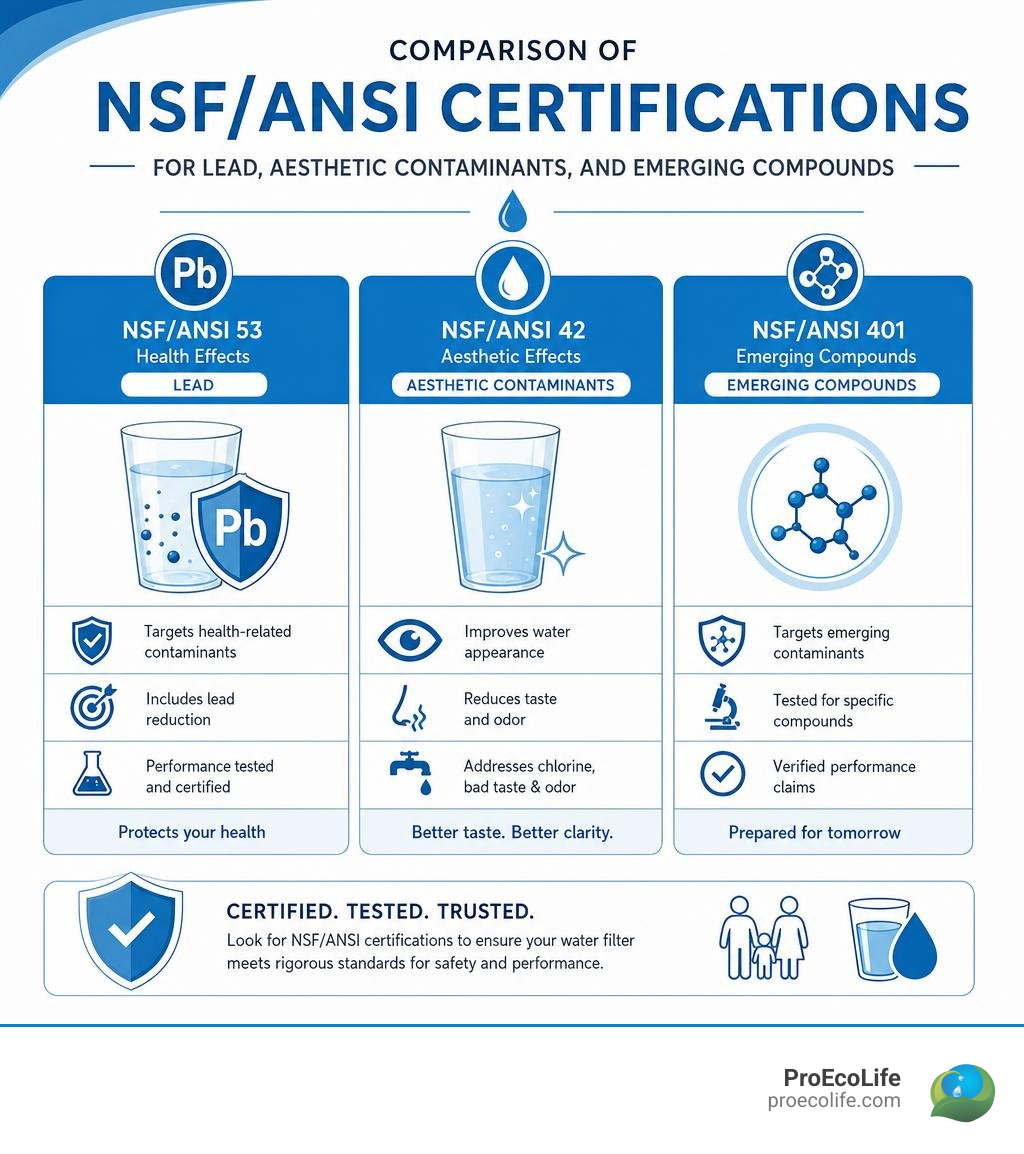
The gold standard for lead reduction is NSF/ANSI Standard 53. This certification proves that an independent laboratory has tested the filter and verified that it reduces lead from an influent concentration of 150 parts per billion (ppb) down to 5 ppb or less.
You should also look for WQA (Water Quality Association) gold seals or testing verified by ISO 17025 accredited laboratories. The EPA provides a point-of-use consumer tool specifically to help homeowners identify which brands meet these strict benchmarks.
Understanding NSF/ANSI 53 and 401 Standards
When shopping for pitcher filters that remove lead, you will likely encounter several different NSF standards:
- NSF/ANSI 42: Covers aesthetic qualities like chlorine taste and odor.
- NSF/ANSI 53: Covers health-related contaminants, including heavy metals like lead, mercury, copper, and cadmium.
- NSF/ANSI 401: Addresses “emerging contaminants” or incidental compounds, such as trace pharmaceuticals, herbicides, and chemical flame retardants.
- NSF/ANSI P231: Covers microbiological purification (bacteria and viruses), which standard carbon filters do not address.
Choosing a filter that covers both Standard 53 and Standard 401 ensures that you are protecting your family from both legacy heavy metals and modern chemical runoff. Our article no lead no worries your guide to lead-free drinking water provides an in-depth breakdown of these standards.
Verifying Filter Performance and Lifespan
Before purchasing, always check the manufacturer’s Performance Data Sheet. For example, the Performance Data Sheet for a certified lead filter will outline the exact percentages of lead removed at different pH levels (such as pH 6.5 and pH 8.5) because lead behaves differently depending on water chemistry.
Additionally, keep an eye on the gallon capacity. While the PUR PLUS Lead Reducing Pitcher Filter, PPF951K (various pack sizes) – PUR is highly effective at reducing heavy metals, it must be replaced every 40 gallons. Other options like the Aquagear filter utilize advanced media that extends the lifespan to 120 gallons, reducing the frequency of filter changes.
Regardless of the brand, staying on top of replacement schedules is critical. Municipal programs, like the Home | City of Evanston Lead Service Line Replacement initiative, remind us that point-of-use filtration is only effective if the filters are maintained properly.
Need Clean, Safe Water at Home?
Get a free water test at your home or business. We install and service whole-house filtration and PEL75 reverse osmosis systems across Chicagoland. We also take select projects in Wisconsin and Indiana.
Book a Free Water TestCall (312) 889-8888Glass vs. Plastic Pitchers: Durability, Taste, and Environmental Impact
Once you have selected a certified filter, you will need to choose the pitcher material. The debate between glass and plastic usually comes down to three main factors: durability, taste, and environmental footprint.
Plastic Pitchers
- Pros: Lightweight, virtually unbreakable, and easier to handle with one hand when full. Most modern options use BPA-free plastics.
- Cons: Can scratch easily over time, which creates tiny crevices where bacteria can harbor. Some users notice a subtle plastic taste when water sits in the reservoir for too long.
- Environmental Impact: While durable, plastic pitchers eventually end up in landfills. However, using a pitcher filter still helps replace over 1,000 single-use plastic bottles per filter lifespan.
Glass Pitchers
- Pros: Non-porous surface that preserves the crisp, clean taste of filtered water without any plastic leaching. Glass is also highly durable against scratching and has a much lower long-term environmental footprint.
- Cons: Heavy, especially when filled to its 7-cup or 10-cup capacity. There is also a real risk of breakage if dropped on hard kitchen countertops or tile floors.
- Microplastics Note: High-quality glass pitchers completely eliminate the risk of shedding microplastics into your drinking water, making them a popular premium choice for health-conscious families.
Frequently Asked Questions About Lead Filtration
Do standard pitcher filters remove lead to safe levels?
No, standard or “classic” pitcher filters—which are primarily designed to improve taste and odor by removing chlorine—do not remove lead. To reduce lead to safe levels (5 ppb or less), you must use a filter specifically certified to NSF/ANSI Standard 53.
If you are looking for alternative ways to address heavy metals in Polish, you can read our guide on jak usunac metale ciezkie z wody.
How often do lead-reducing pitcher filters need to be replaced?
Most lead-reducing filters have a lifespan of 40 gallons, which translates to about 2 months of use for an average household. Some high-capacity filters can last up to 120 gallons (about 6 months).
As a filter nears the end of its life, the accumulation of trapped lead and sediment will cause the flow rate to slow down significantly. Never use a filter past its rated capacity, as it can saturate and begin releasing trapped contaminants back into your water.
Can pitcher filters remove other Chicago water contaminants like PFAS?
Some advanced pitcher filters can reduce PFAS (specifically PFOA and PFOS) along with microplastics and chlorine. For example, dual-stage filters that combine activated carbon blocks with ion-exchange resins or specialized membrane microfilters perform best across multiple contaminant classes. However, for complete peace of mind against the full spectrum of modern chemical runoff, a multi-stage under-sink system remains the most reliable option.
Find Your Perfect Water Solution in Chicago
At ProEcoLife, we have been helping Chicago-area families enjoy clean, healthy water since our founder, Karol Dolega, established our local roots in 2014. We understand the specific plumbing challenges of our Northwest Side neighborhoods and nearby suburbs.
While pitcher filters that remove lead are a helpful first step, they require constant maintenance and only treat a small portion of your home’s water. If you want to explore more comprehensive options like our PEL75 9-Stage RO System, Whole House Filtration, or Well Water Conditioning, we are here to help.
For more tips on choosing the right setup, read our guide on how to choose the best lead water filter in Chicago a 2026 guide.
Ready to take the guesswork out of your home’s water quality? Contact us today to schedule a professional water test.
Call ProEcoLife at (312) 889-8888 or visit proecolife.com to get started.