
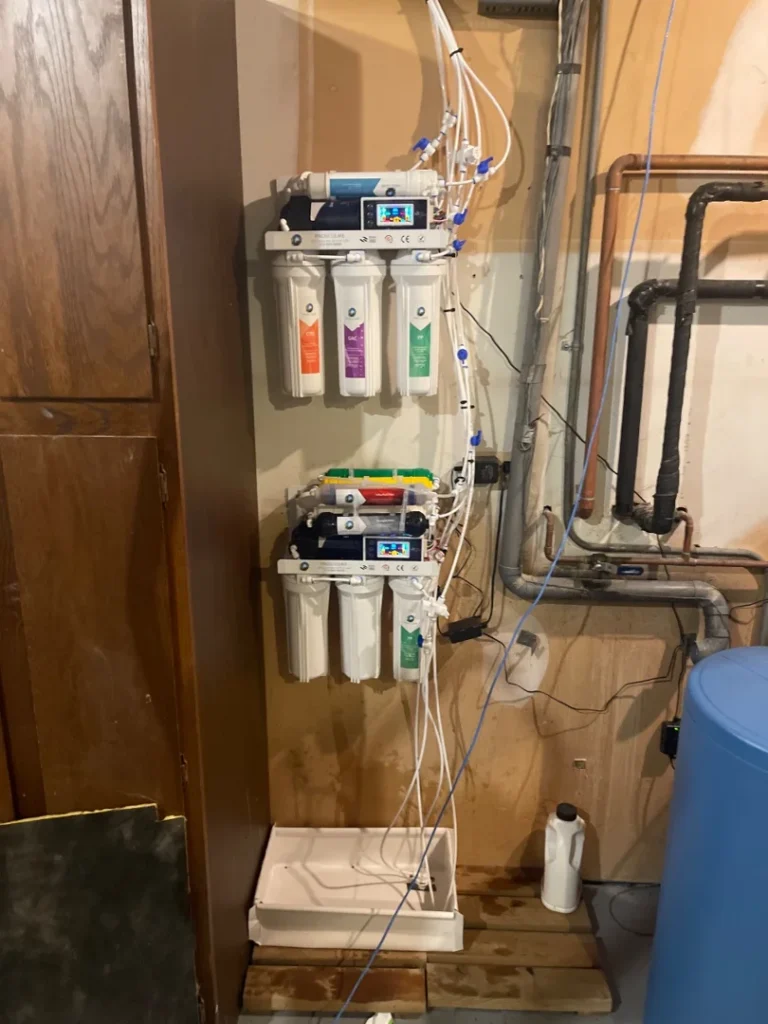
Why Chicago Homeowners Are Turning to 9-Stage Water Filtration
If you’re researching 9-stage water filtration in Chicago, here’s a quick answer:
Top reasons Chicago residents choose 9-stage RO filtration:
- Lead — Chicago has 400,000+ lead service lines, more than any other U.S. city. A 9-stage RO system may remove up to 98% of lead at the tap.
- PFAS — EPA testing found PFOS (5.5 ppt) and PFOA (4.8 ppt) in Chicago water, both above the EPA limit of 4 ppt. Multi-stage RO is one of the few technologies that reliably removes PFAS.
- Disinfection byproducts — TTHMs average 26 ppb in Chicago water, far exceeding EWG health guidelines. Advanced carbon stages in 9-stage systems target these compounds.
- Hard water — Chicago tap water averages 145 mg/L hardness. A 9-stage system addresses hardness while also restoring healthy minerals.
- Peace of mind — A properly certified multi-stage system addresses a wider range of contaminants than basic pitchers or single-stage carbon filters.
Chicago’s tap water starts clean enough — Lake Michigan is a high-quality source, and the Jardine Water Purification Plant (the world’s largest conventional water treatment facility) processes it carefully before it leaves the plant.
But here’s the problem: the water has to travel through miles of aging pipes to reach your glass.
In older neighborhoods across the Northwest Side — places like Norwood Park, Jefferson Park, and Edison Park — and in suburbs like Park Ridge, Niles, and Des Plaines, many homes still sit on lead service lines installed decades ago. The city’s water may meet federal legal standards at the plant. By the time it comes out of your kitchen faucet, though, it can pick up lead, chlorine byproducts, and other contaminants along the way.
That’s exactly why so many Chicago families are looking beyond what the city treats — and turning to home filtration systems that handle what municipal treatment can’t. ProEcoLife, a family-owned Chicago water purification company founded in 2014, has spent over a decade helping local homeowners address these specific concerns with advanced multi-stage filtration built for Chicago’s unique water conditions.
The Reality of Chicago Tap Water and Aging Infrastructure
To understand why a multi-stage system is so crucial, we have to look at the journey water takes through our city. Chicago draws its drinking water from Lake Michigan. From there, the water is processed at massive municipal facilities, including the famous Jardine Water Purification Plant — The Infinite Wiki . While the plant does an incredible job of purifying billions of gallons of water daily using a conventional treatment process, the real challenge begins once that water leaves the facility.
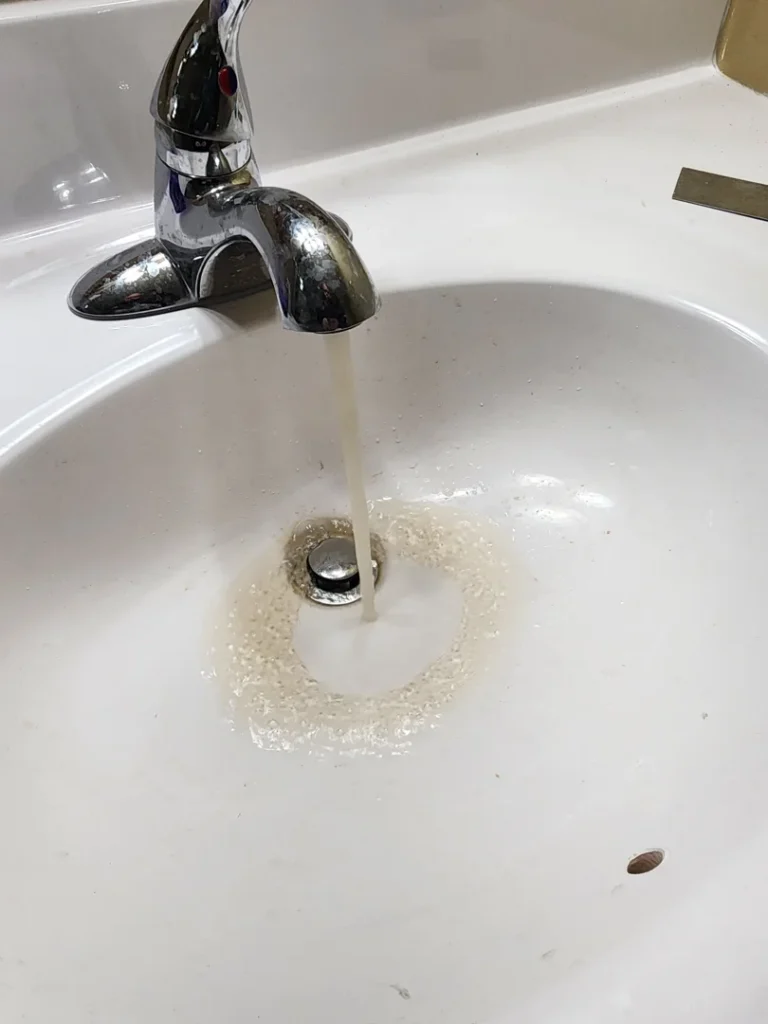
Chicago’s distribution network relies on infrastructure that is, in many areas, over half a century old. The single biggest concern for local homeowners is the presence of lead service lines. It is estimated that Chicago has over 400,000 lead service lines still in active use—more than any other city in the United States.
For homes built before 1986 in Northwest Side neighborhoods like Norwood Park, Jefferson Park, and Edison Park, as well as nearby suburbs like Park Ridge, Niles, Des Plaines, Skokie, Glenview, Arlington Heights, and Morton Grove, the risk of lead leaching into tap water is a daily reality. When water sits stagnant in these lead pipes, the heavy metal can dissolve directly into your drinking supply. Because lead is tasteless, odorless, and invisible, many families remain unaware of its presence without professional water testing.
Furthermore, municipal treatment plants use chlorine or chloramines to disinfect the water and prevent bacterial growth as it travels through the vast pipe network. While this disinfection is necessary for public health, it reacts with organic matter in the water to create chemical disinfection byproducts, such as Total Trihalomethanes (TTHMs) and Haloacetic Acids (HAA5). Independent analyses, such as those conducted by the Environmental Working Group (EWG), have found that these byproducts often exceed strict health-based guidelines in Chicago tap water, even when they technically meet federal legal limits. To learn more about how to protect your household from these specific plumbing risks, read our guide on How to Choose the Best Lead Water Filter in Chicago A 2026 Guide.
What is a 9-Stage Water Filtration Chicago System?
A 9-stage water filtration Chicago system is an advanced water purification setup designed to systematically target and eliminate different classes of contaminants, step by step. Rather than relying on a single filter to do all the heavy lifting, a 9-stage system utilizes a sequence of specialized physical, chemical, and membrane barriers to deliver the highest possible water purity.
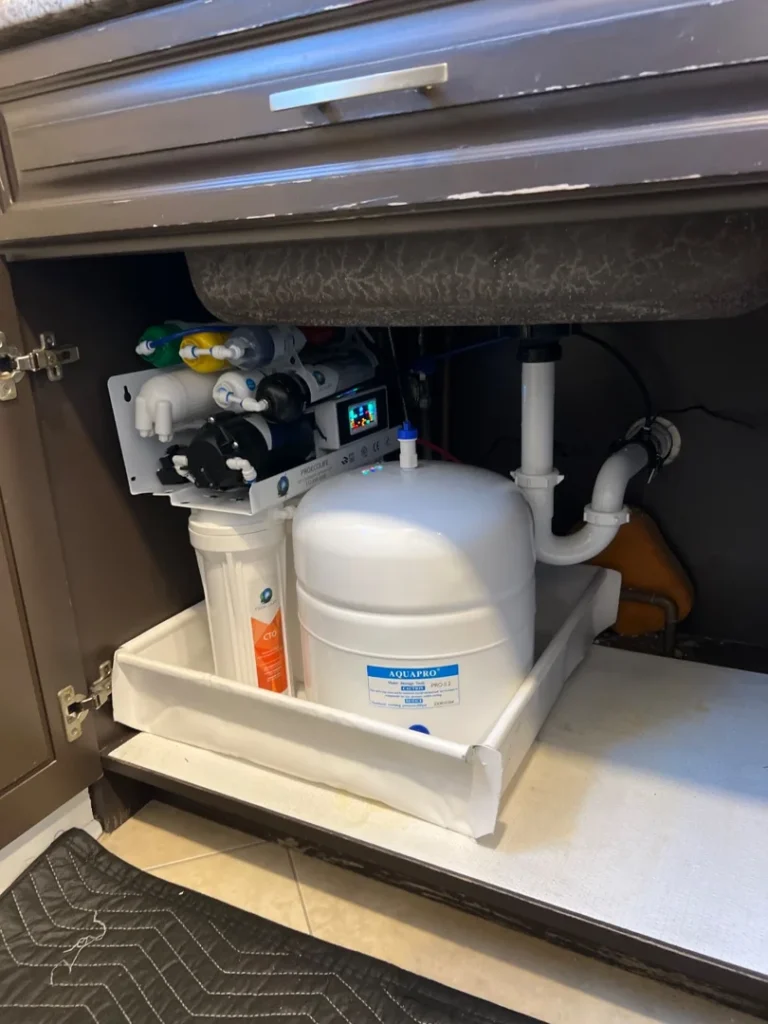
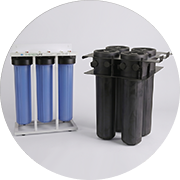
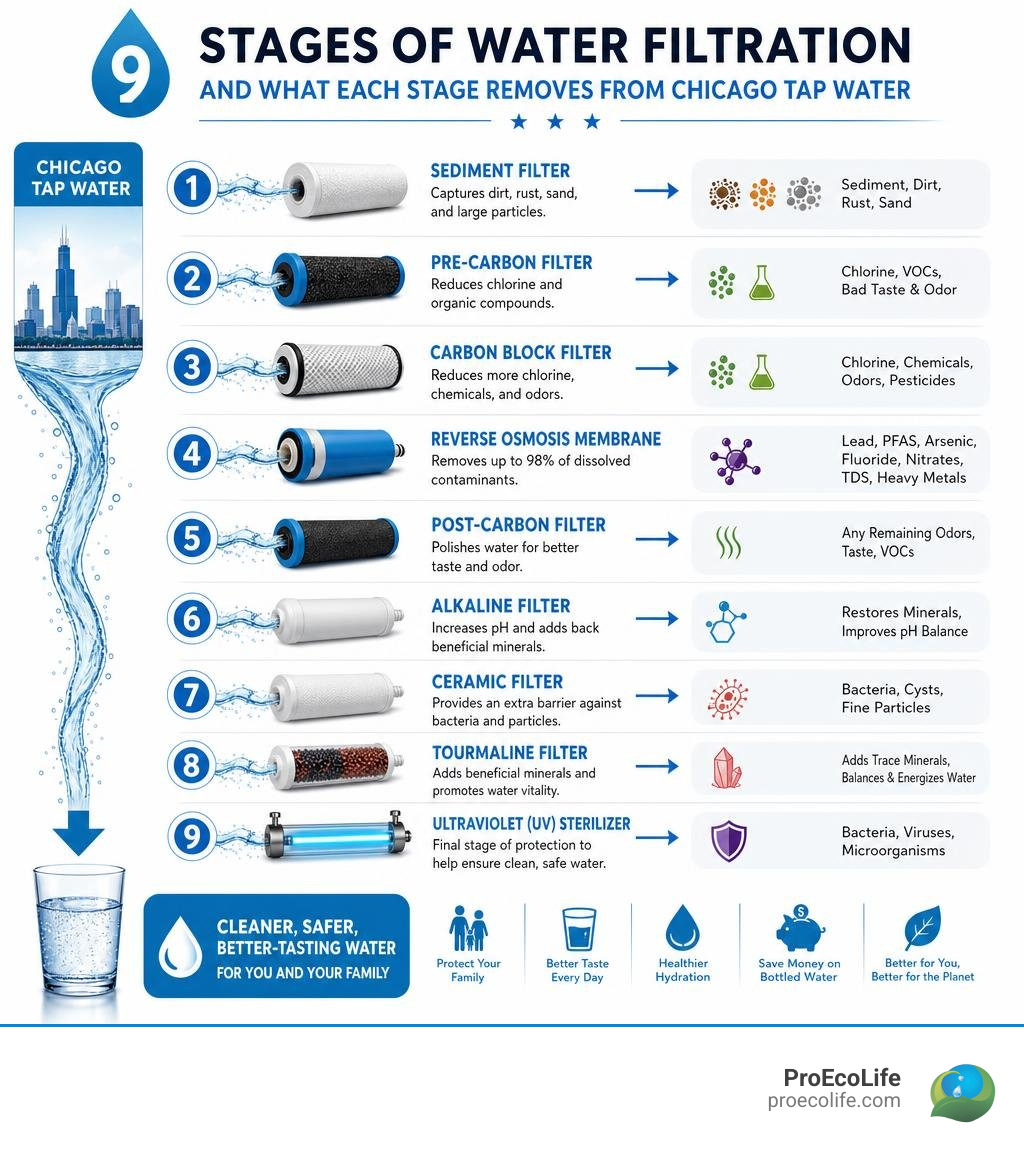
At the heart of this process is our proprietary PEL75 9-Stage RO System. This system is specifically engineered to handle the unique water profile of the Chicago area. Here is how the filtration sequence works:
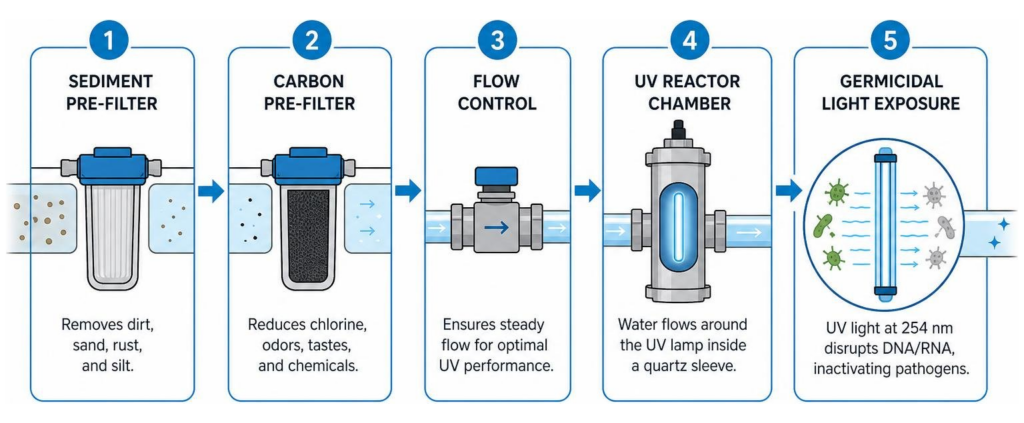
- Sediment Pre-Filtration: Captures larger physical particles like rust, dirt, sand, and pipe scale that are common in aging Chicago water mains.
- Granular Activated Carbon (GAC): Absorbs chlorine, gases, and unpleasant odors, protecting the delicate membrane in later stages.
- Carbon Block Filtration: Further compresses the carbon filtration to capture fine particles, volatile organic compounds (VOCs), and stubborn chemical residues.
- First-Stage Reverse Osmosis Membrane: Water is forced under pressure through a semi-permeable membrane with microscopic pores, filtering out up to 98% of dissolved solids, heavy metals, and lead.
- Second-Stage RO Refining: A secondary pass ensures even the smallest trace elements and microscopic particles are targeted.
- Post-Carbon Polishing: Refines the taste of the purified water as it leaves the storage tank, ensuring a crisp, clean flavor.
- Infrared Mineralization: Activates the water molecules and prepares the water for the introduction of healthy minerals.
- Alkaline Remineralization: Restores essential minerals like calcium and magnesium that were removed during the reverse osmosis process, raising the pH to a healthy alkaline level.
- Final Polish & Taste Enhancement: Ensures the finished water has a refreshing taste that rivals premium bottled spring water.
To dive deeper into the exact science behind these individual steps, you can explore the details of the Proecolife Filters Filtration Stages.
How 9-Stage Water Filtration Chicago Systems Compare to Basic Carbon Filters
Many homeowners wonder why they should invest in a multi-stage system when a standard carbon pitcher filter is so much cheaper. The truth lies in the limitations of basic carbon filtration.
Standard carbon filters, like those found in typical refrigerator dispensers or countertop pitchers, are primarily designed to reduce chlorine taste and odor. They are highly effective at making water taste better, but they struggle to remove dissolved inorganic contaminants, heavy metals, or modern chemical threats like PFAS (per- and polyfluoroalkyl substances).
Because carbon filtration relies on adsorption, the filter media can quickly become saturated. If you do not change a basic filter on a strict schedule, it can actually begin releasing captured contaminants back into your drinking water. In contrast, a multi-stage system like the PEL75 combines physical sediment barriers, chemical carbon adsorption, and membrane-based reverse osmosis. This multi-layered defense ensures that even if one stage is heavily taxed, subsequent stages are there to catch the remaining impurities. For a comparison of how multi-stage setups differ from simpler configurations, see The Complete Guide to 3 Stage Water Filter Housings and Systems.
Under-Sink vs. Whole-House 9-Stage Water Filtration Chicago Options
When looking to improve your home’s water quality, you will generally choose between two main configurations: point-of-use (under-sink) systems and point-of-entry (whole-house) systems.
- Under-Sink Systems (Point-of-Use): Our PEL75 9-Stage RO System is typically installed directly under your kitchen sink. It delivers purified, remineralized alkaline water through a dedicated designer faucet. This setup is highly focused on providing the safest possible water for drinking, cooking, washing vegetables, and brewing coffee. It is incredibly efficient because you are only purifying the water you actually consume. To see if this setup is right for your kitchen, check out our Best Under Sink Water Filter Chicago Reviews and Buying Guide.
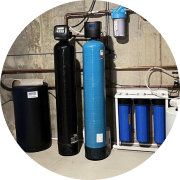
- Whole-House Filtration (Point-of-Entry): If you want to address water quality at every single tap in your home—including your showers, bathroom sinks, and laundry—a Whole House Filtration system is the ideal choice. These systems are installed near your main water shut-off valve. While they do not typically use a 9-stage reverse osmosis membrane at the main entry point (as RO at that scale is highly water-intensive and unnecessary for flushing toilets), they utilize high-capacity media to strip chlorine, sediment, and chemical contaminants before the water ever enters your plumbing. For comprehensive home protection, read our guide on The Best Whole House Water Filtration Systems in Chicago for Crystal Clear Water.
Key Contaminants Removed by Multi-Stage Reverse Osmosis
Chicago’s water contains a complex mix of modern chemical runoff, municipal treatment chemicals, and heavy metals from aging plumbing. A multi-stage reverse osmosis system is uniquely equipped to handle this diverse contamination profile.
Here is a look at the primary contaminants that our advanced systems target, compared to basic filtration options:
| Contaminant Type | Common Sources in Chicago | Basic Carbon Pitcher | 9-Stage RO System (PEL75) |
|---|---|---|---|
| Lead | Aging service lines & brass fixtures | Poor / Moderate | Up to 98% Reduction |
| PFAS / PFOA | Industrial runoff, consumer products | Minimal | Up to 99% Reduction |
| Chlorine & Chloramine | Municipal water disinfection | High | Near 100% Reduction |
| TTHMs & HAA5 | Disinfection chemical byproducts | Moderate | Up to 98% Reduction |
| Chromium-6 | Industrial emissions, natural deposits | None | Up to 95% Reduction |
| Hardness (Calcium/Magnesium) | Lake Michigan bedrock minerals | None | Regulated & Balanced |
By passing water through a semi-permeable membrane with pores as small as 0.0001 microns, reverse osmosis effectively strips away these microscopic threats. Many of our customers in neighborhoods like Jefferson Park and suburbs like Niles notice a dramatic improvement in the clarity and taste of their water once these heavy metals and chemical compounds are removed.
Restoring Essential Minerals and Balancing pH
One of the common criticisms of traditional reverse osmosis systems is that they are too effective. In the process of stripping away harmful contaminants like lead and PFAS, standard RO membranes also remove the healthy, naturally occurring minerals that give water its refreshing taste and body. This can leave the water tasting “flat” or slightly bitter, and it can also lower the pH, making the water mildly acidic.
This is where the magic of a 9-stage system truly shines. After the water passes through the reverse osmosis membrane, it flows through our alkaline remineralization stages. These stages gently reintroduce precise amounts of essential minerals back into the purified water:
- Calcium: Crucial for bone health, muscle function, and teeth, calcium also helps neutralize acidity.
- Magnesium: Supports cardiovascular health, regulates nerve function, and contributes to a clean, crisp taste.
By adding these minerals back in, the system raises the water’s pH to a balanced, alkaline level (typically between 7.5 and 8.5). This process not only improves the health profile of your drinking water but also restores that natural, “mountain spring” taste that makes drinking water a pleasure. For more information on how our systems achieve this perfect balance, read about the Top Reverse Osmosis System Options in Chicago for Pure Water.
Frequently Asked Questions about Chicago Water Filtration
How often do the filters and membranes in a 9-stage system need replacement?
To keep your system performing at its peak, regular maintenance is essential. The lifespan of your filters depends largely on your household’s water usage and the incoming water quality. Generally, we recommend the following replacement intervals for our PEL75 9-Stage RO System:
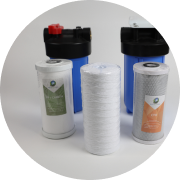
- Stages 1, 2, and 3 (Pre-filters): Should be replaced every 6 to 12 months to protect the RO membrane from clogging with sediment and chlorine.
- Stage 4 (RO Membrane): Typically lasts between 2 to 3 years, depending on water hardness and usage.
- Stages 5 through 9 (Post-filters and Mineralization): Should be replaced every 12 months to ensure continuous taste refinement and optimal mineral levels.
What water certifications should Chicago homeowners look for?
When investing in a filtration system, you want to be certain that the equipment will perform as promised. Look for systems that are tested and certified against rigorous industry standards:
- NSF/ANSI Standard 42: Verifies the system’s ability to reduce aesthetic contaminants like chlorine, taste, and odor.
- NSF/ANSI Standard 53: Crucial for Chicago homes, this standard certifies that the system is proven to reduce specific health-related contaminants, including lead and heavy metals.
- NSF/ANSI Standard 58: The specific standard for reverse osmosis systems, ensuring high-performance contaminant rejection and safety.
- WQA (Water Quality Association) Gold Seal: Indicates that the system has undergone strict testing for structural integrity, material safety, and contaminant reduction performance.
Why does Chicago water need remineralization after reverse osmosis?
Because Lake Michigan water is moderately hard (averaging 145 mg/L), stripping those minerals out during the RO process is necessary to get rid of heavy metals and impurities. However, drinking highly purified, demineralized water over long periods isn’t ideal for taste or hydration. Remineralization is essential because it prevents the water from being aggressive or acidic, which can cause it to leach minerals from your body or metal containers. It also ensures your morning coffee and tea taste rich and balanced.
Conclusion: Securing Clean Water for Your Chicago Home
Investing in a high-quality water filtration system is one of the most impactful steps you can take to protect your family’s health and elevate your daily quality of life. Whether you are dealing with the persistent threat of aging lead service lines on the Northwest Side of Chicago or managing the hard water of the northern suburbs, a tailored filtration strategy is your best line of defense.

Since 2014, ProEcoLife has been dedicated to providing Chicago families with advanced, reliable, and professionally installed water treatment solutions. Founded by Karol Dolega, our company is deeply rooted in the local community. We don’t believe in one-size-fits-all, big-box solutions. Instead, we design our products—from the PEL75 9-Stage RO System and Whole House Filtration to our specialized Shower Filter System, Well Water Conditioning, and Commercial Water Filtration Systems—to meet the precise demands of local water conditions.
If you are ready to experience the difference that pure, mineral-rich alkaline water can make in your home, we are here to help. To learn more about our complete range of services and custom home setups, visit our dedicated page on the Chicago Water Filter System.
To protect your home’s drinking water and find the right system for your family, contact the local experts at ProEcoLife to schedule a water test today at (312) 889-8888 or proecolife.com.