

Is Your Chicago Faucet Water Safe? What You Need to Know About Lead Filtration
A lead filter for faucet use is one of the most practical ways Chicago homeowners can protect their families from lead exposure at the tap — especially in older homes with aging pipes and service lines.
Quick answer: What does a faucet lead filter do?
- Attaches directly to your kitchen faucet (no major plumbing work)
- Filters water through activated carbon or multi-stage media to reduce dissolved lead
- Top faucet filters like PUR and Brita are certified to reduce lead under NSF/ANSI Standard 53
- Filters typically last 100 gallons or about 3 months before replacement
- They reduce lead, chlorine, sediment, and other contaminants — but do not remove PFAS
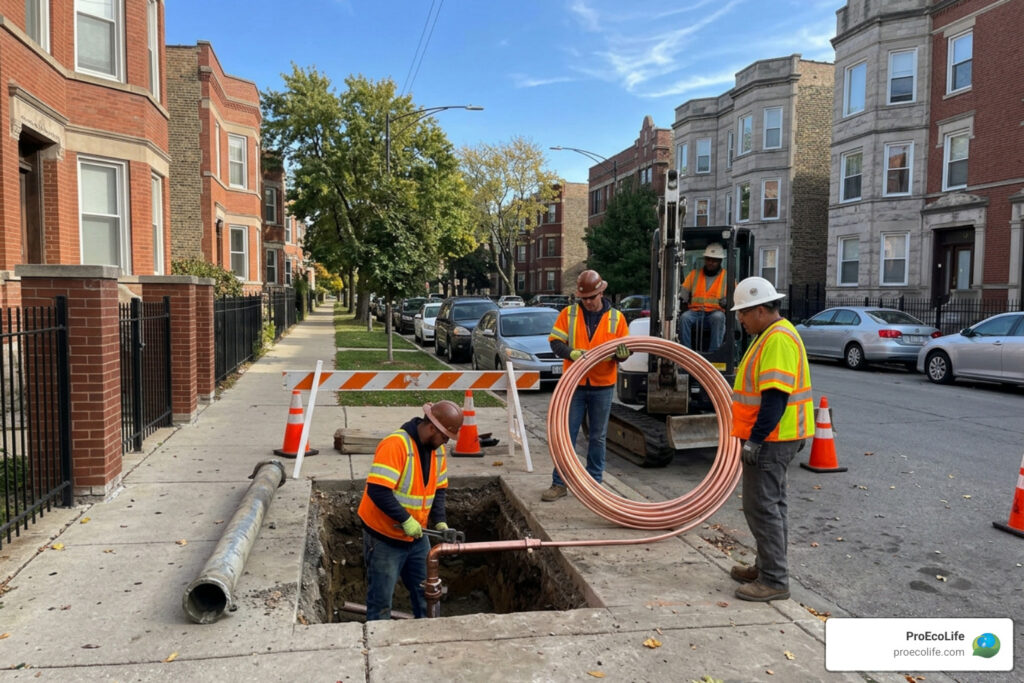
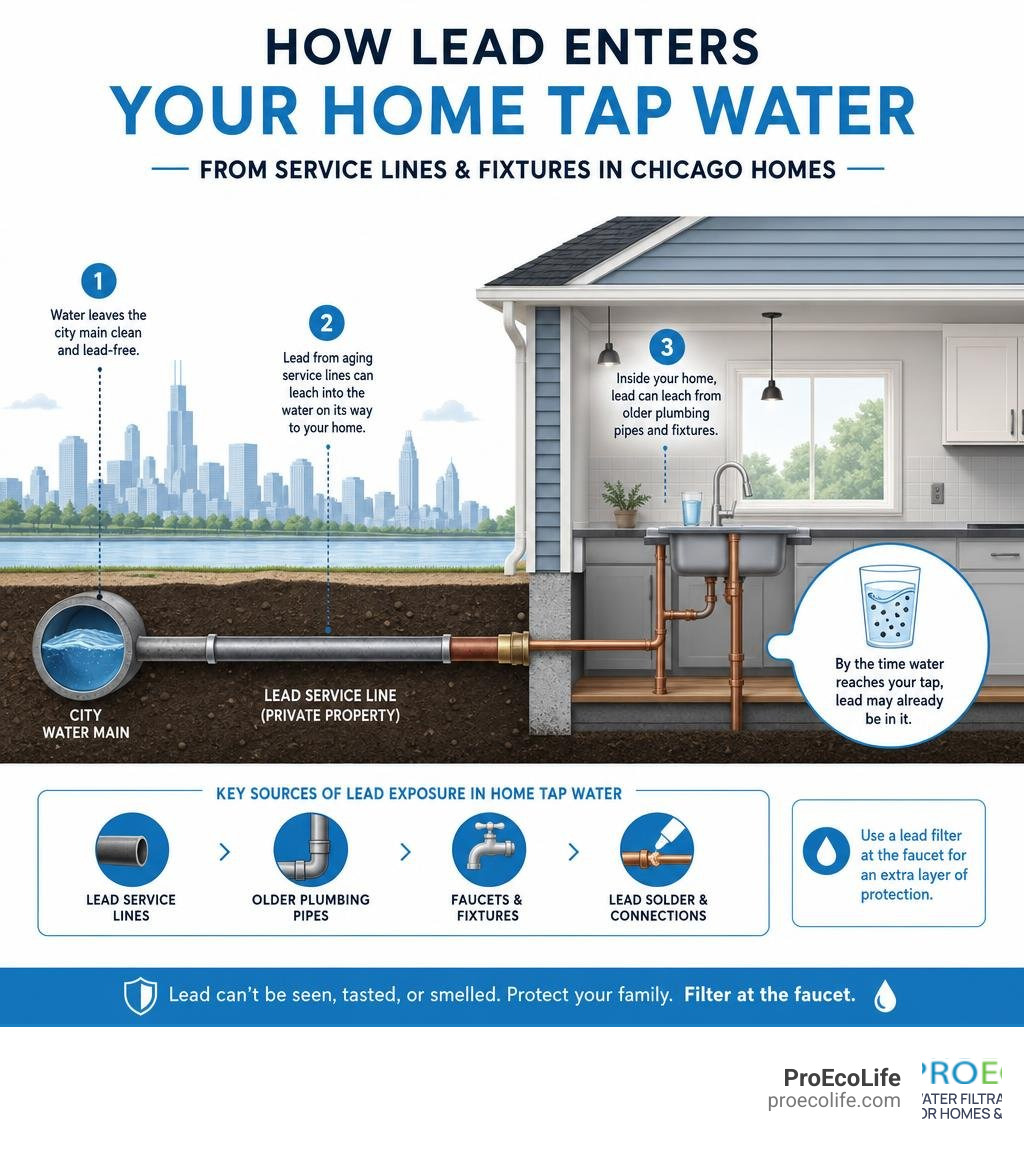
Chicago’s water infrastructure is aging. Many homes across the Northwest Side — from Norwood Park to Jefferson Park to Edison Park — still have original lead service lines running from the city main to the house. Even though Chicago draws from Lake Michigan, lead doesn’t come from the source. It leaches into water inside your home’s own plumbing.
That’s the part that catches many homeowners off guard. The water leaving the treatment plant may be fine. By the time it reaches your glass, it may not be.
Choosing the right filtration matters — and not all faucet filters are created equal.
Why Chicago Homes Need a Lead Filter for Faucet
When it comes to water quality, Chicago has a unique and complex history. While Lake Michigan provides a fantastic raw water source, our city has the highest concentration of lead service lines in the United States. For decades, local building codes actually mandated the use of lead pipes for service lines connecting homes to the municipal water mains. This mandate remained in place until the federal ban in 1986.
If your home in Norwood Park, Edison Park, or Jefferson Park was built before 1986, there is a very high probability that your water travels through a lead pipe before it reaches your kitchen tap.
According to the Water – Lead-Safe Chicago initiative, lead is a highly toxic heavy metal that can leach into drinking water as these aging pipes corrode. Even in nearby suburbs, the story is similar. For instance, the Lead Service Line Replacement program in Park Ridge and the Water Service Distribution Information | Niles, IL – Official Website portal highlight ongoing efforts to track and replace these public hazards.
Furthermore, water quality issues aren’t just limited to older city brick bungalows. Recent reports, such as the Lead Found In Bartlett Drinking Water study (and detailed further in Polish for our bilingual neighbors at Wysoki Poziom Olowiu W Wodzie Pitnej W Bartlett), show that heavy metal contamination remains a persistent modern threat in 2026 across various Chicagoland communities.
Because lead is tasteless, odorless, and invisible, many families unknowingly consume it daily. This is why installing a reliable lead filter for faucet use or a comprehensive under-sink system is not just an aesthetic upgrade—it is a critical health shield. For a deeper dive into local water conditions, explore our How To Choose The Best Lead Water Filter In Chicago A 2026 Guide.
Need Clean, Safe Water at Home?
Get a free water test at your home or business. We install and service whole-house filtration and PEL75 reverse osmosis systems across Chicagoland. We also take select projects in Wisconsin and Indiana.
Book a Free Water TestCall (312) 889-8888Comparing Point-of-Use Filtration Options
When looking to eliminate heavy metals at the kitchen sink, you will primarily choose between point-of-use (POU) systems. These systems filter the water right where you consume it, rather than treating the entire house.

While point-of-use filtration is highly effective, the style of system you choose dictates your daily water pressure, filter lifespan, and contaminant reduction capabilities. Let’s look at how basic faucet-mounted attachments stack up against more robust under-sink systems.
Faucet-Mounted Filters vs. Under-Sink Systems
Faucet-mounted filters are popular because they are highly visible and easy to conceptualize. They screw directly onto the end of your faucet spout. However, they come with significant performance trade-offs:
- Flow Rate: Because of their compact size, faucet-mounted filters have a very slow flow rate—typically around 0.5 gallons per minute (gpm). If you are trying to fill a large pot for pasta, you will be standing at the sink for a while.
- Filter Lifespan: A typical faucet-mounted filter only processes about 100 gallons of water (roughly 3 months of use) before the media is exhausted and must be replaced.
- Aesthetics and Space: They add bulk directly to your faucet neck, which can get in the way when washing large dishes.
In contrast, under-sink systems are installed out of sight beneath your kitchen counter. They offer a much larger filtration surface area, allowing them to handle higher water pressure and filter thousands of gallons before requiring a cartridge change. For example, a dedicated under-sink cartridge can have a capacity of 6,000 gallons depending on incoming lead levels.
To understand which configuration fits your kitchen best, read our guide on Filtry Do Wody Pod Zlew Jak Wybrac Najlepszy Model or compare specifications on a Lead Under Sink Water Filter System.
Choosing a Dedicated Lead Filter for Faucet Systems
If you decide on a faucet-connected system, it is vital to choose one specifically engineered for heavy metals. Standard carbon block filters designed only to improve taste and odor (NSF 42) will not protect your family from dissolved lead.
A dedicated lead filter for faucet setups utilizes specialized media, such as ion-exchange resins blended with sub-micron activated carbon blocks. This combination chemically traps dissolved lead ions while physically filtering out particulate lead.
When searching for the right system, we highly recommend reading our localized guides on How To Choose A Water Filter and Jak Wybrac Najlepszy Filtr Do Wody to make an informed decision based on your specific household needs.
Need Clean, Safe Water at Home?
Get a free water test at your home or business. We install and service whole-house filtration and PEL75 reverse osmosis systems across Chicagoland. We also take select projects in Wisconsin and Indiana.
Book a Free Water TestCall (312) 889-8888Key Features to Look For in a Lead Water Filter
Not all filters are built to handle the heavy-duty contamination found in some Chicagoland plumbing systems. To ensure you are getting real protection, you must look closely at the system’s certifications and technical specifications.
| Feature / Certification | What It Means | Why It Matters for Chicago Homes |
|---|---|---|
| NSF/ANSI Standard 53 | Certified for Health Effects | Verifies the filter actually reduces lead, cysts, and heavy metals. |
| NSF/ANSI Standard 58 | Reverse Osmosis Standard | Applies to advanced multi-stage systems like the PEL75 9-Stage RO System. |
| NSF/ANSI Standard 401 | Emerging Contaminants | Certifies reduction of microplastics, herbicides, and chemical residues. |
| Filter Capacity | Rated in Gallons | Faucet-mounts last ~100 gal; under-sink systems can last up to 6,000 gal. |
| Flow Rate | Gallons Per Minute (GPM) | Determines water pressure. Faucet-mounts are slow (~0.5 GPM); RO systems with dedicated faucets offer a steady stream. |
Certifications and Standards (NSF/ANSI 53 and 58)
The gold standard for lead reduction is independent third-party testing. Never rely on a manufacturer’s untested claims.
- NSF/ANSI Standard 53: This is the specific national standard for drinking water treatment units certified to reduce contaminants with established health effects. To gain this certification, filters are aggressively challenged in laboratory settings with water containing 150 parts per billion (ppb) of lead—which is ten times the EPA’s action level—to ensure they safely reduce it to below 5 ppb.
- NSF/ANSI Standard 58: This standard applies to Reverse Osmosis (RO) systems. If you want the most foolproof protection against lead, heavy metals, and emerging contaminants like PFAS, a multi-stage RO system is the industry benchmark.
For those interested in how these heavy metals behave chemically and how advanced systems neutralize them, our Polish resource Jak Usunac Metale Ciezkie Z Wody provides a great technical breakdown.
Filter Capacity and Flow Rate for a Lead Filter for Faucet
The physical size of your filter directly impacts its capacity and flow rate.
Standard faucet-mounted filters have a very limited contact time with water due to their small size. To effectively capture lead, the water must pass through the media slowly, which restricts the flow rate to roughly 0.5 gpm.
Larger inline systems, such as the WaterSentry 750-gallon Lead Residential Filter, ezH2O Liv, Faucet | Elkay, balance flow rate and capacity more effectively, offering up to 750 gallons of certified filtration or 12 months of use before needing a replacement.
Frequently Asked Questions About Faucet Lead Filters
How long do faucet water filters typically last?
A standard faucet-mounted water filter typically lasts up to 100 gallons or approximately 3 months, whichever comes first. However, in areas with high sediment or hard water—which is common in many Chicago suburbs—the filter pores can clog prematurely.
If you notice your faucet system’s flow rate slowing down significantly, it is a clear physical indicator that the filter media is saturated and needs to be replaced immediately to maintain certified contaminant reduction levels.
Can a faucet filter remove all lead from Chicago water?
While a high-quality, NSF 53-certified lead filter for faucet use can reduce up to 99% of lead, no point-of-use filter can guarantee 100% removal under all conditions. Lead in Chicago water exists in two forms: dissolved lead (which is soluble in water) and particulate lead (tiny physical flakes of metal that break off the pipes).
During city water main construction or service line disturbances, large spikes of particulate lead can overwhelm small faucet filters. For total peace of mind, many local families choose to upgrade to a comprehensive under-sink reverse osmosis system, which provides a physical barrier against both forms of lead.
What are the installation requirements for these systems?
Standard faucet-mounted filters require unscrewing your existing faucet’s aerator and finding a matching thread adapter. While this sounds simple, many modern designer faucets, pull-out sprayers, or square spouts are completely incompatible with faucet-mounted filters.
Furthermore, improper installation can lead to leaks or damage to your faucet threads. For a complete look at the mechanics of faucet attachments, you can read our practical guide on Jak Zamontowac Filtr Do Wody Do Kranu W 5 Minut Praktyczny Poradnik.
For under-sink systems, reverse osmosis units, or whole-house filtration, professional installation is highly recommended to ensure proper connection to your cold water line, leak prevention, and optimal system performance.
Conclusion: Securing Your Home’s Water with ProEcoLife
While a basic lead filter for faucet attachment can provide a temporary band-aid, Chicago’s severe lead infrastructure issues demand a more robust, long-term solution.
At ProEcoLife, founded by Karol Dolega, we have been serving as Chicago’s trusted water purification experts since 2014. We understand the unique challenges of Chicagoland water—from the Lake Michigan source water delivered to Chicago’s Northwest Side neighborhoods like Norwood Park, Edison Park, and Jefferson Park, to the hard water challenges faced by families in Des Plaines, Skokie, Glenview, Arlington Heights, Niles, Park Ridge, and Morton Grove.

Instead of dealing with slow flow rates, frequent filter changes, and bulky faucet attachments, many local families choose our advanced PEL75 9-Stage RO System. This premium under-sink drinking water system provides comprehensive protection, reducing lead, heavy metals, microplastics, and chemical contaminants, while delivering bottled-quality water directly through a dedicated lead-free faucet.
We also offer complete Whole House Filtration systems, Shower Filter System options, specialized Well Water Conditioning for suburban properties, and robust Commercial Water Filtration Systems for local businesses.
To learn more about choosing the best system for your home, read our comprehensive ProEcoLife Chicago Lead Water Filter Guide or explore our guide on Jak Wybrac Idealne Systemy Filtracyjne Do Twojego Domu.
Don’t guess when it comes to your family’s health. Let our local experts help you find the perfect filtration system tailored specifically to your home’s water profile.
Contact ProEcoLife today to schedule a professional water test for your home at (312) 889-8888 or visit proecolife.com.