

Choosing a Whole-House Activated Carbon Water Filter in Chicago
The best whole-house activated carbon water filter for your home is one that fits your peak water flow and is certified to reduce the contaminants found in your water. Installed where water enters the house, it can cut chlorine taste and odor at every tap, including showers. Unlike a filter at one sink, it treats water throughout the home.
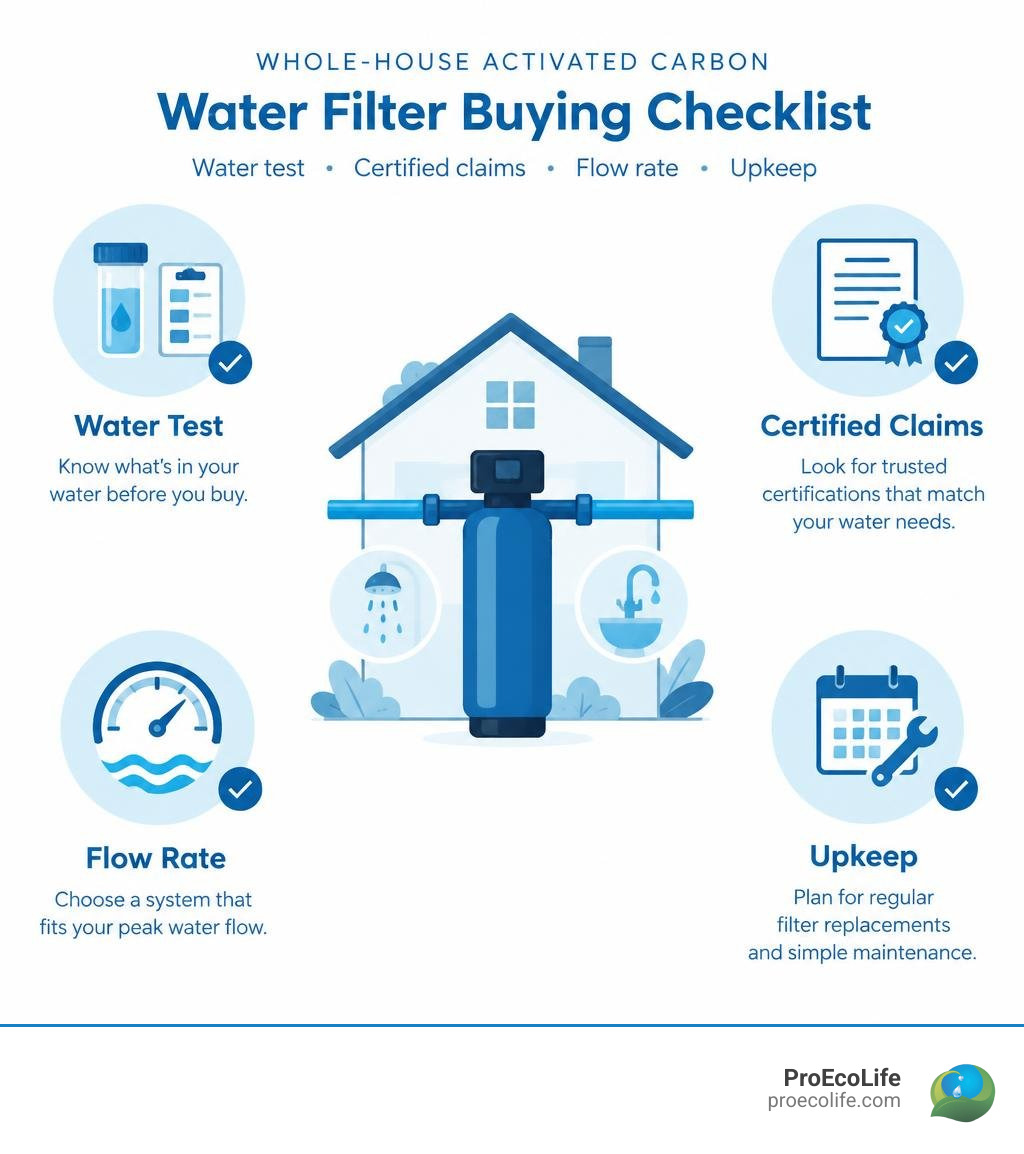
That matters for Chicago homes using Lake Michigan water. But carbon alone is not a reliable fix for lead from aging pipes, and it will not soften the hard water common in some Northwest suburbs. Before you buy, test your water and check the system’s certified claims, flow rate, and replacement schedule. ProEcoLife offers water testing and installation to help Chicago homeowners choose a whole-house setup that matches their water.
Basic activated carbon water filter whole house terms:
- carbon water filtration systems for home
- 5 micron whole house filter
- best whole house water treatment
How an Activated Carbon Water Filter Whole House System Works
At ProEcoLife, we have been serving Chicagoland families since 2014, when our founder Karol Dolega set out to solve the unique municipal water challenges facing our neighborhoods. Whether you live in a classic bungalow in Norwood Park or a newer home in Glenview, understanding how carbon media interacts with tap water helps you choose the right setup.
Activated carbon operates primarily through adsorption—a process where dissolved contaminants are chemically or physically attracted and bound to the vast internal pore matrix of the media. As noted in university research on activated carbon filtration, treating carbon with oxygen or high-heat steam opens up millions of microscopic pores between carbon atoms. This structural change gives a single pound of high-grade activated carbon an effective surface area exceeding 100 acres.
When water enters the tank from your main line, it slowly flows through this dense bed. Organic compounds and chemical disinfectants are pulled out of the stream and locked inside these microscopic crevices.
| Media Type | Primary Mechanism | Best Used For | Typical Lifespan |
|---|---|---|---|
| Granular Activated Carbon (GAC) | Loose carbon granules provide high flow with low initial pressure drop | Broad chemical reduction, municipal chlorine taste and odor | 3 to 5 years (tank-based) |
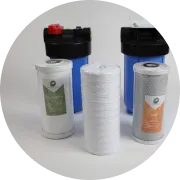
| Solid Carbon Block | Extruded, densely compressed carbon matrix | Fine physical filtration, sediment capture, deep VOC adsorption | 6 to 12 months (cartridge-based) |
| Catalytic Carbon | Chemically modified surface structure to promote rapid electron transfer | Chloramines, hydrogen sulfide, stubborn oxidation byproducts | 3 to 5 years (tank-based) |
Contaminants Removed by Activated Carbon
Municipal utilities treating Lake Michigan water rely heavily on chemical disinfection. While essential for municipal distribution, high levels of disinfectant chemicals leave noticeable odors and create chemical byproducts. An activated carbon system can remove up to 99% of free chlorine and up to 95% of volatile organic compounds (VOCs).
Furthermore, carbon reduces disinfection byproducts such as trihalomethanes (THMs) by up to 90%. THMs form when chlorine interacts with naturally occurring organic matter in raw lake water. Standard carbon media also helps capture agricultural runoff, industrial chemical residues, pesticides, and unpleasant earthy tastes. High-density blocks may also trap microplastics down to their physical pore dimensions. For homeowners deciding whether carbon water filtration systems are worth the investment, the sweeping improvement in everyday taste and chemical reduction offers immediate reassurance.
Limitations and Unfiltered Substances
While activated carbon excels at organic and chemical capture, it is not a cure-all. Carbon media cannot dissolve or trap hard minerals such as calcium and magnesium, which frequently affect well and municipal supplies across Des Plaines, Arlington Heights, and Skokie.
Standard carbon media will not reliably capture dissolved heavy metals, nitrates, or fluoride. In historic areas such as Edison Park and Jefferson Park, aging service lines present severe lead risks. A standalone carbon filter is not certified for lead extraction. Addressing heavy metals requires an engineered whole house filtration system to remove lead or targeted point-of-use reverse osmosis.
Need Clean, Safe Water at Home?
Get a free water test at your home or business. We install and service whole-house filtration and PEL75 reverse osmosis systems across Chicagoland. We also take select projects in Wisconsin and Indiana.
Book a Free Water TestCall (312) 889-8888Comprehensive Benefits Across Your Entire Home
Treating water only at the kitchen faucet leaves the rest of your home exposed to chlorine and municipal additives. When taking a hot shower, chlorine vaporizes into chloroform gas, which enters your lungs and permeates your bathroom air.
Installing point-of-entry carbon filtration may help protect skin and hair from the stripping effects of harsh oxidizers. Many customers notice softer hair, less scalp irritation, and relief from dry, itchy winter skin. By removing aggressive chemical agents before water hits your pipes, whole-house carbon also preserves rubber seals inside washing machines, dishwashers, and water heaters.
Benefits of an Activated Carbon Water Filter Whole House Installation
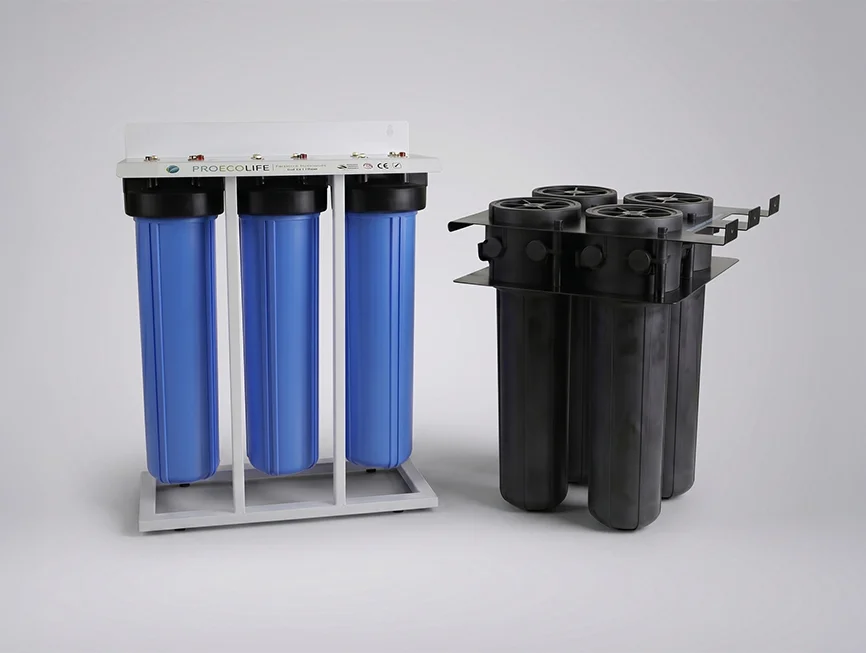
Eliminating chemical fumes transforms everyday indoor air quality. Showering in declorinated water means no chemical vapors settling in your living spaces. In the laundry room, chlorine-free water prevents premature fading and fiber breakdown in delicate clothing. In the kitchen, every faucet delivers clean water that elevates the flavor of coffee, baked bread, and home-cooked meals. Choosing a multi-stage approach, such as modular 3-stage water filter housings and systems, ensures balanced pre-filtration alongside heavy-duty carbon media.
Need Clean, Safe Water at Home?
Get a free water test at your home or business. We install and service whole-house filtration and PEL75 reverse osmosis systems across Chicagoland. We also take select projects in Wisconsin and Indiana.
Book a Free Water TestCall (312) 889-8888Key Specifications and System Sizing Criteria
Choosing the right system requires balancing contact time with household flow rates. If water moves through the media bed too quickly, chemical adsorption drops. If the bed is too dense or undersized, your home experiences significant water pressure drops.
| Home Size / Bathrooms | Recommended Peak Flow Rate | Media Tank Dimensions | Backwash Flow Rate |
|---|---|---|---|
| 1–2 Bathrooms (1–3 occupants) | 8–10 GPM | 9″ x 48″ (1.0 cu. ft.) | 4.0 GPM |
| 2–3 Bathrooms (3–5 occupants) | 12–15 GPM | 10″ x 54″ (1.5 cu. ft.) | 5.0 GPM |
| 4+ Bathrooms (5+ occupants) | 18–20+ GPM | 12″ x 52″ (2.0 cu. ft.) | 7.0 GPM |
Sizing Your Activated Carbon Water Filter Whole House Setup
To properly size a system, calculate the maximum peak demand when multiple fixtures run simultaneously. A shower draws roughly 2.0 to 2.5 gallons per minute (GPM), while washing machines and dishwashers demand 3.0 GPM each. Larger estates in Park Ridge or Northbrook with multiple bathrooms often require robust 20 GPM whole house filters paired with 1-inch or 1.25-inch internal plumbing to prevent flow restriction. Matching these dimensions with proper micron ratings for whole house water filters protects water pressure without compromising particulate filtration.
Essential Industry Standards and NSF Certifications
To verify performance claims, look for validated industry standards:
- NSF/ANSI 42: Certifies aesthetic contaminant reduction, verifying chlorine, taste, and odor removal.
- NSF/ANSI 53: Covers health-related chemical extraction, including volatile organic compounds and synthetic pesticides.
- NSF/ANSI 61: Validates that all system components, plastics, and valves are structurally sound and do not leach harmful chemicals into your water.
Installation, Maintenance, and Multi-Stage Integration
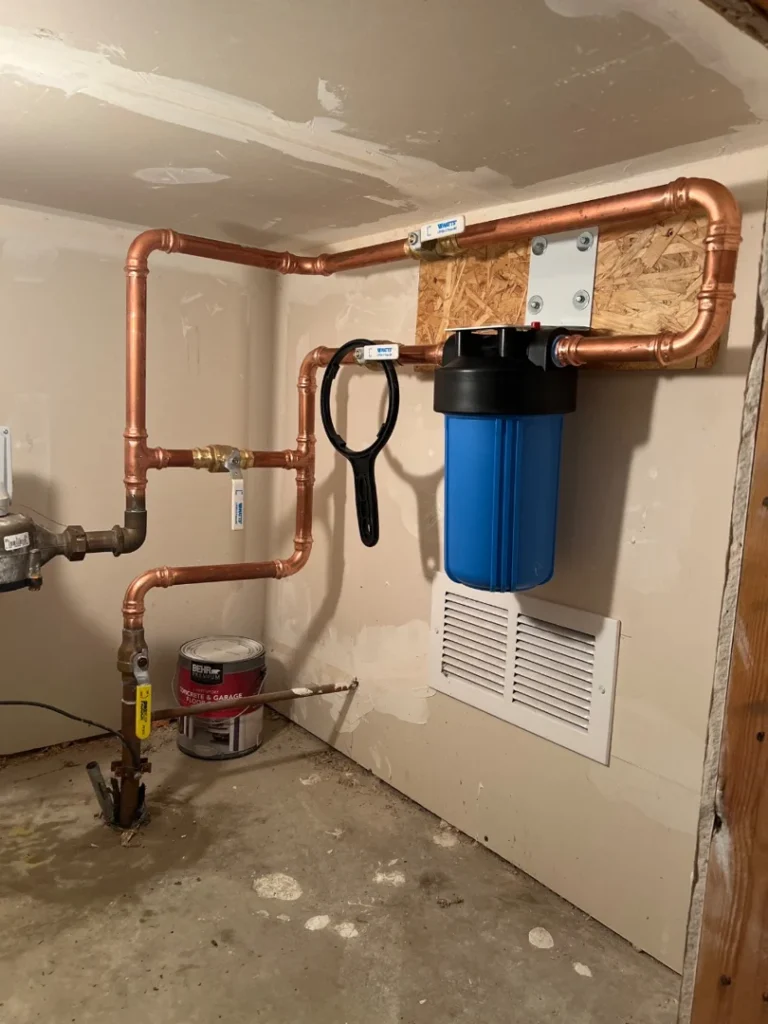
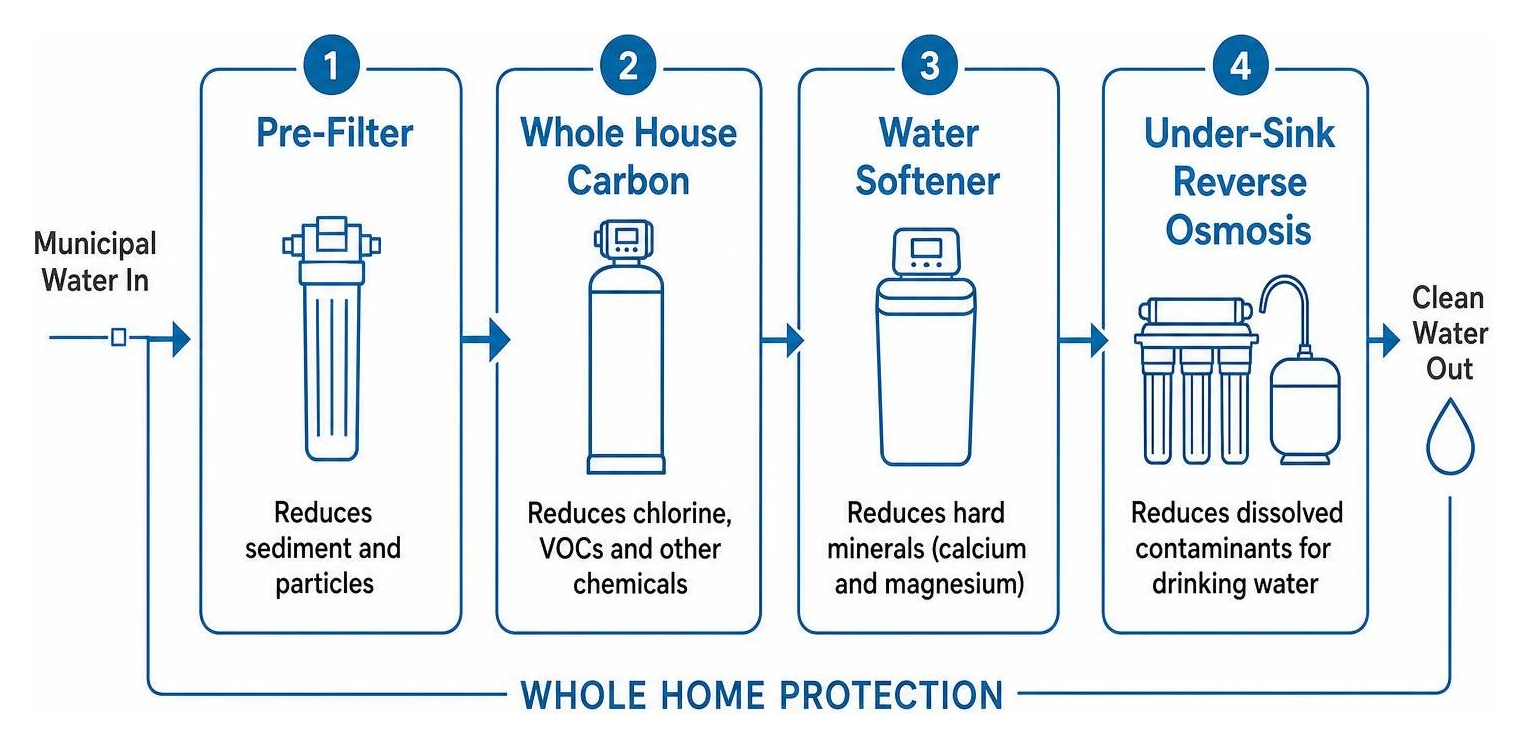
Whole-house filtration systems require professional plumbing placement on the main water line before it branches to the water heater or fixtures. A multi-stage setup begins with a 5-micron sediment pre-filter to catch rust flakes, sand, and pipe scale originating from aging municipal mains.
A dedicated three-valve bypass loop allows smooth maintenance without shutting off the main supply to the house. Modern backwashing carbon systems periodically reverse water flow through the bed, lifting and rinsing the media to flush accumulated particles and prevent channel tracking. For properties relying on private wells in outer suburban pockets or homes seeking biological defense, pairing carbon with a UV whole house water filtration system neutralizes bacteria and viruses that carbon beds cannot treat.
Frequently Asked Questions About Whole-House Carbon Filters
How long does whole-house carbon media typically last?
A standard backwashing tank filled with high-grade granular activated carbon generally treats up to 1,000,000 gallons of municipal water, lasting between 3 to 5 years depending on local chlorine concentrations. Replaceable cartridge-style systems need new carbon block inserts every 6 to 12 months.
Will an activated carbon filter reduce my home’s water pressure?
When engineered and sized properly by a professional, a whole-house carbon system results in a negligible pressure drop of less than 2 to 4 PSI. Noticeable pressure drops usually indicate a clogged sediment pre-filter or an undersized media tank that cannot keep pace with household fixture demand.
Can a carbon filter work alone for complete water purification?
Carbon is an exceptional first-line defense against chemicals and odors, but it cannot solve every water issue. In the Chicagoland area, a complete water setup often combines ProEcoLife Whole House Filtration with dedicated Well Water Conditioning or softening for hard water areas, and our under-sink PEL75 9-Stage RO System to remove lead, heavy metals, and micro-contaminants at the drinking tap.
Conclusion
Protecting your entire home with point-of-entry carbon filtration may help reduce harsh chlorine, volatile chemicals, and foul odors from every tap and shower. Because Chicagoland water quality varies—from aging municipal mains in Chicago to mineral hardness across the suburbs—identifying your exact water profile is the first step toward pure, refreshing water.
Schedule your water testing and professional assessment with ProEcoLife today by calling (312) 889-8888 or visiting proecolife.com.