1. Understand What Chicago Tap Water Demands from Your RO System
Chicago Department of Water Management purifies nearly one billion gallons of drinking water daily from Lake Michigan. While water leaving municipal treatment facilities meets rigorous quality standards established by the Environmental Protection Agency (EPA), the journey to your kitchen faucet presents distinct challenges. Chicago features over 400,000 lead service lines—more than any other city in the nation—connecting municipal water mains directly to individual properties. Furthermore, pre-war housing stock such as two-flats, greystones, and vintage condos in Northwest Side neighborhoods like Norwood Park, Edison Park, and Jefferson Park often contain internal galvanized or lead-soldered piping that sheds particulate rust into indoor plumbing over time.
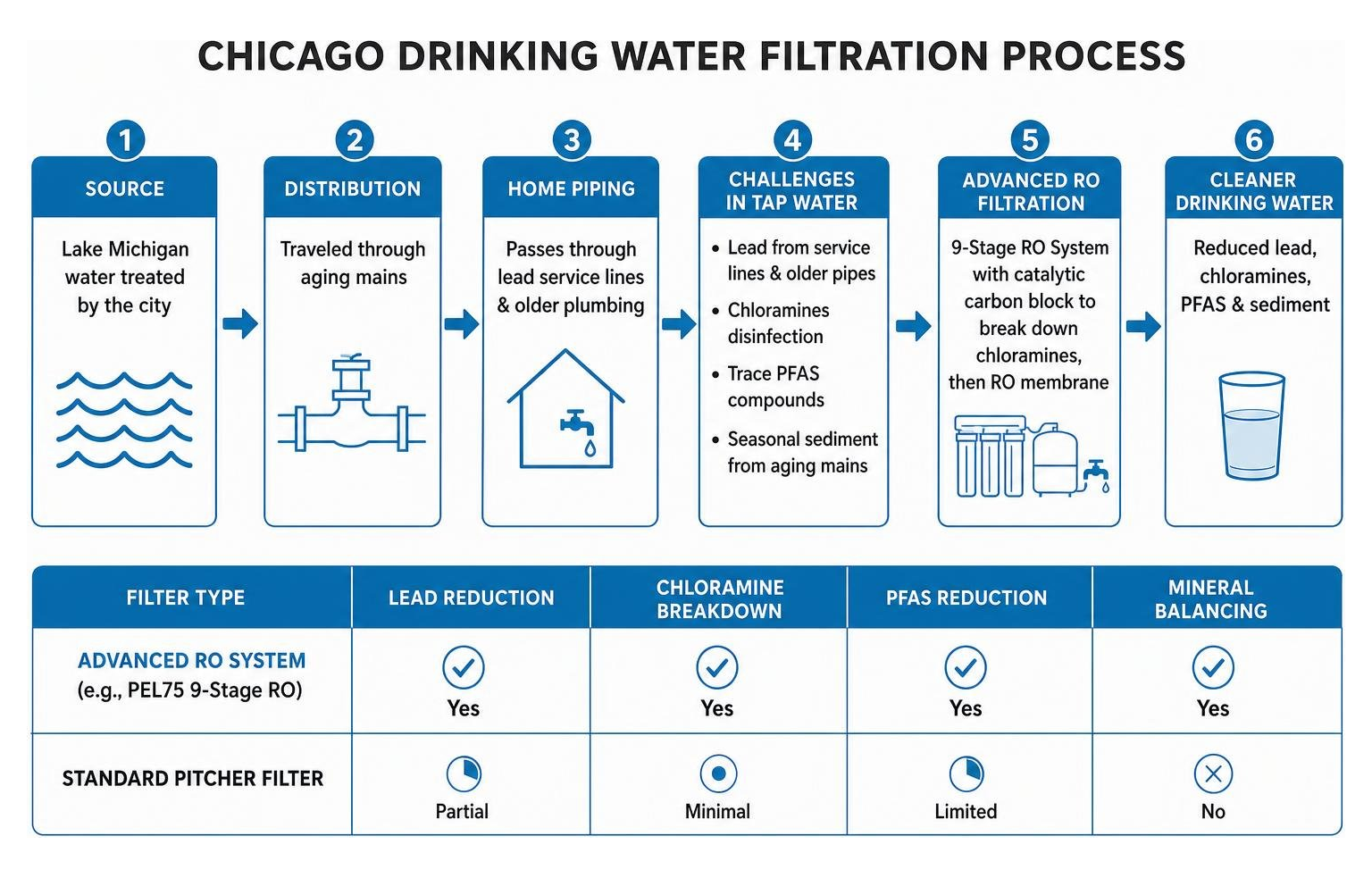
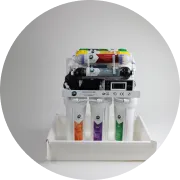
Beyond lead, municipal water treatment relies on chloramines for residual disinfection throughout the distribution grid. Chloramines are significantly more chemically stable than standard chlorine, meaning they do not evaporate easily and pass right through basic sediment and granular carbon filters. Additionally, trace PFAS compounds from regional industrial corridors and seasonal sediment from aging city water mains can impact your home’s water profile. Treating Lake Michigan water at the tap requires an advanced multi-stage approach, such as our PEL75 9-Stage RO System, which utilizes specialized catalytic carbon block media to break down chloramines before water reaches the primary membrane. To learn more about the science behind these processes, explore our In-Depth Guide to Reverse Osmosis Systems.
| Filter Type | Lead Reduction | Chloramine Breakdown | PFAS Reduction | Mineral Balancing |
|---|---|---|---|---|
| Standard Pitcher Filter | Partial | Minimal | Limited | No |
| 3-Stage Under-Sink Filter | Moderate | Poor | Moderate | No |
| Basic 5-Stage RO System | High | Fair | High | No |
| ProEcoLife PEL75 9-Stage RO System | Up to 98% | High (Catalytic Carbon) | High (Below EPA Levels) | Yes (Mineral/Alkaline) |
Identifying Local Water Contaminants Through a Water Test
Water quality varies significantly between a high-rise condo in Evanston, a single-family residence in Park Ridge, and a vintage multi-unit building in Portage Park or Albany Park. While Chicago proper draws water directly from Lake Michigan, homes in the nearby Northwest suburbs frequently experience elevated mineral hard water conditions alongside municipal infrastructure challenges. Total Dissolved Solids (TDS), pH levels, lead concentration, and mineral hardness fluctuate based on local pipe age, municipal blending, and overall distance from pumping stations.
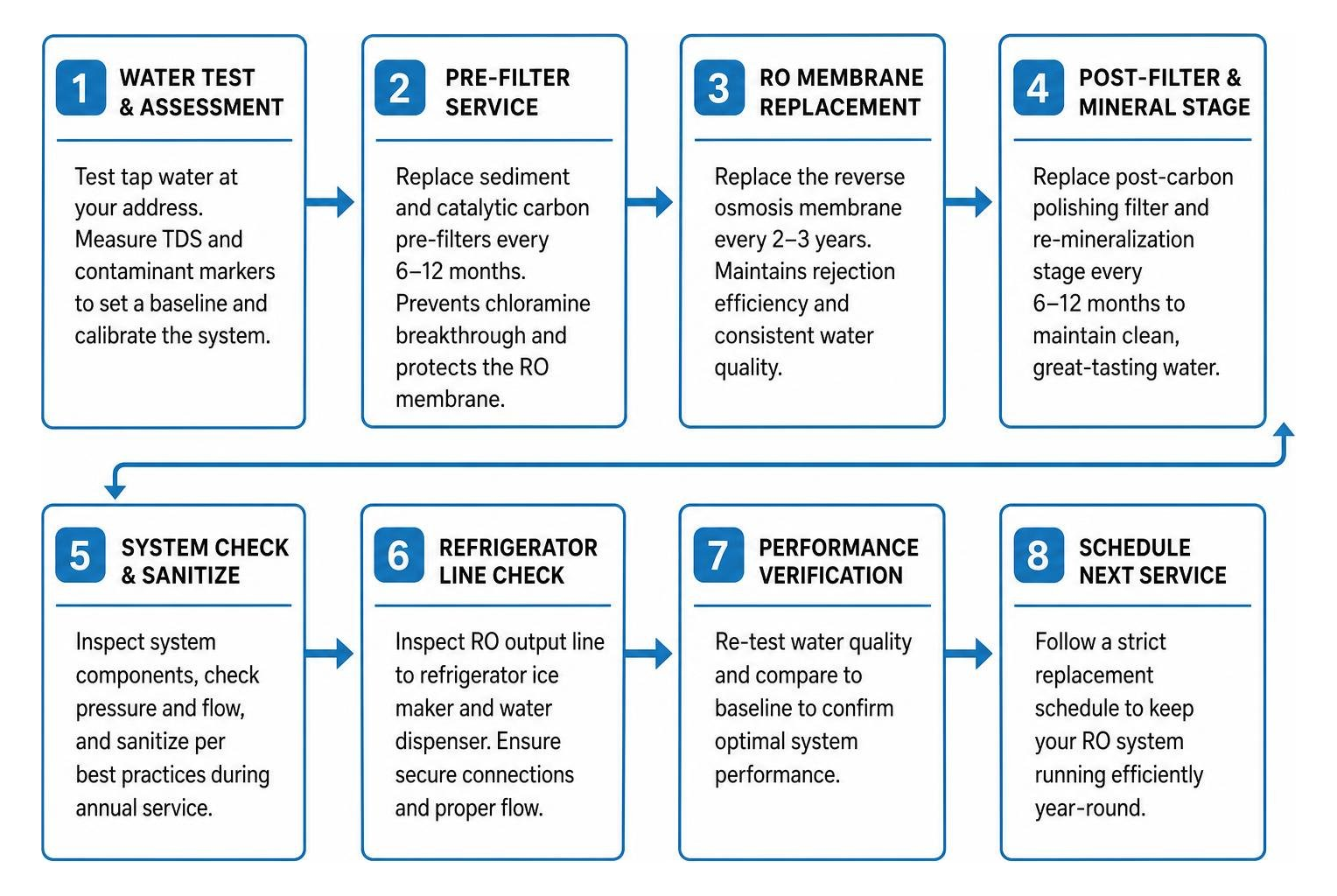
A thorough water test evaluates raw tap water at your specific address. By measuring baseline TDS and contaminant markers, technicians can calibrate your system filtration stages and establish a performance benchmark tailored to your neighborhood. For a closer look at regional solutions, visit our guide on the Chicago Water Filter System.
Why Routine Chicago RO Filter Service Prevents Membrane Clogging
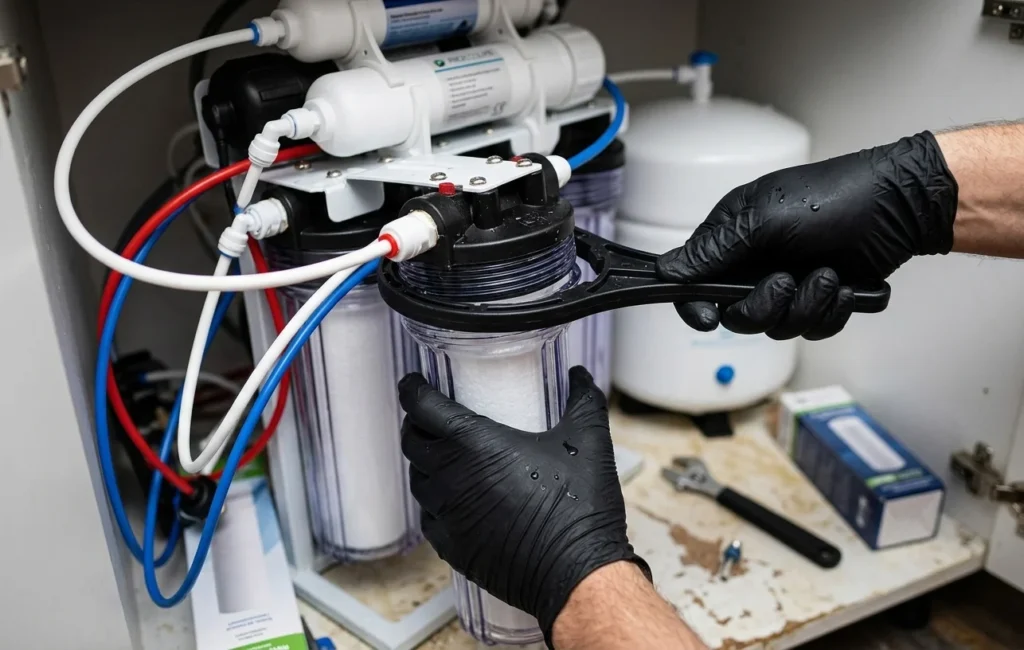
The semi-permeable reverse osmosis membrane is the core component of any high-efficiency RO setup. However, heavy sediment load, pipe scale, and unfiltered chloramines can degrade this delicate membrane prematurely. Pre-filters act as the crucial first line of defense, trapping particulate rust and debris before it fouls downstream components.
When pre-filters become saturated with fine sediment, line pressure drops and destructive chemical compounds can break through to reach the sensitive RO element. Scheduled Chicago RO filter service ensures pre-filter cartridges are swapped before chloramine breakthrough occurs, preserving your membrane’s rejection efficiency and extending overall system lifespan.
2. Follow a Strict Replacement Schedule for Membranes and Pre-Filters
Maintaining consistent water quality requires replacing filter cartridges according to a structured maintenance schedule. While sediment and catalytic carbon pre-filters typically require replacement every 6 to 12 months depending on household consumption, the main reverse osmosis membrane generally needs replacement every 2 to 3 years. Post-carbon polishing filters and re-mineralization stages, which reintroduce beneficial minerals like calcium and magnesium, are routinely serviced alongside annual system checks.
Skipping regular maintenance intervals can lead to reduced flow rates, altered taste, or unexpected mineral buildup inside storage tanks. To better understand how these distinct filtration stages work together under your sink, review our comprehensive article explaining How Does Reverse Osmosis Work.
Servicing High-Traffic Apartment and Condo Installations
Installing and servicing under-sink filtration systems in rental units, historic two-flats, or high-density condos requires a specialized approach. Compact cabinet footprints in bustling neighborhoods like Lakeview, Lincoln Park, or Logan Square demand precise plumbing configurations and space-saving layouts.
Professional technicians utilize non-invasive adapters that tap directly into cold water supply valves without permanently altering shared building infrastructure. Scheduled filter replacements keep these space-saving units operating quietly and efficiently within standard kitchen cabinets. For specialized assistance with space-constrained plumbing setups, consider our Expert Water Filter Installation Services in Chicago.
Connecting and Maintaining Refrigerator Ice Maker Lines
Many homeowners prefer routing their purified reverse osmosis output directly to their refrigerator’s water dispenser and automatic ice maker. Pure, low-TDS water helps eliminate off-flavors and produces crystal-clear ice cubes by removing dissolved minerals that cause cloudiness and freezer scale.
When connecting an RO system to a refrigerator, maintaining proper line pressure is essential. Professional maintenance includes evaluating inline check valves, inspecting tubing connections, and monitoring feed pressure to prevent line freeze-ups or slow ice production rates over time.
Need Clean, Safe Water at Home?
Get a free water test at your home or business. We install and service whole-house filtration and PEL75 reverse osmosis systems across Chicagoland. We also take select projects in Wisconsin and Indiana.
Book a Free Water TestCall (312) 889-88883. Benefits of Professional Chicago RO Filter Service vs. DIY
While DIY filter replacements might seem appealing at first glance, local professional service provides advantages that off-the-shelf replacement kits cannot match. Founder Karol Dolega established ProEcoLife in 2014 on Chicago’s Northwest Side, operating from our local headquarters at 7109 W Higgins Ave. Our dedicated team understands local water infrastructure nuances across Chicago neighborhoods and surrounding suburbs like Niles, Des Plaines, Skokie, and Glenview.

Customizing Maintenance for Older Chicago Plumbing Infrastructure
Pre-war residential structures across Forest Glen, Dunning, and Harwood Heights frequently feature legacy galvanized iron water lines. Over several decades of continuous service, these pipes accumulate internal corrosion and rust that periodically shed fine iron flakes into household water.
Professional technicians adjust pre-filtration configurations based on your building’s plumbing age, installing higher-capacity sediment stages where legacy piping creates elevated turbidity and particulate accumulation.
Choosing Local Installers Over Generic National Brands
Generic national mail-order filter brands supply standardized cartridges optimized for broad, average water conditions across the country. They rarely account for Chicago’s high concentration of lead service lines, local hard water variations in the suburbs, or municipal reliance on chloramines for disinfection.
Working with a local team based on Higgins Ave ensures rapid local response times, localized component configurations, and skilled technicians who live and work in your immediate community—from Mount Prospect and Arlington Heights to Rosemont and Schiller Park.
Need Clean, Safe Water at Home?
Get a free water test at your home or business. We install and service whole-house filtration and PEL75 reverse osmosis systems across Chicagoland. We also take select projects in Wisconsin and Indiana.
Book a Free Water TestCall (312) 889-88884. Track Performance with Documentation and Smart Water Monitoring
Verifying reverse osmosis performance shouldn’t involve guessing or waiting for changes in water taste. Advanced setups integrate smart TDS monitoring, displaying real-time purity levels for both incoming tap water and purified drinking water side-by-side.

Maintaining a detailed service log helps track membrane rejection rates, filter change dates, and operating pressure trends over time. For a deeper look into regional water quality standards and filtration strategies, check out A Comprehensive Guide to Chicago Water Filters.
Flexible Options for System Upgrades
Many households discover that transitioning from single-use bottled water to an under-sink reverse osmosis unit offers noticeable everyday convenience and financial relief. Many customers notice that upfront equipment investment is gradually recovered within the first year of use by eliminating heavy grocery store bottled water purchases. Flexible arrangements make upgrading to an advanced 9-stage unit seamless for residential properties across Morton Grove, Wilmette, and Northbrook.
Scheduling Annual Inspections for Ongoing Chicago RO Filter Service
An annual professional inspection goes beyond simply changing filter cartridges. A complete service visit covers critical system checks to guarantee leak-free operation and optimal purity:
- Live digital TDS output verification and membrane rejection calculation.
- System operating pressure testing and internal automatic shut-off valve checks.
- Sanitary line flushing, system sanitization, and storage tank pressure calibration.
- Fitting inspections across all under-sink quick-connect lines to prevent potential leaks.
Frequently Asked Questions About Chicago RO Maintenance
How often should an RO membrane be replaced in Chicago?
In most Chicago homes, an RO membrane lasts between 2 and 3 years under normal usage conditions. However, high water volume demands or elevated sediment levels in older neighborhoods like Jefferson Park, Dunning, or Logan Square may require earlier replacement. Professional technicians measure total dissolved solids (TDS) reduction percentages during routine service visits to confirm membrane health before recommending a replacement.
Can an under-sink RO system connect to my refrigerator?
Yes. An under-sink reverse osmosis system can easily connect to your refrigerator’s water dispenser and automatic ice maker using standard 1/4-inch or 3/8-inch flexible tubing lines. Technicians verify adequate line pressure and inspect inline check valves during installation so your ice maker functions smoothly without internal scale accumulation.
Why are catalytic carbon pre-filters necessary for Chicago tap water?
Chicago utilizes chloramines rather than standard free chlorine for municipal water disinfection. Chloramines pass through standard carbon block filters relatively untouched and can prematurely degrade sensitive RO membrane materials. Specialized catalytic carbon media breaks down the chemical bond between chlorine and ammonia, protecting downstream system components.
Keep Your Drinking Water Clean with Local Chicago Service
Maintaining your reverse osmosis system helps your family enjoy fresh, high-quality drinking water every day. From address-specific water evaluations to routine cartridge replacements and live TDS verifications, working with a dedicated local provider takes the hassle out of home water treatment.
Whether you reside in Edison Park, Norwood Park, Park Ridge, or Lincolnwood, ProEcoLife provides comprehensive support tailored to Lake Michigan source water, suburban mineral hardness, and local pipe infrastructure. Explore our full line of filtration options on our main Chicago Water Filter System page. Contact ProEcoLife to schedule a water test at proecolife.com.