




Why Chicago Homeowners Are Switching to 20 GPM Whole House Water Filters
If you’re researching a 20 GPM whole house water filter, here’s the quick answer:
Best uses for a 20 GPM whole house water filter:
- Homes with 4+ bathrooms (7+ bathrooms for peak 20 GPM demand)
- Households running multiple showers, appliances, or fixtures at the same time
- Chicago-area homes with aging pipes, lead concerns, or hard Northwest suburb water
- Any home where pressure drops are a constant frustration
Turn on two showers, run the dishwasher, and start a load of laundry — all at once. In many Chicago homes, especially older ones in neighborhoods like Norwood Park, Edison Park, and Jefferson Park, that’s when water pressure quietly gives up.
It’s not just inconvenient. In a city where aging infrastructure means lead service lines are still common, low-pressure filtration systems may not be keeping up with your household’s real demand.
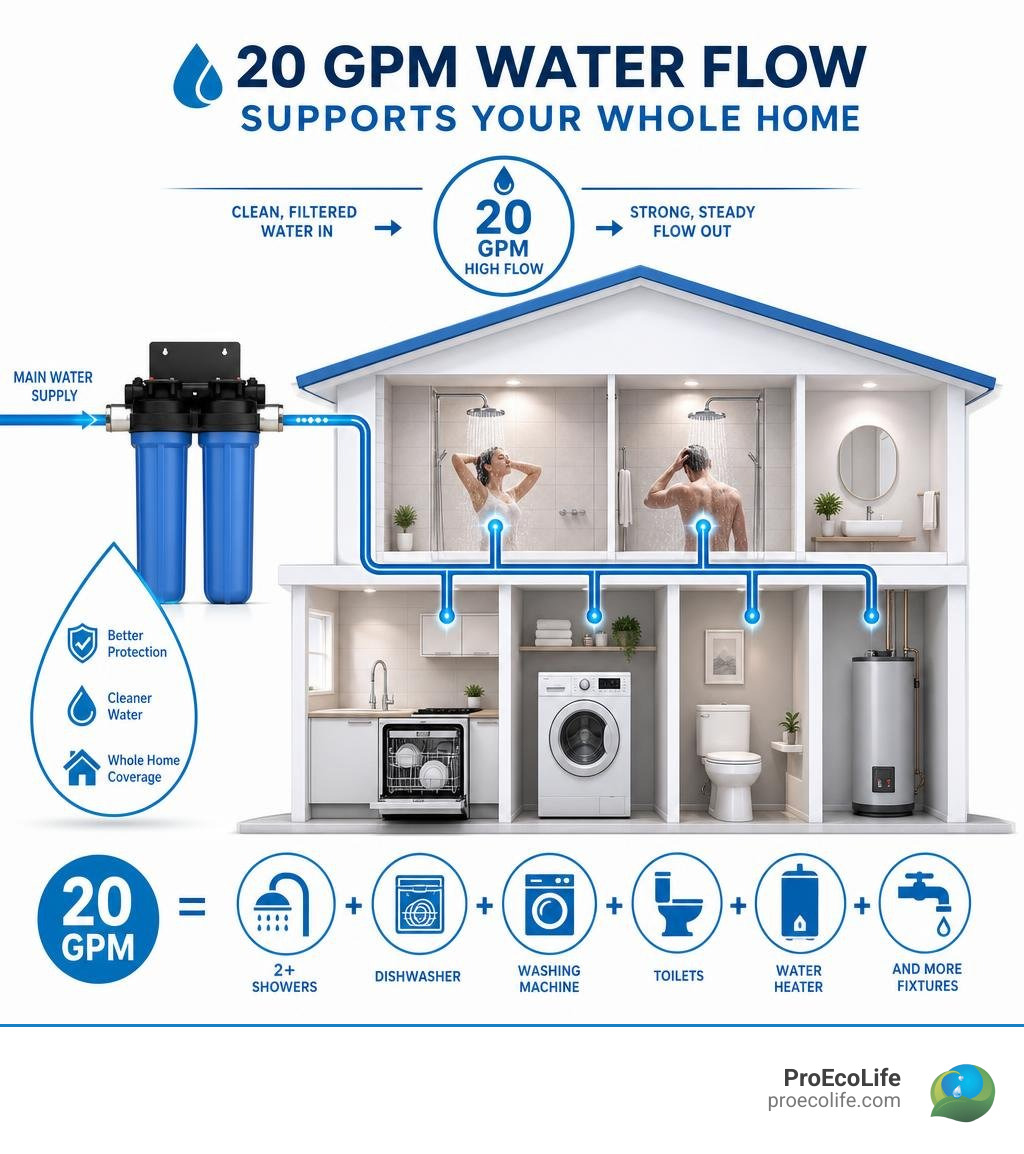
The average shower uses 2.1 gallons of water per minute. A properly sized 20 GPM system can support 9+ simultaneous showers without a noticeable pressure drop. For larger homes, that’s not a luxury — it’s a necessity.
Chicago draws its water from Lake Michigan, but by the time it travels through older distribution lines and into your home’s plumbing, it may carry chloramines, sediment, and heavy metals picked up along the way. A high-flow whole house filter addresses that problem at the point of entry — before water reaches any faucet, shower, or appliance.
This guide rounds up the best 20 GPM whole house filter options and helps you figure out which one fits your Chicago home.
Quick 20 gpm whole house water filter terms:
What is a 20 GPM Whole House Water Filter and How Does It Work?
A 20 GPM whole house water filter is a heavy-duty, high-capacity filtration system designed to process up to 20 gallons of water per minute (GPM) as it enters your home. To put that in perspective, standard residential water filters typically top out at 9 to 12 GPM. When you install a system rated for 20 GPM, you are ensuring that even during periods of peak water use, your household will not experience a frustrating drop in water pressure.
These systems are installed at your home’s main water line, serving as a protective gateway. By treating the water at this single point of entry, every single faucet, showerhead, hose bib, and major appliance in your home receives clean, filtered water.
The mechanics of how these systems work depend on the specific configuration. Generally, they rely on a multi-stage approach to target different sizes and types of contaminants:
- Pre-Filtration: Water first passes through a sediment cartridge that physically traps larger particles like sand, silt, rust, and dirt. This step is critical because it prevents these abrasive particles from clogging the more delicate secondary filters or damaging your home’s plumbing fixtures.
- Adsorption and Chemical Filtration: Next, the water flows through a high-capacity media bed, often containing activated carbon or catalytic carbon. This media works via adsorption—contaminants cling to the massive surface area of the carbon pores. This stage is highly effective at removing chlorine, chloramines, volatile organic compounds (VOCs), and unpleasant tastes or odors.
- Specialized Treatment: Depending on your system’s design, water may pass through a scale inhibitor, a submicron nanofiber membrane, or even an ultraviolet (UV) disinfection chamber to neutralize bacteria and viruses.
By combining these stages into a single high-flow configuration, a 20 GPM system delivers clean water without creating a bottleneck in your plumbing. To explore more about the fundamentals of point-of-entry treatment, you can read our detailed guide on whole house filtration.
Why Your Chicago Home Needs a 20 GPM Whole House Water Filter
In the Chicago area, our primary water source is Lake Michigan. While the city’s municipal water treatment plants do an exceptional job of treating water to meet federal safety standards, the journey from the lake to your tap is a long one.
Many older homes in neighborhoods like Norwood Park, Edison Park, and Jefferson Park still rely on aging water mains and lead service lines. As water travels through these older pipes, it can pick up sediment, rust flakes, and trace heavy metals. Furthermore, municipal water is treated with chlorine or chloramines to keep it sanitized during transit. While necessary for public health, these disinfectants leave behind a distinct chemical taste and smell, and they can dry out your skin and hair when you shower.
Additionally, if you live in nearby suburbs like Park Ridge, Niles, or Des Plaines, you may experience fluctuations in municipal water pressure or municipal blending. When multiple family members are getting ready in the morning—running showers, flushing toilets, and starting the washing machine—a standard filter simply cannot keep up with the demand.
A 20 GPM whole house water filter ensures that your household’s peak water demand is met effortlessly. It provides a robust physical and chemical barrier against the impurities that accumulate in municipal distribution systems, ensuring that your family enjoys clean, high-pressure water from every single tap. For a deeper dive into how these systems protect your household, check out our resource on all about whole house filters.
Comparing a 20 GPM Whole House Water Filter to Lower Flow Systems
When choosing a water filtration system, sizing it correctly is the difference between a great experience and a daily headache. Many standard whole house systems on the market are rated for 9 GPM or 12 GPM. While these might suffice for a smaller townhouse or a home with only one or two bathrooms, they quickly become overwhelmed in larger residences.
If your system’s flow rate is too low for your home’s peak demand, you will experience a significant drop in water pressure. This happens because the water cannot pass through the filtration media fast enough to satisfy all open fixtures. A 20 GPM system provides a generous buffer, allowing multiple major water-using activities to occur simultaneously without any drop in performance.
| Feature / Specification | Standard 10 GPM System | Premium 20 GPM System |
|---|---|---|
| Ideal Home Size | 1–3 Bathrooms | 4+ Bathrooms (up to 7+ bathrooms) |
| Simultaneous Showers Supported | 2–3 showers | 9+ showers |
| Peak Flow Capacity | Up to 12 GPM | Up to 41 GPM (with large tank designs) |
| Typical Port Connection Size | 3/4″ or 1″ | 1.25″ or 1.5″ |
| Media Lifespan (Tank-Based) | 500,000 gallons | 1,000,000+ gallons |
| Pressure Drop at Peak Flow | High (often > 10 PSI) | Minimal (usually < 2-3 PSI) |
For homeowners browsing options, you can find a wide range of Whole-House Water Filtration Systems – Lowe’s to see how various standard retail models compare to commercial-grade high-flow designs.
Need Clean, Safe Water at Home?
Get a free water test at your home or business. We install and service whole-house filtration and PEL75 reverse osmosis systems across Chicagoland. We also take select projects in Wisconsin and Indiana.
Book a Free Water TestCall (312) 889-8888Choosing the Right High-Flow System for Municipal vs. Well Water
The ideal filtration setup depends heavily on where your water comes from. In the Chicago area, we see a stark contrast between homes utilizing municipal Lake Michigan water and those in the outer Northwest suburbs that rely on private or community well water.
For municipal water users in areas like Skokie, Glenview, Arlington Heights, and Morton Grove, the main concerns are chemical disinfectants (chlorine and chloramine), sediment from aging water mains, and heavy metals like lead. To address these, a system featuring a high-capacity catalytic carbon block or a backwashing carbon media bed is highly recommended. Catalytic carbon is specifically modified to break down chloramines, which are much harder to remove than standard chlorine.
For those on well water, the challenges are entirely different. Well water in northern Illinois is notorious for high iron content, manganese, hydrogen sulfide (which causes a rotten-egg odor), and extreme hardness. If you try to run well water through a standard carbon filter without pre-treatment, the iron and hardness minerals will rapidly clog the media, ruining the system. Well water systems require a dedicated iron filter or a well water conditioner before the water reaches any fine carbon filtration stages.

Whether you are dealing with city water or well water, selecting the right configuration is essential to ensure long-term performance. You can read more about customizing your setup in our guide, From Shower to Sink Finding the Best All House Water Filtration System.
Addressing Chicago Lead and Hardness Issues
Lead contamination remains a serious concern for many families living in older Chicago homes. When water sits in lead service lines or older copper pipes joined with lead solder, trace amounts of this toxic metal can leach into your drinking water.
At the same time, many homes in the Northwest suburbs experience incredibly hard water. Hardness is caused by high concentrations of calcium and magnesium. When heated, these minerals precipitate out of the water, leaving behind a rock-hard crust known as limescale. This scale builds up inside your water heater, reducing its efficiency by up to 29%, and coats the inside of your pipes, showerheads, and home appliances.
To combat both issues simultaneously in a high-flow setup, we recommend a multi-stage approach. By pairing a heavy-duty sediment pre-filter with a specialized scale inhibitor or a salt-free water conditioner, you can protect your plumbing from scale buildup without using salt or electricity.
For high-demand properties, systems like the High Flow Whole House Water Filter | 15-35 GPM | Crystal Quest offer customizable configurations that combine high-flow carbon filtration with scale-prevention technologies to handle both chemical impurities and hardness minerals in a single footprint.
Need Clean, Safe Water at Home?
Get a free water test at your home or business. We install and service whole-house filtration and PEL75 reverse osmosis systems across Chicagoland. We also take select projects in Wisconsin and Indiana.
Book a Free Water TestCall (312) 889-8888Professional Installation and Maintenance Requirements
A 20 GPM whole house water filter is a large piece of equipment. Because it must be integrated directly into your home’s main water line—usually right after the water meter or pressure tank—professional installation is highly recommended.
Proper installation involves cutting into your main plumbing line, installing bypass valves (so you can service the filter without shutting off water to the entire house), and ensuring all fittings are perfectly watertight. Because high-flow systems often use larger 1.25-inch or 1.5-inch ports to prevent pressure drops, a professional plumber will have the specialized tools and adapters required to secure a leak-free connection.

Furthermore, professional installation ensures that your system complies with local Chicago plumbing codes and maintains any manufacturer warranties. To understand what to look for when planning your installation, read our expert advice on How to Choose a Water Filter.
Long-Term Maintenance and Filter Replacement Schedules
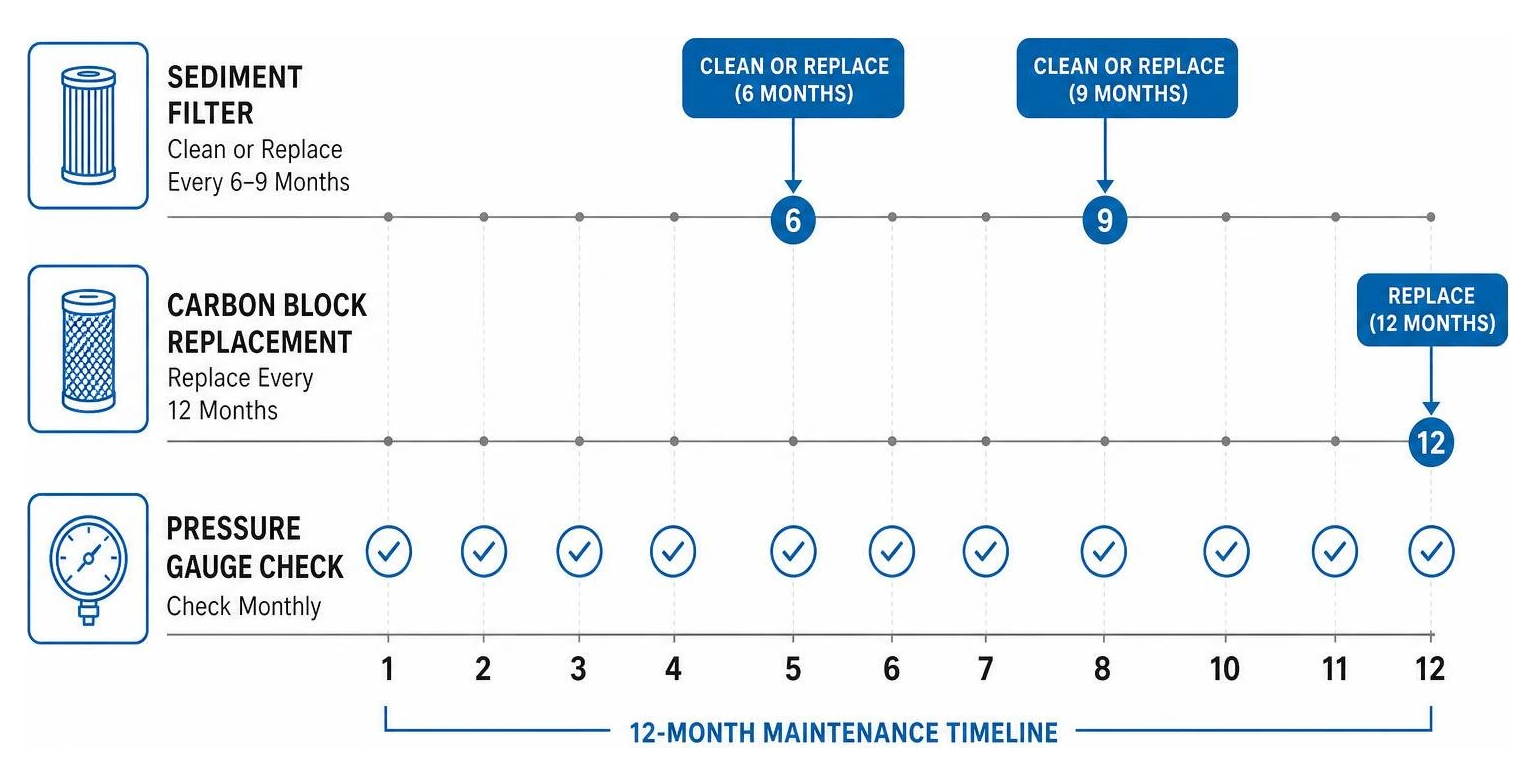
To keep your 20 GPM system running at peak performance, regular maintenance is required. Fortunately, because these systems are built with high-capacity components, maintenance is relatively straightforward:
- Sediment Pre-Filters: These should typically be replaced every 6 to 9 months, depending on the level of sediment in your local water. Some pleated sediment filters can be washed and rinsed out up to three times before needing complete replacement.
- Carbon Media Cartridges: In cartridge-based systems, the primary carbon blocks generally last for about 80,000 to 100,000 gallons of water, or roughly one year.
- Media Tanks: If you choose a large, tank-based backwashing system, the media bed can last anywhere from 3 to 10 years (or up to 1,000,000 gallons) before requiring a complete media replacement.
Monitoring your system’s pressure gauges is the easiest way to know when it’s time for maintenance. A noticeable drop in water pressure between the inlet and outlet gauges indicates that the filter elements are becoming clogged and need attention.
For a complete breakdown of what goes into keeping these systems running smoothly over the years, check out our comprehensive guide on Filtration System maintenance.
Frequently Asked Questions About High-Flow Filtration
Will a high-flow system reduce my home’s water pressure?
When properly sized, a high-quality 20 GPM system will not cause a noticeable drop in your home’s water pressure. Premium systems are designed with large internal flow pathways and high-capacity cartridges that create minimal resistance. For example, a high-flow pleated sediment filter typically introduces a pressure drop of less than 1 PSI at a 20 GPM flow rate. If you do notice a sudden drop in pressure after installation, it is usually a sign that your sediment pre-filter has done its job and is full of debris, indicating it is time for a replacement.
How do I know if my home requires a 20 GPM system?
The easiest way to determine your required flow rate is by counting the number of bathrooms in your home and assessing your family’s daily water habits. If you have 4 or more bathrooms, or if you frequently run multiple high-demand water fixtures simultaneously (such as a multi-headed master shower, a washing machine, and a lawn sprinkler), a 20 GPM system is highly recommended. Sizing your system based on peak usage ensures that you never have to coordinate shower times or worry about a sudden drop in pressure when someone else flushes a toilet.
Can these systems remove lead and chloramines from Chicago water?
Yes, but you must choose a system equipped with the correct filtration media. Standard activated carbon is highly effective at removing chlorine, but it struggles to break down chloramines (which are a combination of chlorine and ammonia used by municipal water plants). To successfully target chloramines and heavy metals like lead, you need a system that utilizes advanced catalytic carbon or specialized submicron nanofiber technology.
For maximum heavy metal and chemical reduction, systems like the Submicron Water Filter System for Whole House – 20 GPM utilize advanced nanofiber technology to trap microscopic particulates, while heavy-duty backwashing options like the Large Home Backwashing Whole House Carbon Water Filter provide massive beds of catalytic carbon to neutralize chemical disinfectants before they reach your tap.
Conclusion
Investing in a 20 GPM whole house water filter is one of the most effective ways to protect your family, your plumbing, and your home appliances from the impurities lurking in your water supply—all without ever sacrificing the water pressure you depend on daily.
At ProEcoLife, we have been proud to serve as Chicago’s trusted local water experts since 2014. Founded by Karol Dolega, our company was built on a deep understanding of the unique water challenges facing our local communities—from the chlorine and aging infrastructure issues on Chicago’s Northwest Side to the hard water challenges in the surrounding suburbs.
Whether you are looking to install our advanced Whole House Filtration system, protect your skin with our specialized Shower Filter System, address hard water with our Well Water Conditioning systems, or explore our PEL75 9-Stage RO System for pristine drinking water, we are here to help. We also design and install Commercial Water Filtration Systems for businesses throughout the region.
We proudly serve Chicago’s Northwest Side neighborhoods, including Norwood Park, Edison Park, Jefferson Park, Oriole Park, Forest Glen, Dunning, Portage Park, and O’Hare, as well as our neighboring suburbs:
- Park Ridge
- Niles
- Des Plaines
- Skokie
- Glenview
- Arlington Heights
- Morton Grove
- Evanston
- Lincolnwood
- Wilmette
- Norridge
- Harwood Heights
- Rosemont
- Schiller Park
- River Grove
- Elmwood Park
- Melrose Park
- Franklin Park
- Bensenville
- Elk Grove Village
- Mount Prospect
- Rolling Meadows
- Palatine
- Wheeling
- Buffalo Grove
- Northbrook
- Northfield
- Deerfield
Don’t let aging pipes or hard water compromise your family’s health and comfort. Take the first step toward crystal-clear, high-pressure water today. Schedule a water test today by contacting the team at ProEcoLife at (312) 889-8888 or visiting us online at proecolife.com.