

Chicago Lead Water: What Every Homeowner Needs to Know Right Now
Chicago lead water contamination is one of the most serious public health challenges facing the city today. With an estimated 400,000 lead service lines — more than any other city in the United States — the risk is real, widespread, and hits close to home for families across neighborhoods like Norwood Park, Edison Park, and Jefferson Park.
Quick facts about lead in Chicago’s water:
- ~400,000 lead service lines exist citywide, out of roughly 491,000 total
- ~68% of Chicago children under age 6 are estimated to be exposed to lead-contaminated drinking water
- 84% of service lines citywide require replacement, rising to 89–92% in majority Black and Latino neighborhoods
- The city’s current replacement plan isn’t projected to finish until 2076 — 30 years past the federal deadline
- Chicago’s tap water meets current federal safety standards, but experts agree there is no safe level of lead exposure
- Homes built before 1986 are at highest risk
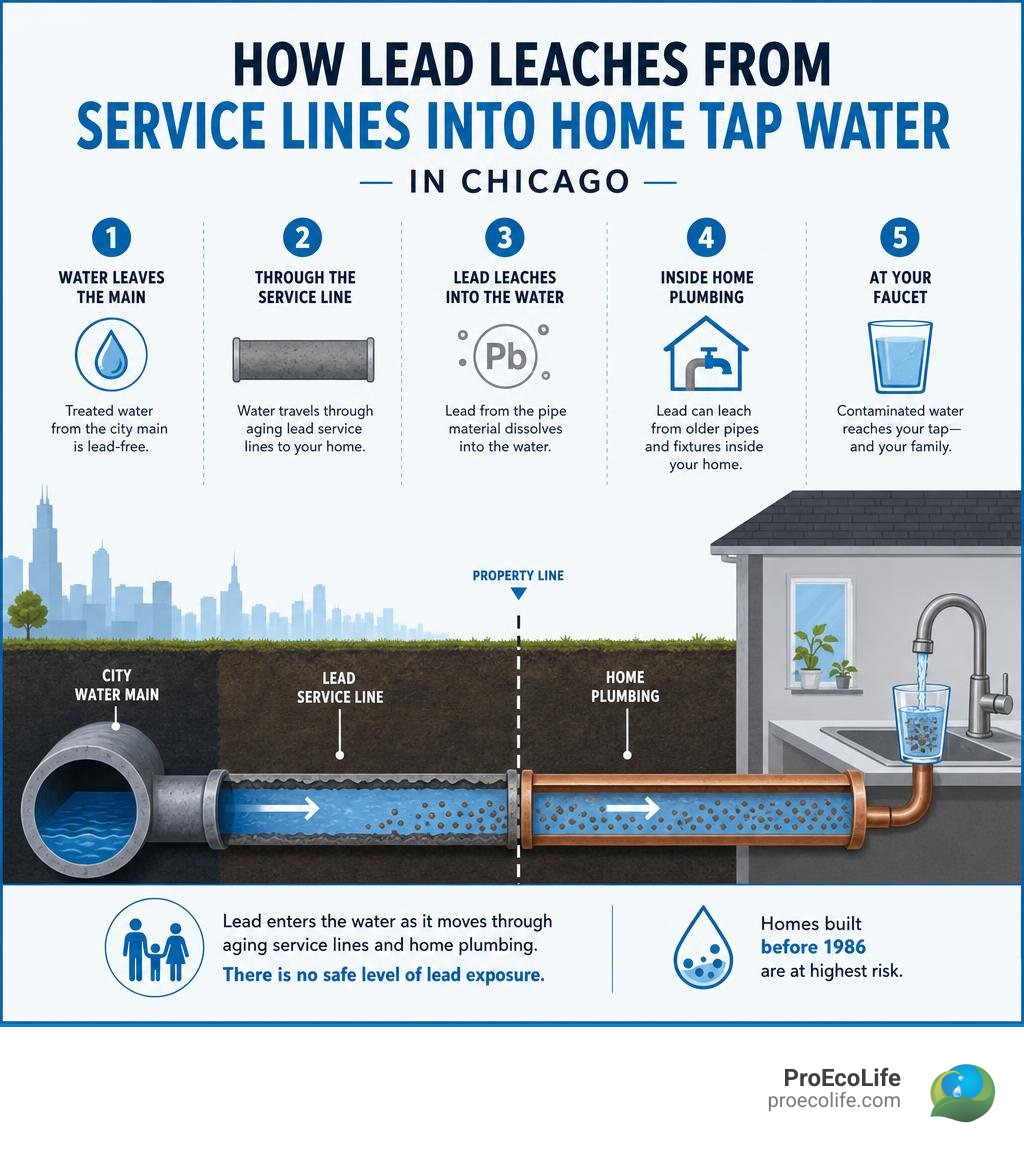
Here’s what matters most: lead doesn’t come from Lake Michigan or the city’s water mains. Chicago’s source water is actually well-treated. The problem happens between the main and your faucet — in aging service lines and older home plumbing that can leach lead directly into the water your family drinks.
That’s a critical distinction. It means your risk depends heavily on your specific home, your block, and your building’s age — not just on city-wide water quality reports.
For homeowners on Chicago’s Northwest Side and in nearby suburbs like Park Ridge, Niles, and Des Plaines, the concern is the same: older infrastructure, aging pipes, and a city replacement timeline that stretches decades into the future. Waiting for a government fix isn’t a practical plan for protecting your family today.
The Reality of Chicago Lead Water: Scale and Infrastructure Challenges
When we look at the sheer scale of the chicago lead water issue, the numbers are staggering. Chicago has approximately 400,000 lead service lines connecting water mains to individual homes. This is the largest concentration of lead service lines of any municipality in the United States.
For decades, the city relied on these pipes to deliver drinking water to single-family homes and two-flat apartments. Today, we are left with a massive, slow-moving environmental crisis. According to city records, roughly 84% of all water service lines across Chicago are either confirmed lead or suspected lead.
The accuracy of the city’s service line inventory remains a major hurdle. While a public database exists to help residents check their address, the historical records are often incomplete. Many properties are still categorized as “suspected lead” or “galvanized requiring replacement” because physical verification has not yet taken place. This lack of precise data leaves thousands of families in limbo, unsure of what is actually buried beneath their front lawns.
Compounding this issue is the incredibly slow pace of municipal replacement. Between 2020 and 2022, the city government replaced only 280 lead service lines—a microscopic 0.007% of the total inventory. As detailed in our deep dive into Chicago’s Risky Water Problem, the sluggish response means that local families continue to face daily exposure. For an in-depth look at how this slow progress impacts local communities, you can read the investigative report by Chicago residents risk daily lead exposure from toxic pipes. Replacing them will take decades. | Grist .
Historical Context of Chicago’s Water Infrastructure
To understand why Chicago is in this position, we have to look back at our local building codes. While many cities began phasing out lead pipes in the mid-20th century, Chicago’s municipal code actually required the use of lead service lines for small residential buildings until the federal government finally banned them in 1986.
Because of this mandate, almost any home built on the Northwest Side or in our surrounding suburbs before 1986 was constructed with a lead service line. To keep lead from dissolving into the water, the city adds a corrosion control chemical (orthophosphate) to the water supply. This chemical creates a thin coating on the inside of the pipes, acting as a temporary barrier.
While the city’s drinking water meets current regulatory standards because of this treatment, the barrier is not foolproof. Construction, water main repairs, temperature fluctuations, and even minor vibrations from street traffic can disrupt this coating, causing lead particles to flake off and enter your home’s tap water. This structural vulnerability is a key reason why Illinois One of Worst Contaminated Water States when it comes to heavy metal exposure.
Surrounding Suburbs and Regional Water Quality
The lead water crisis is not confined strictly to Chicago city limits. Many of our neighboring suburbs on the Northwest Side share the same historical building patterns and aging infrastructure. However, each municipality manages its water quality and pipe replacement programs differently.
In addition to lead concerns, homeowners in the Northwest suburbs frequently contend with extremely hard water sourced from deep aquifers, unlike the Lake Michigan water used in the city. This hard water can accelerate the wear and tear on plumbing fixtures and water treatment systems.
For residents living just outside the city, local municipal guides offer specific details on how nearby communities are tackling their lead service lines:
- Park Ridge: Learn about local testing and replacement initiatives via the Lead Service Line Replacement – Park Ridge page.
- Niles: Check the status of suburban pipe inventories through the Lead Line Replacement Information | Niles, IL – VNiles.com resource.
- Des Plaines: Review the town’s infrastructure updates on the Water Service Line Replacement | City of Des Plaines, IL page.
- Skokie: Find out how Skokie is identifying lead pipes on the Lead Water Service Lines | Skokie, IL portal.
- Lincolnwood: Read about local residential pipe programs at the Lead Service Line Replacement | Lincolnwood Village, IL site.
- Evanston: Explore Evanston’s aggressive replacement timeline and community map at the Home | City of Evanston Lead Service Line Replacement website.
Health Impacts and Demographic Disparities in Lead Exposure

The health consequences of lead in drinking water are severe, and recent scientific modeling has painted a sobering picture of the situation in Chicago. A landmark study estimated that approximately 68% of Chicago children under the age of 6 are exposed to lead-contaminated drinking water. This translates to roughly 129,000 young children across our communities who may be consuming water with detectable lead levels.
Furthermore, water testing data reveals that lead contamination is not a rare occurrence:
- 69% of lead tests conducted in Chicago homes yielded a lead concentration of 1 part per billion (ppb) or greater.
- 33% of tests yielded 5 ppb or greater.
These statistics are particularly alarming because pediatricians and federal agencies, including the EPA and the CDC, agree that there is no safe level of lead in a child’s bloodstream.
The burden of this exposure is not shared equally. Significant racial and socioeconomic disparities exist in exposure levels and testing rates across Chicago’s neighborhoods. Data shows that a ten-percentage-point increase in block-level Black and Hispanic populations is associated with a 4% and 11% increase in lead exposure, respectively.
At the same time, children in these highly affected areas are often tested for blood lead levels at lower rates, meaning their exposure can go unnoticed for years. For a detailed breakdown of how these systemic issues affect local families, read the comprehensive report by Lead pipe problems in Chicago are worst majority Black and Latino neighborhoods – WBEZ Chicago .
How Chicago Lead Water Affects Children and Vulnerable Populations
Lead is a potent neurotoxin that bioaccumulates in the body over time. In infants and young children, whose brains and nervous systems are still rapidly developing, even low levels of lead exposure can cause irreversible damage. The potential health impacts include:
- Lowered IQ and learning disabilities
- Attention deficit disorders and behavioral issues
- Delayed growth and physical development
- Impaired hearing and blood cell formation
For formula-fed infants, the risk is exceptionally high. Because reconstituted baby formula makes up the entirety of their diet, drinking water can account for 40% to 60% of an infant’s total lead exposure. While lead poisoning rates in Chicago children have dropped significantly from 25% in the late 1990s to about 2% today (primarily due to the elimination of leaded gasoline and paint), water remains a persistent, hidden pathway for heavy metals. To learn more about how to identify if your home’s water is carrying these invisible risks, see our guide on Is Your Water Contaminated?.
Comparing Water Contamination to Other Lead Sources
While lead in tap water is a critical concern, it is important to understand how it fits into the broader picture of overall lead hazards in older Chicago homes. Lead-based paint (banned in 1978) and contaminated soil or household dust remain the primary drivers of severe clinical lead poisoning in children. However, water represents a daily, chronic source of exposure that is often overlooked.
| Lead Exposure Source | Primary Exposure Pathway | Relative Risk to Chicago Children | Mitigation Difficulty |
|---|---|---|---|
| Lead-Based Paint (Pre-1978 homes) | Ingesting paint chips, inhaling micro-dust during remodeling | High (Primary cause of clinical poisoning) | Moderate (Abatement / painting over) |
| Water Service Lines (Pre-1986 homes) | Drinking tap water, mixing baby formula, cooking | High (Continuous daily exposure) | High (Requires full pipe replacement or advanced filtration) |
| Contaminated Soil | Outdoor play, tracking dirt indoors | Moderate | Moderate (Mulching, raised garden beds) |
| Household Plumbing (Brass fixtures, lead solder) | Leaching into standing water | Moderate | Low (Fixture replacement, flushing) |
Actionable Mitigation Strategies for Chicago Residents
If you suspect or confirm that your home has a lead service line, you do not have to wait for the city to take action. There are practical, immediate steps you can take to dramatically reduce your family’s exposure to heavy metals.
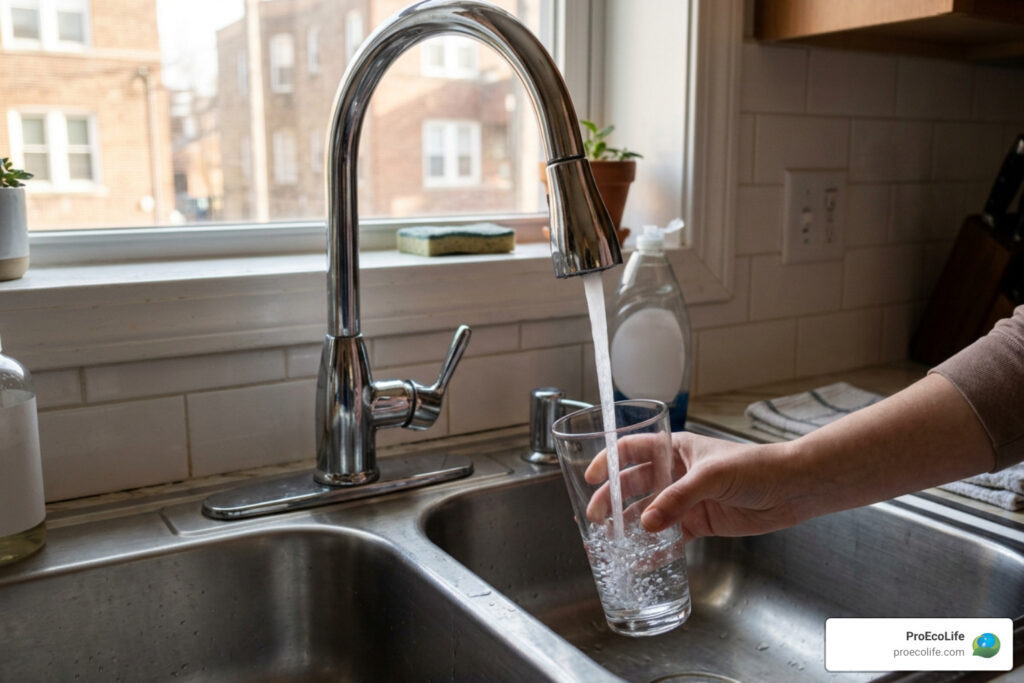
First, always use cold water for drinking, cooking, and preparing baby formula. Hot water dissolves lead much more quickly than cold water, making it far more likely to carry high concentrations of heavy metals.
Second, regular cleaning of your faucet aerators is highly effective. Over time, tiny particles of lead and galvanized iron can break off from your service line and become trapped in the small mesh screens at the tip of your faucets. If left uncleaned, these trapped particles will slowly dissolve, contaminating every glass of water you pour. Simply unscrew the aerators once every few months, rinse out any accumulated sediment, and screw them back on.
To explore all your filtration options and understand what technologies are up to the task, read our comprehensive How to Choose the Best Lead Water Filter in Chicago: A 2026 Guide and learn about the science of heavy metal removal in Heavy Metal Meltdown: The Best Way to Remove Lead from Drinking Water.
Practical Steps to Reduce Chicago Lead Water Exposure at Home
One of the simplest daily habits you can adopt is flushing your plumbing system. When water sits stagnant in lead pipes for six hours or more, lead levels rise significantly.
- The Daily Flush: Before drinking or cooking, run your cold water tap for at least 5 minutes. To conserve water, you can run a load of laundry, take a shower, or run the dishwasher first, and then flush your kitchen tap for 30 to 45 seconds.
- Water Testing: Because lead is completely invisible, tasteless, and odorless, testing is the only definitive way to know if your water is contaminated. Professional testing provides the precise, laboratory-grade analysis you need to make informed decisions about your home. You can learn more about scheduling a professional assessment through our Reliable Water Testing Service in Chicago for Your Home or Business or check out our guide on how to Test Your Water.
Advanced Filtration Solutions by ProEcoLife
While flushing and cleaning aerators are helpful temporary habits, they do not eliminate the root of the problem. For true peace of mind, many Chicago families choose to install advanced, multi-stage water filtration systems designed specifically to handle the unique challenges of Lake Michigan water and aging urban infrastructure.
At ProEcoLife, founded in Chicago in 2014 by Karol Dolega, we have spent over a decade developing water treatment solutions tailored specifically to our local neighborhoods. We understand the unique water chemistry of the Chicago area, from the chlorinated Lake Michigan water supplied to Norwood Park and Jefferson Park, to the heavy mineral hardness found in the well systems of our Northwest suburbs.
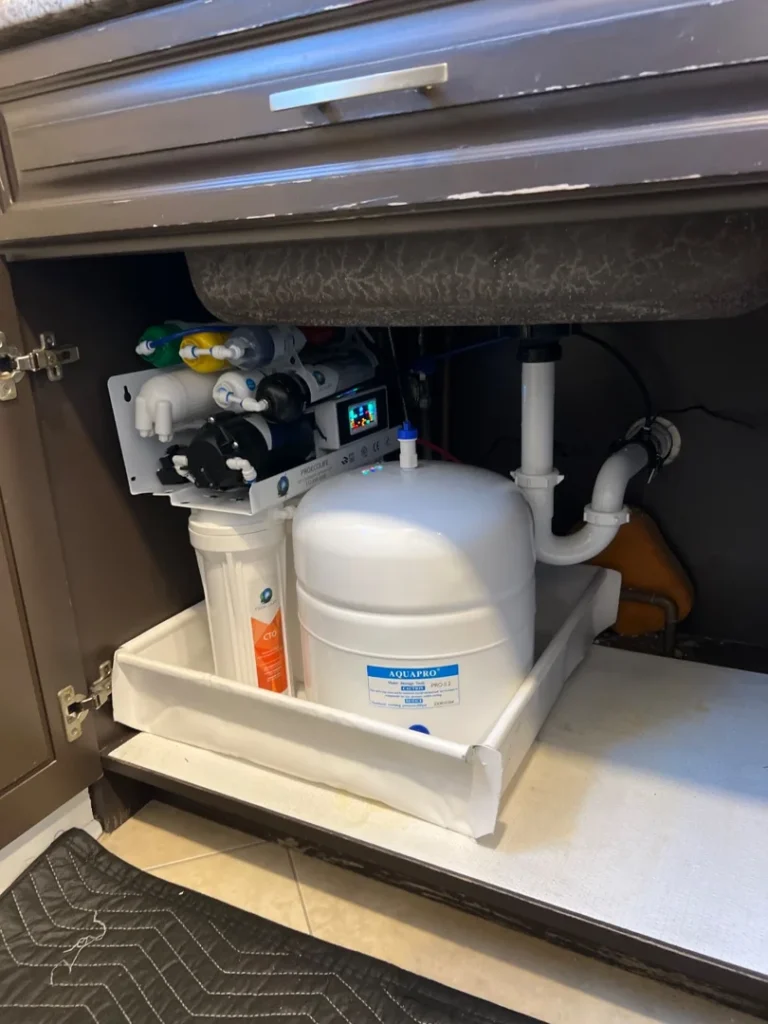
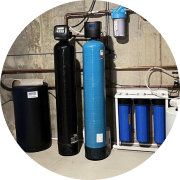
Our signature PEL75 9-Stage RO System utilizes advanced reverse osmosis technology to reduce lead, heavy metals, chlorine, and emerging contaminants like PFAS down to virtually undetectable levels. For homeowners looking for comprehensive, house-wide protection, our Whole House Filtration systems ensure that every tap—from the kitchen sink to the bathroom shower—delivers clean water.
We also offer specialized Shower Filter Systems to protect skin and hair from chlorine, Well Water Conditioning for suburban properties dealing with high iron and hardness, and robust Commercial Water Filtration Systems for local businesses, schools, and offices.
Municipal Programs and the Slow Pace of Pipe Replacement
Chicago’s current municipal strategy to address its lead pipes has drawn widespread criticism from environmental advocates and public health officials alike. Under the city’s current replacement schedule, full modernization of our water infrastructure is projected to take up to 50 years, with a target completion date of 2076. This timeline puts the city three decades behind the federal government’s proposed safety guidelines.
The financial scope of the project is immense, with estimated replacement costs reaching up to $14 billion. Each individual service line replacement in Chicago averages $35,000—a figure significantly higher than the national average due to Chicago’s dense urban layout, concrete parkways, and complex plumbing configurations.
While millions of dollars in federal loans and infrastructure grants have been earmarked for Chicago, progress remains bottlenecked. Out of a $325 million federal loan program, only a fraction of the funds have actually been utilized, leaving hundreds of millions of dollars sitting untouched while lead pipes remain in the ground. For a detailed breakdown of these funding hurdles, read the investigative piece on Why millions earmarked to replace lead pipes in Chicago remain untouched | Grist .
The Federal Mandate vs. Chicago’s 50-Year Plan
The U.S. Environmental Protection Agency (EPA) has introduced the Lead and Copper Rule Improvements (LCRI), which mandates that the vast majority of water utilities across the country replace all lead service lines within a 10-year timeframe starting in 2027. However, due to the unprecedented scale of Chicago’s infrastructure, the city has repeatedly sought extensions and slower compliance schedules.
This delayed timeline has left many local residents in the dark. Under federal rules, the city was required to notify all affected residents about their lead service lines. However, by mid-2025, the city had only mailed out a tiny fraction of the required warning letters, citing administrative challenges and a shortage of testing supplies. For more details on this notification delay, read Chicago Was Supposed to Warn Residents About Toxic Lead Pipes. It’s Barely Started – Inside Climate News and explore the policy conflict in Chicago’s Plan to Replace Lead Pipes Puts It 30 Years Behind the Federal Deadline – Inside Climate News .
Accessing City Resources and Testing Kits
For residents who want to utilize municipal resources while they wait for long-term infrastructure updates, the city offers a few basic programs:
- Free Water Testing: Homeowners can call 311 or submit an online request to receive a basic water testing kit from the Department of Water Management (DWM). The kit requires you to collect water samples after stagnant periods and mail them back for analysis.
- Service Line Lookup Tool: You can enter your address or water account number on the city’s water quality website to check if your service line is officially classified as lead, suspected lead, or copper.
- Subsidized Replacement Programs: The city offers limited, income-eligible programs to cover replacement costs for low-income homeowners, though wait times are often extensive and application backlogs are common.
Frequently Asked Questions About Chicago Tap Water
Is there lead in Chicago’s water mains?
No. There is no lead in the massive water mains that run beneath Chicago’s streets and deliver Lake Michigan water to our neighborhoods. The water mains are constructed of cast iron or ductile iron. Lead only enters the water system when it passes through the private service lines (the pipes connecting the street main to your home) or through older brass fixtures and lead solder inside your home’s private plumbing.
How do I check if my home has a lead service line?
The most reliable way is to locate where the water pipe enters your home—usually in the basement or utility closet near the water meter. Look for a pipe that is dull gray and made of soft metal. You can perform a quick scratch test: gently scratch the surface of the pipe with a key or a coin. If the scratched area turns bright, shiny silver, and a magnet does not stick to it, the pipe is almost certainly lead. If your home was built before 1986, there is a very high probability that you have a lead service line.
Can boiling water remove lead?
No. This is a common and dangerous misconception. Boiling water is highly effective at killing biological contaminants like bacteria and viruses, but it does absolutely nothing to remove heavy metals. In fact, boiling lead-contaminated water actually increases the lead concentration, because some of the water evaporates as steam while the lead remains behind in the pot. The only way to remove lead from your drinking water is through certified physical filtration, such as reverse osmosis.
Conclusion
The reality of chicago lead water is a complex, long-term challenge that will take our local municipalities decades to fully resolve. While Lake Michigan provides us with an abundant source of freshwater, the final stretch of plumbing that carries that water into our kitchens and bathrooms remains highly vulnerable to lead contamination.
Relying solely on city-wide infrastructure projects or daily 5-minute flushing protocols is often not enough to guarantee the safety of your family. Taking a proactive approach to your home’s water quality is the most reliable way to protect your household from chronic heavy metal exposure. To learn more about robust, whole-home water treatment, explore our detailed guide on The Best Whole House Water Filtration Systems in Chicago for Crystal Clear Water.
To take the first step toward securing clean, high-quality water for your home or business, contact ProEcoLife today to schedule a comprehensive water test or visit us online at proecolife.com.