
Lead in Chicago’s Tap Water Is a Real Problem — Here’s What to Do
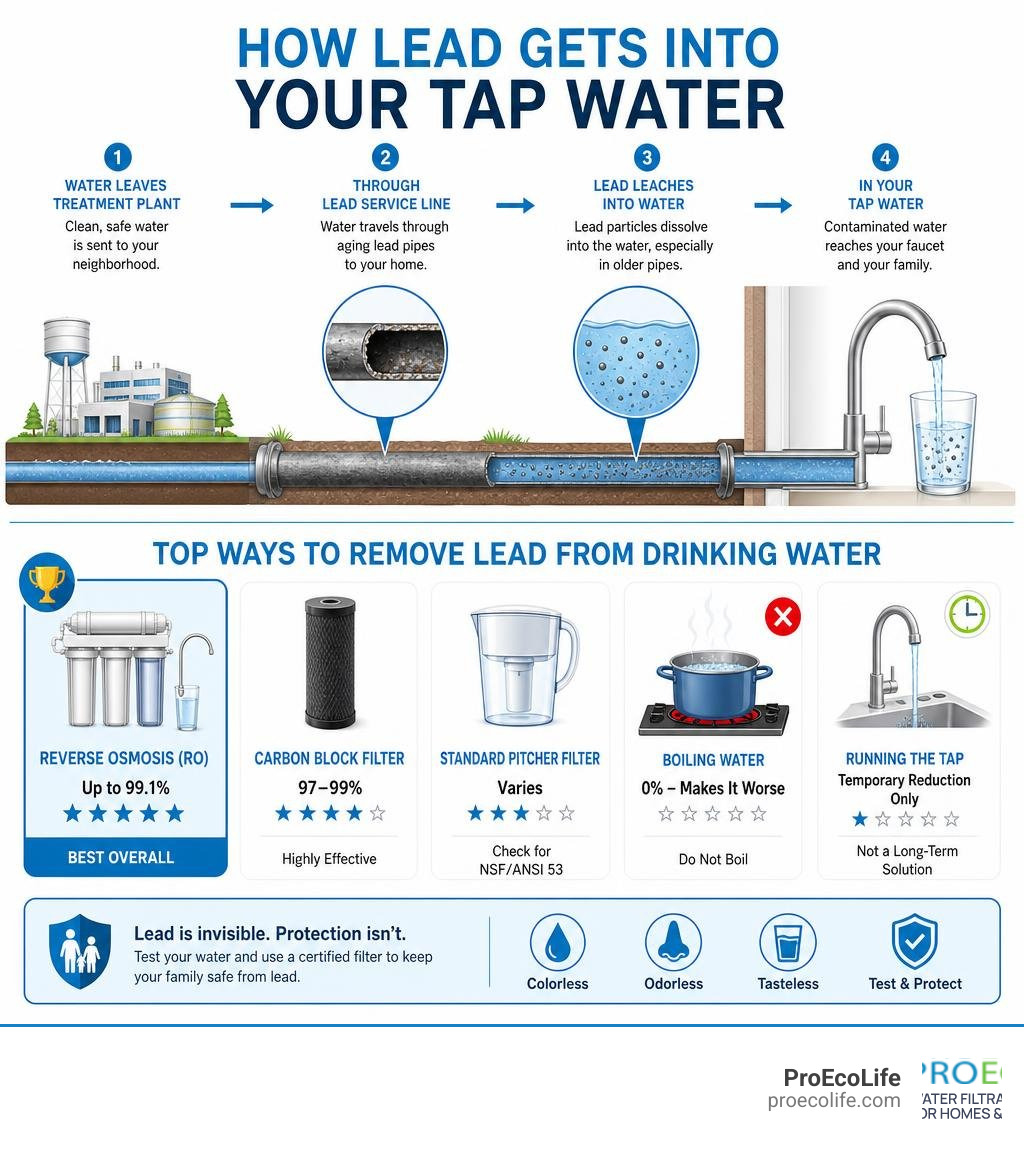
The best way to remove lead from drinking water is to install a certified point-of-use reverse osmosis (RO) system, such as an under-sink RO unit certified to NSF/ANSI Standard 58. Here’s a quick-reference summary:
| Method | Lead Removal Rate | Certified Standard |
|---|---|---|
| Reverse osmosis (RO) | Up to 99.1% | NSF/ANSI 58 |
| Carbon block filter | 97–99% | NSF/ANSI 53 |
| Standard pitcher filter | Varies (not all certified) | Check for NSF 53 |
| Boiling water | 0% — makes it worse | N/A |
| Running the tap | Temporary reduction only | N/A |
Lead is colorless, odorless, and tasteless. You cannot see it, smell it, or taste it in your water. The only way to know it’s there is to test for it — and the only way to reliably remove it is with a certified filter.
This matters a lot in Chicago. The city has one of the largest concentrations of lead service lines in the country. Many homes in neighborhoods like Norwood Park, Edison Park, and Jefferson Park — and in nearby suburbs like Park Ridge, Niles, and Des Plaines — were built before 1986, when lead solder and lead pipes were standard in residential plumbing.
According to the CDC, there is no safe level of lead exposure for children. The EPA has set its maximum contaminant level goal for lead at zero. Even low-level exposure can cause developmental delays, learning problems, and lasting neurological damage in young children.
The good news: the right filtration system can protect your family starting at the tap.
Why Chicago Homes Face a Unique Lead Water Crisis
In the Chicago area, our primary water source is Lake Michigan. While the water treated at municipal plants is of high quality, the real danger lies in the journey that water takes from the water main to your kitchen faucet.
Historically, Chicago municipal codes actually mandated the use of lead service lines for decades—lasting until the federal ban in 1986. This means our local infrastructure has a heavy legacy of lead. In fact, experts estimate that there are approximately 9.2 million lead service lines still in use nationwide, and a significant portion of those are buried right beneath the streets of Chicago and its surrounding areas.
If you live in Northwest Side neighborhoods like Norwood Park, Edison Park, or Jefferson Park, or nearby communities such as Park Ridge, Skokie, and Des Plaines, there is a high probability your home connects to the city main via a lead pipe. When corrosive water sits in these older pipes, lead leaches into the stream. Additionally, homes built before 1986 often feature copper pipes joined with lead solder, and older brass fixtures can contain up to 8% lead. Even modern “lead-free” brass fixtures installed before 2014 are legally allowed to contain up to 8% lead, whereas the post-2014 standard lowered this to 0.25%.
When municipal construction or water main replacements occur in your area, the physical vibrations can disturb these old pipes, causing spikes in lead levels. This is why following the EPA advice for Chicago residents is so crucial. Understanding how these heavy metals enter our homes is the first step toward reclaiming your peace of mind. For a deeper look at the chemistry of these contaminants, you can read more about how to remove heavy metals from water.
Need Clean, Safe Water at Home?
Get a free water test at your home or business. We install and service whole-house filtration and PEL75 reverse osmosis systems across Chicagoland. We also take select projects in Wisconsin and Indiana.
Book a Free Water TestCall (312) 889-8888The Best Way to Remove Lead from Drinking Water: Filtration Technologies Compared
To effectively address lead, we must understand that lead exists in water in two primary forms: dissolved lead (which is soluble and invisible) and particulate lead (tiny physical flakes of metal or scale).
Standard filtration systems are not all created equal. To ensure a filter is capable of removing both dissolved and particulate lead, you must look for independent third-party certifications. Specifically, look for systems certified under NSF/ANSI Standard 53 (for carbon block filtration) or NSF/ANSI Standard 58 (for reverse osmosis systems).
Let’s look at how the primary residential filtration methods stack up:
| Filtration Type | Lead Form Targeted | Pros | Cons |
|---|---|---|---|
| Reverse Osmosis (RO) | Dissolved & Particulate | Removes up to 99.1% of lead, plus hard water minerals, PFAS, and other heavy metals. | Produces wastewater; requires dedicated faucet. |
| Solid Carbon Block | Dissolved & Particulate | Highly effective adsorption; preserves water pressure; easy under-sink installation. | Filter cartridges must be replaced strictly on schedule to avoid breakthrough. |
| Whole-House Carbon | Particulate only (mostly) | Filters water at the main entry point; protects household appliances. | Ineffective against dissolved lead; doesn’t protect against lead leaching inside home plumbing. |
For a comprehensive overview of how to choose a certified device, you can review the EPA guide on choosing the right water filter. To better understand the mechanics behind these methods, explore our detailed guide on how water filtration works and the differences between technologies.
Why Reverse Osmosis is the Best Way to Remove Lead from Drinking Water
If you are looking for the absolute best way to remove lead from drinking water, reverse osmosis is the gold standard.
An RO system uses a semi-permeable membrane with microscopic pores so small that they block dissolved metal ions like lead, allowing only pure water molecules to pass through. This technology removes up to 99.1% of lead from water.
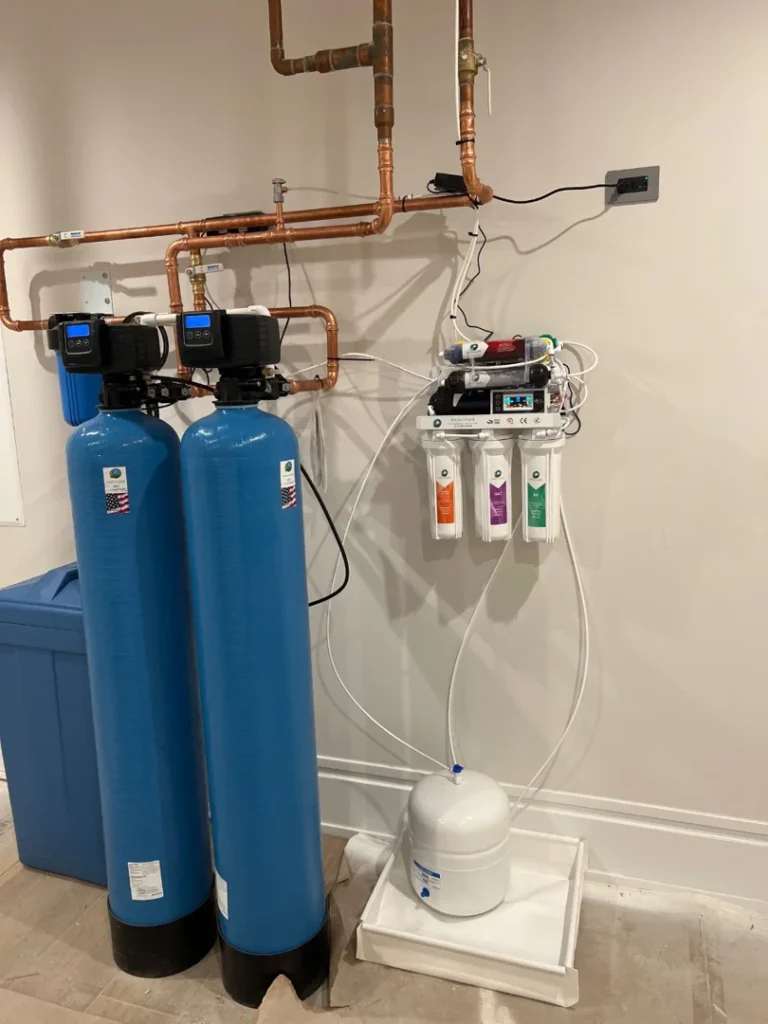
In the Northwest suburbs of Chicago, we also deal with notoriously hard water. High mineral content (calcium and magnesium) can damage household appliances and leave white scale on fixtures. A multi-stage system, like our PEL75 9-Stage RO System, solves both problems simultaneously. It strips away dissolved solids (TDS), heavy metals, and hard minerals, and then carefully remineralizes the water so it tastes crisp, clean, and refreshing.
For more information on the exact mechanics of this multi-stage purification process, check out our article on how reverse osmosis systems work.

Carbon Block Filters: An Alternative Best Way to Remove Lead from Drinking Water
While reverse osmosis is highly efficient, a high-quality solid carbon block filter certified to NSF/ANSI Standard 53 is another excellent option.
These filters work through a process called adsorption, where lead molecules chemically bond to the vast surface area of the activated carbon. Some carbon block systems are engineered to handle high flow rates, making them ideal for dedicated under-sink drinking water taps without the need for a storage tank.
However, carbon block filters have a physical limit. Once the binding sites on the carbon are completely saturated, the filter can no longer trap lead, and contaminants can break through into your glass. This is why keeping a strict replacement schedule is vital. To learn more about what carbon media can and cannot do, read our breakdown of carbon filters and what they remove.
Need Clean, Safe Water at Home?
Get a free water test at your home or business. We install and service whole-house filtration and PEL75 reverse osmosis systems across Chicagoland. We also take select projects in Wisconsin and Indiana.
Book a Free Water TestCall (312) 889-8888Testing and Immediate Mitigation Steps for Chicago Residents
Because lead has no taste or smell, you cannot rely on your senses to detect it. If you suspect your home has lead plumbing, we highly recommend professional water testing.

When testing your water through a certified laboratory, it is important to collect both “first-draw” and “flushed” samples:
- First-Draw Sample: This is the very first water out of the tap after it has sat stagnant in the pipes for at least six hours. It represents the highest potential concentration of lead leached from your indoor plumbing and faucet fixtures.
- Flushed Sample: This sample is collected after running the cold water tap for 1 to 2 minutes. It helps determine if the lead is coming from your home’s internal plumbing or the external service line.
While you are arranging for a professional filtration solution, there are several immediate steps you can take to reduce your exposure:
- Run the Cold Water: If the tap hasn’t been used for several hours, run the cold water for 30 seconds to 2 minutes before using it for drinking or cooking.
- Never Use Hot Tap Water for Consumption: Hot water dissolves lead much faster than cold water. Always draw cold water and heat it on the stove or in a kettle if needed.
- Clean Your Faucet Aerators: Tiny particles of lead can get trapped in the small screens (aerators) at the tip of your faucet. Unscrew them and rinse out any accumulated debris every few months.
For official health guidelines and recommendations on exposure prevention, refer to the CDC guidelines on lead in drinking water. For more tips on evaluating your home’s water needs before making a decision, see our guide on what to look for before buying a water filter.
Frequently Asked Questions about Lead in Water
In our years of serving the Chicago community, we have encountered many common misconceptions about water treatment. Let’s set the record straight on a few of them. If you want to dive deeper into other widespread myths, check out our article debunking six water filtration myths.
Does boiling water remove lead?
No, boiling water does not remove lead. This is perhaps the most dangerous misconception.
Lead is a solid metal with an extremely high boiling point. When you boil water, some of the pure liquid water evaporates into steam, but the lead remains behind. This actually increases the concentration of lead in the remaining water. Never boil water as a strategy to reduce heavy metal contamination.
Do standard pitcher filters remove lead?
Most standard gravity-fed pitcher filters do not remove lead.
The basic pitcher filters commonly found in supermarkets are primarily designed to improve taste and odor by reducing chlorine. They do not contain the specialized media required to capture dissolved lead ions. If you choose to use a pitcher filter, you must verify that the packaging explicitly states it is certified to NSF/ANSI Standard 53 for lead reduction.
Why aren’t whole-house filters recommended as the sole solution for lead?
While we frequently design and install premium Whole House Filtration systems to protect appliances from sediment, chlorine, and hardness, they should not be your sole line of defense against lead.
Lead typically enters drinking water after it passes the main entry point of your home—either from the service line, interior copper pipe solder, or brass faucets. If you filter the water only at the basement entry point, it can still collect lead as it travels through your walls to your kitchen sink. For this reason, a point-of-use system at the kitchen tap is a necessity for complete safety.
Conclusion
At ProEcoLife, founded by Karol Dolega, we have been deeply rooted in the Chicago community since 2014. We understand the unique challenges of our local water infrastructure—from the historic lead service lines on Chicago’s Northwest Side to the hard well water found in some of the collar suburbs.
Protecting your household requires a strategic approach. While Whole House Filtration and Well Water Conditioning systems are highly effective at purifying water for utility use, our PEL75 9-Stage RO System is specifically engineered to provide pristine, lead-free drinking water right at your kitchen tap. We also offer specialized solutions like our Shower Filter System and Commercial Water Filtration Systems to meet every water quality need.
Every home is different, and results vary depending on the age of your plumbing and local municipal infrastructure in areas like Niles, Glenview, Arlington Heights, or Morton Grove. For a comprehensive look at choosing the perfect system for your property, read our 2026 Chicago lead water filter guide.
Contact ProEcoLife today to schedule a water test and protect your home’s drinking water. Call us at (312) 889-8888 or visit proecolife.com.