
Why the 20 x 4.5 Water Filter Is the Workhorse of Chicago Whole-House Filtration
A 20 x 4.5 water filter — commonly called a “Big Blue” cartridge — is the most widely used large-format filter in residential whole-house systems. If you just want the quick answer, here it is:
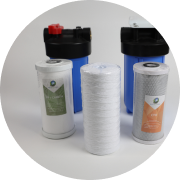
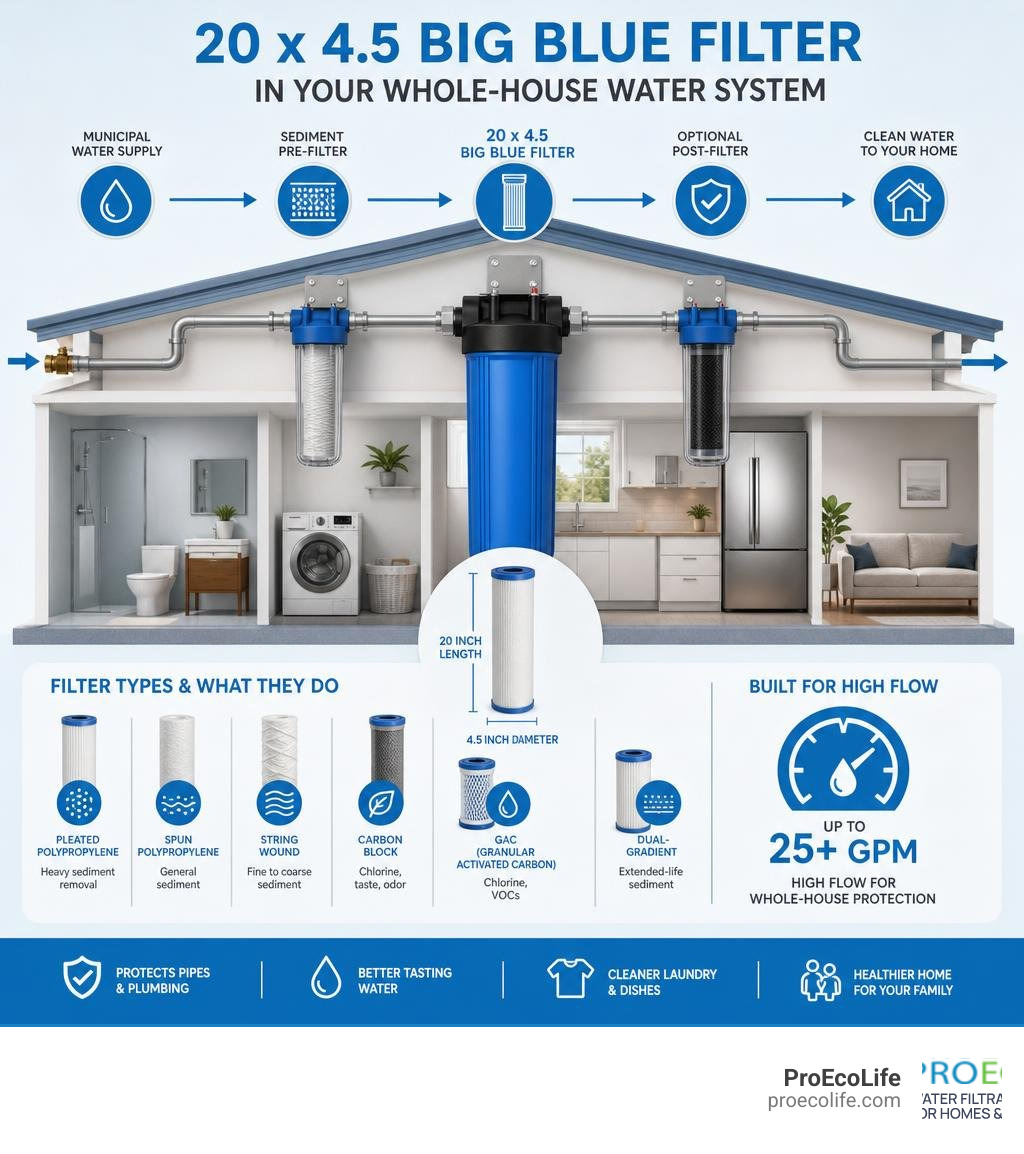
At a glance: 20 x 4.5 water filter types and what they do
| Filter Type | Primary Use | Typical Micron Rating |
|---|---|---|
| Pleated polypropylene | Heavy sediment removal | 5–100 micron |
| Spun polypropylene | General sediment | 1–50 micron |
| String wound | Fine to coarse sediment | 0.5–200 micron |
| Carbon block | Chlorine, taste, odor | 5–10 micron |
| GAC (granular activated carbon) | Chlorine, VOCs | 10–20 micron |
| Dual-gradient | Extended-life sediment | e.g., 25/1 micron |
These cartridges measure 20 inches long by 4.5 inches in diameter and can handle flow rates up to 25 GPM or more — making them the right size for filtering water across an entire home, not just one tap.
For Chicago homeowners, this matters a lot. Lake Michigan source water carries chlorine and disinfection byproducts from municipal treatment. Aging lead service lines — still common on the Northwest Side in neighborhoods like Norwood Park, Edison Park, and Jefferson Park — add another layer of concern. And in suburbs like Park Ridge, Niles, and Arlington Heights, hard water and higher sediment loads put extra demand on any filtration system.
Since 2014, ProEcoLife founder Karol Dolega has been helping Chicago-area families navigate exactly these challenges. The 20 x 4.5 format sits at the core of many whole-house setups — but choosing the right cartridge type, micron rating, and media for your specific water means understanding what these filters actually do.
This guide breaks it all down in plain language.
Choosing the Right 20 x 4.5 Water Filter for Chicago Homes
When we look at the water coming into Chicago homes, we are dealing with a tale of two challenges: physical particles and chemical additives.
The physical particles (sediment, rust flakes from century-old water mains, and debris from local construction) require mechanical filtration. The chemical elements (chlorine used by municipal plants to disinfect Lake Michigan water, along with disinfection byproducts like trihalomethanes) require chemical adsorption.
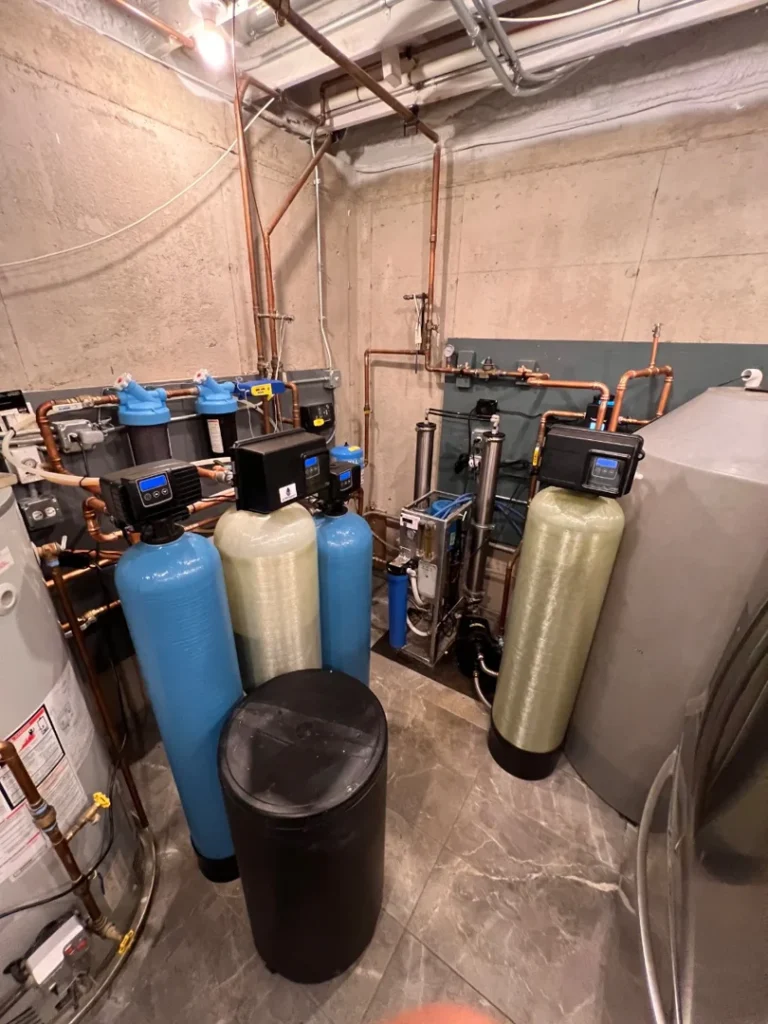
To address both, a standard whole-house configuration often uses a multi-stage approach inside heavy-duty housings. Placing a sediment cartridge and a carbon cartridge side-by-side ensures that each filter does the job it was actually engineered to do.

Selecting the wrong combination can lead to rapidly clogged filters, drop your household water pressure to a slow trickle, or fail to address the chemical tastes and odors that make taking a shower feel like stepping into a public pool. If you want to dive deeper into how to structure these stages, you can read our guide on Jak wybrać idealne systemy filtracyjne do twojego domu?.
Understanding Micron Ratings in a 20 x 4.5 Water Filter
A “micron” is shorthand for a micrometer (one-millionth of a meter). To put that in perspective, a single strand of human hair is about 70 microns wide, while red blood cells are around 8 microns.
When you shop for a 20 x 4.5 water filter, you will see ratings ranging from 1 micron up to 100 microns or more. Understanding how these ratings affect performance and flow is critical:
- Low Micron Ratings (1 to 5 Microns): These filters provide incredibly tight filtration. They excel at capturing very fine silt, coal dust, and even certain cysts. However, because the pores are so small, they create a higher initial pressure drop and can clog quickly if your water has a high sediment load.
- Medium Micron Ratings (10 to 20 Microns): This is the “sweet spot” for many municipal applications. A cartridge like the US Water Systems 20 Micron 4.5 x 20 Water Filter, Pleated Whole … or a standard 10-micron block offers an excellent balance. It captures visible sediment while maintaining a high flow rate with minimal pressure drop.
- High Micron Ratings (50 to 100+ Microns): These are coarse filters designed to catch large debris, sand, and heavy rust flakes. They are often used as a “pre-filter” to protect more sensitive downstream equipment.
In Chicago’s Northwest Side neighborhoods like Norwood Park and Edison Park, water main updates and municipal construction can stir up significant amounts of iron rust and sediment. If you run a tight 1-micron filter as your sole defense, you might find yourself replacing it far too often. Conversely, relying only on a coarse 50-micron filter will allow fine particulates to pass right through, potentially wearing down your plumbing fixtures and appliances.
Single-Micron vs. Dual-Gradient Cartridges
If you want the best of both worlds—fine filtration and a long lifespan—dual-gradient (or multi-depth) cartridges are an exceptional choice.
A standard single-micron filter has the exact same pore size from its outer surface to its inner core. When sediment-heavy water hits it, the outer surface quickly becomes blinded by large particles, rendering the clean interior of the filter useless.
A dual-gradient 20 x 4.5 water filter features a clever design:
- The Outer Core: This layer has a wider micron rating (for example, 25 or 50 microns) to trap larger dirt, sand, and rust particles.
- The Inner Core: As water flows deeper into the cartridge, the material becomes denser, finishing with a tight rating (such as 1 or 5 microns) to capture the finest suspended solids.
By distributing the particle capture throughout the entire depth of the filter, dual-gradient cartridges can hold up to three times the dirt of a standard single-micron spun filter. This makes them highly cost-effective for high-turbidity areas in our local suburbs, saving you from frequent maintenance calls while protecting your home’s water quality.
Comparing Filter Media: Pleated, Spun, Wound, and Carbon
Not all filter materials are created equal. The mechanical structure of the media dictates how much water can pass through, how much dirt it can hold, and what specific contaminants it can remove.
| Media Type | Structure | Dirt-Holding Capacity | Best Used For |
|---|---|---|---|
| Pleated Polyester | Folded sheets around a core | Exceptionally high (surface) | Large sediment, high-flow pre-filtration |
| Spun Polypropylene | Melt-blown graded density | High (depth) | Standard municipal sediment |
| String Wound | Precision-wound cord | High (depth) | Coarse sediment, sand, and rust |
| Carbon Block | Compressed solid carbon | Moderate | Chlorine, taste, odor, VOCs |
| Granular Activated Carbon (GAC) | Loose carbon granules | Lower (mechanical) | High-flow chlorine reduction |
If you are curious about the chemical side of what carbon can do, take a look at our detailed breakdown of Filtry węglowe do wody – co dokładnie usuwają i dla kogo są najlepsze?.
Sediment Filtration: Pleated vs. Spun Poly vs. String Wound
Let’s look at the three main styles of sediment cartridges available in the 20 x 4.5 water filter size:
Pleated Polyester
Pleated filters are constructed by folding synthetic fabric around a central core. This accordion-like design vastly increases the surface area of the filter. Because of this massive surface area, pleated filters like the Amazon.com: Tier1 20 Micron 20 x 4.5 Water Filter – Amazon.com can handle incredibly high flow rates (up to 25–40 GPM) with almost zero initial pressure drop. Some pleated designs are washable and reusable as part of a professional maintenance plan, which may help extend service life in Chicago-area homes dealing with rust and sediment from older water mains.
Spun Polypropylene
Often called “melt-blown” filters, these are manufactured by spinning molten polymer fibers onto a rotating shaft. This creates a seamless, graded-density depth filter. Spun filters like the iSpring FP25BX4 20” x 4.5” Whole House Water Filter Replacement … are highly effective at trapping a wide range of particle sizes throughout their thick walls. They are economical, highly reliable, and resistant to chemical degradation.
String Wound
A classic, time-tested design where polypropylene or cotton string is wound around a rigid core. The winding pattern creates diamond-shaped chambers that get progressively smaller toward the center, offering true depth filtration. String-wound filters are highly favored in applications with broad particle size distributions because they resist unloading captured dirt even under heavy pressure surges.
Taste, Odor, and Chemical Reduction: Carbon Block vs. GAC
When it comes to removing chemical tastes, odors, and chlorine, activated carbon is the undisputed king. However, the physical form of that carbon matters immensely.
Carbon Block Filters
These filters are made by binding fine activated carbon powder into a solid, cylindrical block. Water is forced through the microscopic pores of the block, ensuring maximum contact time with the carbon. A high-quality 5-micron 20 x 4.5 water filter made of carbon block can typically treat up to 100,000 gallons of water at a flow rate of 5 to 15 GPM. It acts as both a physical sediment filter and a chemical adsorber, making it highly effective at removing chlorine, chloramines, and organic compounds.
Granular Activated Carbon (GAC) Filters
GAC cartridges contain loose granules of carbon. Because the carbon is loose, water can flow through it more easily, resulting in higher flow rates and less pressure drop than a carbon block. However, because water can find “channels” or paths of least resistance through the loose granules, the contact time is less consistent. GAC is excellent for high-flow chlorine reduction but is less effective at fine mechanical filtration.
Addressing Chicago’s Unique Water Challenges with Large-Format Filtration
Chicago and its surrounding suburbs have some of the most distinct water profiles in the Midwest. While Lake Michigan provides a plentiful source of fresh water, the journey that water takes from the treatment plant to your tap is where the trouble often begins.

In older Chicago neighborhoods like Jefferson Park and Portage Park, the municipal water mains and residential service lines are often decades old. When the city performs street work or water main updates, the resulting physical vibrations can shake loose years of accumulated iron rust, scale, and sediment. This debris travels straight into home plumbing, where it can clog faucet aerators, ruin water heaters, and degrade water quality.
Furthermore, many older homes still have lead service lines. While a sediment filter alone cannot remove dissolved lead, a properly configured whole-house system—often combined with our advanced under-sink PEL75 9-Stage RO System—provides a multi-layered defense to protect your family.
In the Northwest suburbs, such as Niles, Des Plaines, Skokie, Glenview, and Morton Grove, hard water minerals (calcium and magnesium) present a different set of challenges. This hard water can cause scale buildup in pipes and appliances. Homeowners using private wells in the wider region also have to contend with iron, manganese, sulfur odors, and agricultural runoff like nitrates.
Lifespan and Professional Maintenance of Your 20 x 4.5 Water Filter
A high-capacity 20 x 4.5 water filter is designed to last, but its lifespan is entirely dependent on your local water quality and household water usage.
- Sediment Filters (Pleated, Spun, Wound): Typically last 4 to 6 months or up to 60,000 gallons. If you notice a sudden drop in water pressure when running multiple taps, or if your water takes on a hazy appearance, it is likely time for a replacement.
- Carbon Filters (Block or GAC): Typically last 6 to 12 months or up to 100,000 gallons. A return of chlorine taste or a musty odor in your shower water is a clear indicator that the carbon has reached its adsorption capacity.
While it might be tempting to view filter maintenance as a simple task, we always recommend professional service. Whole-house filtration housings are under constant municipal pressure. A minor mistake during a filter change—such as pinching the O-ring, failing to sanitize the housing interior, or over-tightening the sump—can lead to major leaks, water bypass, or bacterial growth inside the housing.
Our team at ProEcoLife ensures that your ProEcoLife Whole House Filtration System is serviced with precision, using food-grade lubricants, proper sanitization protocols, and pressure-testing to confirm the system is operating properly before it goes back online.
Specialty Media for Suburbs and Well Water
For our suburban customers dealing with complex water issues, standard sediment and carbon cartridges may not be enough. That is where specialty media cartridges in the 20 x 4.5 format come into play:
- KDF (Kinetic Degradation Fluxion) Media: Cartridges containing KDF-55 or KDF-85 use copper-zinc redox reactions to reduce heavy metals, chlorine, and hydrogen sulfide. They also create an bacteriostatic environment that prevents algae and bacteria from growing inside the filter. In some professionally designed systems, a 4 Pack Of Whole House KDF 20 x 4.5 Inch. Big Blue Replacement … type of cartridge may help extend the life of carbon stages.
- Iron and Manganese Reduction: Specialized radial-flow cartridges use manganese greensand or proprietary media to oxidize and trap dissolved iron, preventing red and black staining on your sinks, toilets, and laundry.
- Anion Exchange for Nitrates and Tannins: Specialty resin cartridges can target specific dissolved agricultural runoff or organic tannins that cause yellow water coloration in well-water systems.
By integrating these specialty media options into our tailored Well Water Conditioning or Whole House Filtration systems, we can address even the most challenging suburban water chemistry.
Frequently Asked Questions About 20 x 4.5 Filtration
Are 20 x 4.5 filters compatible across different housing brands?
Yes. One of the benefits of the 20 x 4.5-inch format is that it is a common industry standard used in many Chicago-area whole-house filtration setups. Whether you have a housing manufactured by Pentek, Culligan, Aquaboon, or ProEcoLife, any standard 20 x 4.5-inch replacement cartridge will fit.
However, while the cartridge dimensions are identical, the design of the housing’s bypass channels and O-ring seats can vary. To prevent water from bypassing the filter media entirely, the cartridge should be professionally centered, seated, and pressure-tested during service. If you are looking to upgrade your existing setup, you can explore our premium 20 x 4.5 Filtration Systems – FilterWay options or speak with us about a custom configuration.
What NSF/ANSI certifications should I look for?
When choosing a 20 x 4.5 water filter for a Chicago-area home, look for the following certifications to support material safety and performance:
- NSF/ANSI Standard 42: Covers aesthetic effects, certifying that the filter safely and effectively reduces chlorine, taste, odor, and particulate matter.
- NSF/ANSI Standard 61: Ensures that the materials used to construct the filter cartridge do not leach harmful chemicals or contaminants into your drinking water.
- NSF/ANSI Standard 58: While primarily for reverse osmosis systems, it is a hallmark of structural integrity and contaminant reduction that reflects high manufacturing standards.
How do I know when it is time to replace my whole-house filter?
Many customers in neighborhoods like Norwood Park, Edison Park, and Jefferson Park notice a few common signs when their filter is reaching the end of its life:
- A Drop in Water Pressure: If your shower feels less powerful or your washing machine takes longer to fill, the filter may be choked with sediment.
- Changes in Taste or Odor: If the clean taste of your water begins to slip and that familiar chlorine smell returns, the carbon media may be saturated.
- Visual Discoloration: If you have a translucent housing and the filter cartridge has turned a dark brown or rust color, it has done its job and may need to be replaced.
Because results vary based on local water quality and household water consumption, we recommend having your system professionally inspected annually to support reliable performance.
Conclusion
When it comes to protecting your home, your plumbing, and your family’s health, a robust filtration strategy is essential. The 20 x 4.5 water filter serves as an effective, high-flow solution for the heavy demands of many Chicago-area households.
Since 2014, Karol Dolega and the team at ProEcoLife have been dedicated to providing the Chicago area with top-tier water treatment solutions. From our advanced PEL75 9-Stage RO System for pristine drinking water to our heavy-duty Whole House Filtration, Shower Filter System, Well Water Conditioning, and high-capacity Commercial Water Filtration Systems, we design setups tailored specifically to our local water conditions.
Whether you are dealing with aging infrastructure on Chicago’s Northwest Side or hard water in the surrounding suburbs, we are here to help you find the right filtration path.
Need to understand what is really in your home’s water? Contact the local experts at ProEcoLife to schedule a water test at (312) 889-8888 or proecolife.com.